


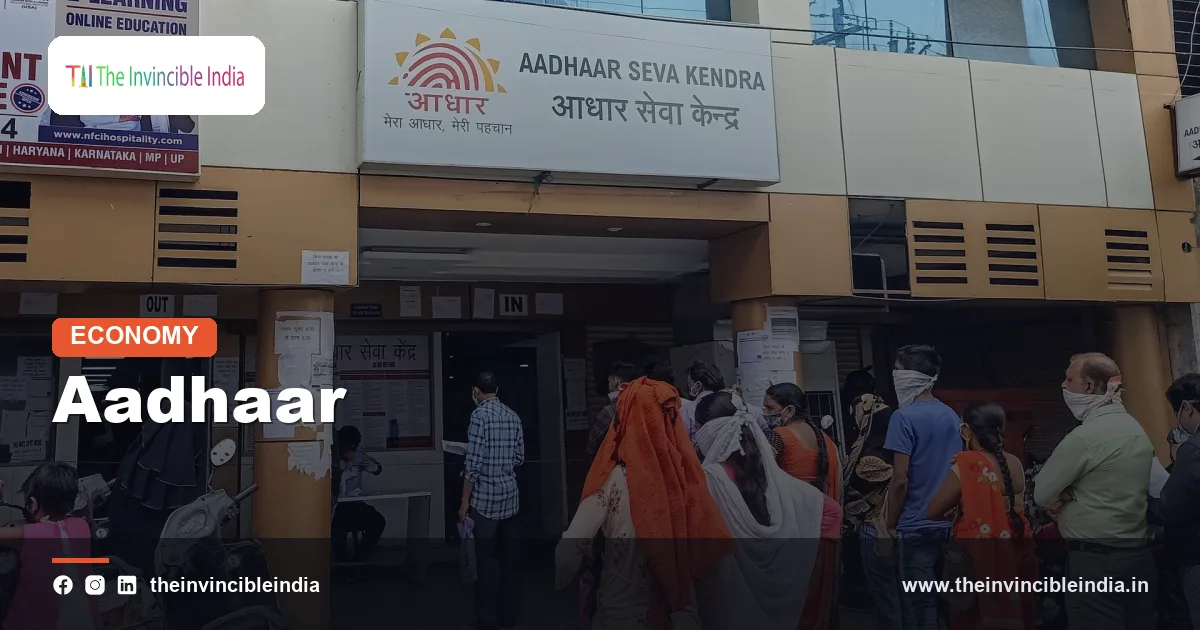
Aadhaar is a 12-digit unique identity number issued to residents of India, and it is widely described as the world’s largest biometric digital identity system. Over a billion residents have been enrolled since the first numbers were issued in 2010, which means the programme now touches almost every part of daily life, from opening a bank account to receiving a government subsidy.
Yet Aadhaar is often misunderstood. It is not a passport, not a citizenship certificate and not a compulsory card for every service. This explainer walks through how Aadhaar was created, who runs it, how enrolment and authentication work, what the law and the Supreme Court say about it, and why it has been both celebrated for inclusion and questioned over privacy. Last updated: 30 September 2026.
Quick Facts
| Item | Details |
|---|---|
| What it is | A 12-digit random unique identity number for residents of India |
| Issuing authority | Unique Identification Authority of India (UIDAI) |
| UIDAI set up | 2009 (initially by executive order, later given statutory status) |
| First number issued | 2010, to a resident of Maharashtra |
| Founding chairman | Nandan Nilekani |
| Governing law | Aadhaar (Targeted Delivery of Financial and Other Subsidies, Benefits and Services) Act, 2016 |
| Data collected | Name, date of birth, gender, address, ten fingerprints, two iris scans and a photograph |
| Key court rulings | Puttaswamy judgments of 2017 (privacy) and 2018 (validity of Aadhaar) |
| Legal status | Proof of identity and address, but not proof of citizenship |
What Is Aadhaar and Why Was It Created?
The word “Aadhaar” means “foundation” or “base” in several Indian languages, and the name was chosen to suggest a common foundation on which many services could be built. Each Aadhaar number is a randomly generated 12-digit number that is unique to one individual. It does not carry any information about a person’s caste, religion, income, health or place of birth. The number is only a pointer to a record held in a central database.
Before Aadhaar, India had no single, portable proof of identity that ordinary residents could easily obtain. Many people, especially the poor, migrants and those living in remote areas, lacked documents such as a passport or a driving licence. Ration cards, voter cards and utility bills were tied to a particular place or scheme, which made it difficult to open a bank account, get a SIM card or claim a benefit after moving to another city.
The idea behind Aadhaar was to give every resident a lifelong, verifiable and portable identity that could be checked online at any time. Because the number is linked to biometric data, it can help establish that a person is who they claim to be, and that one person has not been counted many times under different names.
The core features
- Uniqueness: demographic and biometric details are checked to avoid duplicate numbers.
- Randomness: the number is not derived from personal details.
- Portability: it works anywhere in the country, regardless of where it was issued.
- Online verifiability: service providers can confirm identity within seconds.
Origins: The Creation of UIDAI
The Unique Identification Authority of India was set up in 2009 as an attached office of the Planning Commission. Nandan Nilekani, a co-founder of the technology company Infosys, was appointed its founding chairman, with the rank of a Cabinet minister. His task was to design and roll out a unique identity platform at a scale no country had attempted before.
The first Aadhaar number was issued in 2010 to a resident of a village in Maharashtra, in a ceremony that symbolically launched the programme. In the following years enrolment expanded rapidly through a network of registrars and enrolment agencies, including state governments, banks, post offices and public sector organisations.
UIDAI’s responsibilities include issuing Aadhaar numbers, maintaining the Central Identities Data Repository (CIDR), setting technical and security standards, and operating the authentication systems that let other organisations verify identity. Over time its administrative home has moved within the government, and today it functions under the ministry responsible for electronics and information technology. It is headquartered in New Delhi and works through regional offices.
Key milestones
| Year | Milestone |
|---|---|
| 2009 | UIDAI is set up; Nandan Nilekani becomes founding chairman |
| 2010 | First Aadhaar number is issued in Maharashtra |
| 2013 | Direct Benefit Transfer begins, using Aadhaar-linked bank accounts |
| 2014 | Pradhan Mantri Jan Dhan Yojana is launched; PAHAL scheme for LPG begins |
| 2016 | Aadhaar Act is passed, giving the programme a statutory basis |
| 2017 | Supreme Court recognises the Right to Privacy as a fundamental right |
| 2018 | Supreme Court upholds Aadhaar’s validity with important limits |
| 2019 | Amendments allow voluntary use for authentication and KYC |
How Aadhaar Enrolment Works
Enrolment in Aadhaar is free of charge and open to any resident of India, irrespective of age or nationality. Under the Aadhaar Act, a “resident” is a person who has lived in India for 182 days or more in the twelve months before applying. The process is carried out at enrolment centres, and many centres are run at banks, post offices and government offices.
Step-by-step process
- Demographic data: the applicant provides name, date of birth, gender and address, supported by accepted identity and address documents. Mobile number and email address can also be added on a voluntary basis.
- Biometric capture: an operator records all ten fingerprints, scans both irises and takes a photograph.
- Verification and consent: the applicant checks the information on screen and gives consent before the data is submitted.
- De-duplication: the central system compares the new record against existing ones to ensure the same person does not receive a second number.
- Number generation: once the record clears these checks, the 12-digit number is generated and the resident is informed, with a letter and an electronic version available for download.
Children and updates
Children can be enrolled too. For very young children, a photograph and demographic details are captured and the number is linked to a parent’s Aadhaar, since fingerprints and iris patterns are not yet fully developed. Biometric details are then required to be updated when the child grows older. Adults can also update their address, name or other details, and are encouraged to refresh their records periodically so that the information stays accurate.
Documents are not kept as scanned proof in the way many people assume. What matters in the system is the combination of demographic details and biometrics stored in the central repository, which is protected under strict rules on storage and access.
The Legal Basis: The Aadhaar Act, 2016
An interesting feature of Aadhaar’s history is that the programme ran for several years without a specific law. It began in 2009 through an executive order, and its expansion drew criticism and legal challenges on the ground that such a large collection of personal data needed a statute passed by Parliament.
In 2016 Parliament enacted the Aadhaar (Targeted Delivery of Financial and Other Subsidies, Benefits and Services) Act. The bill was introduced and passed as a money bill, a category of legislation under Article 110 of the Constitution that the Rajya Sabha can only recommend changes to, not reject. The decision to treat it as a money bill was itself debated, and the Supreme Court later examined it in the 2018 judgment.
What the Act provides
- It gives UIDAI statutory status and defines its powers and functions.
- It provides for enrolment, authentication and the issuance of Aadhaar numbers.
- It allows the Central or State governments to require Aadhaar for subsidies, benefits and services funded from the Consolidated Fund of India.
- It sets out rules for protecting identity information, restricting its sharing and prescribing penalties for misuse.
- It states that core biometric information cannot be shared with anyone or used for any purpose other than generating an Aadhaar number and authentication.
The Act was later amended in 2019 to allow voluntary use of Aadhaar for authentication and verification, in line with the Supreme Court’s 2018 decision, and to strengthen safeguards.
Authentication and eKYC: How Aadhaar Verifies Identity
Having an Aadhaar number is one thing; using it to prove identity is another. UIDAI offers several ways for approved organisations to check that the person in front of them matches the record in the database. Importantly, the system usually answers with a simple “yes” or “no” rather than handing over the person’s whole record.
Common authentication methods
- Biometric authentication: a fingerprint or iris scan is captured on a device and matched against the stored record.
- OTP authentication: a one-time password is sent to the mobile number linked to the Aadhaar and entered by the user.
- Demographic authentication: details such as name and date of birth are matched against the record.
- Face authentication: facial matching has been added as another option in recent years.
eKYC
Know Your Customer (KYC) checks are required by banks, insurers, telecom companies and other regulated entities. Aadhaar-based eKYC lets a user consent to share limited details, such as name, address, photograph and date of birth, in digital form directly from the UIDAI database. This replaces stacks of paper photocopies and can cut the time to open an account or activate a service from days to minutes. UIDAI has also introduced an offline, paperless verification option that works without connecting to the central database.
Privacy tools for users
Residents can generate a temporary 16-digit Virtual ID so they do not have to reveal their actual Aadhaar number, download a “masked” Aadhaar that hides most digits, and lock or unlock their biometrics so that fingerprints and iris scans cannot be used without their action. They can also view authentication history to see where their number has been verified.
The JAM Trinity and Direct Benefit Transfer
The most talked-about use of Aadhaar is in welfare delivery. The phrase “JAM trinity” stands for Jan Dhan, Aadhaar and Mobile. The idea is simple: give every household a bank account (Jan Dhan), link it to a verifiable identity (Aadhaar), and use mobile phones to communicate and transact. Together, these three allow money to move directly from the government to a beneficiary’s account.
Direct Benefit Transfer (DBT) was launched in 2013, and it expanded significantly after the Pradhan Mantri Jan Dhan Yojana began in 2014, which aimed at universal access to basic bank accounts. The term JAM became widely used through the Economic Survey of 2014-15.
Examples of DBT
- LPG (PAHAL): under the DBT for LPG scheme, launched in 2014-15, consumers buy cooking gas cylinders and the subsidy is credited to their bank account.
- Pensions: old-age, widow and disability pensions can be paid directly into bank accounts of beneficiaries.
- Scholarships: education grants can be transferred straight to students.
- Rural employment wages: wage payments under public works schemes can be routed through bank accounts.
Cutting leakages and ghost beneficiaries
Before DBT, benefits often passed through many intermediaries, and it was hard to tell whether a person listed as a beneficiary really existed or was counted twice. Because Aadhaar is unique and de-duplicated, it can help remove duplicate and non-existent names, often called “ghost beneficiaries”, from official lists. Supporters say this has reduced leakages and saved public money, while critics point out that estimates of savings vary and that genuine beneficiaries have sometimes been excluded.
Aadhaar in India Stack and Digital Public Infrastructure
Aadhaar is often described as the identity layer of what is called the India Stack, a set of open digital systems and rules that let people and businesses use services online. The stack is frequently discussed as part of India’s Digital Public Infrastructure (DPI), meaning shared, interoperable platforms that governments and private players can build on.
The main layers
- Identity: Aadhaar provides a way to verify who someone is.
- Payments: the Unified Payments Interface (UPI) allows instant bank-to-bank transfers by mobile phone, and Aadhaar-enabled payment services let people withdraw money or check balances using biometrics at micro-ATMs.
- Data sharing: DigiLocker lets citizens store and share official documents, such as certificates and licences, in digital form with consent.
These layers work together. A person can verify identity using Aadhaar, open an account through eKYC, receive money through UPI and share verified documents from DigiLocker without visiting a branch. India’s approach has attracted international interest, with many countries studying how a common digital foundation can make public and private services cheaper to deliver. At the same time, experts note that the success of such a stack depends on strong safeguards for privacy and security.
The Puttaswamy Judgments: Privacy and Aadhaar
Aadhaar’s legal journey is closely tied to two rulings of the Supreme Court in the case known as Justice K.S. Puttaswamy (Retd.) v. Union of India. Justice K.S. Puttaswamy, a retired High Court judge, was among the first to challenge the Aadhaar scheme in court, arguing that it violated personal liberty.
The 2017 ruling on the Right to Privacy
In August 2017, a nine-judge Constitution Bench of the Supreme Court unanimously held that the Right to Privacy is a fundamental right. The Court found that privacy is protected as part of the right to life and personal liberty under Article 21, and as part of the freedoms guaranteed by Part III of the Constitution. This overturned earlier observations in older cases that had suggested privacy was not a fundamental right. The judgment did not decide the fate of Aadhaar itself, but it set the constitutional yardstick against which the scheme would be measured.
The 2018 ruling on Aadhaar’s validity
In September 2018, a five-judge Constitution Bench delivered its verdict on the Aadhaar Act, upholding its constitutional validity by a majority, with one judge dissenting. The Court agreed that Aadhaar could be used for government welfare and subsidies but placed limits on its reach.
- Aadhaar is mandatory for filing income tax returns and for linking with the Permanent Account Number (PAN).
- Aadhaar is mandatory for accessing government welfare schemes and subsidies funded from the Consolidated Fund of India.
- It cannot be made compulsory for opening a bank account or getting a mobile SIM card.
- It cannot be demanded by schools for admission, or for entrance and similar examinations.
- The provision that allowed private companies to demand Aadhaar-based authentication under contracts was struck down.
- Children cannot be denied services for lacking Aadhaar, and the storing of authentication data was limited to a shorter period.
The judgment therefore balanced the state’s interest in welfare delivery with the individual’s right to privacy, and it remains the key legal reference on where Aadhaar can and cannot be required.
Everyday Uses and Benefits of Aadhaar
Since the 2018 judgment, Aadhaar can still be used voluntarily by banks, telecom companies and other entities under the legal framework introduced through the 2019 amendments. Here is a summary of common uses and their status.
| Use | How Aadhaar helps | Position |
|---|---|---|
| Welfare schemes and subsidies | Identifies beneficiaries and enables direct transfers | Can be required by government schemes funded from the Consolidated Fund of India |
| PAN and income tax filing | Links tax records to one identity | Mandatory as upheld by the Supreme Court |
| Bank account opening | eKYC for quick verification | Voluntary; other documents are accepted |
| Mobile connections | eKYC for faster activation | Voluntary; not compulsory |
| Digital documents | Sign-in and verification for services such as DigiLocker | Optional convenience |
| Payments | Aadhaar-enabled payments at micro-ATMs | Optional |
The main benefits
- Inclusion: people who lacked any official document gained a recognised identity, and with it easier access to banking and services.
- Efficiency: digital verification is quicker and cheaper than repeated paperwork.
- Portability: a migrant worker can use the same identity in a new state rather than re-establishing credentials for each service.
- Reduced duplication: de-duplication helps government departments avoid paying the same person twice.
Debates and Concerns Around Aadhaar
Like any large data system, Aadhaar has attracted serious discussion. It is worth presenting the main arguments fairly, because many of them shaped the court rulings and the later legal amendments.
Privacy and surveillance
Critics worry that linking one number to many databases could allow profiling or tracking of individuals, even if the central database stores only limited information. UIDAI and the government have responded that authentication does not record what service a person is using, and that the law restricts sharing of information. The Puttaswamy judgments, and privacy tools such as Virtual ID, are part of the response to these concerns.
Data security
A database containing biometric details of a very large population is an attractive target. There have been media reports and disputes over alleged leaks of Aadhaar numbers from various agencies, while UIDAI has maintained that the central biometric database has not been breached. The broader lesson many experts draw is that Aadhaar numbers should be handled carefully by every organisation that stores them.
Exclusion errors
Biometric matching can fail. Worn fingerprints among manual labourers or the elderly, poor connectivity, and device problems have led to reports of people being turned away from rations or pensions. Government guidance has stressed that no genuine beneficiary should be denied entitlements merely because of an authentication failure, and alternative verification methods exist. Even so, exclusion remains one of the most discussed practical challenges.
Mandatory or voluntary?
Another long-running debate concerns how far Aadhaar should be required. The 2018 judgment drew a line, allowing compulsion for welfare and tax purposes but not for services such as bank accounts, SIM cards or school admissions. Supporters view the system as a public good that works best when widely used, while critics argue that consent should remain central.
What Aadhaar Is Not
Many myths surround Aadhaar, and clearing them up matters for anyone who uses it.
- It is not proof of citizenship. Aadhaar is issued to residents, not only citizens, and UIDAI has clarified that it does not confer citizenship, domicile or any right to residence.
- It is not a travel document. It cannot be used in place of a passport for international travel.
- It is not proof of date of birth in every context. UIDAI’s own guidance notes that Aadhaar is a proof of identity and, with supporting documents, of address. It is not a substitute for a birth certificate.
- It is not a bank or payment account. The number itself does not hold money; it only helps to verify identity.
- It does not contain caste or religion. The database records only limited information, and the law forbids collecting details about race, religion, caste, tribe or health.
Understanding these limits helps avoid confusion at offices and counters, and it keeps expectations realistic about what an Aadhaar card can and cannot do.
Conclusion
Aadhaar started as an ambitious idea to give every resident a foundational identity and has grown into a central piece of India’s digital public infrastructure. It has supported direct benefit transfers, made digital verification faster and helped many people enter the formal financial system. At the same time, the Supreme Court’s Puttaswamy judgments have made clear that identity infrastructure must respect privacy and constitutional limits. The future of Aadhaar will likely depend on how well India balances convenience, inclusion, security and individual rights.
Frequently Asked Questions
What is Aadhaar and who issues it?
Aadhaar is a 12-digit unique identity number issued to residents of India. It is issued by the Unique Identification Authority of India (UIDAI), which was set up in 2009. The number is linked to demographic details and biometric data stored in a central database.
What information is collected when someone enrols for Aadhaar?
Enrolment collects name, date of birth, gender and address, along with ten fingerprints, two iris scans and a photograph. Providing a mobile number and email address is optional. The law does not permit the collection of information about religion, caste, race or health.
Is Aadhaar mandatory?
Not for everything. After the Supreme Court’s 2018 judgment, Aadhaar is mandatory for the Permanent Account Number (PAN), for filing income tax returns and for government welfare schemes and subsidies funded from the Consolidated Fund of India. It cannot be made compulsory for opening a bank account, getting a SIM card or school admission.
Is Aadhaar proof of citizenship?
No. Aadhaar is issued to residents of India and serves as proof of identity, and with supporting documents as proof of address. UIDAI has clarified that it does not prove citizenship, domicile or date of birth.
What is the JAM trinity?
JAM stands for Jan Dhan, Aadhaar and Mobile. It refers to the combination of bank accounts opened under the Jan Dhan scheme, the Aadhaar identity number and mobile phones. Together they allow subsidies, pensions and scholarships to be transferred directly into beneficiaries’ bank accounts through Direct Benefit Transfer.
How can I protect my Aadhaar number from misuse?
You can use a Virtual ID instead of sharing the actual number, use a masked Aadhaar copy where possible, and lock your biometrics when not in use. It also helps to check your authentication history regularly and share your Aadhaar only with organisations that are legally entitled to ask for it.
{“@context”:”https://schema.org”,”@graph”:[{“@type”:”FAQPage”,”mainEntity”:[{“@type”:”Question”,”name”:”What is Aadhaar and who issues it?”,”acceptedAnswer”:{“@type”:”Answer”,”text”:”Aadhaar is a 12-digit unique identity number issued to residents of India. It is issued by the Unique Identification Authority of India (UIDAI), which was set up in 2009. The number is linked to demographic details and biometric data stored in a central database.”}},{“@type”:”Question”,”name”:”What information is collected when someone enrols for Aadhaar?”,”acceptedAnswer”:{“@type”:”Answer”,”text”:”Enrolment collects name, date of birth, gender and address, along with ten fingerprints, two iris scans and a photograph. Providing a mobile number and email address is optional. The law does not permit the collection of information about religion, caste, race or health.”}},{“@type”:”Question”,”name”:”Is Aadhaar mandatory?”,”acceptedAnswer”:{“@type”:”Answer”,”text”:”Not for everything. After the Supreme Court’s 2018 judgment, Aadhaar is mandatory for the Permanent Account Number (PAN), for filing income tax returns and for government welfare schemes and subsidies funded from the Consolidated Fund of India. It cannot be made compulsory for opening a bank account, getting a SIM card or school admission.”}},{“@type”:”Question”,”name”:”Is Aadhaar proof of citizenship?”,”acceptedAnswer”:{“@type”:”Answer”,”text”:”No. Aadhaar is issued to residents of India and serves as proof of identity, and with supporting documents as proof of address. UIDAI has clarified that it does not prove citizenship, domicile or date of birth.”}},{“@type”:”Question”,”name”:”What is the JAM trinity?”,”acceptedAnswer”:{“@type”:”Answer”,”text”:”JAM stands for Jan Dhan, Aadhaar and Mobile. It refers to the combination of bank accounts opened under the Jan Dhan scheme, the Aadhaar identity number and mobile phones. Together they allow subsidies, pensions and scholarships to be transferred directly into beneficiaries’ bank accounts through Direct Benefit Transfer.”}},{“@type”:”Question”,”name”:”How can I protect my Aadhaar number from misuse?”,”acceptedAnswer”:{“@type”:”Answer”,”text”:”You can use a Virtual ID instead of sharing the actual number, use a masked Aadhaar copy where possible, and lock your biometrics when not in use. It also helps to check your authentication history regularly and share your Aadhaar only with organisations that are legally entitled to ask for it.”}}]}]}