


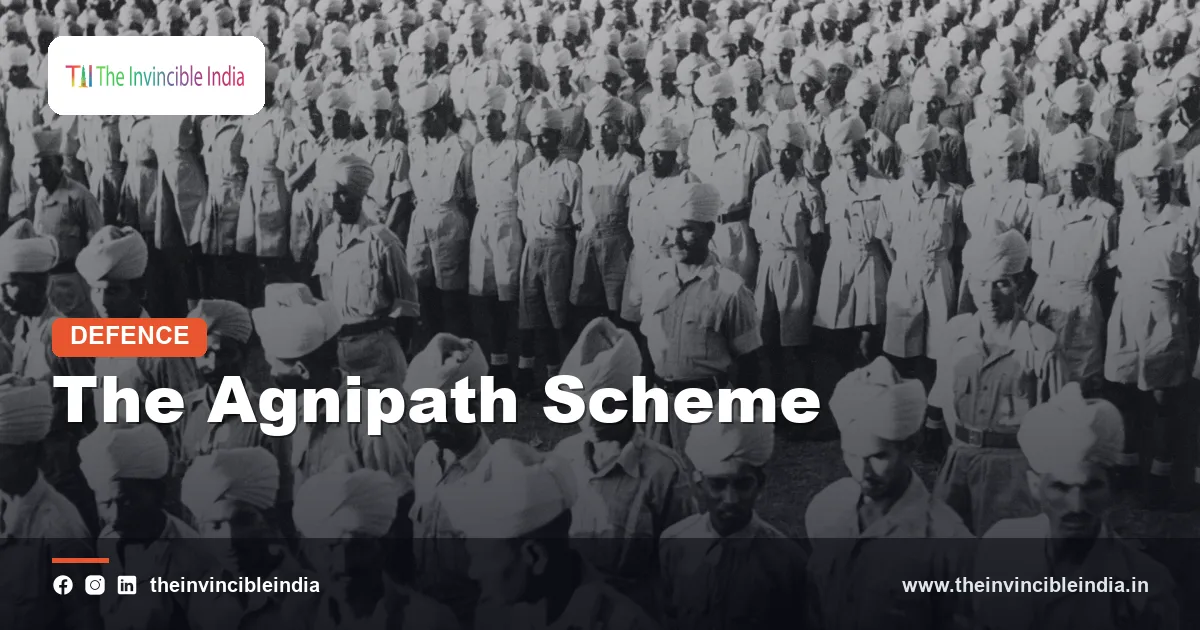
The Agnipath scheme is one of the most significant changes to military recruitment in independent India. Announced on 14 June 2022 by the Defence Minister alongside the three service chiefs, it replaced the long-standing system of hiring soldiers, sailors and airmen for a full career with a new model in which young recruits, called Agniveers, serve for four years. Only a limited share of each batch is then retained for longer service.
Few policy announcements in recent years have drawn such a strong response. Supporters call it a long-overdue step towards a younger, fitter and more technology-ready force, while critics worry about job security, unit cohesion and the future of the young people who leave after four years. This explainer sets out what the scheme does, who it covers, how the money works, what the government says it wants to achieve and what the debate is really about, and it keeps both sides of that debate in view.
Quick Facts
| Item | Details |
|---|---|
| Scheme name | Agnipath (the path of fire); recruits are called Agniveers |
| Announced | 14 June 2022 |
| Applies to | Recruitment of soldiers below officer rank into the Army, Navy and Air Force |
| Tenure | Four years, including the initial training period |
| Retention | Up to about 25% of each batch absorbed into regular service for a further 15 years, on merit and vacancies |
| Exit corpus | Seva Nidhi, a tax-free lump sum of roughly Rs 11-12 lakh as announced |
| Pension | No pension and no lifelong ex-servicemen status for those who complete the four years |
| Administering ministry | Ministry of Defence, through the Department of Military Affairs |
What Is the Agnipath Scheme?
Agnipath is a recruitment framework, not a new branch of the military. It governs how India’s armed forces enrol the men and women who fill the ranks below commissioned officers: infantry soldiers in the Army, sailors in the Navy and airmen in the Air Force. Anyone selected under the scheme is given the title Agniveer, and each service has its own trade and category structure within that title.
The scheme was presented as a “transformative” reform that would let the forces take in youthful talent on a continuous basis. Under it, recruits join for a fixed four-year engagement. Roughly the first six months go to basic training, and the remaining time is spent in operational and unit duties. Agniveers wear the uniform of their service and serve with their units, but their terms of service differ from those of regular personnel.
The basic design
- Enrolment is for four years under a defined Agniveer category of each service.
- Applicants were announced to be roughly between 17.5 and 21 years of age, with a one-time extension to 23 years for the first recruitment cycle because of the earlier pause.
- A skill certificate and a bridging qualification are offered on exit, so that the experience can be recognised in civilian employment and further study.
- After four years, a merit-based process selects a limited share to continue as regular cadre.
The Old Recruitment Model It Replaced
Before Agnipath, soldiers were enrolled through a long-established system that went back to colonial times and was modified after independence. Candidates attended recruitment rallies, cleared physical, medical and written tests, and were enrolled for a long engagement. In the Army, a jawan typically served somewhere between 15 and 20 years in the ranks before retiring and drawing a pension, and many continued to higher non-commissioned and junior commissioned ranks.
This model had a few defining features. Regiments recruited and trained soldiers who would stay together for most of their working lives, building deep familiarity within units. Retirees at a relatively young age, often in their late thirties or early forties, drew a pension and held ex-servicemen status, with access to canteen, health and re-employment benefits. Officers, by contrast, were and still are chosen through separate channels such as the National Defence Academy, Combined Defence Services Examination and Short Service Commission, which Agnipath does not alter.
The pause that preceded the change
Army recruitment rallies were stopped from early 2020 because of COVID-19 restrictions. Intake was effectively frozen for roughly two years, leaving a backlog of aspirants who had trained, cleared parts of the process and were waiting. When Agnipath arrived, many of them found the older route replaced and the age window narrowing, which became an important trigger for the 2022 anger.
Who Can Become an Agniveer and How Selection Works
The scheme covers recruitment of non-officer ranks in all three services, and each service runs its own selection. Candidates are expected to meet standards for age, education and fitness, including medical and physical tests. Educational requirements vary by trade, with many general-duty roles open to those who have passed Class 10 and technical roles requiring Class 12, with relevant subjects for certain categories.
Selection typically involves a written test, physical standards and a medical examination, followed by a merit list. Over time the services have adjusted the process, including the use of online registration and common entrance examinations for several categories. The Navy and Air Force also opened the scheme to women in the sailor and airman categories, while the Army began using it for women in certain roles such as the Corps of Military Police.
Training and deployment
After enrolment, Agniveers go to the training centres of their service. They are then posted to units and are expected to take on duties that match those of regular personnel in their trades. The first batches began training towards the end of 2022 and in early 2023, which means the first cohort completes its four years only around the turn of 2026-27.
Pay, Seva Nidhi and Other Financial Terms
Money is where the scheme differs most clearly from the older system. Agniveers draw a monthly package that was announced as roughly Rs 30,000 in the first year, rising to around Rs 40,000 in the fourth year, with a share of this retained for the corpus. As announced, about 30% of the monthly emolument is set aside every month and the government makes a matching contribution, and the combined sum with interest forms the Seva Nidhi.
Seva Nidhi explained
The Seva Nidhi is a lump sum paid at the end of the four-year term. It is exempt from income tax and was described as being in the region of Rs 11-12 lakh on exit. It is meant to give a young person capital for a business, education or a fresh career. Figures have been quoted in slightly different ways in official material and press coverage, so they should be treated as approximate and as announced.
Insurance and other terms
- Agniveers receive a substantial non-contributory life insurance cover during service, and additional ex-gratia compensation was announced in case of death, with a provision for pay for the unserved portion of the tenure.
- Compensation for disability depends on its degree.
- Leave entitlements and risk and hardship allowances apply as for regular personnel in similar deployments.
- Those who complete the four years without being retained do not receive a pension and are not treated as ex-servicemen for the lifelong benefits that regulars enjoy.
The 25% Retention and the 75% Exit
The structural heart of Agnipath is the split at the end of four years. Up to about a quarter of each Agniveer batch can be absorbed into the regular cadre. Those selected serve a further period of around 15 years under conditions comparable to those of regular recruits, which includes pension eligibility according to the terms of the permanent engagement. Selection depends on organisational need and vacancies, performance during service, conduct and an assessment process.
The remaining roughly 75% leave with the Seva Nidhi, a skill certificate and the experience gained in uniform. The government’s position is that these young men and women exit as disciplined, trained and fit individuals in their early to mid twenties who are highly employable. Several priorities were announced to help them find work, which are covered in the dedicated section below.
Why the ratio matters
The 75:25 ratio is the most debated number in the whole scheme. It determines how competitive the retention process is, how motivated recruits remain in the final years and how many young people must find new careers at around 22 to 25 years of age. Reports have in the past suggested that the retention share might be raised, but any such change would be a policy decision for the government, and readers should rely on current official notifications.
Old Model vs Agnipath at a Glance
| Feature | Earlier model | Agnipath scheme |
|---|---|---|
| Engagement length | Around 15-20 years in the ranks | Four years for Agniveers; about 15 more for those retained |
| Share retained | Most recruits served full term | Up to about 25% retained |
| Pension | Regular defence pension after qualifying service | None after four years; applies only to retained cadre |
| Exit benefit | Pension, canteen and health benefits, ex-servicemen status | Seva Nidhi lump sum, skill certificate |
| Typical age on leaving | Late thirties to early forties | Early to mid twenties |
| Recruitment pattern | Rallies and regiment-based intake | Annual all-India, merit-based intake |
| Officers | Separate channels | Unchanged and not covered |
What the Government Hoped to Achieve
The government put forward several reasons for the change, and they fit together as a single argument about the future shape of the forces.
A younger and fitter force
The first aim is to lower the average age of personnel. Officials spoke of bringing the typical age profile of the forces down by several years, from the early thirties to the late twenties. The reasoning is that conflict is increasingly technology-intensive and physically demanding at the sharp end, and a younger cadre is better suited to both.
Easing the pension burden
The second aim is financial. The defence pension bill is one of the largest single items in the defence budget, and it has grown steadily with the number of retirees and with revisions such as One Rank One Pension. By bringing in a larger number of short-term recruits who do not draw pensions, the government hopes to free resources for modernisation, including equipment, technology and infrastructure.
Technology, skills and society
The third aim is skills. Modern warfare involves drones, cyber capability, electronic systems and data, and supporters argue that younger, adaptable recruits can absorb these quickly. The fourth aim is social, which is to give the wider economy a steady stream of disciplined, trained and confident young people who have served the nation, and who may become entrepreneurs, skilled workers or security professionals.
The 2022 Protests
The announcement in June 2022 was followed within days by agitation across several states, with Bihar, Uttar Pradesh, Haryana and Telangana seeing some of the most visible protests. Demonstrators, many of them young aspirants who had been preparing for years, blocked roads and railway lines, and there were incidents of arson at stations and trains in some places. A nationwide bandh call followed on 20 June 2022, and rail and road traffic was disrupted in several regions.
The main grievances were the four-year term, the absence of pension, the one-time age relaxation being seen as insufficient, and the cancelling of recruitment already in progress. In response, the government announced a one-time age extension for the first cycle, reservations in various services for those completing the term, and explained the rationale in public briefings. The courts subsequently examined the scheme, and in early 2023 the Delhi High Court upheld it and dismissed petitions that challenged it, which meant it could proceed.
Why the reaction was so strong
- A military job has long been seen in many regions as a route to stable, dignified lifetime employment.
- Many aspirants had waited through the COVID pause and felt the rules changed abruptly.
- The loss of a pension changed the basic bargain that families associated with a military career.
Concerns Raised by Critics and Defence Observers
Alongside the street protests, a more technical debate began among veterans, analysts and former service chiefs. Their concerns were mostly about military effectiveness and fairness, not just jobs.
Unit cohesion and regimental ethos
India’s regiments draw strength from long-term bonds, tradition and trust built over years of shared service. Critics asked whether a four-year engagement, with a substantial share of soldiers leaving after that, would weaken cohesion and the depth of skill, particularly in specialised and high-risk roles that take time to master.
Training time and operational readiness
With training taking a share of the four years, some analysts questioned how much real operational time would remain, particularly for technical trades. Others wondered whether motivation could be sustained when the prospect of a permanent position depends on a competitive selection. Supporters respond that selection is itself an incentive to perform.
Equity and the future of those who leave
Critics also asked whether Agniveers, who serve in the same places as regular soldiers, should have different terms, and whether the 75% who exit would find suitable jobs in a labour market that has its own challenges. Some worried about the social effect of trained young people with limited employment options, though the government rejects this and points to the support measures it has announced.
Opportunities After Four Years
To address concerns about life after service, the government announced a set of measures aimed at those who complete the term. These are described as policy commitments and have been implemented through separate notifications by different departments, so the exact details should be checked against current official orders.
- A reservation of about 10% in vacancies in the Central Armed Police Forces and the Assam Rifles, with additional age relaxation for Agniveers.
- A similar 10% reservation in certain posts in the Ministry of Defence and in defence public sector undertakings.
- Priority recruitment in the police forces of several states and Union Territories, announced by their respective governments.
- A skill certificate and a credit-linked pathway to a higher education qualification, announced by the education authorities, with bank loan support for entrepreneurship.
- Interest from industry in hiring those with discipline and technical training.
Critics point out that these reserved vacancies are limited in number compared with the large number of Agniveers who will exit each year, while the government maintains that it is a start and that further avenues will open as the scheme matures.
Review, Refinement and the Road Ahead
Since its launch, the scheme has been examined and discussed repeatedly. Press reports have indicated that the government and the services have been reviewing the scheme in light of experience, and that proposals such as a longer tenure or a higher retention percentage have been discussed. No such change should be assumed unless officially notified, and readers should consult the Ministry of Defence for the latest position.
The first full test will come as the earliest batches complete their four years and the retention and exit process plays out in practice. How many are retained, how the exiting Agniveers find work and how units perform with a younger, rotating cadre will shape the verdict. Supporters will watch for evidence of lower costs and better fitness, and critics will watch cohesion, morale and employment.
Conclusion
The Agnipath scheme is best understood as a deliberate break from a century-old recruitment tradition, driven by a wish for a younger and more modern force and a more sustainable defence budget. It remains contested because it touches things that matter deeply: livelihoods, security, military tradition and the promise made to those who serve. Whatever view one takes, the useful way to follow it is through official notifications and actual outcomes for the batches that have gone through.
Frequently Asked Questions
What is the Agnipath scheme?
Agnipath is the recruitment scheme announced on 14 June 2022 for soldiers below officer rank in the Army, Navy and Air Force. Recruits, known as Agniveers, serve for four years, including training. A limited share of each batch, up to about 25%, is later retained for regular service.
How long do Agniveers serve and what happens afterwards?
The tenure is four years including the initial training period. At the end, up to about 25% are selected for a further engagement of around 15 years based on merit and vacancies. The rest leave with the Seva Nidhi lump sum and a skill certificate.
What is the Seva Nidhi?
It is a tax-free exit package built from monthly contributions by the Agniveer and matching contributions by the government, with interest. As announced, it amounts to roughly Rs 11-12 lakh at the end of four years.
Do Agniveers get a pension?
Those who leave after four years do not receive a pension and do not get the lifelong ex-servicemen benefits given to regular personnel. Agniveers who are retained into the regular cadre are covered by the terms of that longer engagement.
Does the scheme apply to officers?
No. Officers are recruited through separate routes such as the National Defence Academy and the Short Service Commission, and Agnipath does not change those channels. It concerns only soldiers, sailors and airmen below officer rank.
Why was the scheme controversial?
Critics raised concerns about job security, the lack of pension, cohesion in regiments and the prospects of those who leave after four years, and there were protests in several states in 2022. The government says it will bring a younger force, reduce the pension burden and give disciplined youth skills and opportunities. The scheme is reportedly under review and refinement.
{“@context”:”https://schema.org”,”@graph”:[{“@type”:”FAQPage”,”mainEntity”:[{“@type”:”Question”,”name”:”What is the Agnipath scheme?”,”acceptedAnswer”:{“@type”:”Answer”,”text”:”Agnipath is the recruitment scheme announced on 14 June 2022 for soldiers below officer rank in the Army, Navy and Air Force. Recruits, known as Agniveers, serve for four years, including training. A limited share of each batch, up to about 25%, is later retained for regular service.”}},{“@type”:”Question”,”name”:”How long do Agniveers serve and what happens afterwards?”,”acceptedAnswer”:{“@type”:”Answer”,”text”:”The tenure is four years including the initial training period. At the end, up to about 25% are selected for a further engagement of around 15 years based on merit and vacancies. The rest leave with the Seva Nidhi lump sum and a skill certificate.”}},{“@type”:”Question”,”name”:”What is the Seva Nidhi?”,”acceptedAnswer”:{“@type”:”Answer”,”text”:”It is a tax-free exit package built from monthly contributions by the Agniveer and matching contributions by the government, with interest. As announced, it amounts to roughly Rs 11-12 lakh at the end of four years.”}},{“@type”:”Question”,”name”:”Do Agniveers get a pension?”,”acceptedAnswer”:{“@type”:”Answer”,”text”:”Those who leave after four years do not receive a pension and do not get the lifelong ex-servicemen benefits given to regular personnel. Agniveers who are retained into the regular cadre are covered by the terms of that longer engagement.”}},{“@type”:”Question”,”name”:”Does the scheme apply to officers?”,”acceptedAnswer”:{“@type”:”Answer”,”text”:”No. Officers are recruited through separate routes such as the National Defence Academy and the Short Service Commission, and Agnipath does not change those channels. It concerns only soldiers, sailors and airmen below officer rank.”}},{“@type”:”Question”,”name”:”Why was the scheme controversial?”,”acceptedAnswer”:{“@type”:”Answer”,”text”:”Critics raised concerns about job security, the lack of pension, cohesion in regiments and the prospects of those who leave after four years, and there were protests in several states in 2022. The government says it will bring a younger force, reduce the pension burden and give disciplined youth skills and opportunities. The scheme is reportedly under review and refinement.”}}]}]}