


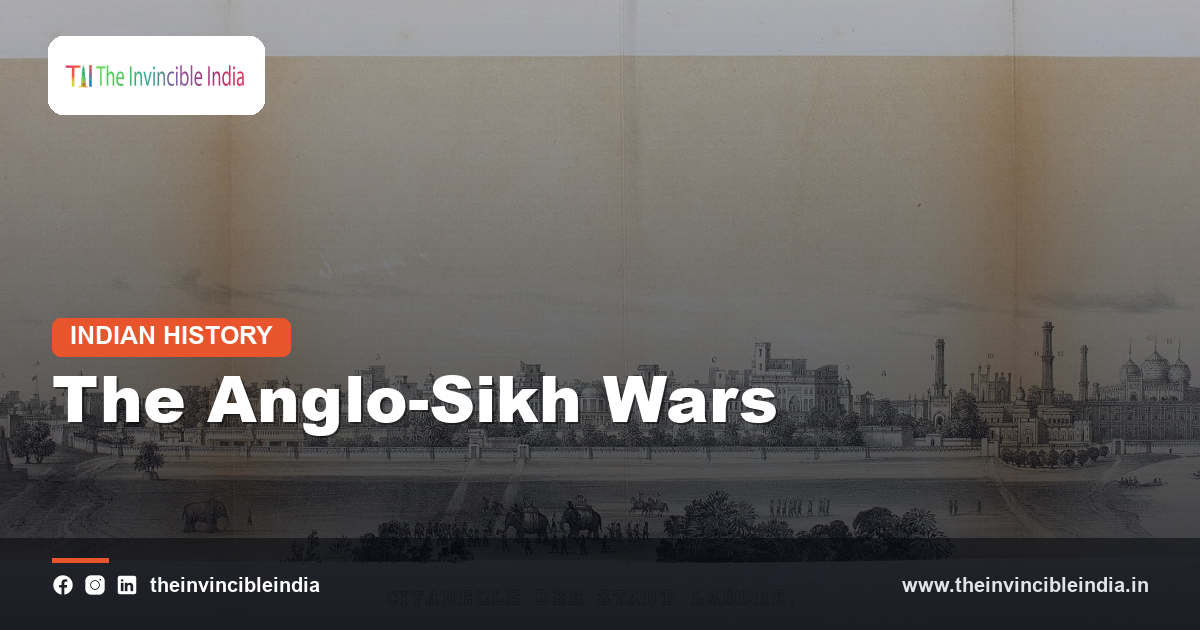
The two Anglo-Sikh Wars, fought in the 1840s, brought to an end the last great independent kingdom of the Indian subcontinent. After the death of Maharaja Ranjit Singh, whose achievements are described in the guide to the Sikh Empire, the Punjab slid into factional struggle at its court, even as the East India Company consolidated its hold on the neighboring territories. Two hard-fought wars followed, in which the disciplined Khalsa army fought with remarkable courage. Their outcome transformed the Punjab from a sovereign realm into a province of British India, and it reshaped the political and cultural map of northern India for generations.
Quick Facts
| Detail | Information |
|---|---|
| Conflicts | First and Second Anglo-Sikh Wars |
| Period | The mid-to-late 1840s |
| Combatants | Sikh Empire against the East India Company |
| Key Battles | Mudki, Ferozeshah, Aliwal, Sobraon, Chillianwala, Gujrat |
| Result | Annexation of the Punjab by the Company |
| Heir of the Empire | Maharaja Duleep Singh, a child ruler |
The Sikh Empire at Its Height
To understand the Anglo-Sikh Wars, it is necessary to recall the strength of the state that fought them. Maharaja Ranjit Singh had united the Sikh misls into a single kingdom centered on Lahore, extending its authority from the Sutlej toward the Khyber Pass and into Kashmir and Multan. His government combined Sikh, Hindu, and Muslim officers, and his court was known for its tolerance and splendor. His greatest achievement was the army, which he modernized with European-trained officers and a disciplined infantry and artillery. For many years, this strong and prosperous kingdom served as a buffer between the British territories and the lands beyond the Indus. The Sikh Empire was therefore a formidable power, and its fall was not inevitable but resulted from circumstances that arose after its founder’s death.
Ranjit Singh and the Treaty with the British
During his lifetime Ranjit Singh maintained a careful relationship with the East India Company, avoiding open conflict with a power whose resources he respected. An early treaty set the Sutlej as a boundary between his realm and the Company’s protected states, and the two powers maintained friendly relations for decades. This policy gave the Punjab years of peace in which to consolidate and prosper. Yet it also left the kingdom with a long frontier facing a rapidly expanding rival. The understanding held as long as the maharaja lived and kept the army under firm control. After his death, the diplomacy that had preserved the peace gradually lost its anchor, and the frontier became a potential source of conflict rather than a stable boundary.
Court Intrigue After the Maharaja
The death of Ranjit Singh was followed by a succession of short-lived rulers and bitter rivalry among court factions. Powerful ministers, the Dogra brothers, and other nobles competed for influence, and several leading figures were killed in the struggle. Unstable leadership weakened the central government and left the army as the most important force in the state. Maharani Jind Kaur emerged as regent for her young son Duleep Singh, trying to hold the kingdom together amid the turmoil. The vacuum at the center encouraged ambitious officials to pursue their own interests, sometimes at the expense of the state. The disorder at Lahore was the single most important internal cause of the crisis that followed, since it undermined both political direction and military confidence.
The Khalsa Army and Its Panchayats
The Khalsa army, as the Sikh forces were known, was among the best-trained armies in Asia at the time. It included well-drilled infantry, a large artillery arm, and cavalry, and it was organized along modern lines under officers trained in European methods. After the maharaja’s death, the soldiers formed regimental committees called panchayats, which claimed a voice in state affairs and sometimes acted independently of the court. This gave the army political weight but also made it difficult for civilian leaders to control. Many soldiers were deeply devoted to the Sikh state and to the memory of Ranjit Singh. The mix of strong military pride and weak political leadership became one of the defining features of the period, influencing how the forces were used in the coming war.
The British Position on the Frontier
While the Punjab grew unstable, the East India Company strengthened its presence along the Sutlej frontier. It had annexed Sindh and extended its control over other neighboring territories, and it increased its garrisons and military roads near the border. Company officials watched the disorder at Lahore closely and debated how to respond. Some saw the Punjab as the last major independent power on the subcontinent, and its absorption as a logical step in the extension of British authority. Others preferred to maintain the existing arrangement as long as it served British interests. The growth of British military strength near the border caused concern at Lahore, and it contributed to a climate of suspicion that made a clash between the two sides more likely.
Causes of the First Anglo-Sikh War
The first war grew out of a combination of internal and external pressures rather than a single event. The Sikh court was divided, and some leaders appear to have believed that sending the unruly army against the Company might relieve internal tensions or weaken the army. The soldiers, for their part, were alarmed by British military buildup and feared an invasion. In the mid-1840s the Khalsa army crossed the Sutlej, an act the Company treated as a declaration of war. The decision to cross was influenced by the mistrust, intrigue, and suspicion that characterized relations on both sides. Whatever the exact balance of motives, the crossing opened a conflict that would prove far more costly and closely contested than the British had expected.
Mudki and Ferozeshah
The first major engagements of the war took place at Mudki and Ferozeshah, in the country south of the Sutlej. At Mudki, the Company’s forces met the advancing Sikh army and fought a hard action that ended in a British success but at considerable cost. Ferozeshah followed soon after and was an even more fiercely contested encounter, remembered for the stubborn resistance of the Sikh gunners and infantry. British accounts acknowledged the unexpected strength of their opponents, and the Company’s own position at times appeared precarious. The battles showed that the Khalsa army was a serious adversary whose courage and artillery could threaten even experienced forces. Both battles also revealed the lack of coordinated leadership on the Sikh side, which would prove a decisive weakness.
Aliwal and Sobraon
The war reached its climax with the battles of Aliwal and Sobraon in the following weeks. At Aliwal, a British force defeated a Sikh detachment, helping the Company regain the initiative. At Sobraon, the Sikh army held a strongly fortified position with its back to the Sutlej, and the fighting there was among the most desperate of the campaign. Sikh soldiers resisted with great determination, and tradition remembers leaders such as Sham Singh Attariwala, who fought to the end. Charges of treachery against some commanders have been debated by historians, who note that command failures and the lack of reliable leadership contributed to the outcome. The defeat at Sobraon broke the Khalsa army’s strength in this campaign and opened the road to Lahore for the Company’s forces.
The Treaty of Lahore and Its Consequences
After Sobraon, the Company imposed a settlement that sharply reduced the power of the Sikh state. The Treaty of Lahore required the Sikhs to give up the territory between the Sutlej and the Beas, to pay a large indemnity, and to limit the size of their army. Because the kingdom could not pay the full amount in cash, it ceded Kashmir and other hill territories, which the Company then transferred to Gulab Singh of Jammu through the Treaty of Amritsar. The young Duleep Singh remained nominally on the throne, but a British resident at Lahore began to exercise wide authority. A later agreement at Bhairowal strengthened this arrangement. The settlement left the Punjab weakened and resentful, planting the seeds of a second conflict.
British Residents and Growing Resentment
Under the new arrangement, British officers such as Henry Lawrence became powerful figures at the Lahore court, guiding policy while the child maharaja reigned. Many of the Khalsa soldiers who had been disbanded or reduced were left without livelihoods, and the dismissal of old officers created widespread discontent. The removal of Maharani Jind Kaur from her role as regent, followed by her exile from the Punjab, angered many who saw her as a symbol of Sikh sovereignty. Local chiefs resented the loss of their influence, and the countryside remained uneasy. This atmosphere of resentment, together with the harsh terms of the treaty, made lasting peace unlikely. The period between the wars was therefore marked by growing tension rather than reconciliation.
The Revolt at Multan
The spark for the second war came from Multan, where the governor Mulraj resigned his post after a dispute over taxation and administration. British officers who were sent to take over the province were attacked, and the unrest quickly widened into a rebellion. The Company’s response was initially slow, and the revolt gave time for wider discontent to gather strength. Sher Singh Attariwala, a Sikh leader who had been sent against the rebels, later joined them with his troops, and the conflict spread across the Punjab. Many veterans of the earlier war rallied to the cause. What began as a local revolt thus grew into a full national resistance, in which the Sikhs sought to recover the independence they had lost.
The Second Anglo-Sikh War
The second war was fought mainly in the northern and western Punjab, with sieges and open battles testing both sides. The Company’s armies advanced against Multan and against the main Sikh forces led by Sher Singh. The battle of Chillianwala was a bloody and indecisive encounter, in which the Sikh forces held their ground and inflicted heavy losses, causing alarm in Britain. Multan eventually fell after a long siege, releasing British troops for the final campaign. The conflict reflected a more determined and united Sikh effort than before, though it still lacked the unified leadership that victory would have required. The war showed the Khalsa’s continuing military strength, even as the eventual outcome favored the Company’s greater resources.
Chillianwala and Gujrat
The decisive battle of the second war was fought at Gujrat, where the Company’s army, now reinforced after the fall of Multan, engaged the Sikh forces in a large action. British commanders relied heavily on artillery, using concentrated fire to weaken the Sikh position before advancing their infantry. The Sikh forces fought bravely but were ultimately defeated, and their army was driven back and forced to surrender soon afterward. Chillianwala earlier in the campaign had been a costly experience for the British, and the contrast with the victory at Gujrat shows how the balance shifted. The defeat at Gujrat ended organized resistance, and the surrender of the Khalsa army sealed the fate of the independent Punjab.
Annexation of the Punjab
After the victory, the Governor-General, Lord Dalhousie, announced the annexation of the Punjab into the Company’s territories, ending the Sikh Empire. The young Maharaja Duleep Singh was deposed and pensioned, and the administration of the province passed to a Board of Administration, led by officers such as the Lawrence brothers. The Koh-i-Noor diamond, long a treasure of the Lahore court, was surrendered to the British Crown. The annexation was a landmark event, bringing the last great independent power in the subcontinent under British control. It also extended British authority to the northwestern frontier, giving the Company control over one of the richest and most strategically important regions of India. The Sikh state had ceased to exist as a sovereign entity.
The Fate of the Royal Family
The fall of the kingdom changed the lives of the royal family dramatically. Duleep Singh was sent away from the Punjab as a child, raised under British supervision, and later settled in England, where he lived as a pensioner of the Crown. Over time he came to question the terms of his exile and sought to reclaim his heritage, though his efforts brought him little success. Maharani Jind Kaur, who had served as regent, lived for years in exile and became a symbol of resistance for many Sikhs. Their story is remembered as a poignant episode, illustrating the personal cost of the loss of sovereignty. The fate of the royal house continues to inspire both historical study and popular remembrance in the Punjab.
The Anglo-Sikh Wars Today
The Anglo-Sikh Wars remain an important subject in the history and memory of the Punjab and of India as a whole. Battlefields and memorials, including those at Sobraon and Ferozeshah, are visited by those who wish to honor the soldiers who fell. Historians continue to debate the role of political intrigue, military leadership, and British ambition in the conflict, while museums and archives preserve documents, weapons, and paintings of the era. The courage of the Khalsa army is widely remembered, and the Sikh Empire is celebrated as a distinctive episode of indigenous rule. Later Sikh soldiers served in large numbers in the British Indian Army, a development that grew from the post-war settlement. Understanding the wars helps explain how the Punjab entered the modern age.
Sources & Further Reading
- Ministry of Culture, Government of India (indiaculture.gov.in).
- Archaeological Survey of India (asi.nic.in).
Frequently Asked Questions
What were the Anglo-Sikh Wars?
The Anglo-Sikh Wars were two conflicts in the 1840s between the Sikh Empire and the East India Company. They ended with the annexation of the Punjab and the end of Sikh sovereignty.
What caused the First Anglo-Sikh War?
The war grew out of political instability in Lahore after the death of Ranjit Singh, the influence of the powerful Khalsa army, and British military buildup along the Sutlej frontier. Mutual suspicion led to the crossing of the Sutlej and the outbreak of fighting.
What was the outcome of the First Anglo-Sikh War?
The Sikh army was defeated, notably at Sobraon, and the Treaty of Lahore imposed territorial losses, an indemnity, and limits on the army. A British resident came to hold wide authority at the Lahore court.
How did the Second Anglo-Sikh War begin?
It began with a revolt at Multan, led by the governor Mulraj, which spread as Sikh leaders and soldiers joined in. The fighting ended with the Company’s victory at Gujrat.
What happened to Maharaja Duleep Singh?
After the annexation, the young maharaja was deposed and later settled in England as a pensioner of the British Crown. His story is remembered as a symbol of the loss of the Sikh kingdom.