


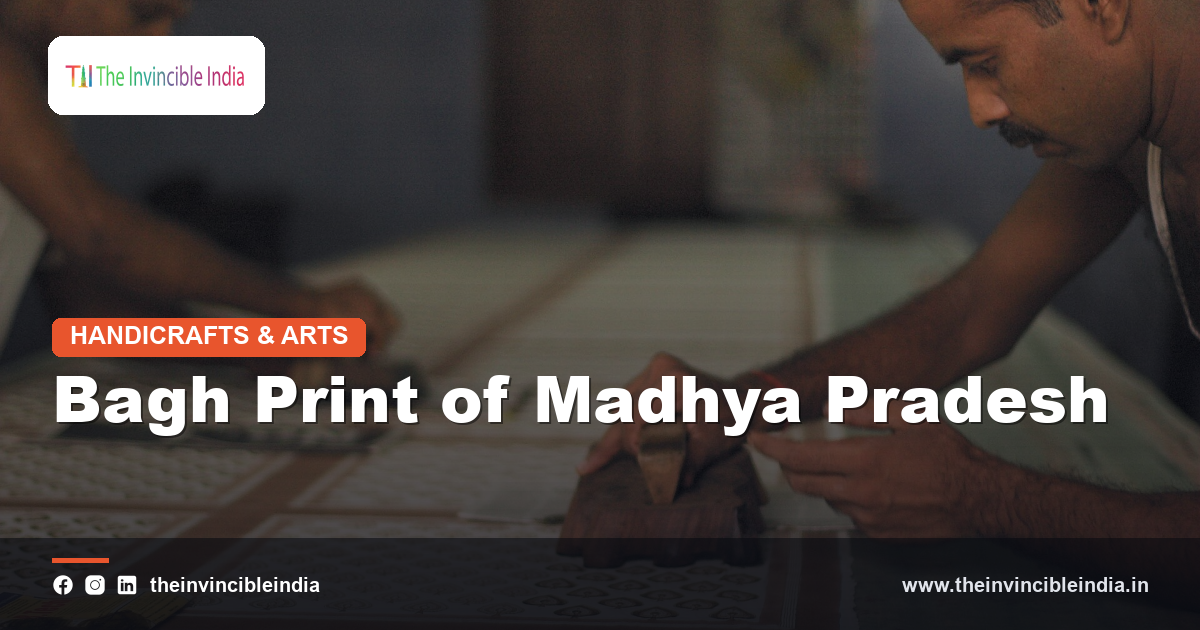
Bagh print is a hand block printing craft named after Bagh, a small village on the banks of the Bagh river in Madhya Pradesh, where artisans use naturally sourced dyes and hand-carved wooden blocks to create bold geometric and floral patterns on cotton cloth. The craft belongs to a wider family of Indian resist and print textile traditions that also includes techniques such as Bandhani tie-dye, though Bagh print is distinguished by its reliance on carved wooden blocks and a distinctive natural-dye process closely tied to the mineral-rich waters of the local river. Practised for generations by artisan families in the region, Bagh print remains defined by its labour-intensive preparation methods and its instantly recognisable palette of deep red, black, and white.
Quick Facts
| Detail | Information |
|---|---|
| Also Known As | Bagh block print |
| Primary Region | Bagh village, Dhar district, Madhya Pradesh |
| Core Technique | Hand block printing with natural dyes |
| Key Dyes | Alizarin red, iron-based black |
| Common Motifs | Geometric and floral repeat patterns |
| Recognition | Geographical Indication (GI) tag |
Origins Along the Bagh River
Bagh print takes its name directly from the village of Bagh, located on the banks of the Bagh river in the Dhar district of Madhya Pradesh, where the mineral qualities of the river water are traditionally credited with playing an important role in the dyeing process. This geographic link is central to the craft’s identity.
Artisan families in and around the village have practised hand block printing for generations, developing techniques closely adapted to local water conditions and available natural materials. This deep regional rootedness means that Bagh print, much like other geographically defined crafts, is difficult to fully replicate outside its area of origin.
The Khatri Printing Community
Bagh print has historically been practised by families belonging to the Khatri community, whose members have specialised in hand block printing and natural dyeing across several generations. This community-based transmission of skill has been essential to preserving the craft’s traditional methods.
Knowledge of block carving, dye preparation, and printing technique within Khatri households is typically passed down informally, with younger family members learning through direct observation and practice alongside experienced elders. This apprenticeship-style learning remains central to how the craft continues today.
Preparing the Cotton Cloth
Before printing can begin, raw cotton cloth undergoes an extended preparation process that typically includes washing, bleaching, and treatment with a mixture involving harda, the powdered fruit of the myrobalan tree, which helps the fabric better absorb natural dyes. This preparatory stage is essential to achieving vivid, long-lasting colour.
The treated cloth is then dried thoroughly, often laid out along riverbanks or open fields, before it is considered ready for the printing stage. This careful preparation reflects the broader emphasis within natural-dye textile crafts on thorough groundwork prior to any decorative application.
Carving the Wooden Printing Blocks
Bagh print relies on hand-carved wooden blocks, traditionally made from teak or another suitably dense wood, into which artisans cut detailed geometric and floral designs intended for repeated stamping across the fabric. Carving these blocks requires considerable skill and precision, and a single elaborate block may take an experienced carver several days to complete.
Separate blocks are often carved for different colours or design elements within a single pattern, allowing printers to build up complex, layered motifs through successive printing passes. The quality and precision of these blocks directly determines the clarity and consistency of the finished printed design, and well-maintained blocks may remain in active use across many years of production.
Natural Dyes: Red, Black, and White
Bagh print is distinguished by its characteristic palette of deep red, black, and the natural white or off-white of the base cotton, achieved entirely through natural dye sources rather than synthetic colourants. Alizarin, derived from madder root, is commonly associated with the craft’s signature red tones, producing a warm, earthy shade that is difficult to replicate exactly with synthetic dye.
Black tones are typically produced using iron-based mordant solutions that react with tannins in the fabric treatment to create a stable dark colour. This reliance on natural mineral and plant-based sources gives Bagh print its distinctive, slightly muted colour character compared to synthetic block-printed textiles, and it also means dye preparation requires careful attention to proportion and timing.
The Resist and Mordant Printing Process
Bagh printing typically involves applying mordant solutions through carved blocks directly onto the prepared cloth, with these mordants later reacting with dye baths to fix colour permanently in the printed areas. This mordant-based approach is a defining feature of the technique.
Areas of the cloth not intended to take on a particular colour may be treated differently or left untreated, allowing printers to build multi-coloured designs through a sequence of careful, controlled printing and dyeing steps. This layered process demands precise coordination between block placement and subsequent dye treatment.
Washing in the River Waters
After dyeing, printed cloth is traditionally washed extensively in the waters of the Bagh river, a step widely credited with helping set colours firmly and remove excess dye and mordant residue. This washing stage is considered an essential part of achieving the craft’s characteristic finish.
The mineral composition of the local river water is often cited by artisans as contributing subtly to the final colour tone achieved, reinforcing the strong connection between Bagh print and its specific geographic location. This dependence on local water resources underscores why authentic Bagh print is closely tied to the village itself.
Sun-Drying and Finishing
Following washing, printed cloth is laid out to dry under direct sunlight, a stage that both completes the drying process and is thought to help further stabilise the natural dyes used in printing. Riverbank fields near Bagh are traditionally used for this purpose.
Once dried, the fabric may undergo final finishing steps such as pressing or folding before it is considered ready for sale or garment construction. This combination of natural drying and simple finishing keeps the overall production process closely tied to traditional, low-mechanisation methods.
Geometric and Floral Motifs
Bagh print designs commonly feature geometric repeat patterns, including grids, diagonals, and stylised florals, arranged in structured, evenly spaced layouts across the fabric. These patterns often draw on a long-established regional design vocabulary.
The precision required to align repeated block impressions accurately is considerable, and skilled printers develop a practised sense of spacing and rhythm that ensures a seamless, continuous pattern across an entire length of cloth. This visual regularity is one of the most recognisable qualities of authentic Bagh print work.
Garments and Home Textiles
Bagh print fabric is used across a range of products, including sarees, dupattas, kurtas, and bedspreads, with its bold red and black palette suiting both traditional garments and contemporary home furnishings. The craft’s versatility has helped it find markets beyond its original regional context, extending into cushion covers, table linen, and other decorative household items.
Designers have increasingly incorporated Bagh print into modern fashion collections, pairing its distinctive natural-dye aesthetic with contemporary silhouettes while maintaining the traditional hand block printing process. This adaptability has helped sustain demand for the craft among a broader consumer base, including buyers specifically seeking naturally dyed, handmade textiles over synthetic alternatives.
Comparisons with Other Block Printing Traditions
Bagh print is often discussed alongside other Indian hand block printing traditions, each distinguished by regional dye sources, motif styles, and finishing methods particular to their place of origin. This comparison helps highlight what makes each tradition distinct within the broader craft category.
While sharing the fundamental technique of carved wooden block printing, Bagh print’s specific reliance on the Bagh river’s water and its characteristic red-black-white palette set it apart from block printing traditions found in other parts of India. This regional specificity is central to how the craft is identified and marketed.
Artisan Livelihoods and Economics
Bagh print production supports artisan families in and around Bagh village, many of whom have practised the craft across multiple generations as their primary or supplementary source of household income. The labour-intensive nature of the process means production volumes remain relatively limited compared to industrial printing, keeping much of the work concentrated among a fairly small number of specialised households.
Craft cooperatives and government support programmes have worked to improve market access and fair compensation for Bagh print artisans, recognising both the cultural value of the craft and the economic challenges faced by small-scale, manual production methods in a competitive textile market.
Geographical Indication and Recognition
Bagh print has received Geographical Indication recognition, formally linking the craft to its place of origin and helping protect its name from use by producers outside the traditional Bagh region who may not follow authentic natural-dye methods. This recognition supports both cultural authenticity and artisan livelihoods.
Government and craft development bodies have also supported documentation and promotion efforts aimed at raising awareness of Bagh print among domestic and international buyers, helping ensure the craft’s continued relevance in a changing textile market.
Symbolism in Bagh Print Patterns
Many of the geometric and floral patterns associated with Bagh print carry meanings drawn from long-standing regional decorative conventions, with particular arrangements traditionally considered suitable for specific garments or occasions. Printers often select or adapt patterns based on this established visual vocabulary rather than working from entirely new designs each time.
This reliance on a shared repertoire of established motifs allows experienced printers to work efficiently while still producing visually varied results, since even a limited set of blocks can be combined in many different sequences and colour arrangements. Such flexibility within a defined tradition has helped Bagh print remain both consistent in character and adaptable to different product types.
Training New Generations of Printers
Passing on the specialised knowledge required for Bagh print, from block carving to mordant preparation and precise printing technique, depends heavily on direct training within artisan families and local workshops. Younger members typically begin with simpler tasks before progressing to more demanding stages of the process.
Craft development organisations have increasingly supported this transmission of skill through structured training programmes, recognising that the natural-dye and hand block printing techniques central to Bagh print cannot easily be learned from documentation alone. Sustained investment in training remains important for ensuring the craft’s long-term continuity.
Bagh Print Today
Bagh print today continues to be produced by artisan families in the village of Bagh, maintaining a natural-dye hand block printing process that has changed relatively little over generations despite broader shifts in the textile industry. Its distinctive palette remains immediately recognisable to those familiar with Indian block-printed textiles.
Sustained institutional support, growing interest in natural-dye and handmade textiles, and continued transmission of skill within artisan families suggest that Bagh print is likely to remain an important part of Madhya Pradesh’s craft heritage for the foreseeable future.
Sources & Further Reading
- Ministry of Textiles, Government of India (texmin.nic.in).
- Ministry of Culture, Government of India (indiaculture.gov.in).
Frequently Asked Questions
What gives Bagh print its name?
Bagh print is named after the village of Bagh in Madhya Pradesh’s Dhar district, located on the banks of the Bagh river, whose water is traditionally used in the craft’s dyeing and washing process.
What colours are typically used in Bagh print?
Bagh print traditionally uses a palette of deep red derived from alizarin, black from iron-based mordants, and the natural white of the base cotton fabric.
Who traditionally practises Bagh print?
Bagh print has historically been practised by families of the Khatri community, who have passed down block carving, dyeing, and printing skills across generations.
Why is the Bagh river important to the craft?
The mineral composition of the Bagh river’s water is traditionally used for washing printed cloth and is credited with helping fix natural dyes and contribute to the craft’s distinctive colour tone.
Is Bagh print made using synthetic dyes?
No, authentic Bagh print relies on natural dye sources such as madder-derived alizarin for red and iron-based mordants for black, rather than synthetic colourants.