


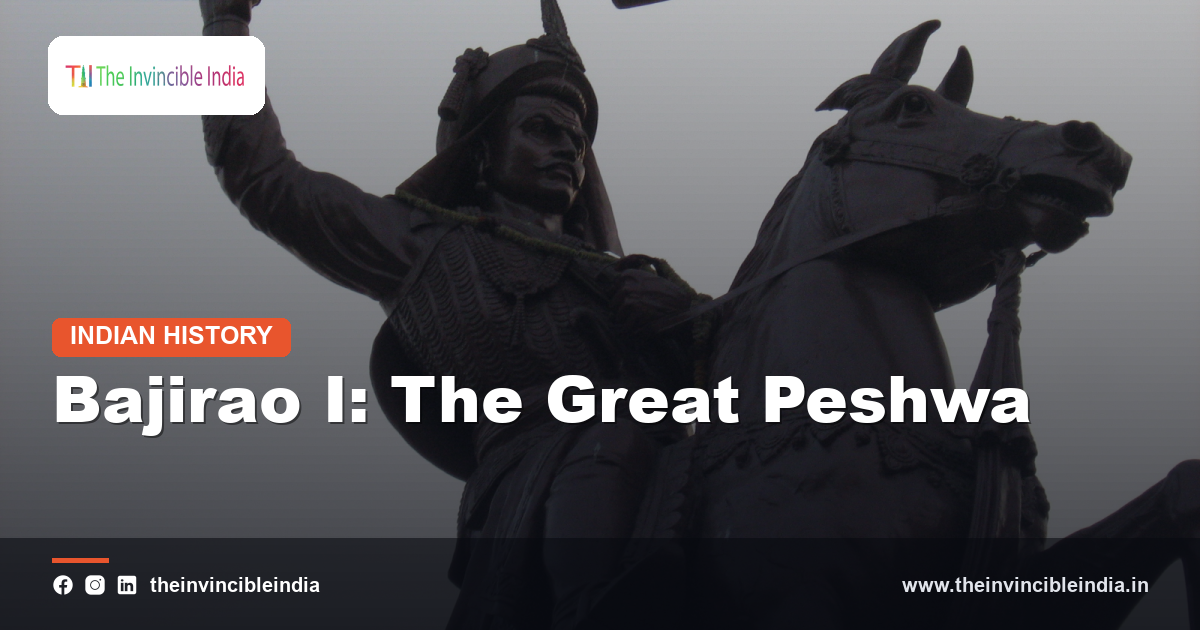
Among the figures who shaped the trajectory of the Maratha empire in the eighteenth century, Bajirao I occupies a particularly prominent place, remembered as a Peshwa whose energetic leadership helped extend Maratha influence across large parts of the Indian subcontinent. Rising to the position of chief minister under the Maratha ruling house, he became known for his tireless campaigning and for consolidating the administrative structures that allowed the Peshwa’s office to grow in authority alongside the Chhatrapati. His base at Pune, centered on the fortified residence of Shaniwar Wada, developed into an important seat of Maratha power during his tenure. This guide surveys his role, career, and enduring legacy within Maratha history.
Quick Facts
| Detail | Information |
|---|---|
| Title | Peshwa (chief minister) of the Maratha empire |
| Base of Power | Pune, centered on Shaniwar Wada |
| Approximate Period | First half of the 18th century |
| Known For | Extensive military campaigning and expansion of Maratha influence |
| Administrative Role | Strengthening the office of the Peshwa within Maratha governance |
| Legacy | Remembered as one of the most effective and energetic Peshwas in Maratha history |
Background and Early Life
Bajirao I was born into a family with established ties to Maratha administration, growing up in an environment where service to the ruling house and familiarity with statecraft were part of daily life. His early years coincided with a period of consolidation for the young Maratha state, which was working to secure its position in the Deccan following the earlier struggles of its founding generation. Exposure to both military affairs and administrative matters from a young age helped prepare him for the responsibilities he would later assume. Accounts of his formative years emphasize a combination of physical vigor and sharp political instinct, qualities that would come to define his later career. This grounding in Maratha court life set the stage for his eventual rise to one of the most powerful positions within the empire.
Appointment as Peshwa
Bajirao’s appointment as Peshwa placed him at the head of Maratha civil and military administration, a position that had grown significantly in importance as the responsibilities of governing an expanding state increased. The role of Peshwa, originally a chief ministerial office serving the Chhatrapati, had begun evolving toward greater independent authority even before his tenure, and Bajirao’s energetic exercise of the position accelerated this trend considerably. His appointment reflected confidence in his abilities at a relatively young age, a decision that would prove consequential for the future direction of Maratha power. From this position, he was able to coordinate military campaigns, manage relations with regional powers, and oversee the administration of an expanding sphere of Maratha influence. His tenure as Peshwa marks a significant chapter in the institutional development of Maratha governance.
Vision for Maratha Expansion
Bajirao is remembered for articulating an ambitious vision of Maratha expansion that looked beyond the Deccan heartland toward influence across a much wider swath of the Indian subcontinent. He is often associated with the idea of extending Maratha reach into northern and central India, recognizing the opportunities presented by the weakening authority of the Mughal court during this period. This vision emphasized rapid, mobile campaigning as a means of projecting power and extracting resources across distant territories rather than relying solely on slow territorial annexation. His approach reflected a broader strategic outlook that sought to position the Maratha state as a dominant force across much of India, not merely a regional power confined to the Deccan. This expansive vision shaped Maratha military and political strategy for decades after his own lifetime.
Military Campaigns in the Deccan
Within the Deccan itself, Bajirao led numerous campaigns aimed at consolidating Maratha authority and countering rival regional powers that sought to check the growth of Maratha influence. His military approach relied heavily on the speed and mobility of Maratha cavalry forces, which were well suited to rapid campaigning across the varied terrain of the region. These campaigns helped secure Maratha control over key territories and resources within the Deccan, reinforcing the state’s core base of power even as attention increasingly turned toward more distant ambitions. Success in these regional conflicts also helped establish Bajirao’s reputation as a capable and energetic military commander early in his tenure. This foundation of Deccan consolidation provided the resources and confidence that supported his later, more far-reaching campaigns.
Campaigns Toward Northern and Central India
Bajirao is particularly remembered for extending Maratha military activity into northern and central India, leading campaigns that brought Maratha forces into contact with territories and powers far from their Deccan base. These expeditions took advantage of the declining authority of the Mughal empire, allowing Maratha forces to assert influence and extract tribute across a widening territorial reach. The logistical demands of campaigning across such distances required considerable organizational skill, an area in which Bajirao is generally credited with notable effectiveness. His northern campaigns contributed significantly to establishing the Marathas as a paramount power across large parts of India during the eighteenth century. This extension of Maratha reach beyond the Deccan represents one of the most consequential aspects of his military legacy.
Military Strategy and Mobility
Bajirao’s military reputation rests significantly on his effective use of fast-moving cavalry warfare, a style of campaigning that allowed Maratha forces to cover considerable distances and strike with speed against less mobile opponents. This approach favored rapid maneuvering, surprise, and the avoidance of prolonged sieges in favor of decisive engagements and swift territorial gains. Such tactics proved particularly effective against larger but less agile forces, allowing the Marathas to punch above their apparent weight in several campaigns. His generalship is often cited by historians as a significant factor in the Maratha state’s ability to expand its influence rapidly during this period. This emphasis on mobility and speed became a hallmark of Maratha military practice well beyond his own lifetime.
Relations with the Mughal Court
Bajirao’s career unfolded during a period of significant weakening in Mughal central authority, a development that created both opportunities and complications for Maratha ambitions in northern India. Relations with the Mughal court fluctuated between confrontation and negotiation, as Maratha forces sought to extract concessions, tribute, or territorial rights from an empire increasingly unable to enforce its authority across its nominal domains. These interactions reflected the broader realignment of power taking place across India during this period, as regional forces including the Marathas increasingly asserted independent influence. Bajirao’s approach to these relations combined military pressure with pragmatic negotiation, seeking tangible gains rather than pursuing conflict for its own sake. This complex relationship with the declining Mughal court shaped much of the political context in which his campaigns took place.
Administrative Contributions
Beyond his military achievements, Bajirao is credited with strengthening the administrative apparatus that supported Maratha governance, particularly in organizing the resources needed to sustain extensive and frequent military campaigns. His tenure saw efforts to systematize revenue collection and resource mobilization across territories under Maratha influence, providing a more reliable foundation for the state’s expanding ambitions. These administrative measures worked alongside his military campaigns, ensuring that battlefield successes could be translated into sustained political and economic gains. His attention to the practical mechanics of governance, alongside his prominence as a military leader, reflects a well-rounded approach to statecraft. This combination of military and administrative competence contributed significantly to the durability of Maratha expansion during and after his tenure.
Shaniwar Wada and Pune
Bajirao’s base at Pune grew in importance during his tenure as Peshwa, developing into a significant center of Maratha political and administrative life centered on the fortified residence known as Shaniwar Wada. This residence served not only as a home for the Peshwa’s family but also as a hub of administration from which campaigns were planned and governance affairs were conducted. The growth of Pune as a Maratha power center during this period reflects the increasing prominence of the Peshwa’s office within the broader Maratha political structure. Shaniwar Wada’s architecture and scale came to symbolize the authority and prestige associated with the Peshwa position. Today, the site remains an important historical landmark closely associated with Bajirao and the broader history of the Peshwas.
Relations with Maratha Nobility
As Peshwa, Bajirao had to navigate relationships with a range of powerful Maratha nobles and regional chieftains, whose cooperation was essential to sustaining large-scale military campaigns and effective governance. Balancing the ambitions and interests of these regional figures required considerable political skill, as excessive central control risked alienating powerful allies while too much autonomy could undermine coordinated action. Bajirao is generally credited with managing these relationships effectively during his tenure, maintaining sufficient cohesion among Maratha nobility to support sustained campaigning across distant territories. This delicate balance between central authority and regional autonomy characterized much of Maratha governance during this expansive period. His success in managing these relationships contributed significantly to the overall effectiveness of Maratha military and political efforts.
Reputation as a Military Leader
Bajirao’s reputation as a military leader rests on a record of sustained campaigning marked by energy, speed, and a general pattern of success across numerous engagements throughout his career. Historians and later commentators have frequently pointed to his personal stamina and willingness to lead campaigns in person as important factors underlying Maratha battlefield effectiveness during his tenure. His approach to warfare, emphasizing rapid movement and decisive action, influenced the broader character of Maratha military practice in the decades that followed. This reputation for effective and energetic leadership contributed to his standing as one of the most celebrated figures in Maratha history. His military legacy remains a central element of how his overall contribution to Maratha expansion is remembered.
Family and Succession
Bajirao’s family played a significant role in the continuation of Peshwa authority, with his descendants going on to hold the position in subsequent generations and continuing many of the administrative and military patterns he had established. The hereditary nature of the Peshwa’s office by this period reflects the degree to which the position had evolved from a purely appointed ministerial role toward a more established family dynasty within Maratha governance. This continuity helped ensure a degree of institutional stability even as individual Peshwas brought their own priorities and approaches to the office. The family’s continued prominence within Maratha politics for generations afterward speaks to the strong foundation Bajirao helped establish during his own tenure. This dynastic continuity forms an important part of the broader institutional legacy associated with his career.
Later Years and Death
Bajirao continued his demanding schedule of campaigning and administration through the later years of his tenure, maintaining the energetic pace that had characterized his career from its early stages. The physical demands of sustained military campaigning across considerable distances over many years took a toll, and his death came while Maratha expansion under his leadership remained very much in progress. His passing marked the end of a particularly dynamic phase in Maratha history, though the momentum of expansion he had helped establish continued under his successors. Accounts of his final years generally emphasize his continued commitment to Maratha ambitions even as the demands of leadership accumulated. His death is remembered as the close of a formative chapter in the broader story of Maratha power.
Historical Assessment
Historians generally regard Bajirao as one of the most significant Peshwas in Maratha history, crediting him with transforming the office into a position of substantial independent authority while dramatically extending the reach of Maratha influence. Assessments of his career emphasize the combination of military talent, administrative competence, and strategic vision that allowed him to pursue an ambitious agenda of expansion during a relatively short tenure. While later historical and popular retellings have sometimes added dramatic or romanticized elements to his story, careful historical study focuses on his documented contributions to Maratha military and administrative development. This balanced historical assessment situates Bajirao within the broader context of eighteenth-century Indian political transformation. His career continues to be studied as a significant case of effective leadership during a formative period of Maratha expansion.
Bajirao I Today
Today, Bajirao I is remembered as a celebrated figure in Maratha history, commemorated through statues, historical sites, and continued scholarly and popular interest in his career and achievements. Shaniwar Wada in Pune remains a significant heritage site closely associated with his tenure, drawing visitors interested in the history of the Peshwas and the broader Maratha empire. His life and campaigns continue to feature prominently in popular culture, including literature and film, which have introduced his story to wider audiences beyond specialist historians. Educational and cultural institutions in Maharashtra and beyond continue to highlight his contributions as part of the broader narrative of Maratha history. As such, Bajirao I remains a defining figure in the historical memory of the Maratha empire and its eighteenth-century expansion.
Sources & Further Reading
- Ministry of Culture, Government of India (indiaculture.gov.in).
- Archaeological Survey of India (asi.nic.in).
Frequently Asked Questions
Who was Bajirao I?
Bajirao I was a Peshwa, or chief minister, of the Maratha empire in the eighteenth century, remembered for his energetic military campaigns and his role in expanding Maratha influence across India.
What is Bajirao I best known for?
He is best known for extending Maratha military reach into northern and central India, strengthening the office of the Peshwa, and his association with Shaniwar Wada in Pune.
What military approach did Bajirao I use?
Bajirao relied heavily on fast-moving cavalry warfare, emphasizing speed and mobility to campaign successfully across large distances and outmaneuver less agile opponents.
What is Shaniwar Wada?
Shaniwar Wada is the historic fortified residence in Pune associated with the Peshwas, serving as an administrative and family seat during Bajirao’s tenure and afterward.
Why is Bajirao I significant in Maratha history?
He is significant for transforming the Peshwa’s office into a position of substantial authority and for driving a period of major territorial and political expansion for the Maratha state.