


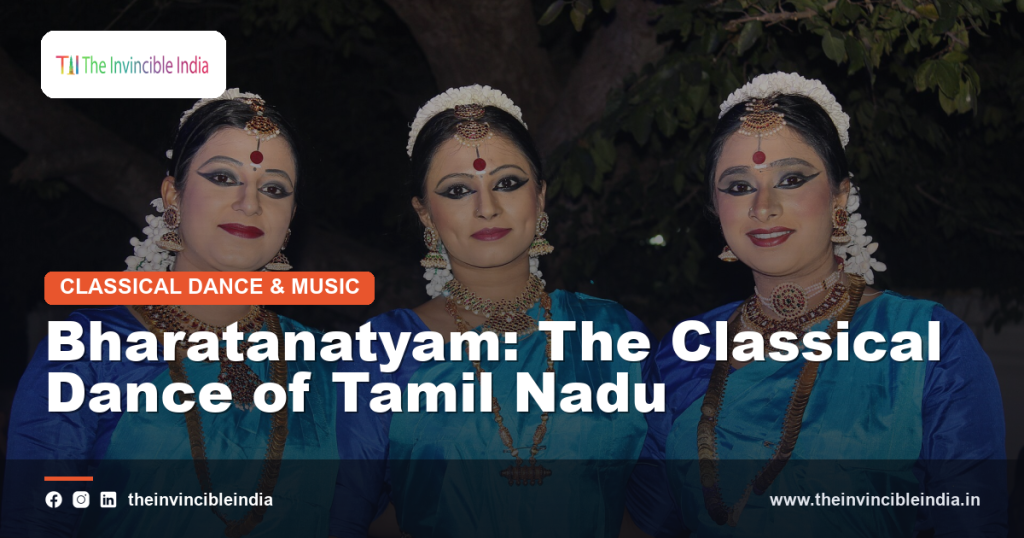
Bharatanatyam is one of the eight classical dance forms of India and the classical dance of Tamil Nadu, celebrated for its sculptural poses, precise geometry, intricate footwork and powerful storytelling. Among the oldest surviving dance traditions in the country, it grew in the temples of the Tamil country as an act of devotion before being reshaped in the twentieth century into the concert art seen on stages worldwide. Rooted in the ancient treatise on performance, the Natya Shastra, Bharatanatyam unites pure rhythmic movement with expressive mime to bring gods, heroes and human emotion to life. This guide traces its history, technique, music, costume and living practice today.
Quick Facts
| Detail | Information |
|---|---|
| Type | One of India’s eight classical dance forms |
| Origin | Tamil Nadu, South India |
| Roots | Temple dance tradition; codified in the Natya Shastra |
| Signature posture | Aramandi (half-seated position) with turned-out knees |
| Music | Carnatic music, led by the nattuvanar |
| Recognition | Recognised by the Sangeet Natak Akademi as a classical dance |
Origins in the Tamil Temples
Bharatanatyam developed in the temples of Tamil Nadu, where it was performed as a form of worship long before it reached the modern stage. For centuries the dance was part of temple ritual, offered before the deity as a sacred act rather than as public entertainment. Its movements, poses and gestures drew on a shared visual language that also shaped South Indian temple sculpture, so that the postures of the dancer and the carved figures on temple walls echo one another. This intimate link between dance, devotion and architecture gave Bharatanatyam its distinctive character, in which every line of the body is composed with a sculptor’s sense of balance and form.
The Natya Shastra Foundation
The theoretical foundation of Bharatanatyam, as of all Indian classical dance, lies in the Natya Shastra, the ancient Sanskrit treatise on drama, dance and music attributed to the sage Bharata. This encyclopaedic text sets out the principles of movement, gesture, expression and aesthetic experience, including the theory of rasa, the emotional flavour that a performance evokes in the audience. Bharatanatyam takes from this tradition its vocabulary of hand gestures, its codified expressions and its understanding of dance as a means of storytelling and spiritual communication. Later texts on dance and music in the South added further detail, but the Natya Shastra remains the wellspring from which the grammar of the form flows.
The Devadasi Tradition
For much of its history, Bharatanatyam was preserved and transmitted by the devadasis, women dedicated to temple service who were trained from childhood in dance and music, and by the hereditary teachers known as nattuvanars who guided them. These artists sustained the repertoire and technique across generations, and the classical margam performed today owes much to their custodianship. During the colonial period the tradition came under severe social and legal pressure, and the temple dance was stigmatised and eventually banned in its old form. That upheaval nearly extinguished the art, and its survival depended on a conscious effort to lift it out of decline and present it anew.
The Twentieth-Century Revival
Bharatanatyam was revived and reinvented in the early twentieth century, most famously through the work of Rukmini Devi Arundale, who founded the institution Kalakshetra in Chennai in 1936 and reframed the dance as a respectable concert art with a strong spiritual and aesthetic dimension. The lawyer and cultural campaigner E. Krishna Iyer also played a decisive role in defending the tradition and persuading audiences of its artistic worth. The revival kept the core technique and repertoire inherited from the nattuvanars while presenting the dance on the proscenium stage for a wider public. This movement secured Bharatanatyam’s place among the great classical arts of India and opened it to students from every background.
The Three Elements of the Dance
Bharatanatyam is built on three interwoven elements. Nritta is pure dance, abstract and rhythmic, in which the body traces patterns in time with the beat without conveying a specific meaning. Nritya is expressive dance, which combines movement with gesture and facial expression to communicate a mood or narrative. Natya is the dramatic element, the enactment of a story with character and emotion. A full performance moves between these registers, offering the audience both the dazzle of technical precision and the depth of emotional storytelling. The balance of rhythm and expression, of the abstract and the dramatic, is what gives the form its richness and its enduring appeal.
Adavus and the Aramandi Posture
The building blocks of Bharatanatyam are the adavus, the basic units of movement that combine steps, positions of the feet, and coordinated arm and hand gestures. Students spend years mastering these units, which are then strung together into longer sequences of choreography. Underlying almost every movement is the aramandi, the characteristic half-seated posture in which the knees are bent and turned outward and the body is held in a stable, symmetrical square. This grounded stance gives Bharatanatyam its powerful geometry and its distinctive sculptural quality, and maintaining it correctly through a demanding performance requires great strength, stamina and control built up over long training.
Mudras: The Language of the Hands
Hand gestures, or mudras, form a precise sign language at the heart of Bharatanatyam. A single hand can form many distinct shapes, and combined with the other hand and with movement they can represent objects, actions, animals, deities and abstract ideas. Through this vocabulary the dancer can narrate a story, name a character or evoke a scene without a single word. The gestures are drawn from the classical treatises and are used together with facial expression to make meaning clear to the audience. Learning to use the mudras fluently, so that they flow naturally and expressively rather than mechanically, is one of the great skills of the trained dancer.
Abhinaya and Expression
Abhinaya, the art of expression, is the emotional soul of Bharatanatyam. Through subtle movements of the eyes, eyebrows, face and body, the dancer conveys the shifting moods of a character and draws the audience into the story. In expressive pieces the performer may portray several characters in turn, moving between them with a change of bearing and expression, and can dwell on a single line of poetry, exploring its meaning through different interpretations. This capacity to communicate deep and nuanced emotion through the body is what distinguishes a mature artist, and the finest exponents can hold an audience spellbound with the smallest gesture or the flicker of an eye.
The Margam: The Recital Sequence
A traditional Bharatanatyam recital follows a structured sequence known as the margam, which unfolds as a carefully designed arc from pure rhythm to profound expression and back. It typically opens with the alarippu, an invocatory piece of pure movement, followed by the jatiswaram, a rhythmic dance set to musical notes. The shabdam introduces expression and narrative, leading to the varnam, the elaborate centrepiece that demands the fullest range of both rhythmic and expressive skill. Lighter expressive pieces such as padams and javalis follow, and the recital closes with the tillana, a joyful, fast-paced dance of pure rhythm. This progression gives a performance its shape and allows the dancer to display every facet of the art.
Music and the Orchestra
Bharatanatyam is performed to Carnatic music, the classical tradition of South India, and the ensemble is an essential partner to the dancer. The performance is traditionally led by the nattuvanar, the conductor who keeps time with a pair of small cymbals and recites the rhythmic syllables that drive the dance. A vocalist provides the songs and poetry, while the mridangam supplies the percussion, and melodic instruments such as the violin, veena or flute complete the ensemble. The intimate coordination between dancer and musicians, especially in the interplay of rhythmic passages, is central to the experience, and a fine recital is a dialogue between movement and sound.
Costume, Jewellery and Makeup
The Bharatanatyam costume is designed to enhance the lines of the dance and to honour its temple heritage. The dancer wears a brightly coloured, stitched costume, often based on the silk sari, with a pleated fan of cloth at the front that opens dramatically when the knees bend in the aramandi. Traditional temple jewellery adorns the head, ears, neck and waist, and the dancer wears bells, or ghungroos, tied around the ankles to sound out the rhythm of the feet. The hands and feet are marked with red dye, and the eyes are strongly outlined so that expressions read clearly from a distance. Together the costume and adornment frame the dancer as a living image of the sacred art.
The Theory of Rasa
At the philosophical core of Bharatanatyam lies the theory of rasa, the aesthetic essence or emotional flavour that a performance is meant to evoke in the spectator. Derived from the Natya Shastra, the idea holds that through the skilful portrayal of a mood, the dancer awakens a corresponding emotional experience in the audience, so that art becomes a shared act of feeling. The tradition identifies a set of primary emotional states, such as love, valour, compassion, wonder and peace, each with its own rasa. A great performance is judged not only by technical accuracy but by its power to transport the viewer into this heightened emotional world, and it is the pursuit of rasa that lifts the dance from display into art.
Male Dancers and the Modern Stage
Although Bharatanatyam is often associated with female performers, men have long played an important part in the tradition, above all as the nattuvanars who taught, composed and conducted the dance. In the modern era male dancers have also become celebrated soloists, and the concert stage now welcomes performers of every gender. The reinvention of the dance in the twentieth century opened it beyond the hereditary community that once guarded it, so that today students from all walks of life train seriously in the form. This broadening has enriched Bharatanatyam with new voices and interpretations while preserving the rigour and depth of the classical technique handed down by earlier generations.
Learning Bharatanatyam
Training in Bharatanatyam is a long and disciplined journey, traditionally undertaken under the close guidance of a guru. Students begin with the fundamentals of posture, rhythm and the basic adavus, gradually building the strength, stamina and precision the dance demands, before moving on to expressive work and the full repertoire. A landmark in a dancer’s training is the arangetram, the debut solo recital in which a student presents the complete margam in public for the first time, marking readiness to perform independently. Beyond technique, the training instils an understanding of music, poetry and the spiritual dimension of the art, and the bond between teacher and student remains central to how the tradition is passed on.
Bharatanatyam Today
Today Bharatanatyam is among the most widely practised of the Indian classical dances, taught in schools and academies across India and around the world and performed on countless stages. Once confined to temple ritual and to a hereditary community, it is now learned by students of every background, and both women and men perform it professionally. Contemporary choreographers explore new themes and collaborations while the classical margam continues to be cherished and preserved. The Indian diaspora has carried the dance across the globe, and international audiences have embraced its beauty. In balancing deep tradition with living creativity, Bharatanatyam remains a vibrant emblem of India’s cultural heritage.
Sources & Further Reading
- Sangeet Natak Akademi, national academy for music, dance and drama, on the recognised classical dance forms of India (sangeetnatak.gov.in).
- Ministry of Culture, Government of India, on Indian classical dance traditions (indiaculture.gov.in).
- The Natya Shastra of Bharata, the foundational Sanskrit treatise on dramaturgy, dance and music.
- Kalakshetra Foundation, Chennai, on the revival of Bharatanatyam and the work of Rukmini Devi Arundale (kalakshetra.in).
Frequently Asked Questions
What is Bharatanatyam?
Bharatanatyam is one of the eight classical dance forms of India and the classical dance of Tamil Nadu. It is known for its geometric poses, intricate footwork, hand gestures and expressive storytelling, and grew from a temple dance tradition rooted in the ancient Natya Shastra.
Where did Bharatanatyam originate?
Bharatanatyam originated in the temples of Tamil Nadu in South India, where it was performed as a devotional art. It was preserved by the devadasis and hereditary teachers before being revived as a concert art in the twentieth century.
What is the aramandi in Bharatanatyam?
The aramandi is the characteristic half-seated posture of Bharatanatyam, in which the knees are bent and turned outward and the body is held in a stable, symmetrical square. It gives the dance its distinctive sculptural geometry and demands considerable strength.
Who revived Bharatanatyam in the twentieth century?
Bharatanatyam was revived in the early twentieth century largely through Rukmini Devi Arundale, who founded Kalakshetra in Chennai in 1936, and the campaigner E. Krishna Iyer, who defended the tradition and helped re-establish it as a respected classical art.
What is a margam?
The margam is the traditional sequence of a Bharatanatyam recital, moving from the invocatory alarippu through the rhythmic jatiswaram and shabdam to the central varnam, then expressive padams and javalis, and closing with the lively tillana.