


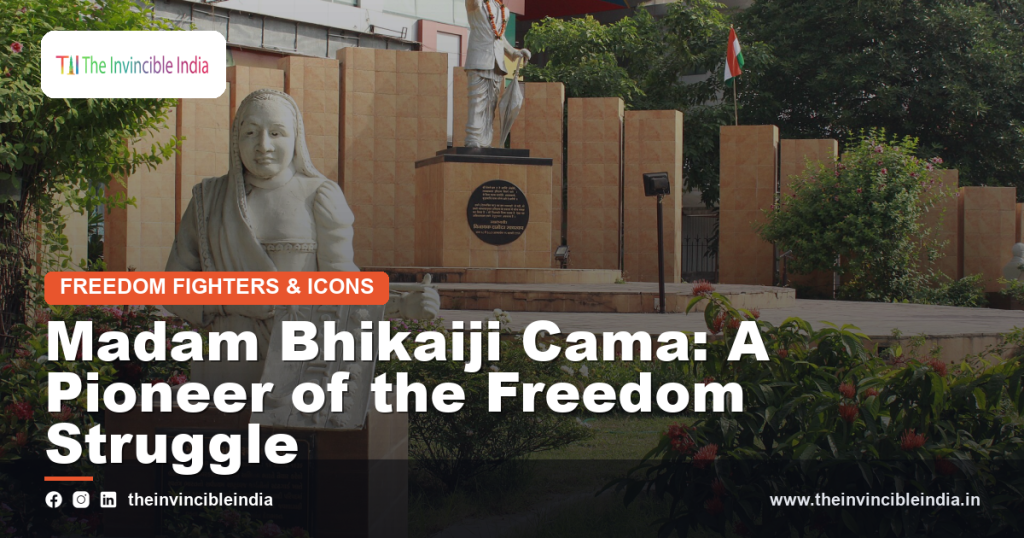
Madam Bhikaiji Cama was one of the most remarkable pioneers of India’s freedom struggle, a revolutionary who carried the cause of independence far beyond the country’s shores and worked tirelessly from exile in Europe to awaken international sympathy for India’s cause. She is remembered above all for unfurling an early version of the Indian national flag before an international audience, a bold act of defiance that announced India’s claim to nationhood on the world stage, much as Sarojini Naidu would later carry India’s voice to international forums. Living for decades in exile, under constant watch by colonial authorities, she never wavered in her dedication to the cause of freedom. This guide explores the life, struggle and enduring legacy of Madam Bhikaiji Cama, a true pioneer of the freedom movement.
Quick Facts
| Detail | Information |
|---|---|
| Known as | Madam Cama |
| Born | 1861, in Bombay (present-day Mumbai) |
| Died | 1936 |
| Famous act | Unfurling an early version of the Indian flag in Europe |
| Base of activity | Decades of political exile in Europe |
| Role | Pioneer of the revolutionary nationalist movement abroad |
A Pioneer of the Freedom Struggle
Madam Bhikaiji Cama occupies a pioneering place in the history of India’s freedom struggle, remembered as one of the earliest and most determined nationalists to carry the cause of independence beyond the borders of India itself. At a time when the mainstream movement at home was still finding its voice, Cama worked from distant Europe to build international awareness and sympathy for India’s claim to freedom, undertaking a form of nationalist activity that few of her contemporaries attempted. Her courage in living and working for decades far from home, under close watch by colonial authorities, set her apart as a uniquely committed figure. As a pioneer of the freedom struggle on the international stage, Madam Bhikaiji Cama holds an enduring and distinctive place among India’s revolutionary nationalists.
Early Life in Bombay
Bhikaiji Cama was born in 1861 in Bombay into a prosperous Parsi family, and she grew up amid the cosmopolitan commercial and intellectual life of the city, which was then emerging as one of India’s most dynamic urban centres. Her upbringing gave her access to education and to a wide circle of social contacts, advantages that she would later put to effective use in her public and political work. Even in these early years, she displayed the strong-willed and compassionate character that would later define her public life. This grounding in the vibrant civic culture of Bombay gave Cama both the resources and the outlook that would shape her later career as a nationalist and social worker.
Social Service in Bombay
Before her emergence as a revolutionary nationalist, Cama was deeply engaged in social service in Bombay, particularly during a period of severe epidemic and hardship in the city, when she worked selflessly to relieve the suffering of the afflicted. Her dedicated service during this crisis brought her into close contact with the deprivation faced by ordinary people under colonial administration, an experience that appears to have sharpened her political consciousness. This period of humanitarian work also affected her own health, leading eventually to her departure abroad for treatment. This early record of compassionate social service reveals the depth of Cama’s commitment to the welfare of her fellow countrymen even before she turned to organised nationalist activity.
Move to Europe
Cama’s departure from India, undertaken initially for reasons of health, took her to Europe, where she would spend the greater part of the remainder of her life and where her most significant contributions to the freedom struggle would take shape. Settling for extended periods in Britain and later in France, she found herself amid a growing community of Indian students, intellectuals and political exiles who were beginning to organise nationalist activity from abroad. This move to Europe, though not originally undertaken for political purposes, placed Cama in an ideal position to become one of the leading figures of the revolutionary nationalist movement operating outside India. Her long years in Europe form the central chapter of her extraordinary public life.
Association with Revolutionaries Abroad
In Europe, Cama became closely associated with a network of Indian revolutionary nationalists who had gathered there to organise support for India’s independence beyond the reach of colonial surveillance at home. She worked alongside prominent figures of this expatriate revolutionary community, contributing her energy, her resources and her considerable talents as an organiser and public speaker to their shared cause. This association placed her at the heart of one of the most important centres of revolutionary nationalist activity outside India during the early twentieth century. Her close involvement with this community of exiled revolutionaries marks a defining stage in Cama’s development as a leading figure of the freedom struggle abroad.
Unfurling the Flag
Madam Cama is celebrated above all for the historic occasion on which she unfurled an early version of the Indian national flag before an international gathering in Europe, a bold and symbolic act asserting India’s right to nationhood before a world audience. This dramatic gesture, undertaken at considerable personal risk, was intended to draw international attention to the cause of Indian independence and to demonstrate that Indians themselves claimed the status of a free nation, irrespective of colonial rule. The act was widely reported and became one of the most celebrated symbolic moments of the early revolutionary movement. This unfurling of the flag remains the single most iconic episode of Madam Bhikaiji Cama’s remarkable life.
The Design of the Flag
The flag that Cama displayed on that historic occasion was among the early attempts by Indian nationalists to create a symbol representing the aspirations of a free and united India, incorporating motifs intended to reflect the country’s diverse religious and regional traditions. Though this early design would evolve considerably before India’s eventual adoption of its present national flag, the act of creating and displaying such a symbol was itself a significant assertion of national identity at a time when no officially recognised Indian flag existed. This early flag stands as an important artefact in the visual and symbolic history of Indian nationalism. Cama’s association with this pioneering flag secures her a unique place in that history.
A Voice for Independence Abroad
Beyond the single dramatic act of unfurling the flag, Cama worked continuously as a voice for Indian independence among international audiences, addressing gatherings, meeting sympathetic political figures and using every available opportunity to press the case for India’s freedom before the world. She argued passionately that India’s cause was part of a broader global struggle for justice and self-determination, seeking to build alliances and sympathy among international observers and fellow revolutionaries from other countries. This sustained international advocacy, carried out over many years, extended the reach of the Indian nationalist message far beyond what could have been achieved from within India alone. Cama’s role as a persistent voice for independence abroad remains central to her historical significance.
Publishing Revolutionary Literature
Cama supported and contributed to the publication of nationalist literature from her base in Europe, helping to produce material that could be circulated among Indian communities abroad and, where possible, smuggled back into India despite the vigilance of colonial censors. This literature carried messages of national pride, resistance to colonial rule and the case for independence, reaching audiences that might otherwise have had little access to such ideas. Through this publishing activity, Cama helped to sustain a flow of nationalist ideas across international borders at a time when the colonial authorities worked hard to suppress such material within India itself. This contribution to nationalist publishing is an important part of her broader work for the cause.
Networking with International Sympathisers
Cama was notably effective in building relationships with sympathetic political figures, socialists and fellow anti-colonial activists from other countries, recognising that India’s cause could benefit from association with broader international movements for justice and self-determination. She attended international gatherings and forged connections that helped to place the question of Indian independence within a wider global conversation about colonialism and freedom. This ability to network across national and political boundaries reflected both her personal charisma and her strategic understanding of how international opinion might be mobilised in India’s favour. Her skill in building these international connections was among her most valuable contributions to the revolutionary nationalist movement abroad.
Surveillance and Exile
Cama’s activities inevitably drew the close attention of colonial intelligence services, which monitored her movements and associations for many years, treating her as one of the more significant figures in the network of revolutionary nationalists operating from abroad. As a result, she was effectively barred from returning to India for a very long period, living for decades in a state of political exile far from her homeland and her family. This extended surveillance and exile imposed heavy personal costs, yet Cama continued her work undeterred, sustained by her unwavering commitment to the cause of independence. This long period of exile under close watch is a testament to the seriousness with which colonial authorities regarded her activities.
Decades in Political Exile
Cama spent the greater part of her adult life in political exile, moving between different countries in Europe as circumstances required, always maintaining her connections to the cause of Indian independence despite the personal hardships of prolonged separation from home. This long exile tested her resolve in ways few of her contemporaries within India ever experienced, yet by all accounts she remained steadfast in her convictions throughout these difficult decades. Her willingness to endure such prolonged personal sacrifice for the sake of a cause she might not live to see fulfilled speaks to the depth of her commitment. These decades in exile form the central, defining period of Madam Bhikaiji Cama’s extraordinary life.
Return to India in Later Life
Only in her final years, after decades away from her homeland, was Cama able to return to India, arriving back in the country for which she had sacrificed so much of her life, in circumstances shaped by advancing age and declining health. Her return, after such a long absence, was a poignant moment that brought her personal journey full circle, even though the independence she had worked so long to achieve had not yet been won. This late return to India after a lifetime of exile is a moving conclusion to the story of her devoted service to the national cause. Her homecoming in these final years stands as a fitting, if bittersweet, close to her long revolutionary career.
Champion of Womens Participation
Throughout her career, Madam Cama stood as a striking example of women’s capacity for leadership and sacrifice in the cause of national freedom, at a time when such prominent public roles for women were rare both in India and abroad. Her example encouraged the participation of women in the freedom struggle and demonstrated that the movement’s leadership was not confined to men alone. She is remembered as an early and inspiring figure in the broader history of women’s contribution to India’s independence movement. This role as a champion, by example, of women’s participation in the freedom struggle adds an important dimension to Cama’s historical significance.
Vision for India
Cama held a clear and passionate vision of a free, united and self-governing India, a vision she articulated repeatedly in her speeches and writings to international audiences over the course of her long exile. She believed firmly that India’s independence was not merely a national aspiration but a matter of universal justice, consistent with the broader international movement towards self-determination for subject peoples. This vision sustained her through decades of hardship and separation from her homeland, providing the unwavering sense of purpose that characterised her entire public life. Cama’s clear articulation of this vision for a free India remains an important part of her intellectual and political legacy.
The Legacy of Bhikaiji Cama
The legacy of Madam Bhikaiji Cama rests on her pioneering role in carrying India’s demand for freedom to the international stage, most memorably through her unfurling of an early version of the national flag before a world audience. Her decades of work in exile, building networks among international sympathisers and sustaining the flow of nationalist ideas across borders, expanded the reach and the resonance of the Indian freedom struggle beyond what could have been achieved from within the country alone. As an early and inspiring example of women’s leadership in the movement, she also broadened the horizons of who could lead the national cause. This many-sided legacy secures Cama’s place among the true pioneers of India’s freedom struggle.
Cama Remembered Today
Today Madam Bhikaiji Cama is remembered and honoured as one of the most courageous and far-sighted pioneers of India’s freedom struggle, celebrated particularly for her historic act of unfurling an early version of the national flag before the world. Institutions, memorials and streets across India bear her name in tribute to her decades of selfless service to the cause of independence, carried out largely from distant exile. She is honoured especially as an inspiring example of women’s leadership and sacrifice in the national movement. As a true pioneer of the freedom struggle, Madam Bhikaiji Cama endures in the nation’s memory as a symbol of unwavering dedication to the cause of Indian independence.
Sources & Further Reading
- Ministry of Culture, Government of India, on pioneers of the revolutionary freedom movement (indiaculture.gov.in).
- National Archives of India, records relating to Indian revolutionary nationalists in Europe.
Frequently Asked Questions
Who was Madam Bhikaiji Cama?
Madam Bhikaiji Cama was a pioneering Indian revolutionary who spent decades in political exile in Europe, working tirelessly to build international support for India’s independence and famously unfurling an early version of the national flag before a world audience.
What flag did Bhikaiji Cama unfurl?
Bhikaiji Cama unfurled an early version of the Indian national flag, one of the first attempts by nationalists to create a symbol of a free and united India, during a historic occasion before an international gathering in Europe.
Why did Bhikaiji Cama live in exile?
Cama lived in exile because her revolutionary activities in Europe, including her association with Indian nationalists abroad, drew close surveillance from colonial authorities, who effectively barred her from returning to India for many decades.
What was Bhikaiji Camas role in the freedom struggle?
Cama served as a leading voice for Indian independence on the international stage, building networks with sympathetic foreign activists, supporting nationalist publishing, and demonstrating the capacity of women for leadership in the freedom movement.
How is Bhikaiji Cama remembered today?
Bhikaiji Cama is remembered as a courageous pioneer of the freedom struggle, honoured through memorials and institutions across India, and celebrated especially for her historic flag-unfurling and her lifelong dedication to India’s independence.