


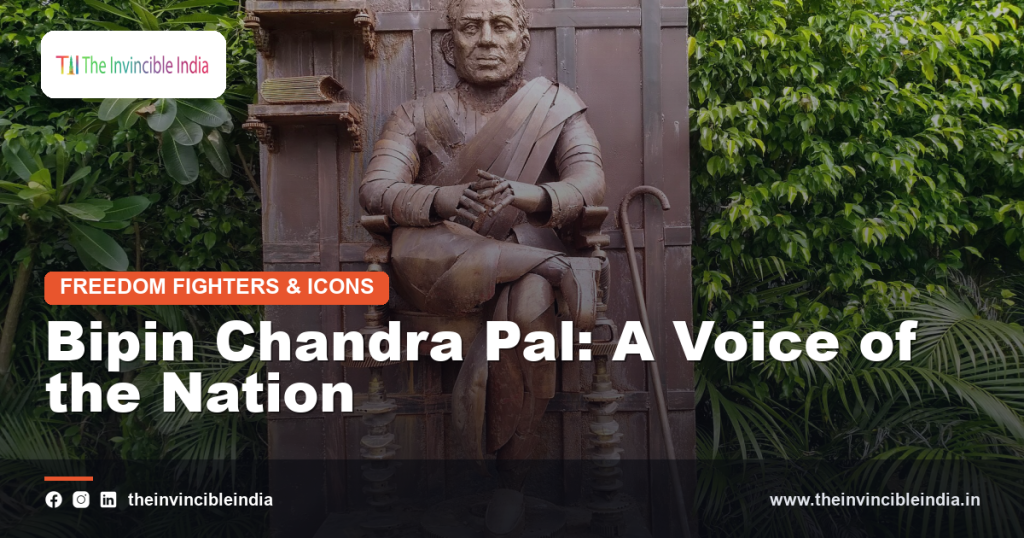
Bipin Chandra Pal was one of the most passionate and eloquent voices of India’s early nationalist movement, a fearless orator and journalist whose words helped rouse a generation to the cause of self-rule. Remembered as one of the Lal-Bal-Pal trio alongside Lala Lajpat Rai and Bal Gangadhar Tilak, Pal gave voice to the more assertive, radical wing of the Indian National Congress at a time when the movement was still finding its strength. He was a leading figure of the Swadeshi movement that swept Bengal, using his gifts as a writer and speaker to awaken national pride and to press the case for boycott, self-reliance and swaraj. This guide explores the life, ideas and lasting legacy of Bipin Chandra Pal, a true voice of the nation.
Quick Facts
| Detail | Information |
|---|---|
| Known as | One of the Lal-Bal-Pal trio of nationalist leaders |
| Born | 1858, in Bengal Presidency (present-day Bangladesh region) |
| Died | 1932 |
| Movement | Leading figure of the Swadeshi movement in Bengal |
| Vocation | Nationalist orator, journalist and writer |
| Belief | A radical, assertive path towards self-rule |
A Voice of the Nation
Bipin Chandra Pal is remembered above all as a voice, one of the most stirring and persuasive orators to emerge from the early Indian nationalist movement, whose speeches and writings carried the message of self-respect and self-rule to audiences across the country. At a time when the national movement was still cautious and largely constitutional in its methods, Pal’s passionate rhetoric gave expression to a deeper, more urgent longing for freedom that was beginning to stir among the people. His gift for language, whether spoken or written, made him one of the most effective communicators of nationalist ideas of his generation. As a voice of the nation, Bipin Chandra Pal helped to awaken a new spirit of assertive nationalism that would carry the movement forward.
Early Life and Education
Bipin Chandra Pal was born in 1858 in Bengal Presidency, into a family that valued learning, and he grew up in an environment shaped by the currents of religious and social reform then sweeping the region. He received a modern education that exposed him to Western political ideas as well as to the rich intellectual and literary traditions of Bengal, an early combination that would shape his distinctive nationalist outlook. Even as a young man, Pal showed the independence of mind and the passionate conviction that would mark his later public career. This formative period, rooted in the reformist ferment of nineteenth century Bengal, gave Pal both the intellectual grounding and the moral seriousness that defined his lifelong commitment to the national cause.
Entry into Public Life
Pal’s entry into public life came through journalism and social reform activity, fields in which he found an outlet for his convictions and his considerable talent for persuasive writing. Working as a journalist allowed him to reach a wide audience with his views on religion, society and the national question, and he steadily built a reputation as a thoughtful and forceful commentator on the issues of his day. His early involvement in causes of social reform reflected a broader concern with the moral regeneration of Indian society, which he saw as inseparable from the political struggle for self-rule. This grounding in journalism and reform work gave Pal the platform and the voice from which he would later emerge as a national figure.
A Fiery Nationalist Orator
Above all else, Bipin Chandra Pal was celebrated as an orator of extraordinary power, capable of stirring vast audiences with his passionate appeals to national pride and self-respect. His speeches combined moral conviction with practical argument, urging his listeners to reclaim their dignity from colonial subjugation and to take the path of self-reliance rather than dependence. Contemporaries and later historians alike have noted the emotional force and intellectual clarity that Pal brought together in his public addresses, a rare combination that made him one of the most sought-after speakers of the nationalist movement. This reputation as a fiery and persuasive orator remains central to how Bipin Chandra Pal is remembered in the history of India’s freedom struggle.
Member of the Lal-Bal-Pal Trio
Pal’s name has become permanently linked with those of Lala Lajpat Rai and Bal Gangadhar Tilak in the celebrated formulation Lal-Bal-Pal, a trio of leaders who together represented the more assertive and militant wing of the Indian National Congress in the early years of the twentieth century. Together, these three leaders argued for a more determined and self-reliant approach to the national struggle, in contrast to the cautious, petition-based methods favoured by the movement’s earlier moderate leadership. Their combined influence helped to shift the tone and direction of Indian nationalism towards greater assertiveness and mass participation. This association as part of the Lal-Bal-Pal trio remains one of the defining features of Pal’s place in nationalist history.
The Swadeshi Movement
Bipin Chandra Pal became one of the leading figures of the Swadeshi movement, the great campaign that swept Bengal and much of India in the early twentieth century, urging Indians to embrace indigenous goods and industries and to reject foreign products as an assertion of national self-respect. Pal travelled widely, addressing meetings across the country and using his powers of persuasion to spread the message of Swadeshi far beyond its original home in Bengal. He saw the movement not merely as an economic boycott but as a moral and spiritual awakening of the nation to its own capacities. His tireless work for the Swadeshi cause established Pal as one of its most energetic and effective national champions.
Advocate of Boycott and Self-Reliance
As part of his advocacy for Swadeshi, Pal was a forceful proponent of the boycott of foreign goods and institutions, arguing that genuine self-respect required Indians to withdraw their support from the structures of colonial dependence. He linked this economic boycott to a broader vision of national self-reliance, urging the development of indigenous industry, education and enterprise as the true foundation of freedom. For Pal, boycott was not merely a tactic of protest but an expression of a deeper philosophy of self-help and national regeneration. This consistent advocacy of boycott and self-reliance placed Pal among the intellectual architects of the constructive, self-strengthening dimension of the Swadeshi movement.
A Radical Voice within Congress
Within the Indian National Congress, Pal became identified with the assertive faction that grew impatient with the slow, moderate methods of the organisation’s early leadership and demanded a more direct and confrontational approach to winning self-government. This division between moderate and more radical approaches shaped Congress politics for years, and Pal, alongside his fellow leaders of the Lal-Bal-Pal trio, gave articulate voice to the demand for a bolder, mass-based struggle. His willingness to challenge the prevailing consensus within the Congress reflected his deep conviction that half measures would not secure India’s freedom. This role as a radical voice within the national movement marks Pal as one of the pioneers of a more assertive Indian nationalism.
Partition of Bengal and Its Impact
The administrative partition of Bengal in the early twentieth century, widely seen by Indians as an attempt to divide and weaken the national movement, became a catalyst for the great upsurge of nationalist feeling with which Pal’s name is closely associated. In the wave of protest and mobilisation that followed, Pal emerged as one of the most prominent leaders, channelling popular anger into the organised Swadeshi and boycott campaigns. He argued passionately that the partition revealed the true character of colonial rule and strengthened the case for self-government. This episode, and Pal’s forceful response to it, marked a turning point in his career and in the broader history of Bengali and Indian nationalism.
Journalism and Nationalist Writing
Throughout his life, Pal used journalism as one of his most powerful instruments, editing and writing for nationalist publications that carried the message of Swadeshi, self-reliance and eventual self-rule to a wide readership. His editorial work combined sharp political commentary with a broader vision of cultural and moral awakening, reflecting his belief that the press had a vital role to play in shaping national consciousness. Through his writing, Pal reached audiences who might never have heard his public speeches, extending his influence across the country and beyond his native Bengal. This substantial body of nationalist journalism remains an important part of Pal’s contribution to the intellectual history of the Indian freedom movement.
Imprisonment and Sacrifice
Pal’s outspoken nationalism and his refusal to compromise his principles brought him into direct conflict with the colonial authorities, and he faced imprisonment and hardship for his role in the movement, a sacrifice he bore with characteristic resolve. Rather than being deterred by such treatment, Pal’s experience of persecution only reinforced his conviction in the justice of the national cause and his determination to continue his work. His willingness to suffer personal consequences for his beliefs earned him the respect of fellow nationalists and added moral weight to his public standing. This record of personal sacrifice in the service of the national cause is an important part of the story of Bipin Chandra Pal.
Philosophy of Nationalism
Pal’s nationalism was never narrowly political but was rooted in a broader philosophy that combined spiritual and cultural renewal with the demand for political self-rule, a synthesis characteristic of much early Bengali nationalist thought. He believed that India’s freedom struggle was inseparable from a deeper awakening of national self-respect, cultural confidence and moral regeneration among its people. This philosophical dimension gave his political arguments an added depth and resonance, appealing not only to practical grievances but to a larger vision of national dignity. Pal’s distinctive philosophy of nationalism, blending the political and the spiritual, remains one of the more intellectually significant aspects of his contribution to the freedom movement.
Later Political Life
In the later decades of his life, Pal continued to participate in public and political affairs, though the movement itself was evolving under new leadership and new methods as it moved towards its final phase. He remained a respected elder statesman of Indian nationalism, his early contributions to the Swadeshi movement and to the assertive wing of the Congress recognised even as younger leaders took up the mantle of the struggle in new ways. Pal’s later years reflect the continuity between the movement’s formative period and its later, mass-based phase. His sustained engagement with public life until his final years underscores his lifelong dedication to the cause of India’s freedom.
A Thinker and Writer
Beyond his political activity, Bipin Chandra Pal was a serious thinker and prolific writer whose works addressed questions of religion, society, culture and politics with considerable depth and originality. His writings reflect a mind engaged with the broader intellectual currents of his time, seeking to articulate a distinctively Indian response to the challenges of modernity and colonial rule. This body of written work, extending well beyond his more famous political journalism, reveals the intellectual seriousness that underlay his public career. As a thinker and writer, Pal made a lasting contribution to Indian public discourse that complements and enriches his better-known reputation as a nationalist orator.
The Legacy of Bipin Chandra Pal
The legacy of Bipin Chandra Pal rests on his role as one of the most passionate and articulate voices of early Indian nationalism, a leader whose oratory and writing helped to awaken a new spirit of assertiveness and self-reliance in the national movement. As a member of the celebrated Lal-Bal-Pal trio, he helped to broaden the base and raise the temperature of the freedom struggle at a crucial moment in its development. His tireless advocacy of Swadeshi, boycott and self-rule, sustained through personal sacrifice, left a lasting mark on the movement that followed. This legacy secures Pal’s place among the foremost pioneers of assertive Indian nationalism.
Pal Remembered Today
Today Bipin Chandra Pal is remembered as one of the great orators and nationalist thinkers of his era, his name honoured alongside those of his fellow leaders in the Lal-Bal-Pal trio wherever the history of the Swadeshi movement is recalled. His contributions to nationalist journalism and to the philosophy of self-reliant nationalism continue to be studied by historians of the freedom struggle, and memorials and institutions across Bengal and India bear tribute to his memory. He is celebrated particularly as a symbol of passionate, principled nationalism rooted in cultural pride. As a true voice of the nation, Bipin Chandra Pal endures in the collective memory of India’s long struggle for freedom.
Sources & Further Reading
- Ministry of Culture, Government of India, on leaders of the Swadeshi movement (indiaculture.gov.in).
- Sahitya Akademi, records on Bengali nationalist writers and thinkers.
Frequently Asked Questions
Who was Bipin Chandra Pal?
Bipin Chandra Pal was a fiery nationalist orator, journalist and writer, remembered as one of the Lal-Bal-Pal trio whose passionate advocacy of self-reliance and boycott helped drive the Swadeshi movement and shape a more assertive phase of India’s freedom struggle.
What is the Lal-Bal-Pal trio?
The Lal-Bal-Pal trio refers to Lala Lajpat Rai, Bal Gangadhar Tilak and Bipin Chandra Pal, three leaders who together represented the assertive, self-reliant wing of the Indian National Congress in the early twentieth century.
What was Pals role in the Swadeshi movement?
Bipin Chandra Pal was one of the leading figures of the Swadeshi movement, travelling widely to spread its message of boycotting foreign goods and embracing indigenous industry as an expression of national self-respect and self-reliance.
Why was the partition of Bengal significant to Pal?
The partition of Bengal sparked a wave of nationalist protest with which Pal became closely associated, as he channelled popular anger into organised Swadeshi and boycott campaigns and argued that the partition exposed the true character of colonial rule.
What is Bipin Chandra Pals legacy?
Pal’s legacy lies in his role as one of the most persuasive orators and writers of early Indian nationalism, whose advocacy of self-reliance and assertive struggle helped broaden and energise the freedom movement in its formative decades.