


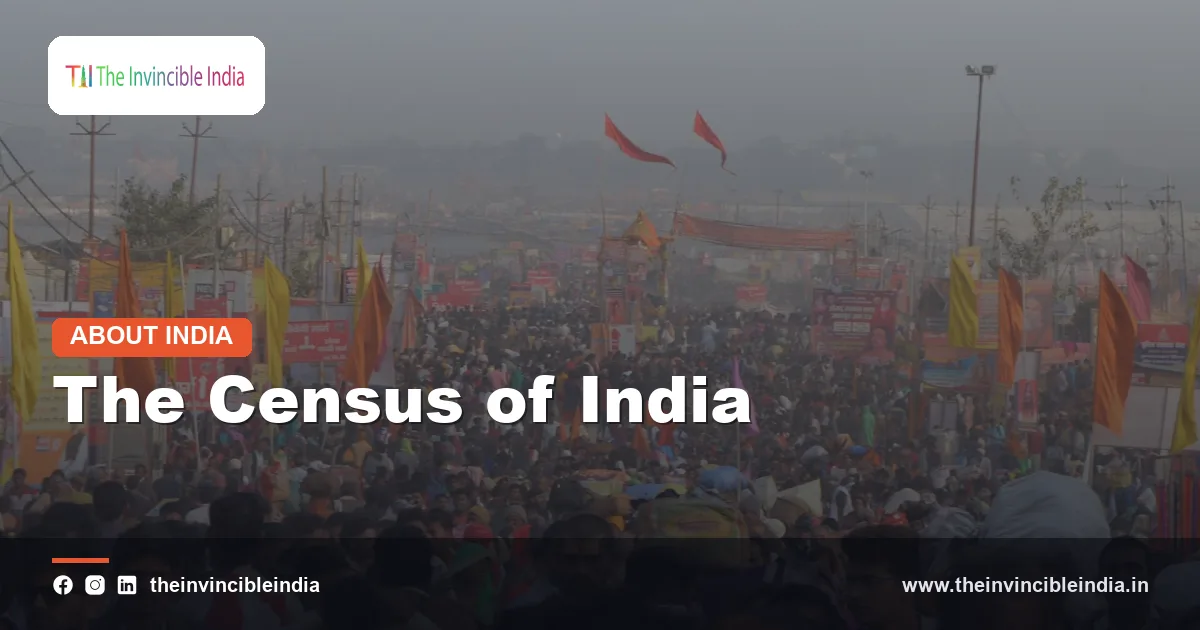
The Census of India is the largest administrative and statistical exercise in the country, a complete head-count in which every household and every resident is enumerated and described. Conducted once every ten years, it produces the most detailed and authoritative picture of who Indians are, where they live, how they earn a living, what languages they speak and what kind of homes they inhabit. Almost every serious debate on population, development, welfare or representation eventually returns to census numbers.
This explainer walks through the whole story: how the census began under the British, how it is organised today under the Census Act, 1948, how the two-phase operation actually works on the ground, what questions it asks, and why the data matters for everything from parliamentary seats to school planning. It also explains why the decadal series, unbroken since 1881, was interrupted when the exercise due in 2021 was postponed, and why the next census is so closely awaited.
Quick Facts
| Item | Details |
|---|---|
| Nature of exercise | Complete enumeration of the population, held once every ten years |
| First (non-synchronous) census | 1872, under Viceroy Lord Mayo |
| First synchronous census | 1881; decadal series continued unbroken after that |
| First census after Independence | 1951 |
| Conducting body | Office of the Registrar General and Census Commissioner, India (RGI), under the Ministry of Home Affairs |
| Legal basis | Census Act, 1948 (Census is a Union subject in the Seventh Schedule) |
| Two phases | Houselisting and Housing Census, followed by Population Enumeration |
| Last completed census | 2011 (the 15th since 1872 and the 7th since Independence) |
| Census due in 2021 | Postponed; the next census is awaited |
What the Census of India Is and Why It Matters
A census is different from a survey. A survey asks questions of a sample and estimates the rest; a census attempts to count everyone. The Census of India covers every village, town, city and hamlet, from remote Himalayan settlements to dense metropolitan slums, and it also counts people who have no homes at all. Because it is a total count, it can offer figures right down to the village or urban ward, something no sample can do reliably.
A Snapshot of a Moving Nation
Each census fixes a reference moment, a specific date and time at which the population is counted, so that the whole country is described as it stood at one instant. Babies born after the reference moment are left out and people who died after it are still included. This discipline lets the numbers add up cleanly across states and districts.
Why a Decadal Rhythm
Ten years is long enough for real change to show, whether that is migration, urbanisation, changing literacy or shifting family size. It is also short enough for the data to stay useful. Between censuses, other systems such as sample surveys and the civil registration system track trends, but they all use the census as their foundation. The census is, in effect, the sampling frame and reference for nearly all other social statistics in India.
History of the Census in India
Counting people is an old idea in the subcontinent. Ancient texts such as the Arthashastra describe officials who kept village-level records of population and livestock for taxation, and the Mughal-era Ain-i-Akbari contains a great deal of administrative and demographic information. These were administrative records rather than modern censuses, though, because they were not systematic head-counts of the whole population.
The 1872 Beginning
The modern story starts in the colonial period. Partial and regional enumerations were carried out in different places between 1865 and 1872, and the 1872 exercise, conducted while Lord Mayo was Viceroy, is regarded as India’s first population census. It is described as non-synchronous because different regions were counted at different times rather than on one common date.
The 1881 Synchronous Census
The census of 1881 was the first synchronous one, with the whole country counted on a single reference date, and it set the template for every census since. From 1881 the exercise has been repeated every ten years without a break, through famines, epidemics, two world wars, Partition and the birth of the Republic. Notable milestones are listed below.
| Year | Milestone |
|---|---|
| 1872 | First non-synchronous census, under Lord Mayo |
| 1881 | First synchronous census; regular decadal series begins |
| 1901 | Detailed social classification, including caste, under the Census Commissioner H. H. Risley |
| 1921 | Often called the Year of the Great Divide, after which population growth accelerated |
| 1931 | Last census to publish caste-wise counts for all castes |
| 1951 | First census of independent India |
| 1961 | Census organisation placed on a permanent footing |
| 2011 | Most recent completed census, the 15th in the series |
After 1951, independent India continued enumerating Scheduled Castes and Scheduled Tribes but did not collect caste data for other communities, a position that is now changing.
Who Conducts It: The Registrar General and the Census Act, 1948
The census is carried out by the Office of the Registrar General and Census Commissioner, India, usually called the RGI. It functions under the Ministry of Home Affairs, Government of India. The office became a permanent organisation in 1961, with a Registrar General who also serves as the Census Commissioner. Besides the decadal census, the same office oversees the Sample Registration System and the national framework for registration of births and deaths.
The Legal Framework
The Census Act, 1948 provides the legal backing. Census appears as an entry in the Union List of the Seventh Schedule to the Constitution, which means only Parliament can legislate on it and the Central Government is responsible for conducting it. Under the Act, the Union Government declares its intention to hold a census through a notification in the Official Gazette, appoints census officers and sets the reference date. The Census Rules, 1990 contain the procedural details.
State and District Machinery
The RGI does not count households itself. Each state and Union Territory appoints a Director of Census Operations, and the state government and district administration lend staff and logistics. District Collectors act as principal census officers in their districts. The Act makes it a duty for residents to answer the questions put to them and provides penalties for refusing or for giving false information.
How the Census Works: Two Phases
The Census of India is not a single visit. It is done in two distinct stages that are separated by several months, so that the first can prepare the ground for the second.
Phase One: Houselisting and Housing Census
In the first phase, enumerators visit every building and list every household in their assigned area. They record the condition and material of the house, the number of rooms, the source of drinking water, access to electricity, type of latrine and drainage, the fuel used for cooking and ownership of assets such as a radio, television, computer, vehicle or phone. This phase produces the housing and amenities data and also builds the master list of households that the next phase will use.
Phase Two: Population Enumeration
The second phase is the actual head-count. Every person in every household is asked about name, age, sex, relationship to the head of household, marital status, religion, Scheduled Caste or Scheduled Tribe status, mother tongue and other languages known, literacy and education, disability, occupation, work status and migration. Each census sets a reference date. For the 2011 census this was 1 March 2011, with special arrangements for snow-bound regions that are counted earlier. The houseless population is enumerated on the night before the main reference date.
Digital Methods
Paper schedules and optical scanning were the norm for decades, but the upcoming census is expected to rely much more on mobile applications and digital data capture, with options for residents to enter their own details online. As the exercise is yet to take place, readers should check official RGI announcements for the latest schedule.
The Army Behind the Count: Enumerators and Confidentiality
Few civilian operations anywhere in the world mobilise as many people as the Indian census. During the 2011 round, roughly 2.7 million officials, most of them working on top of their regular jobs, fanned out across the country to cover about 640 districts, several thousand towns and more than half a million villages.
Who the Enumerators Are
The majority of enumerators are government schoolteachers, supported by other state and local government employees such as anganwadi workers, clerks and revenue staff. Each enumerator is responsible for a compact block of households, and supervisors check the work of a group of enumerators. Training sessions are held in local languages, and staff receive an honorarium for the extra duty. Enumerators travel on foot, by boat, by bus and sometimes through forest and mountain terrain to reach remote habitations.
Confidentiality of Individual Data
The census is protected by a strong confidentiality rule. Section 15 of the Census Act says that census records are not open to public inspection, and the information supplied by any individual cannot be used as evidence in a court of law. The data is used and released only in aggregate form, as totals and tables, and not as personal records. This legal protection is meant to encourage truthful answers and to separate the census from tax, policing or other enforcement functions.
What the Census Measures
The census collects data on a wide range of subjects, and each subject answers a particular question about the nation. The main indicators are summarised below.
| Subject | What it tells us |
|---|---|
| Population count and growth rate | How many people there are and how quickly numbers are rising or slowing |
| Density | Persons per square kilometre, showing pressure on land |
| Sex ratio and child sex ratio | Females per 1,000 males, overall and among children aged 0 to 6 |
| Age structure | Share of children, working-age adults and the elderly |
| Literacy and education | Who can read and write, and levels of schooling attained |
| Rural-urban distribution | How many people live in villages, statutory towns and census towns |
| Language and mother tongue | Linguistic diversity and bilingualism |
| Religion | Religious composition of the population |
| Scheduled Castes and Scheduled Tribes | Size and distribution of these groups |
| Migration | Place of birth, last residence, duration and reasons for moving |
| Occupation and workers | Main and marginal workers, and the types of work they do |
| Disability | Persons with different kinds of disabilities |
| Housing and amenities | Quality of homes, drinking water, electricity, sanitation, cooking fuel and assets |
What Counts as Urban
The census uses a clear definition. Statutory towns are places with a municipality, corporation or similar body. Census towns are places that meet three tests: a population of at least 5,000, at least 75 per cent of the male working population in non-agricultural work, and a density of at least 400 persons per square kilometre. This is why many large villages are classified as urban in the data.
Language Data
The linguistic data is among the most closely studied. Respondents state their mother tongue, and the census groups the thousands of raw responses into a smaller set of languages. In 2011, Hindi was the most widely reported mother tongue by a clear margin, followed by Bengali and Marathi, while the Constitution recognises 22 Scheduled Languages.
Key Findings of Census 2011
The 2011 census remains the latest completed count, so its findings still serve as the official baseline. The headline result was that India’s population crossed 1.2 billion, at roughly 1.21 billion. India was the second most populous country in the world after China, and it accounted for a little over 17 per cent of the world’s people on about 2.4 per cent of its land area.
- Growth slowed. The decadal growth rate fell to about 17.7 per cent, a sharp drop of nearly four percentage points from the previous decade.
- Literacy improved. The literacy rate rose to about 74 per cent, with female literacy improving faster than male literacy, though a wide gap between the sexes remained.
- Sex ratio improved overall. The overall sex ratio rose to 943 females per 1,000 males, but the child sex ratio fell, which drew considerable policy attention.
- Urbanisation advanced. Roughly 31 per cent of Indians lived in urban areas, and for the first time the absolute increase in population was greater in urban than in rural areas.
- Regional variation was striking. Uttar Pradesh was the most populous state, Kerala led in literacy and had a high sex ratio, and Bihar had the lowest literacy among the states.
The census also recorded a third category, Other, in the sex column, giving official visibility to transgender persons for the first time in this series. Data released afterwards covered religion, language, disability and a host of other subjects.
Why the Census Matters: Its Uses
Census figures are woven into the machinery of governance. Their uses fall into several broad areas.
Political Representation and Delimitation
The Constitution requires that, after every census, the allocation of seats in the Lok Sabha and the division of states into territorial constituencies be readjusted. The exercise is called delimitation and is carried out by an independent Delimitation Commission. The seats reserved for Scheduled Castes and Scheduled Tribes are also fixed according to their population shares. Constitutional amendments passed in 2001 froze the allocation of seats among states on the basis of the 1971 census until the first census taken after 2026, so the upcoming census has considerable significance for future representation. The Women’s Reservation Act of 2023 is also linked to the first census and delimitation exercise that follows.
Planning and Resource Sharing
The Finance Commission, which recommends how central taxes are shared with states, uses population and demographic data in its formulae, and the most recent commissions have used 2011 figures. Welfare programmes, school and hospital planning, housing and sanitation schemes and the identification of backward districts all depend on census numbers.
Research and Business
Economists, demographers and sociologists rely on census tables, and businesses use them to locate markets, estimate demand and decide where to open outlets. Public data products include the Primary Census Abstract, village and town directories, district handbooks and census atlases.
Related Datasets: NPR and SECC 2011
Two other exercises are often discussed alongside the census, and they are frequently confused with it. They are different in purpose and legal basis.
National Population Register (NPR)
The National Population Register is a register of the usual residents of the country, prepared under the Citizenship Act, 1955 and the Citizenship Rules, 2003. A usual resident is someone who has lived in a place for six months or more, or who intends to stay for six months or more. It was first compiled in 2010 alongside the houselisting phase of the 2011 census and updated in later years. Unlike census data, the NPR is a named register of individuals.
Socio-Economic and Caste Census (SECC) 2011
The SECC 2011 was a separate door-to-door exercise carried out by the Ministry of Rural Development and the Ministry of Housing and Urban Poverty Alleviation, not by the RGI. It gathered socio-economic data on households to help identify deprived families for welfare schemes and also collected caste information. Its deprivation data was used for targeting benefits, but the caste data was not released in full, which is one reason why demands for a proper caste count have persisted.
The Delayed Census and the Road Ahead
The census due in 2021 was scheduled to be held in two phases, with houselisting in 2020 and population enumeration in early 2021. The operation was postponed in 2020 because of the COVID-19 pandemic, and it remained pending for years afterwards. This is the first time since 1881 that the decadal series has been interrupted, making 2011 the last completed census. In the meantime, a large number of schemes, estimates and policies have continued to rest on 2011 numbers, projections and sample surveys.
Caste Enumeration
A major new feature of the next census is the decision to include the enumeration of caste, which would be the first comprehensive caste count in a national census since 1931. Supporters argue that this will provide data for better targeting of welfare and reservation policy, while others point to the difficulty of designing the questions and categories. The exact format will be determined by official notifications.
What to Expect
Officials have indicated a digital census, with mobile-based data capture and options for self-enumeration, and a reference date in 2027. Because the schedule is subject to official notification, readers should rely on the RGI and the Ministry of Home Affairs for the latest details. Whatever the schedule, the next census will be the first count in more than a decade and will reset the baseline for delimitation, planning and research.
Conclusion
The Census of India is more than a head-count. It is the foundation on which India’s political representation, financial transfers, welfare planning and social research are built. Its history stretches from the 1872 enumeration under Lord Mayo and the first synchronous census of 1881 through an unbroken decadal series that was disturbed only by the pandemic-era postponement of the 2021 round. With the next census awaited and caste enumeration on the agenda, the exercise is poised to be among the most consequential in the country’s history.
Frequently Asked Questions
How often is the Census of India held?
The census is held once every ten years. The first synchronous census was in 1881, and the decadal series ran without a break until the 2021 round was postponed. The last completed census was in 2011.
Who conducts the census and under what law?
It is conducted by the Office of the Registrar General and Census Commissioner, India, which works under the Ministry of Home Affairs. The legal basis is the Census Act, 1948, along with the Census Rules, 1990.
Is my personal information kept confidential?
Yes. Section 15 of the Census Act says census records are not open to public inspection and cannot be used as evidence in court. Data is published only in aggregate form, never as individual records.
What are the two phases of the census?
The first is the Houselisting and Housing Census, which lists buildings and households and records housing conditions and amenities. The second is Population Enumeration, in which every individual is counted and asked about age, education, work, language, religion and other details.
What is the difference between the census, the NPR and the SECC?
The census collects anonymised data in aggregate under the Census Act. The National Population Register is a named register of usual residents prepared under citizenship law. The SECC 2011 was a separate socio-economic survey conducted by the rural development and urban housing ministries to identify deprived households.
Why was the 2021 census postponed?
It was postponed in 2020 because of the COVID-19 pandemic, and it remained pending for several years. This made it the first interruption in the decadal series since 1881, and the next census is awaited, with caste enumeration planned.
{“@context”:”https://schema.org”,”@graph”:[{“@type”:”FAQPage”,”mainEntity”:[{“@type”:”Question”,”name”:”How often is the Census of India held?”,”acceptedAnswer”:{“@type”:”Answer”,”text”:”The census is held once every ten years. The first synchronous census was in 1881, and the decadal series ran without a break until the 2021 round was postponed. The last completed census was in 2011.”}},{“@type”:”Question”,”name”:”Who conducts the census and under what law?”,”acceptedAnswer”:{“@type”:”Answer”,”text”:”It is conducted by the Office of the Registrar General and Census Commissioner, India, which works under the Ministry of Home Affairs. The legal basis is the Census Act, 1948, along with the Census Rules, 1990.”}},{“@type”:”Question”,”name”:”Is my personal information kept confidential?”,”acceptedAnswer”:{“@type”:”Answer”,”text”:”Yes. Section 15 of the Census Act says census records are not open to public inspection and cannot be used as evidence in court. Data is published only in aggregate form, never as individual records.”}},{“@type”:”Question”,”name”:”What are the two phases of the census?”,”acceptedAnswer”:{“@type”:”Answer”,”text”:”The first is the Houselisting and Housing Census, which lists buildings and households and records housing conditions and amenities. The second is Population Enumeration, in which every individual is counted and asked about age, education, work, language, religion and other details.”}},{“@type”:”Question”,”name”:”What is the difference between the census, the NPR and the SECC?”,”acceptedAnswer”:{“@type”:”Answer”,”text”:”The census collects anonymised data in aggregate under the Census Act. The National Population Register is a named register of usual residents prepared under citizenship law. The SECC 2011 was a separate socio-economic survey conducted by the rural development and urban housing ministries to identify deprived households.”}},{“@type”:”Question”,”name”:”Why was the 2021 census postponed?”,”acceptedAnswer”:{“@type”:”Answer”,”text”:”It was postponed in 2020 because of the COVID-19 pandemic, and it remained pending for several years. This made it the first interruption in the decadal series since 1881, and the next census is awaited, with caste enumeration planned.”}}]}]}