


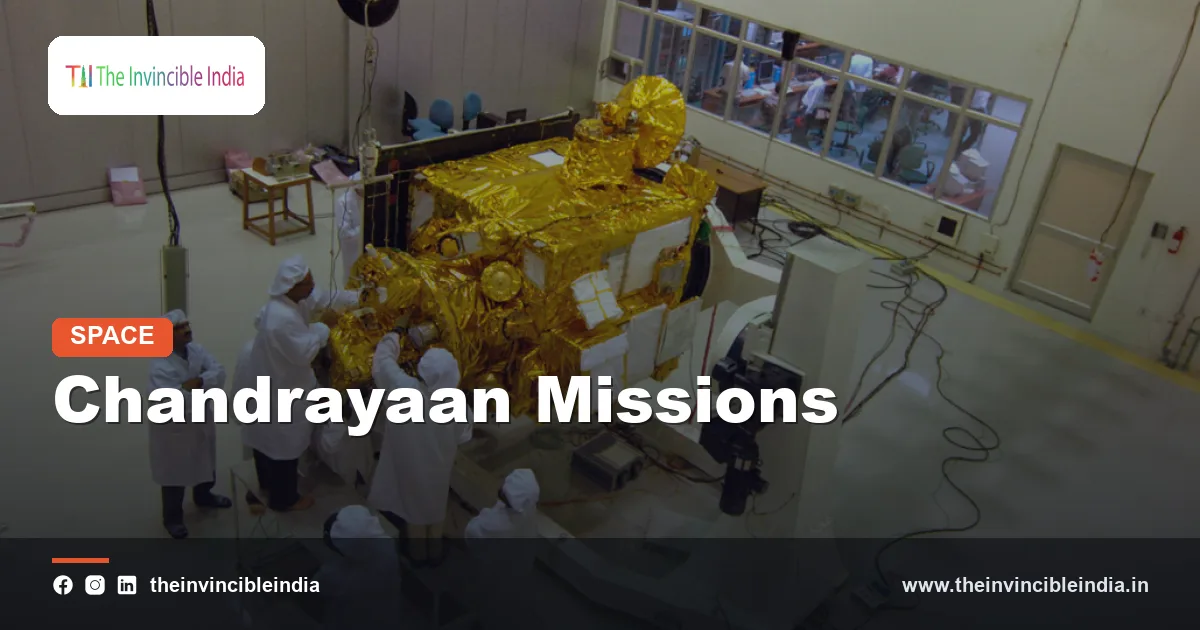
Few chapters of India’s scientific story inspire as much pride as Chandrayaan, the series of lunar exploration missions run by the Indian Space Research Organisation (ISRO). The name comes from Sanskrit, where chandra means the Moon and yaan means vehicle, so it translates simply as “Moon craft”. Over roughly fifteen years the programme has moved from a modest first orbiter to a lander that touched down closer to the lunar south pole than any spacecraft before it.
This explainer walks through every Chandrayaan mission in order, from the launch of Chandrayaan-1 in 2008 to the historic soft landing of Chandrayaan-3 in 2023. It also covers the science these spacecraft were built to do, the engineers and leaders behind them, why the missions are famous for their frugal budgets, and where India’s lunar ambitions are heading next.
Quick Facts About the Chandrayaan Programme
| Item | Detail |
|---|---|
| Programme | Chandrayaan, India’s lunar exploration series |
| Space agency | Indian Space Research Organisation (ISRO), headquartered in Bengaluru |
| Launch site | Satish Dhawan Space Centre, Sriharikota, Andhra Pradesh |
| Chandrayaan-1 | Launched 22 October 2008 on a PSLV; India’s first Moon mission |
| Chandrayaan-2 | Launched 22 July 2019 on a GSLV Mk III (LVM3); lander lost on 7 September 2019 |
| Chandrayaan-3 | Launched 14 July 2023; soft landing on 23 August 2023 |
| Notable first | First country to land near the lunar south pole |
| Global standing | Fourth country to soft-land on the Moon, after the USSR, the USA and China |
| National observance | 23 August is celebrated as National Space Day |
What Is the Chandrayaan Programme?
The Chandrayaan programme is ISRO’s long-running effort to study the Moon, first with orbiters and later with landers and rovers. It grew out of decades of experience in building launch vehicles and satellites. By the early 2000s India had mastered the Polar Satellite Launch Vehicle (PSLV), was flying communication and remote-sensing satellites in large numbers, and scientists began asking whether the same expertise could reach beyond Earth orbit.
The Moon was a natural first target. It is close enough to reach with existing technology, yet scientifically rich, holding a record of the early solar system that Earth’s active geology has erased. The Moon mission concept was publicly announced by then Prime Minister Atal Bihari Vajpayee in his Independence Day address of 15 August 2003, and Chandrayaan-1 followed five years later.
Why the Moon Matters
- It preserves clues about how Earth and the Moon formed and evolved.
- Permanently shadowed craters near the poles may hold frozen water.
- Its surface offers a testing ground for technologies needed for deeper space travel.
- Success builds national scientific capability and inspires young learners.
Chandrayaan-1: India’s First Journey to the Moon
Chandrayaan-1 lifted off from Sriharikota on 22 October 2008 aboard a PSLV rocket. It was India’s first mission beyond Earth orbit and placed the country among a small group of nations that had sent spacecraft to the Moon. The spacecraft was a relatively small orbiter, weighing a little over a tonne at launch, and after a series of orbit-raising manoeuvres it settled into a polar orbit about 100 kilometres above the lunar surface.
Orbiter and Moon Impact Probe
The mission had two main elements. The orbiter carried eleven scientific instruments, some built by ISRO and others contributed by international partners, including NASA, the European Space Agency and Bulgaria. Its job was to map the Moon’s surface in visible, near-infrared and X-ray light, measure the composition of the crust and study the terrain in three dimensions.
The second element was the Moon Impact Probe (MIP). Released from the orbiter in November 2008, it descended toward the surface carrying an Indian tricolour and instruments to study the thin lunar atmosphere as it fell. It struck the Moon near the Shackleton crater at the south pole, making India the fourth country whose national flag had reached the lunar surface.
The Water Discovery
The mission’s most celebrated scientific result came from the Moon Mineralogy Mapper (M3), a NASA instrument riding aboard the spacecraft. Its data helped confirm the presence of water molecules and hydroxyl on the lunar surface, especially at higher latitudes. This overturned the long-held picture of the Moon as completely dry and reshaped lunar science. Radar data from another NASA instrument, Mini-SAR, added to the evidence for ice in polar craters.
Contact with the spacecraft was lost in late August 2009, ahead of its planned two-year lifespan. Even so, Chandrayaan-1 is widely regarded as a major success, since it delivered its principal objectives and produced data scientists continue to study.
Chandrayaan-2: Ambition, Setback and a Working Orbiter
After the success of Chandrayaan-1, ISRO aimed higher. Chandrayaan-2, launched on 22 July 2019, was a far more complex mission designed to combine an orbiter, a lander and a rover in a single project. It flew on the GSLV Mk III, the heavy-lift rocket later known as LVM3, which was then making one of its early operational flights.
The Three Components
- Orbiter: carried eight scientific payloads to study the surface, minerals, exosphere and possible water signatures from lunar orbit.
- Vikram lander: named after Vikram Sarabhai, the founder of India’s space programme, and intended to make a controlled soft landing near the south polar region.
- Pragyan rover: a small six-wheeled vehicle, whose name means wisdom, designed to move around the landing site and analyse the soil.
The 7 September 2019 Landing Attempt
The orbiter entered lunar orbit in August 2019, and Vikram separated from it in early September. On 7 September 2019, during the final descent, the lander deviated from its planned path and communication was lost when it was only a couple of kilometres above the surface. Investigations pointed to a problem in the braking phase, linked to the way the lander’s velocity and software handled the descent, so it hit the surface at a much higher speed than intended.
The landing failure was a disappointment, but the orbiter kept working. Its instruments continue to return valuable data, and the mission taught ISRO lessons that shaped the next attempt.
Chandrayaan-3: The Historic Soft Landing
ISRO chose not to abandon the goal. Chandrayaan-3 was designed as a focused follow-up: a lander and a rover, with a propulsion module to carry them to the Moon, and without a new orbiter, since the Chandrayaan-2 orbiter was still healthy and could act as a communication relay. The design was strengthened with larger fuel reserves, more robust legs, extra sensors and a wider landing zone.
Launch and Journey
The mission lifted off on 14 July 2023 from Sriharikota on an LVM3 rocket. The spacecraft first orbited Earth, raised its orbit in stages, was sent on a trans-lunar trajectory and entered lunar orbit in early August. Later in the month, the lander separated from the propulsion module and began lowering its orbit in preparation for descent.
Touchdown on 23 August 2023
On 23 August 2023, in the evening hours, the Vikram lander completed its powered descent and made a controlled soft landing at a site near the lunar south pole, at about 69 degrees south latitude. Control rooms across the country erupted in celebration. The rover Pragyan rolled out soon afterwards and began exploring.
The achievement carried several distinctions. India became the first country to land near the lunar south pole, and the fourth country to complete a soft landing on the Moon, following the Soviet Union, the United States and China.
Naming and Commemoration
- The touchdown location was named Shiv Shakti Point.
- 23 August was declared National Space Day to mark the landing and encourage interest in space science.
Chandrayaan-1, 2 and 3 Compared
The three missions built on one another. The table below sets them side by side.
| Feature | Chandrayaan-1 | Chandrayaan-2 | Chandrayaan-3 |
|---|---|---|---|
| Launch date | 22 October 2008 | 22 July 2019 | 14 July 2023 |
| Launch vehicle | PSLV | GSLV Mk III (LVM3) | LVM3 |
| Components | Orbiter and Moon Impact Probe | Orbiter, Vikram lander and Pragyan rover | Lander, rover and propulsion module |
| Key date | Impact probe reached the Moon in November 2008 | Landing attempt on 7 September 2019 | Soft landing on 23 August 2023 |
| Outcome | Major success; helped confirm lunar water; contact lost in 2009 | Lander crashed; orbiter still productive | Successful soft landing near the south pole |
The Science Goals and Instruments
Each Chandrayaan mission pursued a mix of surface, subsurface and atmospheric studies. The instruments differ, but the underlying questions are consistent: what is the Moon made of, how did it form, and can its resources support future exploration?
Water Ice and Volatiles
The poles are of special interest because some craters never see sunlight and stay extremely cold. Water ice trapped there could be billions of years old and might one day be used for drinking water, oxygen or rocket fuel. Chandrayaan-1’s findings first pointed toward this possibility, and later missions have tried to build on it.
Mineralogy and Composition
Orbital cameras and spectrometers map which minerals appear where, revealing the Moon’s geological history. On the surface, Chandrayaan-3’s rover carried instruments to analyse the elemental makeup of the soil, including the presence of sulphur and other elements, giving direct ground-truth measurements near the pole.
Exosphere, Plasma and Seismic Activity
- ChaSTE measured how temperature varies with depth in the lunar soil, giving insight into how heat moves through the regolith near the pole.
- ILSA, the Instrument for Lunar Seismic Activity, was designed to detect ground vibrations, or moonquakes, and to help understand the Moon’s interior.
- RAMBHA-LP studied the density of charged particles, or plasma, close to the surface.
- The rover’s laser and X-ray spectrometers analysed the chemical composition of the soil.
- A small experimental payload on the propulsion module observed Earth’s light signatures from lunar orbit, useful for studying planets beyond our solar system.
How Chandrayaan-3’s Vikram and Pragyan Worked
After landing, Vikram deployed a ramp, and Pragyan drove onto the lunar surface, moving in careful stages under commands from Earth. The rover covered on the order of a hundred metres, and its instruments studied the soil while the lander’s payloads recorded temperature, seismic and plasma data. The two communicated with Earth partly through the Chandrayaan-2 orbiter, a neat example of one mission supporting another.
Surviving the Lunar Day
Both spacecraft relied on solar power and were designed to work for about one lunar day, which equals roughly fourteen Earth days. As night fell, temperatures dropped drastically, and the lander and rover were put into sleep mode in early September 2023. Attempts to wake them at the start of the next lunar day did not succeed, which was not unexpected, since they were never built to survive the extreme cold of the long lunar night.
The Hop Experiment
Before the mission ended, engineers also carried out an additional test. The Vikram lander fired its engines to lift off briefly and set down again a short distance away. This “hop” demonstrated technology relevant to future missions that will need to return samples to Earth.
The People and the Low-Cost Story
Behind every launch stand thousands of scientists, engineers, technicians and project managers. The chairman of ISRO at the time of Chandrayaan-1 was G. Madhavan Nair, with M. Annadurai as its project director. K. Sivan led ISRO during Chandrayaan-2, and S. Somanath during Chandrayaan-3, with P. Veeramuthuvel serving as project director for the third mission. Many of the mission’s most visible faces were women engineers and scientists, whose contribution drew wide attention after the landing.
Frugal Engineering
The Chandrayaan missions are famous for their comparatively small budgets. Chandrayaan-3’s cost was reported at roughly six hundred crore rupees, less than the budget of many big-screen films. Several factors help explain this:
- Extensive use of indigenous components and in-house design.
- Reuse of proven technologies and lessons from earlier missions.
- Lean project management and lower engineering labour costs.
- Efficient trajectory planning, using Earth-orbit-raising manoeuvres rather than a single powerful rocket burn.
This approach earned ISRO international respect and reinforced India’s reputation for cost-effective space engineering.
Chandrayaan in the Larger ISRO Story
The lunar missions sit within a wider programme that has grown steadily since the 1960s. India’s first Mars mission, the Mars Orbiter Mission (Mangalyaan), reached Mars orbit in 2014 on its very first attempt. Chandrayaan then showed that ISRO could handle the tougher challenge of landing on another world.
Aditya-L1
India’s first dedicated solar observatory, Aditya-L1, was launched on 2 September 2023, only days after the Chandrayaan-3 landing. It studies the Sun from a point near the first Sun-Earth Lagrange point, giving continuous views of solar activity and the space weather that affects satellites and power grids.
Gaganyaan
Gaganyaan is India’s human spaceflight programme, aimed at sending astronauts to low Earth orbit and bringing them home safely. Skills refined during Chandrayaan, such as precision navigation, propulsion and mission control, feed directly into it.
What Comes Next: Chandrayaan-4 and LUPEX
ISRO has outlined further lunar goals. The planned Chandrayaan-4 is intended to be a sample-return mission, collecting lunar material and bringing it back to Earth. This is a demanding step, because it requires landing, launching from the Moon, docking in lunar orbit and re-entering Earth’s atmosphere safely.
India is also working with Japan on the Lunar Polar Exploration Mission (LUPEX), sometimes described as a Chandrayaan-5-type collaboration. It is planned as a joint effort between ISRO and the Japan Aerospace Exploration Agency (JAXA), in which India is expected to provide the lander and Japan the rover and launch vehicle. Its aim is to study the availability of water in the polar regions in more detail.
Timelines for such missions can change as designs mature, so it is best to treat launch dates as targets rather than fixed promises. Longer term, India has spoken of an Indian astronaut on the Moon in the coming decades and of building its own space station.
Why Chandrayaan Matters to India
The impact of Chandrayaan extends well beyond the laboratory. For students, the live telecast of the 2023 landing became a shared national moment, and interest in science and engineering careers received a visible boost. For the industry, hundreds of private and public suppliers contribute components and services, and a growing space start-up sector has developed alongside ISRO in recent years.
Internationally, the programme strengthened India’s role as a partner in space exploration, and the shared data from the missions is of use to researchers worldwide. It also demonstrated persistence: after the 2019 setback, the team returned within four years and succeeded.
Conclusion
From a first orbiter that helped reveal water on the Moon, to a lander that fell short in 2019 and a follow-up that triumphed in 2023, the Chandrayaan story is one of steady learning. Each mission added capability, and each result, whether a triumph or a setback, moved India closer to more ambitious goals such as sample return and joint polar exploration. As new missions take shape, the programme will likely remain a central symbol of Indian scientific ambition. Last reviewed: 29 September 2026.
Frequently Asked Questions
What does Chandrayaan mean?
Chandrayaan is a Sanskrit-derived name meaning “Moon craft”, from chandra (Moon) and yaan (vehicle). It is the name given to ISRO’s series of lunar exploration missions.
Which Chandrayaan mission landed on the Moon successfully?
Chandrayaan-3 made a successful soft landing on 23 August 2023 near the lunar south pole. Chandrayaan-1 was an orbiter with an impact probe, and the Chandrayaan-2 lander crashed on 7 September 2019 during its landing attempt.
Why was the Chandrayaan-3 landing considered historic?
India became the first country to land near the lunar south pole and the fourth to soft-land on the Moon, after the Soviet Union, the United States and China. The landing site was named Shiv Shakti Point, and 23 August is now celebrated as National Space Day.
What did Chandrayaan-1 discover?
Chandrayaan-1 carried NASA’s Moon Mineralogy Mapper, whose data helped confirm the presence of water molecules and hydroxyl on the Moon’s surface. The finding changed the scientific view of the Moon as a completely dry world.
Why are the Chandrayaan missions so low-cost?
ISRO relies on indigenous design, reuse of proven technology, lean project management and efficient trajectory planning. Chandrayaan-3 was reported to cost roughly six hundred crore rupees, which is far less than comparable missions elsewhere.
What is planned after Chandrayaan-3?
Chandrayaan-4 is planned as a lunar sample-return mission, and India is collaborating with Japan on the LUPEX polar exploration mission. These sit alongside other programmes such as Aditya-L1 and Gaganyaan, and launch dates may change over time.
{“@context”:”https://schema.org”,”@graph”:[{“@type”:”FAQPage”,”mainEntity”:[{“@type”:”Question”,”name”:”What does Chandrayaan mean?”,”acceptedAnswer”:{“@type”:”Answer”,”text”:”Chandrayaan is a Sanskrit-derived name meaning “Moon craft”, from chandra (Moon) and yaan (vehicle). It is the name given to ISRO’s series of lunar exploration missions.”}},{“@type”:”Question”,”name”:”Which Chandrayaan mission landed on the Moon successfully?”,”acceptedAnswer”:{“@type”:”Answer”,”text”:”Chandrayaan-3 made a successful soft landing on 23 August 2023 near the lunar south pole. Chandrayaan-1 was an orbiter with an impact probe, and the Chandrayaan-2 lander crashed on 7 September 2019 during its landing attempt.”}},{“@type”:”Question”,”name”:”Why was the Chandrayaan-3 landing considered historic?”,”acceptedAnswer”:{“@type”:”Answer”,”text”:”India became the first country to land near the lunar south pole and the fourth to soft-land on the Moon, after the Soviet Union, the United States and China. The landing site was named Shiv Shakti Point, and 23 August is now celebrated as National Space Day.”}},{“@type”:”Question”,”name”:”What did Chandrayaan-1 discover?”,”acceptedAnswer”:{“@type”:”Answer”,”text”:”Chandrayaan-1 carried NASA’s Moon Mineralogy Mapper, whose data helped confirm the presence of water molecules and hydroxyl on the Moon’s surface. The finding changed the scientific view of the Moon as a completely dry world.”}},{“@type”:”Question”,”name”:”Why are the Chandrayaan missions so low-cost?”,”acceptedAnswer”:{“@type”:”Answer”,”text”:”ISRO relies on indigenous design, reuse of proven technology, lean project management and efficient trajectory planning. Chandrayaan-3 was reported to cost roughly six hundred crore rupees, which is far less than comparable missions elsewhere.”}},{“@type”:”Question”,”name”:”What is planned after Chandrayaan-3?”,”acceptedAnswer”:{“@type”:”Answer”,”text”:”Chandrayaan-4 is planned as a lunar sample-return mission, and India is collaborating with Japan on the LUPEX polar exploration mission. These sit alongside other programmes such as Aditya-L1 and Gaganyaan, and launch dates may change over time.”}}]}]}