


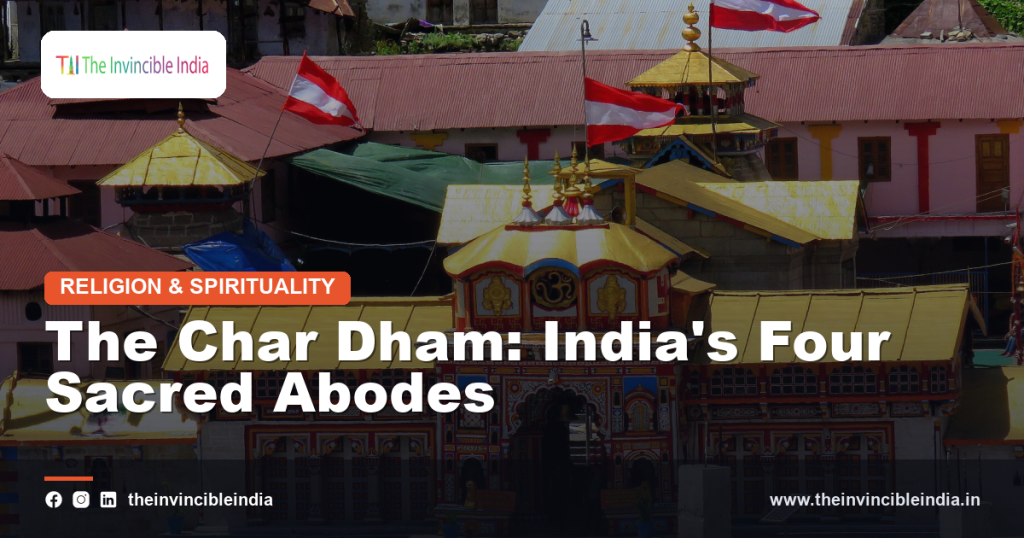
The Char Dham, meaning the four abodes, are among the holiest pilgrimage destinations of Hinduism, four sacred sites revered as the great spiritual corners of India. Traditionally, the term refers to the four holy abodes established across the four corners of the country, a pilgrimage of the deepest significance for Hindus. The name is also used for the four sacred shrines of the Himalayas, known as the Chota Char Dham, which draw vast numbers of pilgrims each year. To undertake the Char Dham pilgrimage is regarded as one of the most meritorious of spiritual journeys, cleansing the soul and bringing the pilgrim closer to the divine. This guide explores the Char Dham, both the great national abodes and the Himalayan shrines, their significance and the pilgrim journey, a central part of India’s spiritual and pilgrimage tradition.
Quick Facts
| Detail | Information |
|---|---|
| Meaning | Char Dham means the four abodes |
| The great Char Dham | Four holy abodes across the corners of India |
| The Chota Char Dham | Four sacred shrines in the Himalayas of Uttarakhand |
| Significance | Among the holiest pilgrimages of Hinduism |
| Tradition | Associated with the great teacher Adi Shankaracharya |
| Merit | The pilgrimage is regarded as deeply meritorious |
The Four Sacred Abodes
The Char Dham, the four abodes, are four of the most sacred pilgrimage sites in Hinduism, revered as holy dwellings of the divine and as the great spiritual anchors of the land. To visit these four sacred abodes is considered one of the holiest of pilgrimages, a journey of deep spiritual significance believed to cleanse the soul and bring blessing and closeness to the divine. The four abodes are spread across the country, so that the pilgrimage embraces the whole land in a great sacred circuit. As among the holiest destinations of Hindu pilgrimage, the Char Dham hold a place of the deepest reverence, and the aspiration to complete this sacred journey is cherished by devout Hindus across India.
The Vision of the Char Dham
The concept of the Char Dham reflects a beautiful vision of the whole of India as a single sacred landscape, bound together by holy places at its four corners. The four abodes, spread across the far reaches of the country, unite the land in a great spiritual geography, so that the pilgrimage to all four is a journey across the whole of India, expressing the unity of the sacred land. This vision of the four abodes as the spiritual corners of the country gives the Char Dham a significance beyond the individual sites, expressing a sense of India as one sacred whole. This grand conception of a nation bound together by its holiest places is one of the most striking aspects of the Char Dham tradition.
Adi Shankaracharya
The tradition of the four great abodes as a unified pilgrimage is associated with the revered philosopher and teacher Adi Shankaracharya, one of the greatest figures in the history of Indian thought. According to tradition, this great teacher, who travelled across India and did much to revive and unify Hindu religion and philosophy, is connected with establishing the four abodes at the corners of the land as a great pilgrimage, binding the country together spiritually. This association with Adi Shankaracharya gives the Char Dham a deep connection to the revival and unification of Hindu tradition and to one of its greatest teachers. The link to this revered figure underlines the profound spiritual and philosophical significance attached to the Char Dham pilgrimage.
The Four Corners of India
The great Char Dham comprises four holy abodes situated in the four corners of India, in the north, west, east and south of the country, so that the complete pilgrimage spans the whole land. Each of these abodes is a major centre of pilgrimage and devotion in its own right, sacred to the divine and drawing devotees from across the country, and together they mark the spiritual boundaries of the land. To visit all four, journeying from one corner of India to another, is the great aspiration of the Char Dham pilgrimage. The spread of the four abodes across the far corners of the country is central to the meaning of the Char Dham, expressing the vision of the whole of India as a single sacred realm.
The Northern Abode
In the north, high in the Himalayas, lies one of the four great abodes, a revered shrine sacred to the divine and set amid the majestic mountains. This northern abode, reached by a journey into the high Himalayas, is a place of great sanctity and spiritual atmosphere, drawing pilgrims to worship at its ancient shrine in the lap of the mountains. Its Himalayan setting, amid soaring peaks and sacred rivers, adds to its profound spiritual power. As the northern corner of the great Char Dham, this abode holds a place of deep reverence, and the journey to it, through the sacred landscape of the Himalayas, is itself an important part of the pilgrimage and its spiritual meaning.
The Western Abode
In the west, on the coast, lies another of the four great abodes, an ancient and holy city sacred to the divine and rich in legend and devotion. This western abode, a place of deep sanctity by the sea, is associated with cherished sacred traditions and draws pilgrims to its revered shrine. Its ancient temples and its holy associations make it a major centre of pilgrimage and one of the spiritual anchors of the land. As the western corner of the great Char Dham, this abode holds a place of deep reverence, and it forms an essential part of the great pilgrimage that spans the four corners of India, uniting the far reaches of the country in a single sacred circuit.
The Eastern Abode
In the east, by the sea, lies another of the four great abodes, a famous and holy city whose great temple is among the most revered in India and whose deity is beloved across the land. This eastern abode is renowned for its magnificent temple and its cherished traditions of worship, drawing vast numbers of pilgrims, and its great festival is one of the most famous in the country. Its deep sanctity and its beloved deity make it one of the great centres of pilgrimage and devotion. As the eastern corner of the great Char Dham, this abode holds a place of the deepest reverence and forms an essential part of the sacred circuit that binds together the four corners of the land.
The Southern Abode
In the south, near the very tip of the country, lies the fourth of the great abodes, a sacred island town whose ancient temple is among the holiest in the land. This southern abode, reached across the sea to the south, is a place of great sanctity, associated with cherished sacred traditions and famed for its magnificent temple, drawing pilgrims from across the country. Its holy associations and its revered shrine make it one of the great centres of pilgrimage. As the southern corner of the great Char Dham, this abode completes the sacred circuit of the four abodes, so that the full pilgrimage embraces the entire land, from the Himalayas of the north to the far south by the sea.
The Himalayan Chota Char Dham
Alongside the great national Char Dham, the term is also used for the Chota Char Dham, a group of four sacred Himalayan shrines that form one of the most important pilgrimages in India, drawing vast numbers of pilgrims each year. These four holy sites, set high in the mountains of the Himalayas, are revered as sacred sources and abodes of the divine, and the journey to them, through the majestic and sometimes challenging mountain landscape, is a great spiritual undertaking. The Himalayan Char Dham has become immensely popular, and for many the Char Dham pilgrimage refers above all to this Himalayan circuit. These sacred mountain shrines are among the most cherished and visited pilgrimage destinations of India.
The Sacred Sources of Rivers
Among the Himalayan shrines of the Chota Char Dham are sacred sites connected to the sources of holy rivers, deeply revered in Hindu tradition. The great rivers of India, above all the Ganga, are held to be sacred and divine, and the places near their sources in the Himalayas are among the holiest of pilgrimage sites, where pilgrims worship the sacred rivers and the divine. To journey to these sacred sources, high in the mountains, is an act of great devotion and merit. The connection of the Himalayan Char Dham to the sacred sources of the holy rivers adds to its profound spiritual significance and reflects the deep reverence for the rivers in the religious life of India.
The Merit of Pilgrimage
In Hindu tradition, pilgrimage to sacred places is regarded as a deeply meritorious act, bringing spiritual benefit, blessing and progress towards liberation, and the Char Dham, as among the holiest of destinations, are believed to bestow the greatest merit. To undertake the Char Dham pilgrimage is held to cleanse the soul of sins, to bring the pilgrim closer to the divine, and to advance them on the spiritual path, and for many devout Hindus completing this pilgrimage is a cherished lifelong aspiration. This belief in the great spiritual merit of the Char Dham pilgrimage is central to its importance and to the devotion with which pilgrims undertake the arduous and sacred journey to the holy abodes.
The Pilgrim Journey
The Char Dham pilgrimage, whether the great national circuit or the Himalayan shrines, is a significant journey, often arduous, especially in the case of the high mountain shrines reached through challenging terrain. Pilgrims undertake the journey with devotion, enduring hardship as part of the spiritual discipline of the pilgrimage, and the journey itself, through sacred landscapes, is an important part of the experience. Along the way, pilgrims worship at the shrines, bathe in sacred waters and immerse themselves in the spiritual atmosphere of the holy places. The pilgrim journey to the Char Dham, with its devotion, its hardship and its encounter with the sacred, is a profound spiritual experience and the heart of the Char Dham tradition.
A Living Tradition
The Char Dham pilgrimage is a vibrant living tradition, undertaken by great numbers of pilgrims every year, especially to the Himalayan shrines, which see vast crowds during the pilgrimage season. The tradition has been sustained across the centuries and remains a central part of the religious life of Hindus, drawing devotees of all ages and from all parts of the country and beyond. Efforts are made to support the pilgrims and to manage the great numbers who undertake the journey. This continuing vitality, with millions drawn each year to the sacred abodes, shows the enduring power and importance of the Char Dham in the religious life of India and the deep devotion it continues to inspire.
Faith and the Mountains
The Himalayan Char Dham in particular expresses the deep bond in Indian tradition between faith and the mountains, for the Himalayas are revered as the sacred abode of the gods and a realm of profound spiritual power. To journey into these majestic mountains in search of the divine, to worship at shrines set amid soaring peaks and sacred rivers, is an experience of great spiritual intensity, in which the grandeur of nature and the devotion of the pilgrim meet. This reverence for the Himalayas as a sacred landscape, and the drawing of pilgrims into the mountains in search of the divine, is a beautiful and profound aspect of the Char Dham tradition and of the wider spiritual heritage of India.
The Char Dham Today
Today the Char Dham remain among the holiest and most cherished pilgrimage destinations of Hinduism, drawing vast numbers of devout pilgrims each year, especially to the sacred shrines of the Himalayas. The tradition, whether the great national circuit of the four abodes or the Himalayan Chota Char Dham, continues to hold a central place in the religious life of Hindus, and the aspiration to complete the pilgrimage is cherished across the country. As sacred abodes of the divine, as the spiritual corners of the land, and as goals of one of the holiest of pilgrimages, the Char Dham endure as a profound expression of the devotion, pilgrimage and sacred geography that lie at the heart of the spiritual heritage of India.
Sources & Further Reading
- Ministry of Culture, Government of India, on the pilgrimage traditions of India (indiaculture.gov.in).
- Ministry of Tourism, Government of India, on the Char Dham pilgrimage sites (tourism.gov.in).
Frequently Asked Questions
What is the Char Dham?
The Char Dham, meaning the four abodes, are four of the most sacred pilgrimage sites of Hinduism. The term refers to four holy abodes across the corners of India, and is also used for the Chota Char Dham, four sacred shrines in the Himalayas of Uttarakhand.
What is the significance of the Char Dham pilgrimage?
The Char Dham pilgrimage is regarded as one of the holiest and most meritorious of spiritual journeys in Hinduism, believed to cleanse the soul, bring the pilgrim closer to the divine and advance them on the spiritual path. For many devout Hindus it is a cherished lifelong aspiration.
What is the Chota Char Dham?
The Chota Char Dham is a group of four sacred Himalayan shrines in the mountains of Uttarakhand that form one of the most important and popular pilgrimages in India, drawing vast numbers of pilgrims each year to worship at these holy sites set high in the Himalayas.
Who is associated with establishing the Char Dham?
The tradition of the four great abodes as a unified pilgrimage is associated with the revered philosopher and teacher Adi Shankaracharya, who travelled across India and is connected with establishing the four abodes at the corners of the land as a great pilgrimage.
Why is the Char Dham spread across India?
The great Char Dham is spread across the four corners of India, in the north, west, east and south, expressing a vision of the whole country as a single sacred landscape bound together by its holiest places, so the full pilgrimage embraces the entire land.