


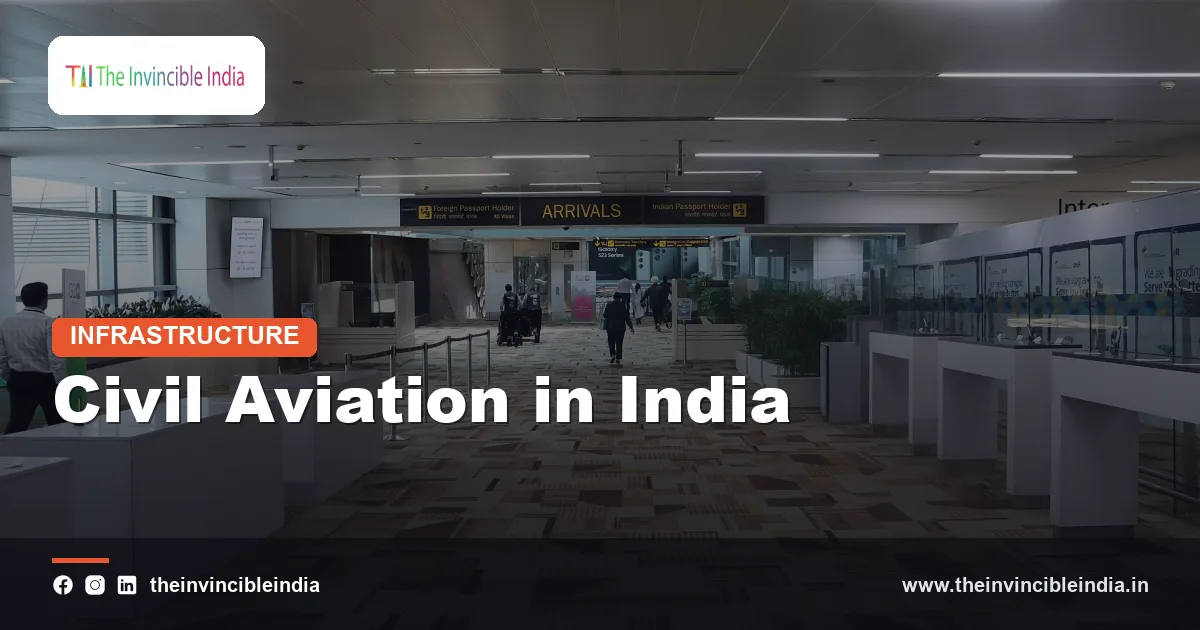
Few sectors have changed everyday life in India as visibly as the sky above it. The story of civil aviation in India runs from a single mail flight in 1932 to a network that carries hundreds of millions of passengers a year, and the country is now routinely described as one of the largest and fastest-growing aviation markets in the world. By domestic traffic, it ranks among the top few markets globally.
This explainer walks through how the system works: where it began, how the nationalisation and liberalisation eras reshaped it, which institutions regulate it, how airports and airlines are organised, what the UDAN scheme does for small-town connectivity, and which challenges still hold the industry back. Figures are given as approximate and dated, because aviation numbers change quickly.
Quick Facts
| Topic | Detail |
|---|---|
| First commercial flight | 15 October 1932, flown by J.R.D. Tata (Karachi to Bombay) |
| Nationalisation | Air Corporations Act, 1953 created Air India and Indian Airlines |
| Liberalisation | Open skies and private airlines allowed from the early 1990s |
| Nodal ministry | Ministry of Civil Aviation |
| Safety regulator | Directorate General of Civil Aviation (DGCA) |
| Airport and air traffic body | Airports Authority of India (AAI), formed in 1995 |
| Regional connectivity scheme | UDAN (Ude Desh ka Aam Naagrik), launched in 2016 |
| Market position | Among the top three domestic aviation markets in the world |
| Major 2022 event | Tata Group took over Air India in January 2022 |
The Scale of Civil Aviation in India Today
Indian skies are among the busiest and most closely watched in the world. In the years before the pandemic, domestic air traffic was growing at double-digit rates, and after the sharp fall of 2020 and 2021 it recovered strongly, with the busiest days in recent years seeing several hundred thousand domestic passengers flying within a single day. Airports across the country now handle well over a thousand scheduled departures daily.
The growth story rests on a simple fact: only a small share of Indians have ever flown. Even as the market has become one of the largest by volume, the number of flights taken per person each year remains a fraction of the figure in the United States or China. That gap is what airlines, airport operators and aircraft manufacturers refer to when they speak of India’s long runway for growth. It also explains why every few months brings a new airline announcement, a new terminal or a new route.
Three layers of the market
- Domestic scheduled services between metros, state capitals and growing cities form the bulk of passenger traffic.
- International services link India with the Gulf, Southeast Asia, Europe and North America, and carry a large diaspora and labour-migration market.
- Cargo, general aviation and helicopter services cover freight, charters, medical evacuation, pilgrimage and offshore operations.
A Brief History: From Mail Planes to Mass Travel
The story begins on 15 October 1932, when J.R.D. Tata flew a de Havilland Puss Moth carrying mail from Karachi to Bombay, with the route extended onward to Madras by a colleague. That flight launched Tata Air Services, which became Tata Airlines in 1938 and was renamed Air India in 1946 when it became a public limited company. International service began in 1948 with a Bombay to London route operated by Air India International, a joint venture with the government.
The nationalisation era
In 1953 Parliament passed the Air Corporations Act, which nationalised the industry. Air India took over international operations, while Indian Airlines, formed by merging several smaller carriers, took over domestic ones. For almost four decades these two state-owned corporations held a legal monopoly on scheduled services. The era built a trained workforce and a recognisable national brand, but it also meant limited capacity, high fares and little customer choice. Flying remained a rare luxury for most families.
Open skies and liberalisation
The early 1990s brought change. Air taxi operators were permitted first, and private scheduled airlines such as Jet Airways, Sahara and Damania followed. The monopoly provisions were removed when the older law was repealed in 1994, and in 1995 the Airports Authority of India was created by merging two earlier airport bodies. This “open skies” shift for domestic services was part of the wider economic liberalisation of the period, and it also paved the way for private participation in airports in the 2000s.
The low-cost revolution
The decisive shift came in the 2000s. Air Deccan, founded by Captain G.R. Gopinath, started operations in 2003 with a strikingly low-fare model aimed at first-time flyers. SpiceJet, GoAir and IndiGo followed in 2005 and 2006. Their emphasis on point-to-point routes, a single aircraft type, quick turnarounds and online booking cut costs, pulled people from trains and buses, and made flying an aspiration for the middle class. Within a decade, low-cost carriers carried the majority of domestic passengers.
Timeline of Key Milestones
| Year | Milestone |
|---|---|
| 1932 | J.R.D. Tata flies the first commercial mail flight |
| 1934 | Aircraft Act enacted, the foundation of aviation regulation |
| 1946 | Tata Airlines becomes Air India |
| 1953 | Air Corporations Act nationalises the airlines |
| 1990s | Open skies; private carriers return to scheduled flying |
| 1995 | Airports Authority of India formed |
| 2003 to 2006 | Low-cost carriers such as Air Deccan, SpiceJet and IndiGo launch |
| 2006 | Delhi and Mumbai airports move to public-private partnerships |
| 2016 | UDAN regional connectivity scheme launched |
| 2022 | Tata Group takes over Air India |
| 2024 | Vistara merges into Air India; new Bharatiya Vayuyan Adhiniyam replaces the 1934 Act |
Who Regulates Indian Aviation: The Institutional Framework
Aviation is a tightly regulated sector, partly because India is a signatory to the Chicago Convention of 1944 and a member of the International Civil Aviation Organization (ICAO), whose standards it is expected to follow. Responsibility is divided among several bodies, each with a distinct job.
| Body | Role |
|---|---|
| Ministry of Civil Aviation | Formulates national policy, oversees the sector and administers major schemes |
| DGCA | Safety regulator: licenses pilots and engineers, certifies aircraft, approves airlines and sets operating rules |
| AAI | Owns, develops and manages many airports and provides air traffic services across Indian airspace |
| BCAS | Bureau of Civil Aviation Security, which sets and audits security standards |
| AAIB | Aircraft Accident Investigation Bureau, which investigates accidents and serious incidents |
| AERA | Airports Economic Regulatory Authority, which regulates tariffs at major airports |
Why the separation matters
Keeping safety oversight with the DGCA, security with the BCAS and investigation with a separate bureau is meant to prevent conflicts of interest. An investigator looking into an accident should not report to the same office that certified the aircraft. The legal base for all of this was the Aircraft Act of 1934 and its rules, which were succeeded in 2024 by the Bharatiya Vayuyan Adhiniyam, a modern statute meant to ease regulation and update the law for the current industry.
What each body means for a passenger
For a traveller, the framework shows up in familiar ways. The DGCA decides how many hours a pilot may fly in a stretch and what an airline must do for a delayed or cancelled flight. The BCAS standards determine the checks at the security gate. The AAI controllers guide the aircraft in the air, and the Ministry sets the policy direction, for instance through regional connectivity or airport privatisation.
Airports: Hubs, PPPs and a Growing Network
India’s airport map has changed dramatically in two decades. The major international gateways, namely Delhi (Indira Gandhi International), Mumbai (Chhatrapati Shivaji Maharaj International), Bengaluru (Kempegowda International) and Hyderabad (Rajiv Gandhi International), handle the largest volumes. Delhi is the busiest and operates multiple runways, while Mumbai manages enormous traffic on a heavily constrained site. Chennai, Kolkata, Kochi, Ahmedabad and others form the next tier.
The public-private partnership model
Because the public purse could not fund every upgrade, the government turned to private capital. Delhi and Mumbai were modernised through joint ventures led by private consortia from 2006, while Bengaluru and Hyderabad were built as greenfield airports and opened in 2008. Cochin International Airport earlier showed that a company with public shareholders could build and run an airport successfully. Later rounds leased several AAI airports, including Ahmedabad, Jaipur and Lucknow, to private operators for long terms. The result has been better terminals, more retail and food outlets, and new non-aeronautical revenue, though debates over user charges and tariffs continue.
More airports, more places
The number of operational airports has risen sharply, from around the seventy mark in the mid-2010s to well over a hundred and forty in recent years, counting heliports and water aerodromes in some official tallies. New greenfield projects, such as those at Navi Mumbai and near Noida, are designed to relieve pressure on overloaded metro airports and to create multi-airport systems around large cities, much like London or New York.
UDAN: Making Flying Affordable for Smaller Towns
UDAN stands for Ude Desh ka Aam Naagrik, loosely “let the common citizen fly”. It is the regional connectivity scheme launched in 2016 to link smaller towns, hill regions and remote areas to the national network. The first UDAN flight in 2017 connected Shimla with Delhi, and the scheme has since expanded to routes in the Northeast, the Himalayan belt and the islands.
How the scheme works
- Capped fares: a share of seats on selected routes is sold at a fare capped at a modest level, roughly in the range of Rs 2,500 for about an hour of flying.
- Viability support: airlines receive viability gap funding to cover the difference between their costs and the capped revenue, funded in part by a small levy on other flights.
- Revival of airstrips: dormant airstrips and small airports are developed or refurbished so that smaller aircraft can operate there.
- Route bidding: airlines bid for routes, and the winner gets exclusivity for a defined period.
UDAN has also been extended to heliports and seaplane or water aerodrome services. Its record is mixed: many routes have taken root and linked towns that never had scheduled air service, while others have struggled with thin demand and airline financial stress. It remains a defining feature of the policy landscape and a rare example of a scheme that tries to make flying a service for ordinary citizens and not only for the wealthy.
Airlines: Market Structure and Consolidation
India’s airline market is dominated by low-cost and hybrid carriers. IndiGo, which began flying in 2006, has become the largest airline by a wide margin and has for years held roughly half or more of the domestic market. The Tata-owned group, now operating Air India, Air India Express and the former Vistara network, is the other major force. SpiceJet, Akasa Air (launched in 2022), Alliance Air and a handful of small regional operators fill out the picture.
The Tata return and the Vistara merger
In January 2022 the government completed the sale of Air India to Tata Sons, returning the airline to the group that founded it ninety years earlier. Under the Tata umbrella, the full-service carrier Vistara, a joint venture with Singapore Airlines, was merged into Air India, a process completed in late 2024. Low-cost operations were also consolidated under Air India Express. The aim was a single, larger full-service carrier plus a unified low-cost arm.
A story of failures too
Not every airline survived. Kingfisher Airlines stopped flying in 2012 after heavy debt, and Jet Airways, once the leading full-service private carrier, suspended operations in 2019. Several smaller airlines also vanished. These episodes are a reminder of how thin aviation margins can be, and why consolidation has become a recurring feature of the Indian market.
What Is Driving the Growth
Several long-term trends underpin the expansion of civil aviation in India.
- Rising incomes and a large middle class: as household incomes grow, discretionary spending on travel rises, and flying competes more directly with long-distance trains.
- Tourism and pilgrimage: domestic leisure travel, religious circuits and international inbound tourism all support demand.
- Business travel: India’s service economy and its spread across many cities keep corporate demand strong.
- Digital booking: smartphones and online platforms have made buying a ticket as easy as booking a cab.
- Policy support: regional connectivity, airport expansion and a more open approach to private investment all help.
The aircraft order books
The confidence of Indian carriers is visible in their orders. In 2023, IndiGo placed one of the largest single aircraft orders in history for Airbus A320-family jets, and Air India announced a very large order of hundreds of Airbus and Boeing aircraft. Such deals put Indian airlines among the world’s biggest customers of aircraft makers. They also create demand for pilots, engineers and maintenance facilities in the country, and they signal that airlines expect the market to keep growing for many years.
Challenges Facing the Sector
Growth has not made the business easy. The main pressure points are well known.
Fuel taxes and costs
Aviation turbine fuel (ATF) is one of the biggest items in an airline’s cost sheet. It is outside the Goods and Services Tax, so states levy their own sales tax or VAT, and the rates vary widely from one state to another. Airlines have long argued that this raises costs and distorts route economics, and the matter is a regular subject of policy discussion.
Profitability
Fares are competitive, many costs such as aircraft leases, spare parts and fuel are linked to the dollar, and the rupee often moves against the industry. As a result, even large carriers have posted losses in many years, and the failures of Kingfisher and Jet Airways are a constant backdrop.
Congestion and infrastructure
Peak-hour pressure at the metro airports, limited runway slots, airspace restrictions and shortages of trained air traffic controllers and pilots can all lead to delays. Maintenance, repair and overhaul capacity is also still developing, and many components are repaired abroad.
Sustainability
Aviation is a hard-to-abate source of carbon emissions. Indian airports have been adopting solar power, and Cochin International Airport became the first in the world to run fully on solar energy in 2015. The industry is also exploring sustainable aviation fuel, more efficient aircraft and electric or hydrogen options for the longer term, in line with India’s wider climate goals.
Drones and the Future of Indian Skies
The next phase of aviation will look different from the last. Drones are emerging as a significant part of the airspace, with the Drone Rules of 2021 simplifying approvals and the Digital Sky platform handling permissions. Uses range from agriculture and surveying to medical delivery and infrastructure inspection, supported by production incentives for domestic manufacturers.
What to watch
- New greenfield airports and multi-airport systems around big cities, easing congestion.
- Expanded UDAN routes and regional airlines using smaller aircraft.
- Domestic maintenance and pilot training to cut dependence on foreign facilities.
- Digital airport services such as facial-recognition boarding.
- Advanced air mobility, including trial programmes for electric aircraft and air taxis.
Conclusion
From a single mail plane in 1932 to a network of well over a hundred airports, civil aviation in India reflects the country’s wider economic story: state-led beginnings, a liberalising turn, private capital and a rapidly growing consumer base. The institutional framework of the Ministry, the DGCA, the AAI, the BCAS and the AAIB keeps the system safe and organised. The task ahead is to turn rapid growth into a financially sound, safe and sustainable industry that reaches every region.
Frequently Asked Questions
Who operated the first commercial flight in India?
J.R.D. Tata flew the first commercial flight on 15 October 1932, carrying mail from Karachi to Bombay. His venture, Tata Air Services, later became Tata Airlines and then Air India.
What does the DGCA do?
The Directorate General of Civil Aviation is the safety regulator. It licenses pilots and engineers, certifies aircraft, approves airline operations and enforces safety rules. It works under the Ministry of Civil Aviation.
What is the UDAN scheme?
UDAN, short for Ude Desh ka Aam Naagrik, is the regional connectivity scheme launched in 2016. It makes flying affordable on selected routes through capped fares and viability gap funding for airlines, and it revives small airstrips to connect smaller towns.
What is the role of the Airports Authority of India?
The AAI, formed in 1995, builds, manages and upgrades many airports and provides air traffic control and navigation services across Indian airspace. Some major airports are now run by private operators under long-term arrangements.
Why did airlines like Kingfisher and Jet Airways fail?
Both were affected by heavy debt and high operating costs in a sector with thin margins. Kingfisher stopped flying in 2012 and Jet Airways in 2019. High fuel costs and intense fare competition have been cited among the pressures on Indian airlines.
Which Indian airports are the biggest?
Delhi, Mumbai, Bengaluru and Hyderabad are the largest international gateways, with Delhi usually the busiest. Chennai, Kolkata and several other cities form the next rank, and many new airports are being added.
{“@context”:”https://schema.org”,”@graph”:[{“@type”:”FAQPage”,”mainEntity”:[{“@type”:”Question”,”name”:”Who operated the first commercial flight in India?”,”acceptedAnswer”:{“@type”:”Answer”,”text”:”J.R.D. Tata flew the first commercial flight on 15 October 1932, carrying mail from Karachi to Bombay. His venture, Tata Air Services, later became Tata Airlines and then Air India.”}},{“@type”:”Question”,”name”:”What does the DGCA do?”,”acceptedAnswer”:{“@type”:”Answer”,”text”:”The Directorate General of Civil Aviation is the safety regulator. It licenses pilots and engineers, certifies aircraft, approves airline operations and enforces safety rules. It works under the Ministry of Civil Aviation.”}},{“@type”:”Question”,”name”:”What is the UDAN scheme?”,”acceptedAnswer”:{“@type”:”Answer”,”text”:”UDAN, short for Ude Desh ka Aam Naagrik, is the regional connectivity scheme launched in 2016. It makes flying affordable on selected routes through capped fares and viability gap funding for airlines, and it revives small airstrips to connect smaller towns.”}},{“@type”:”Question”,”name”:”What is the role of the Airports Authority of India?”,”acceptedAnswer”:{“@type”:”Answer”,”text”:”The AAI, formed in 1995, builds, manages and upgrades many airports and provides air traffic control and navigation services across Indian airspace. Some major airports are now run by private operators under long-term arrangements.”}},{“@type”:”Question”,”name”:”Why did airlines like Kingfisher and Jet Airways fail?”,”acceptedAnswer”:{“@type”:”Answer”,”text”:”Both were affected by heavy debt and high operating costs in a sector with thin margins. Kingfisher stopped flying in 2012 and Jet Airways in 2019. High fuel costs and intense fare competition have been cited among the pressures on Indian airlines.”}},{“@type”:”Question”,”name”:”Which Indian airports are the biggest?”,”acceptedAnswer”:{“@type”:”Answer”,”text”:”Delhi, Mumbai, Bengaluru and Hyderabad are the largest international gateways, with Delhi usually the busiest. Chennai, Kolkata and several other cities form the next rank, and many new airports are being added.”}}]}]}