


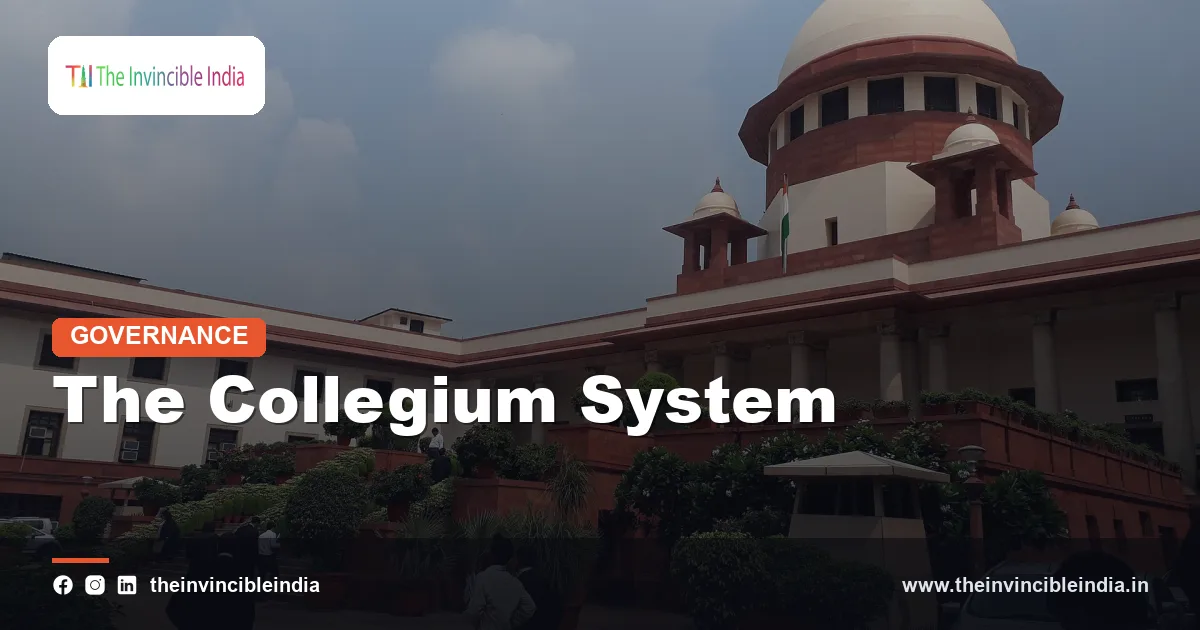
The collegium system is the method by which judges of the Supreme Court and the High Courts of India are appointed and transferred, and it is one of the most unusual arrangements in any democracy. Judges, led by the Chief Justice of India, effectively choose their own colleagues. What makes it more remarkable is that the word “collegium” does not appear anywhere in the Constitution. It is a system that the judiciary itself built, case by case, by interpreting a few short constitutional phrases.
The story of the collegium is really the story of a single word: “consultation”. The Constitution says the President appoints judges “after consultation” with the Chief Justice of India and other judges. Over roughly two decades, in three landmark rulings known as the Judges Cases, the Supreme Court transformed that word from a courtesy into a binding rule of judicial primacy. This explainer walks through the constitutional text, the three cases, how the collegium functions today, the failed attempt to replace it, and the continuing debate around it.
Quick Facts
| Aspect | Details |
|---|---|
| What it is | A judge-led mechanism for appointing and transferring judges of the Supreme Court and High Courts |
| Source | Judicial interpretation (the Judges Cases); not mentioned in the Constitution’s text |
| Relevant Articles | Article 124 (Supreme Court), Article 217 (High Courts), Article 222 (transfer of High Court judges) |
| First Judges Case | S.P. Gupta v. Union of India, 1981 (executive primacy) |
| Second Judges Case | Supreme Court Advocates-on-Record Association v. Union of India, 1993 (collegium created) |
| Third Judges Case | Special Reference No. 1 of 1998, an advisory opinion under Article 143 (collegium expanded) |
| Supreme Court collegium | The Chief Justice of India and the four senior-most judges of the Court |
| Attempted replacement | National Judicial Appointments Commission (99th Amendment, 2014), struck down in October 2015 |
What Is the Collegium System?
A collegium is simply a body of senior colleagues who take decisions collectively. In the Indian context, it refers to a small group of the senior-most judges of the Supreme Court, together with the Chief Justice, who decide whom to recommend for judgeships in the higher judiciary. The government then formally processes those recommendations, and the President signs the warrant of appointment.
It is important to understand what the system covers and what it does not. It covers:
- Appointment of judges to the Supreme Court of India.
- Appointment of judges and Chief Justices of the High Courts.
- Transfer of High Court judges and Chief Justices from one High Court to another.
- Elevation of High Court judges to the Supreme Court.
It does not cover the subordinate judiciary (district and lower courts), where recruitment and control are handled through High Court-supervised processes and state procedures under Articles 233 to 235. The collegium is therefore a feature of the higher judiciary alone, which is also where its constitutional and political significance is greatest.
What the Constitution Actually Says
The constitutional text is short. Under Article 124(2), every Supreme Court judge is appointed by the President by warrant, “after consultation with such of the Judges of the Supreme Court and of the High Courts in the States as the President may deem necessary”. For every appointment other than that of the Chief Justice, the Chief Justice of India must be consulted. Under Article 217(1), a High Court judge is appointed by the President after consultation with the Chief Justice of India, the Governor of the State, and, for judges other than the Chief Justice, the Chief Justice of that High Court. Article 222 allows the President to transfer a judge from one High Court to another after consultation with the Chief Justice of India.
Qualifications and retirement
- A Supreme Court judge must be a citizen who has been a High Court judge for at least five years, or a High Court advocate for at least ten years, or, in the President’s opinion, a distinguished jurist (Article 124(3)).
- A High Court judge must be a citizen who has held judicial office for ten years or been a High Court advocate for ten years (Article 217(2)).
- Supreme Court judges retire at 65 and High Court judges at 62.
Why “consultation” and not “concurrence”
The Constituent Assembly debated this point in 1949. Some members wanted the Chief Justice’s concurrence to be mandatory, while others feared executive dominance. Dr B.R. Ambedkar argued that it would be dangerous to give the Chief Justice an absolute veto, since the Chief Justice is also a fallible individual with the failings of ordinary people. The Assembly settled on “consultation”, leaving the exact balance to be worked out in practice.
Before the Collegium: Executive Primacy in Practice
For the first quarter-century after 1950, appointments followed the text in a straightforward way. The executive, in practice the Union Law Ministry and the Prime Minister, made the final choice after consulting the Chief Justice, and in many cases the Chief Justice’s views were respected. Seniority played a strong role, and the senior-most Supreme Court judge was routinely appointed Chief Justice of India.
That convention was disturbed twice, and both episodes shaped the later judicial reaction:
- 1973: Soon after the Kesavananda Bharati judgment, A.N. Ray was appointed Chief Justice of India over three judges senior to him, who resigned in protest.
- 1977: M.H. Beg was appointed Chief Justice over Justice H.R. Khanna, who had been the senior-most judge.
The perception that appointments could be used to reward or discourage particular judicial attitudes became a powerful argument for placing the process in judicial hands. The Emergency period also saw large-scale transfers of High Court judges, which fed concerns about the independence of the bench and shaped the thinking of many lawyers and jurists in the decades that followed.
The First Judges Case (1981): Executive Primacy Affirmed
The first major test came in S.P. Gupta v. Union of India, decided in 1981 by a seven-judge Constitution Bench. The case arose from challenges to executive decisions on the continuation of additional judges and the transfer of High Court judges, and it is often called the Judges Transfer Case as well.
The Court read Articles 124 and 217 literally. It held that “consultation” did not mean “concurrence”. The Chief Justice of India’s opinion deserved great weight, but it did not bind the executive. The Union government could, for reasons it recorded, differ from the Chief Justice’s recommendation, and the final authority therefore rested with the executive.
The judgment had other notable effects. It widened the law on standing for public interest litigation, strengthening the idea that citizens could approach courts for broader public causes. But on appointments, it left the judiciary with a purely advisory role. This position held for twelve years and was criticised by many lawyers and jurists who felt it left the independence of the judiciary exposed to political discretion.
The Second Judges Case (1993): The Collegium Is Born
In Supreme Court Advocates-on-Record Association v. Union of India (1993), a nine-judge Constitution Bench overruled S.P. Gupta. This is the case that created the collegium. The majority held that independence of the judiciary is part of the basic structure of the Constitution, and that the process of appointment must therefore protect it.
The key holdings were:
- “Consultation” in Articles 124 and 217 means effective consultation, and the opinion of the Chief Justice of India has primacy.
- The Chief Justice’s opinion is not a purely personal one. It reflects the collective view formed in consultation with the two senior-most judges of the Supreme Court, which is why the body came to be called a collegium.
- The recommendation of the Chief Justice and the collegium is normally binding on the executive. The government may raise objections on a recommendation, but if the collegium reiterates its choice, the appointment must be made.
- The senior-most Supreme Court judge, if fit, should be appointed Chief Justice of India.
- Appointments and transfers in the higher judiciary are to be made primarily on the judiciary’s initiative, and the executive may not appoint a person the Chief Justice considers unsuitable.
The majority justified this reading on the grounds that the judiciary is best placed to assess the merit and integrity of candidates and that executive-driven appointments risked compromising independence. The ruling was a decisive shift: a constitutional silence had been turned into judicial primacy.
The Third Judges Case (1998): The Collegium Expanded
A few years later, the President, acting on the advice of the Union government, sought the Supreme Court’s opinion on nine questions about how the 1993 judgment should operate. This was done through a reference under Article 143, which allows the President to seek the Court’s advisory opinion. A nine-judge bench answered in 1998 in Special Reference No. 1 of 1998.
The Court reaffirmed the 1993 position but refined the structure of the collegium, concluding that the Chief Justice’s opinion should be formed in consultation with a larger group of senior colleagues, not merely two. It held that:
- For appointments to the Supreme Court, the collegium consists of the Chief Justice of India and the four senior-most Supreme Court judges.
- For appointments to the High Courts, including Chief Justices, the collegium consists of the Chief Justice of India and the two senior-most Supreme Court judges, who also consult Supreme Court judges familiar with the High Court concerned.
- For transfers of High Court judges, the Chief Justice of India consults the four senior-most Supreme Court judges and the Chief Justices of the High Courts involved.
- The Chief Justice of India alone cannot make a recommendation; if two or more judges of the collegium give an adverse opinion, the recommendation should not be sent to the government.
- The opinions of the collegium members and of other consulted judges must be recorded in writing.
The opinion also stated that if the Chief Justice made a recommendation without following the collegium process, it would not be binding on the government. It therefore completed the framework that the system still follows today.
The Three Judges Cases at a Glance
| Case | Year | Bench | Meaning of “consultation” | Who has primacy |
|---|---|---|---|---|
| S.P. Gupta v. Union of India (First Judges Case) | 1981 | Seven judges | Not “concurrence”; the Chief Justice’s view is only advisory | Executive |
| Supreme Court Advocates-on-Record Association v. Union of India (Second Judges Case) | 1993 | Nine judges | Effectively “concurrence”; the Chief Justice’s collective opinion is binding | Judiciary (Chief Justice with a two-judge collegium) |
| Special Reference No. 1 of 1998 (Third Judges Case) | 1998 | Nine judges | Collective opinion of a wider collegium | Judiciary (Chief Justice with four senior-most judges for the Supreme Court) |
How the Collegium Works Today
The process differs slightly for the Supreme Court and the High Courts, but the basic pattern is a recommendation by the judiciary, a verification and processing role for the executive, and a formal appointment by the President.
Supreme Court appointments
The Chief Justice of India heads a collegium of four senior-most colleagues. The collegium deliberates on candidates, usually High Court Chief Justices and senior High Court judges, and sometimes distinguished advocates. Seniority across High Courts, regional and community representation, and merit are all considered. Its recommendation goes to the Union Law Ministry, and the Prime Minister advises the President on the appointment.
High Court appointments
Here the process begins in the High Court. The Chief Justice of the High Court, in consultation with the two senior-most judges of that Court, prepares proposals for candidates, who come from the Bar or from the subordinate judicial service. Proposals travel to the State Chief Minister and Governor, and the Union Law Ministry may seek background inputs from investigative agencies. The Supreme Court collegium then takes a decision, after which the file moves to the President.
| Body | Composition | Role |
|---|---|---|
| Supreme Court collegium | Chief Justice of India and four senior-most judges | Recommends Supreme Court appointments |
| Supreme Court collegium for High Courts | Chief Justice of India and two senior-most judges | Final judicial approval of High Court judges and Chief Justices |
| High Court collegium | High Court Chief Justice and two senior-most judges of that Court | Initiates proposals for High Court judges |
The government’s role
The executive is not entirely absent. It can seek clarifications, share inputs on a candidate’s background, and return a recommendation once for reconsideration with its reasons. But if the collegium reiterates the same name after considering those objections, the government is bound to make the appointment. There is no constitutional time limit for the government to act, which has been a source of friction.
The NJAC Episode: Parliament Tries to Change the System
Criticism of the collegium led to a legislative attempt to replace it. Proposals for a national commission for judicial appointments had been floated for decades, and the National Commission to Review the Working of the Constitution (2002) had also recommended one. In 2014, Parliament passed the Constitution (Ninety-ninth Amendment) Act and the National Judicial Appointments Commission Act, which came into force in April 2015.
The NJAC was to have six members:
- The Chief Justice of India (chairperson).
- Two other senior-most Supreme Court judges.
- The Union Minister of Law and Justice.
- Two eminent persons, nominated by a committee of the Prime Minister, the Chief Justice and the Leader of the Opposition (or the leader of the largest opposition party).
The commission was designed to bring the executive and civil society into the process, and the amendment had been passed by Parliament with overwhelming support and ratified by state legislatures.
The 2015 judgment
In October 2015, a five-judge Constitution Bench of the Supreme Court, in what is often called the Fourth Judges Case, struck down both the amendment and the Act by a 4:1 majority. The majority held that the NJAC compromised the primacy of the judiciary in appointments and violated the independence of the judiciary, which is part of the basic structure of the Constitution. The presence of the Law Minister and two eminent persons, whose votes could in combination block a judicial nominee, was a particular concern. Justice J. Chelameswar dissented, upholding the amendment and arguing that the collegium process lacked transparency and needed reform. The collegium was restored, and the Court invited suggestions to improve it.
The Memorandum of Procedure and the Question of Delays
The Memorandum of Procedure (MoP) is the document that sets out the administrative steps and the division of responsibilities between the judiciary and the executive in appointments. Its present form traces back to the period following the Third Judges Case. After the NJAC verdict, the Court asked the government to revise the MoP to deal with concerns such as transparency, eligibility criteria and a mechanism for complaints, but the revision has remained a subject of discussion between the two sides.
Points of tension
- National security: the government has sought a clause allowing it to reject a candidate on national security grounds, while the judiciary has been wary of giving the executive a broad veto.
- Timelines: there is no binding deadline for the government to clear names, and vacancies in courts can persist for long.
- Selective clearance: concerns have been voiced that the government at times clears some names from a recommended list while leaving others pending, which can affect the seniority of the judges.
- Secretariat and criteria: proposals to set up a permanent secretariat and to publish eligibility benchmarks have been discussed to reduce subjectivity.
Since 2017 the Supreme Court collegium has begun publishing its resolutions on the Court’s website, a step towards greater openness, though debate about how much reasoning should be disclosed continues.
The Debate: Criticisms and Defences
The collegium has strong supporters and strong critics. Both sides raise serious points, and a fair assessment needs to acknowledge them.
Main criticisms
- Opacity: deliberations are closed-door, no formal criteria are published, and the reasons for selecting or ignoring a candidate are often not recorded in detail.
- Nepotism concerns: critics allege that candidates with family or professional links to the judiciary have an advantage, a perception popularly summed up by the phrase “uncle judges”.
- Limited accountability: as no external body reviews the choices, there is little recourse if the process falls short.
- Diversity: women, and candidates from socially and regionally marginalised backgrounds, have historically been under-represented on the higher benches.
- Extra-constitutional origin: some constitutional scholars argue that the collegium is a judicial creation rather than a constitutional mandate, and that the text envisaged a larger executive role.
Main defences
- Independence: the history of supersessions and transfers shows the risk of executive control, and judges, who work closely with the Bar, are well placed to judge merit and integrity.
- Basic structure: the Supreme Court regards judicial independence as essential to the separation of powers and to enforcing fundamental rights against the State, which makes the State an interested party in judicial appointments.
- Reform from within: the system has begun to publish resolutions and has indicated an intention to improve transparency and diversity.
Comparative models differ widely. The United States relies on presidential nomination with Senate confirmation, while the United Kingdom uses an independent Judicial Appointments Commission established in 2006. India’s approach, where the judiciary holds primacy, is unusual, and the debate is about finding a balance between independence and accountability.
Conclusion
The collegium system shows how a constitution can evolve through interpretation. A single word in Articles 124 and 217 gave rise to a whole institutional structure, built through three Judges Cases and reaffirmed when the NJAC was struck down in 2015. Its defenders see it as a guarantee that the judiciary can stand firm against the State. Its critics see a closed process that needs transparency, clearer criteria and accountability.
Whether the future lies in reforming the collegium, revisiting the Memorandum of Procedure or designing a new commission, the central question remains the same: how can India choose its judges in a way that is both independent and answerable to the public? That question will continue to define the relationship between the judiciary, the executive and Parliament. This article was last updated on 1 October 2026.
Frequently Asked Questions
Is the collegium system mentioned in the Constitution?
No. The Constitution only says that the President appoints judges after consultation with the Chief Justice of India and other judges. The collegium was developed by the Supreme Court through the Second Judges Case (1993) and the Third Judges Case (1998).
Who are the members of the Supreme Court collegium?
The Supreme Court collegium consists of the Chief Justice of India and the four senior-most judges of the Supreme Court. For High Court appointments, the Chief Justice of India and the two senior-most judges take the decision, after the process begins in the concerned High Court.
Can the government reject a collegium recommendation?
The government can raise objections and send a recommendation back for reconsideration once. If the collegium reiterates the same name, the government is bound to appoint that person. There is no fixed time limit for the government to act.
What were the three Judges Cases?
The First Judges Case (S.P. Gupta, 1981) held that the executive had primacy. The Second Judges Case (1993) overruled it and gave primacy to the judiciary through a collegium. The Third Judges Case (1998), an advisory opinion, expanded the collegium to the Chief Justice and four senior-most judges for the Supreme Court.
Why was the NJAC struck down?
The National Judicial Appointments Commission, created by the 99th Constitutional Amendment in 2014, included the Law Minister and two eminent persons alongside three judges. In October 2015, a Constitution Bench held by a 4:1 majority that this compromised judicial independence, a part of the basic structure, and struck down the amendment and the Act.
What are the main criticisms of the collegium system?
Critics point to a lack of transparency, absence of published criteria, concerns about nepotism, limited accountability and weak diversity on the bench. Supporters answer that the system protects judicial independence from executive influence, and that it has started publishing its resolutions.
{“@context”:”https://schema.org”,”@graph”:[{“@type”:”FAQPage”,”mainEntity”:[{“@type”:”Question”,”name”:”Is the collegium system mentioned in the Constitution?”,”acceptedAnswer”:{“@type”:”Answer”,”text”:”No. The Constitution only says that the President appoints judges after consultation with the Chief Justice of India and other judges. The collegium was developed by the Supreme Court through the Second Judges Case (1993) and the Third Judges Case (1998).”}},{“@type”:”Question”,”name”:”Who are the members of the Supreme Court collegium?”,”acceptedAnswer”:{“@type”:”Answer”,”text”:”The Supreme Court collegium consists of the Chief Justice of India and the four senior-most judges of the Supreme Court. For High Court appointments, the Chief Justice of India and the two senior-most judges take the decision, after the process begins in the concerned High Court.”}},{“@type”:”Question”,”name”:”Can the government reject a collegium recommendation?”,”acceptedAnswer”:{“@type”:”Answer”,”text”:”The government can raise objections and send a recommendation back for reconsideration once. If the collegium reiterates the same name, the government is bound to appoint that person. There is no fixed time limit for the government to act.”}},{“@type”:”Question”,”name”:”What were the three Judges Cases?”,”acceptedAnswer”:{“@type”:”Answer”,”text”:”The First Judges Case (S.P. Gupta, 1981) held that the executive had primacy. The Second Judges Case (1993) overruled it and gave primacy to the judiciary through a collegium. The Third Judges Case (1998), an advisory opinion, expanded the collegium to the Chief Justice and four senior-most judges for the Supreme Court.”}},{“@type”:”Question”,”name”:”Why was the NJAC struck down?”,”acceptedAnswer”:{“@type”:”Answer”,”text”:”The National Judicial Appointments Commission, created by the 99th Constitutional Amendment in 2014, included the Law Minister and two eminent persons alongside three judges. In October 2015, a Constitution Bench held by a 4:1 majority that this compromised judicial independence, a part of the basic structure, and struck down the amendment and the Act.”}},{“@type”:”Question”,”name”:”What are the main criticisms of the collegium system?”,”acceptedAnswer”:{“@type”:”Answer”,”text”:”Critics point to a lack of transparency, absence of published criteria, concerns about nepotism, limited accountability and weak diversity on the bench. Supporters answer that the system protects judicial independence from executive influence, and that it has started publishing its resolutions.”}}]}]}