


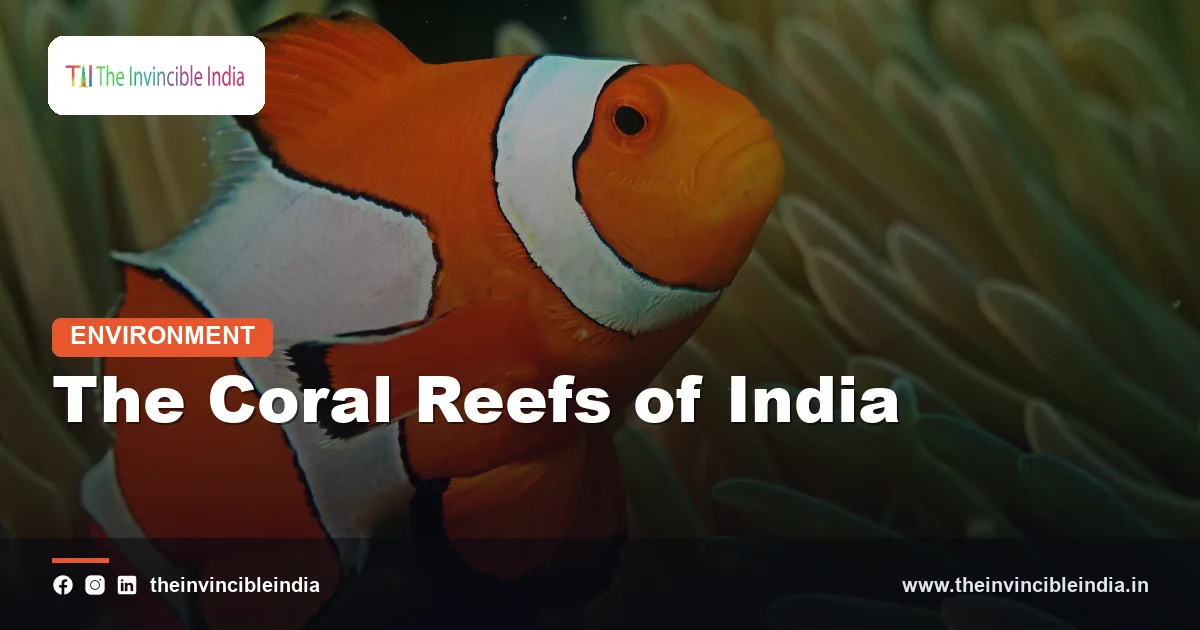
Beneath the warm, clear waters around the Indian coastline lies a world that most people never see: living cities of stone, colour and movement. The coral reefs of India are among the country’s richest natural treasures, sheltering thousands of marine species, shielding island communities from storms and quietly supporting the livelihoods of fishing families and tourism operators. Scientists often call coral reefs the “rainforests of the sea” because they pack an astonishing diversity of life into a tiny fraction of the ocean.
Yet these ecosystems are fragile. A rise of just a degree or two in sea temperature can push corals past their limits, and pollution, destructive fishing and coastal construction add further strain. This explainer walks through what coral reefs are, why they matter, where India’s reefs are found, the kinds of reef that occur here, the threats they face, and the laws and restoration efforts working to protect them.
| Quick Facts | Details |
|---|---|
| Nickname | “Rainforests of the sea” |
| Reef builders | Tiny coral polyps living in partnership with microscopic algae (zooxanthellae) |
| Four major reef regions in India | Gulf of Mannar, Gulf of Kutch, Lakshadweep, Andaman and Nicobar Islands |
| Reef types found in India | Fringing reefs, patch and platform reefs, and atolls |
| Northernmost major reefs | Gulf of Kutch, Gujarat |
| Richest and most diverse reefs | Andaman and Nicobar Islands |
| Main threat | Coral bleaching caused by marine heatwaves and climate change |
| Key legal protection | Wildlife (Protection) Act, 1972; Coastal Regulation Zone rules; Marine Protected Areas |
What Are Coral Reefs and How Do They Form?
A coral reef is not a single organism but an enormous community built over thousands of years by animals called coral polyps. A polyp is a small, soft-bodied creature, related to sea anemones and jellyfish, that sits in a hard cup of limestone (calcium carbonate) which it makes by drawing minerals from seawater. When a polyp dies, its skeleton stays behind, and new polyps settle on top. Generation after generation, these skeletons pile up and cement together, forming the solid framework we call a reef.
The partnership with algae
Reef-building corals live in a close partnership with microscopic algae called zooxanthellae, which live inside the coral’s tissue. The algae use sunlight to make food through photosynthesis and share much of it with the coral, while the coral provides shelter and nutrients in return. These algae also give corals their brilliant colours. This is why reef-building corals are found mostly in shallow, sunlit, clear and warm tropical seas, generally where the water stays above roughly 20 degrees Celsius.
Hard corals and soft corals
- Hard (stony) corals build the limestone skeleton and are the true architects of reefs.
- Soft corals and gorgonians have flexible bodies and add shape, colour and habitat but do not build the main reef structure.
- Associated life such as sponges, sea fans, anemones and coralline algae helps bind and decorate the reef.
Why Coral Reefs Matter: The Rainforests of the Sea
Coral reefs cover well under one per cent of the ocean floor, yet they are home to a very large share of all marine species, commonly estimated at around a quarter. Fish, crabs, molluscs, sea turtles, sharks, rays, sea cucumbers and countless invertebrates breed, feed and take shelter among the coral branches. This density of life is why reefs are compared to tropical rainforests.
Benefits to people
- Coastal protection: Reefs act as natural breakwaters. They absorb a large part of wave energy, reducing erosion and flood damage on coasts and low-lying islands.
- Fisheries and food: Many commercially valuable fish, lobsters and other seafood depend on reefs for breeding grounds and nurseries.
- Tourism and livelihoods: Snorkelling, scuba diving, glass-bottom boat rides and island tourism provide income for communities in the Andamans and Lakshadweep.
- Medicine and science: Reef organisms are studied for compounds with possible medical uses, and corals preserve records of past ocean conditions in their skeletons.
- Sand and land: Over time, broken coral and shells become the white sand of beaches, and in places form entire islands.
Reefs as health indicators
Because corals are so sensitive to temperature, light, clarity and water quality, they serve as early-warning indicators of the health of the wider ocean. When reefs decline, it usually signals deeper problems in the marine environment.
Types of Coral Reefs and Which Occur in India
Reefs are traditionally grouped into three main types, a classification that goes back to the nineteenth-century naturalist Charles Darwin, who proposed how one type can gradually grow into another as an island slowly sinks beneath the sea.
| Reef type | Description | Where in India |
|---|---|---|
| Fringing reef | Grows directly along the shore of an island or mainland, separated from land by a narrow, shallow channel at most | Andaman and Nicobar Islands; around many Gulf of Mannar islands |
| Barrier reef | Lies farther from shore, separated from land by a deeper, wider lagoon | Barrier-like stretches occur along parts of the Andaman and Nicobar group, though India has no reef on the scale of Australia’s Great Barrier Reef |
| Atoll | A ring-shaped reef enclosing a central lagoon, often built on a sunken volcanic base | Lakshadweep islands |
| Patch and platform reefs | Isolated, flat-topped or irregular reef patches in shallow water | Gulf of Kutch; Gulf of Mannar and Palk Bay |
India’s reef landscape is therefore varied. Lakshadweep offers classic ring-shaped atolls, the Andamans have extensive fringing reefs, and the gulfs along the mainland coast hold patchy, platform-style reefs that grow in more turbid, tide-swept waters.
India’s Four Major Coral Reef Regions
The coral reefs of India are concentrated in four principal regions, each with its own character, history and conservation story. Together they span the Arabian Sea, the Bay of Bengal and the waters off the southern tip of the peninsula.
| Region | State or Union Territory | Main reef character | Protected status |
|---|---|---|---|
| Gulf of Mannar | Tamil Nadu | Fringing and patch reefs around a chain of islands | Marine National Park and Biosphere Reserve |
| Gulf of Kutch | Gujarat | Patch and platform reefs; India’s northernmost | Marine National Park and Sanctuary |
| Lakshadweep | Union Territory of Lakshadweep | Atolls in the Arabian Sea | Parts under protection; coral sensitive zones |
| Andaman and Nicobar Islands | Union Territory | Fringing reefs, the richest and most diverse | Several Marine National Parks |
Gulf of Mannar: Reefs Along the Tamil Nadu Coast
The Gulf of Mannar lies between the southeastern tip of India and Sri Lanka. Off the coast of Tamil Nadu, a chain of around twenty islands stretches from Rameswaram to Thoothukudi, and coral reefs fringe and surround many of them. The Gulf of Mannar Marine National Park was established in 1982, and the wider area was declared a Biosphere Reserve in 1989, the first marine biosphere reserve in South and Southeast Asia.
What makes it special
- Its reefs and associated habitats of seagrass beds, mangroves and mudflats make it one of the most biologically rich coastal regions in the country.
- It shelters dugongs, sea turtles, dolphins, seahorses and a great variety of reef fish and molluscs.
- Dense coastal populations depend on its fisheries, which has historically led to heavy pressure from over-fishing, coral mining for lime and construction, and the use of destructive nets.
Because the people living beside the gulf rely so heavily on its resources, conservation here has increasingly focused on community participation and alternative livelihoods such as seaweed and sea-based enterprises.
Gulf of Kutch: India’s Northernmost Reefs
On the coast of Gujarat, the Gulf of Kutch holds the northernmost coral reefs in the country. Conditions here are tough: the gulf has some of the highest tidal ranges in India, murky water and wide swings in temperature and salinity. Even so, hardy corals have established patch and platform reefs around islands such as Pirotan, along with mangroves and mudflats rich in birdlife.
The area was among the earliest in India to receive marine protection. The Marine National Park and Sanctuary in the Gulf of Kutch, which covers numerous islands along the Jamnagar coast, was declared in the early 1980s and is often described as the first marine national park in India. The reefs here are less diverse than those of the Andamans, with fewer coral species, but their northerly location makes them scientifically valuable for studying how corals cope with extreme conditions.
Pressures in this region include industrial development, shipping and pollution from the busy Gujarat coast, as well as coral extraction and sedimentation, making careful management essential.
Lakshadweep: Islands Built on Coral
Lakshadweep, in the Arabian Sea off the Kerala coast, is a Union Territory made up of tiny islands that are almost entirely products of coral. Most of its land consists of atolls, ring-shaped reefs enclosing calm lagoons, with the islands themselves formed from coral debris piled up over many centuries. Lakshadweep is the only region in India dominated by atoll-type reefs.
Reefs and island life
- The reefs form the foundation of the islands, supplying sand, protecting shorelines and nurturing the lagoon fisheries, especially tuna, on which communities depend.
- Lagoon waters and clear conditions attract visitors for diving and water sports, which supports a growing but carefully regulated tourism sector.
- Because the islands lie only a few metres above sea level, the health of the reef is directly tied to island survival and to the threat of sea-level rise.
Lakshadweep’s reefs were severely hit by the 1998 global bleaching event, which caused widespread coral death, and have shown a slow, uneven recovery since. They remain one of the most closely watched reef systems in the country.
Andaman and Nicobar Islands: The Richest Reefs
The Andaman and Nicobar Islands, scattered across the Andaman Sea and the Bay of Bengal, hold the most extensive and diverse coral reefs in India. The surrounding waters are relatively clear, and the reefs grow mainly as fringing reefs along island shores, supporting a very large number of hard coral species along with a huge variety of fish and other marine life, comparable to the diversity of Southeast Asian reefs.
Protected areas and attractions
- Mahatma Gandhi Marine National Park, near Wandoor in the Andamans, protects a group of islands and their reefs and was established in the early 1980s.
- Rani Jhansi Marine National Park protects further reef and mangrove habitat in the Ritchie’s Archipelago area.
- Popular dive and snorkel sites in the archipelago draw tourists from across the world, making reefs a major contributor to the local economy.
The islands’ remoteness has helped to keep many reefs in better condition than those on the crowded mainland coast, but they are not immune. They have faced bleaching, the effects of the 2004 tsunami, and growing visitor numbers.
Other Reefs and Newly Recorded Sites
Beyond the four main regions, smaller and patchier reefs occur at several points along the mainland coast, and survey work continues to turn up new records.
- Malvan, Maharashtra: A marine sanctuary along the Konkan coast protects scattered coral communities and rocky habitats near shore.
- Gulf of Khambhat, Gujarat: Some small coral patches have been reported in this tidal, sediment-heavy gulf.
- Palk Bay and the Tamil Nadu coast: Reef patches extend north of the Gulf of Mannar towards Palk Bay.
- Karnataka and Goa: Isolated coral communities have been documented around offshore islands such as Netrani, popular with divers.
- Offshore banks and the east coast: Researchers have recorded coral communities in deeper waters and along parts of the Bay of Bengal coast, showing that India’s reef inventory is still being refined.
These smaller sites are usually less diverse than the major reefs, but they add to the country’s marine natural heritage and often receive less formal protection.
Coral Bleaching: The Biggest Threat
The most serious danger to coral reefs worldwide, including the coral reefs of India, is coral bleaching. When seawater stays unusually warm for an extended period, corals become stressed and expel the zooxanthellae living in their tissue. Without the algae, the coral loses both its main food source and its colour, turning pale or white, which is why the process is called bleaching.
What bleaching does
A bleached coral is not yet dead, and if temperatures fall quickly enough it can recover by regaining its algae. But if the heat persists, the coral starves and dies, and the reef framework is gradually overgrown by algae and eroded. Marine heatwaves, driven by long-term warming of the oceans due to climate change and made worse in certain years by the El Nino climate pattern, are the main trigger.
Major bleaching events
- 1998: A strong El Nino produced the first truly global bleaching event, and Indian reefs, especially in Lakshadweep, the Andamans and the Gulf of Mannar, suffered heavy losses.
- 2010: Another widespread warming episode caused significant bleaching in the Andaman and Nicobar Islands and other Indian reef areas.
- 2014 to 2017: A prolonged global event, with severe heat stress reported in 2016, again affected Indian reefs.
- Later events: Further global bleaching episodes in the early 2020s have underlined that these heatwaves are becoming more frequent, leaving reefs less time to recover.
Other Threats to India’s Reefs
Heat stress rarely acts alone. Corals that are already weakened by other pressures are far less able to survive a warm spell.
- Ocean acidification: The ocean absorbs part of the carbon dioxide released by human activity, becoming slightly more acidic. This makes it harder for corals to build their calcium carbonate skeletons.
- Pollution and nutrient runoff: Sewage, agricultural runoff and industrial waste feed algae that smother corals and cloud the water.
- Sedimentation: Dredging, port construction and land clearing wash silt onto reefs, blocking sunlight needed by zooxanthellae.
- Destructive fishing: Dynamite or blast fishing, bottom trawling and fine-mesh nets damage the reef structure and deplete reef fish that keep algae in check.
- Coastal development and coral mining: Reefs have been quarried for lime and building material in the past, and construction along shores increases pressure.
- The 2004 tsunami: The Indian Ocean tsunami of December 2004 physically damaged reefs in the Andaman and Nicobar Islands through debris, sediment and shifting land levels.
- Crown-of-thorns starfish: Population outbreaks of this coral-eating starfish can strip large areas of live coral.
- Unregulated tourism: Anchoring, trampling and careless diving can break fragile corals.
Legal Protection, Restoration and Global Frameworks
India protects its reefs through a mix of area-based protection, species protection and coastal regulation.
Marine Protected Areas
Marine National Parks and Sanctuaries, such as those in the Gulf of Kutch, the Gulf of Mannar and the Andaman and Nicobar Islands, limit damaging activities within their boundaries. The Gulf of Mannar’s Biosphere Reserve status adds a wider management framework that recognises the needs of local communities.
Wildlife law
Under the Wildlife (Protection) Act, 1972, corals are listed in the Schedules that give them legal protection, and collecting, trading or damaging them is an offence. Black coral, hard corals and several other groups receive the strongest level of protection. Restrictions on trade in stony corals also exist under the international CITES treaty, which India has joined.
Coastal Regulation Zone rules
The Coastal Regulation Zone (CRZ) notifications classify coral reefs and their surroundings as ecologically sensitive areas, placing strict limits on construction, dredging and waste disposal near them. These rules are meant to keep development away from the most vulnerable coastal habitats.
Restoration and research
Alongside protection, India has begun to actively repair damaged reefs and to build scientific knowledge about them.
- Coral transplantation: Fragments of healthy coral are attached to artificial frames or degraded patches so that they can grow and re-establish reef cover. Projects of this kind have been tried in the Gulf of Mannar and elsewhere.
- Artificial reefs: Structures placed on the seabed give corals and fish new surfaces to settle on.
- Research bodies: Institutions such as the Zoological Survey of India, the Central Marine Fisheries Research Institute, the National Centre for Coastal Research and various universities monitor reef health, map species and test restoration methods.
- Community engagement: Fisher communities are trained and offered alternative incomes so that pressure on reefs falls.
International commitments
India takes part in international frameworks that cover reef conservation, including the Convention on Biological Diversity, CITES, the International Coral Reef Initiative and the global climate commitments under the Paris Agreement. Protecting marine life is also part of the United Nations Sustainable Development Goal 14, “Life Below Water”.
Conclusion
The coral reefs of India are living infrastructure: they feed communities, protect shores, draw visitors and hold a major part of the nation’s marine biodiversity. Their biggest challenge is the warming of the oceans, which no single reserve or law can solve alone. Local action such as cleaner coasts, regulated fishing and sensible tourism helps reefs stay healthy enough to withstand heat, but ultimately the long-term fate of reefs depends on cutting the greenhouse gas emissions that drive climate change. Protecting these underwater rainforests is therefore both a conservation goal and an investment in India’s coastal future. 1 October 2026
Frequently Asked Questions
Where are the main coral reefs in India?
India’s coral reefs are concentrated in four regions: the Gulf of Mannar in Tamil Nadu, the Gulf of Kutch in Gujarat, the Lakshadweep islands in the Arabian Sea, and the Andaman and Nicobar Islands. Smaller reef patches also occur at places such as Malvan in Maharashtra and around Netrani Island in Karnataka.
Which region has the richest coral reefs in India?
The Andaman and Nicobar Islands have the most extensive and diverse coral reefs in India. Their clear waters and fringing reefs support a very wide range of hard corals, fish and other marine organisms.
What is coral bleaching and why does it happen?
Coral bleaching happens when corals under heat stress expel the colourful algae living in their tissue, leaving them white. It is mainly caused by marine heatwaves linked to climate change and El Nino years. If the stress lasts too long, the coral starves and dies.
What kinds of coral reefs are found in India?
India has fringing reefs, notably in the Andaman and Nicobar Islands and around the Gulf of Mannar islands, atolls in Lakshadweep, and patch or platform reefs in the Gulf of Kutch and Gulf of Mannar. Reefs here are generally smaller and less continuous than the vast barrier reefs found in places like Australia.
How are coral reefs protected in India?
They are protected through Marine National Parks and Sanctuaries, the Wildlife (Protection) Act, 1972, which lists corals as protected, and the Coastal Regulation Zone rules that treat reefs as ecologically sensitive. Restoration work such as coral transplantation and the monitoring done by research institutions add further support.
Why do coral reefs matter to people?
Reefs protect coastlines from waves and erosion, provide breeding grounds for fish that feed coastal communities, support tourism and diving income, and act as early indicators of ocean health. For low-lying islands like those in Lakshadweep, reefs literally form and defend the land.
{“@context”:”https://schema.org”,”@graph”:[{“@type”:”FAQPage”,”mainEntity”:[{“@type”:”Question”,”name”:”Where are the main coral reefs in India?”,”acceptedAnswer”:{“@type”:”Answer”,”text”:”India’s coral reefs are concentrated in four regions: the Gulf of Mannar in Tamil Nadu, the Gulf of Kutch in Gujarat, the Lakshadweep islands in the Arabian Sea, and the Andaman and Nicobar Islands. Smaller reef patches also occur at places such as Malvan in Maharashtra and around Netrani Island in Karnataka.”}},{“@type”:”Question”,”name”:”Which region has the richest coral reefs in India?”,”acceptedAnswer”:{“@type”:”Answer”,”text”:”The Andaman and Nicobar Islands have the most extensive and diverse coral reefs in India. Their clear waters and fringing reefs support a very wide range of hard corals, fish and other marine organisms.”}},{“@type”:”Question”,”name”:”What is coral bleaching and why does it happen?”,”acceptedAnswer”:{“@type”:”Answer”,”text”:”Coral bleaching happens when corals under heat stress expel the colourful algae living in their tissue, leaving them white. It is mainly caused by marine heatwaves linked to climate change and El Nino years. If the stress lasts too long, the coral starves and dies.”}},{“@type”:”Question”,”name”:”What kinds of coral reefs are found in India?”,”acceptedAnswer”:{“@type”:”Answer”,”text”:”India has fringing reefs, notably in the Andaman and Nicobar Islands and around the Gulf of Mannar islands, atolls in Lakshadweep, and patch or platform reefs in the Gulf of Kutch and Gulf of Mannar. Reefs here are generally smaller and less continuous than the vast barrier reefs found in places like Australia.”}},{“@type”:”Question”,”name”:”How are coral reefs protected in India?”,”acceptedAnswer”:{“@type”:”Answer”,”text”:”They are protected through Marine National Parks and Sanctuaries, the Wildlife (Protection) Act, 1972, which lists corals as protected, and the Coastal Regulation Zone rules that treat reefs as ecologically sensitive. Restoration work such as coral transplantation and the monitoring done by research institutions add further support.”}},{“@type”:”Question”,”name”:”Why do coral reefs matter to people?”,”acceptedAnswer”:{“@type”:”Answer”,”text”:”Reefs protect coastlines from waves and erosion, provide breeding grounds for fish that feed coastal communities, support tourism and diving income, and act as early indicators of ocean health. For low-lying islands like those in Lakshadweep, reefs literally form and defend the land.”}}]}]}