


The Dashavatara are the ten avatars, or incarnations, of the great god Vishnu, one of the most beloved and profound concepts in Hindu tradition. According to this teaching, Vishnu, the preserver of the universe, descends to earth in various forms whenever righteousness declines and evil threatens the world, in order to restore the moral order and protect the good. The ten principal avatars, from the fish that saved the world in a great flood to the future avatar yet to come, form a fascinating sequence, and among them are the beloved figures of Rama and Krishna. Rich in myth, meaning and symbolism, the Dashavatara express the profound idea of the divine descending to save the world. This guide explores the concept of the avatar and the ten great incarnations of Vishnu.
Quick Facts
| Detail | Information |
|---|---|
| Meaning | Dashavatara means the ten avatars |
| Deity | The incarnations of Vishnu, the preserver |
| Concept | The divine descending to restore righteousness |
| The beloved avatars | Rama and Krishna are among the ten |
| The sequence | From Matsya, the fish, to Kalki, yet to come |
| Significance | The promise that the divine acts to save the world |
The Ten Avatars of Vishnu
The Dashavatara, meaning the ten avatars, are the ten principal incarnations of the great god Vishnu, one of the most beloved and important concepts in Hindu religion and mythology. According to this teaching, Vishnu, the preserver and protector of the universe, takes birth on earth in various forms across the ages to restore righteousness and protect the world whenever evil threatens to overwhelm it. The ten avatars form a fascinating and meaningful sequence, ranging from animal forms to human and divine figures, and including the beloved incarnations of Rama and Krishna. Rich in story, symbolism and spiritual meaning, the Dashavatara are among the most cherished and significant concepts of Hindu tradition and a central part of the worship of Vishnu.
The Concept of the Avatar
Central to the Dashavatara is the profound concept of the avatar, the descent of the divine into the world in a particular form. The word avatar means a descent, and it refers to the incarnation of a deity, above all Vishnu, who takes birth on earth to accomplish a divine purpose. The idea is beautifully expressed in the teaching that whenever righteousness declines and unrighteousness rises, the divine takes form and comes into the world to restore the moral order, to protect the good and to destroy evil. This concept of the avatar, of the divine descending into the world to save it, is one of the most profound and beloved ideas in Hinduism, and it lies at the heart of the Dashavatara.
Why Vishnu Descends
The purpose of the avatars of Vishnu is to restore righteousness and protect the world in times of crisis, when evil and unrighteousness threaten to overwhelm the moral order. According to the teaching, whenever dharma, righteousness, declines and adharma, unrighteousness, rises, Vishnu takes form and descends to earth to set things right, to protect the good, to destroy the forces of evil, and to re-establish the moral order of the world. Each of the avatars comes at such a time of crisis to accomplish this divine purpose. This understanding of why Vishnu descends, to save the world and restore righteousness in times of crisis, gives the avatars their meaning and expresses the reassuring belief that the divine acts to protect the world and uphold the good.
Matsya, the Fish
The first of the ten avatars is Matsya, the fish, in which Vishnu took the form of a great fish to save the world and its wisdom from a catastrophic flood. According to the myth, Matsya warned a righteous man of a coming deluge that would engulf the world and guided him to safety, preserving the seeds of life and the sacred knowledge through the flood so that the world could be renewed afterwards. The story of Matsya, the divine fish who saves the world from the flood, is the first in the sequence of avatars, coming at the very beginning of the cycle. As the saviour of the world and its wisdom from the great flood, Matsya is a beloved and significant first avatar of Vishnu.
Kurma, the Tortoise
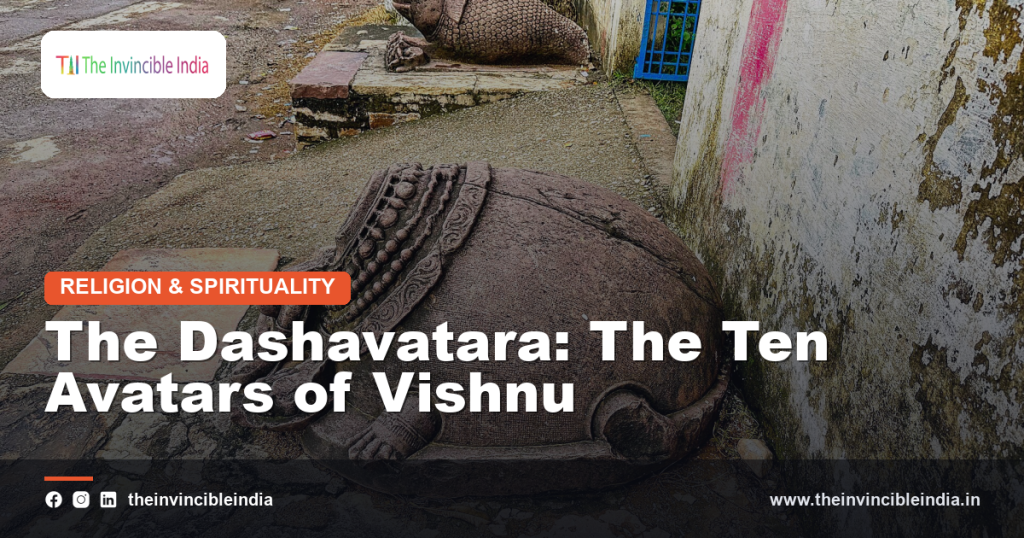
The second avatar is Kurma, the tortoise, in which Vishnu took the form of a great tortoise to support the churning of the cosmic ocean. According to the myth, when the gods and demons churned the ocean to obtain the nectar of immortality, using a great mountain as the churning rod, Vishnu became a tortoise and bore the mountain on his back to support it during the churning, making the great task possible. The story of Kurma, the divine tortoise who upholds the churning of the ocean, is a significant episode in the mythology of the avatars, connected to the great story of the churning of the ocean. As the supporter of the cosmic churning, Kurma is an important avatar of Vishnu in the sequence of the Dashavatara.
Varaha, the Boar
The third avatar is Varaha, the boar, in which Vishnu took the form of a mighty boar to rescue the earth from the depths of the cosmic ocean. According to the myth, when a demon dragged the earth down beneath the waters, Vishnu became a great boar, dived into the ocean, and lifted the earth back to safety on his tusks, saving the world and destroying the demon. The story of Varaha, the divine boar who rescues the earth, is a powerful episode in the mythology of the avatars, expressing the divine as the saviour and lifter of the world. As the rescuer of the earth from the cosmic ocean, Varaha is a significant and beloved avatar of Vishnu among the ten.
Narasimha, the Man-Lion
The fourth avatar is Narasimha, the man-lion, in which Vishnu took a fierce form, half man and half lion, to destroy a terrible demon and protect his devotee. According to the myth, a powerful demon had gained a boon that made him nearly invincible, but Vishnu, taking the form of Narasimha, neither fully man nor fully beast, was able to overcome the terms of the boon and destroy the demon, saving his devoted follower, the demon’s own son. The story of Narasimha, the fierce man-lion who destroys the demon and protects his devotee, is one of the most dramatic and beloved of the avatar myths, expressing the divine as the protector of the faithful and the destroyer of evil.
Vamana, the Dwarf
The fifth avatar is Vamana, the dwarf, in which Vishnu took the form of a small brahmin to humble a mighty king and restore the balance of the world. According to the myth, when a powerful king had gained dominion over the three worlds, Vishnu came to him as a dwarf and asked for as much land as he could cover in three steps; when the request was granted, Vamana grew to a cosmic size and covered the worlds in his strides, restoring the proper order. The story of Vamana, the dwarf who becomes cosmic and reclaims the worlds, is a beloved and meaningful avatar myth, expressing the divine humbling of pride and the restoration of the cosmic balance.
Parashurama
The sixth avatar is Parashurama, a warrior sage who took up arms to rid the world of tyranny and injustice. According to tradition, Parashurama, a brahmin bearing an axe, appeared at a time when the warrior rulers had become arrogant and oppressive, and he acted to destroy the tyrannical and unrighteous and to restore the moral order. He is regarded as a fierce and powerful avatar who upheld righteousness against oppression. The story of Parashurama, the warrior sage who cleanses the world of tyranny, is a significant avatar in the sequence, expressing the divine as the destroyer of injustice and oppression and the defender of righteousness. As a fierce upholder of dharma, Parashurama holds an important place among the ten avatars of Vishnu.
Rama
The seventh avatar is Rama, the beloved prince and hero of the great epic the Ramayana, one of the most cherished of all the incarnations of Vishnu. Rama is revered as the ideal man and the embodiment of righteousness, whose story of exile, the rescue of his wife Sita, and the triumph over the demon king Ravana is beloved throughout India and has shaped its values and imagination for thousands of years. As an avatar, Rama came to destroy the evil Ravana and to restore righteousness, and he is worshipped as a supreme deity in his own right. The avatar of Rama, the righteous prince and hero of the Ramayana, is one of the most beloved and important of the Dashavatara and a central figure of Hindu devotion.
Krishna
The eighth avatar is Krishna, one of the most beloved and profound of all the incarnations of Vishnu, whose life and teachings are cherished throughout India. Krishna is revered as the enchanting divine cowherd, the playful and miraculous child, the lover of the gopis, the great teacher who delivers the Bhagavad Gita, and the divine guide of the Mahabharata, and he is worshipped as a supreme deity in his own right. As an avatar, Krishna came to destroy evil, protect the good and teach the path to the divine. The avatar of Krishna, at once the beloved divine child and lover and the supreme teacher of the Gita, is one of the most cherished and significant of the Dashavatara and one of the most beloved forms of the divine in all of Hinduism.
The Ninth Avatar
The ninth avatar is understood in different ways in different traditions, reflecting the richness and variety of the tradition. In many accounts, the ninth avatar is the Buddha, the great teacher whose incarnation is understood in various ways within the tradition, while in other accounts a different figure, such as Balarama, the brother of Krishna, is counted as the ninth avatar. This variation in the identity of the ninth avatar reflects the different regional and sectarian traditions within Hinduism and the way the concept of the avatars developed over time. Whatever the identity assigned to it, the ninth avatar holds its place in the sequence of the Dashavatara, and the variation itself is an interesting aspect of the rich tradition of the ten avatars of Vishnu.
Kalki, the Avatar to Come
The tenth and final avatar is Kalki, the avatar who is yet to come, who will appear at the end of the present age to destroy evil and restore righteousness, ushering in a new age. According to the tradition, in the far future, when unrighteousness and evil have overwhelmed the world at the end of the present dark age, Vishnu will descend as Kalki, often depicted as a warrior on a white horse, to destroy the wicked, end the age of darkness, and inaugurate a new age of righteousness. The avatar of Kalki, the saviour yet to come, is the final incarnation in the sequence of the Dashavatara, expressing the hope of the ultimate triumph of righteousness and the renewal of the world at the end of the age.
A Meaningful Sequence
The sequence of the ten avatars, from the fish to the future saviour, has been seen as carrying deep meaning, and some have found in it a fascinating progression. The avatars begin with forms from the water and the animal world, move through part-animal and then fully human forms, and culminate in the avatar yet to come, a progression that some have compared to an unfolding or evolution of forms. Whether or not such interpretations were intended, the sequence of the avatars, from the aquatic Matsya to the fully human and divine Rama and Krishna and the future Kalki, forms a meaningful and fascinating whole. This ordered sequence of the ten avatars, and the meanings that have been found in it, is one of the intriguing aspects of the Dashavatara.
The Avatars in Art and Culture
The Dashavatara have inspired a rich heritage of art, literature, dance and devotion across India, their stories beloved and their forms depicted in countless works. The ten avatars are portrayed in temple sculpture and painting, celebrated in poetry and song, enacted in dance and drama, and worshipped in devotion, and the stories of the avatars, above all of Rama and Krishna, are among the most beloved in all of Indian culture. The theme of the Dashavatara is a favourite subject of Indian art. This rich presence of the avatars in the art, literature and devotional life of India reflects the deep love and importance of the concept, and the Dashavatara remain a cherished and inspiring theme of Indian culture and religion.
The Meaning of the Avatars
The concept of the Dashavatara carries a profound and reassuring meaning, expressing the belief that the divine is not remote and indifferent but acts in the world to protect the good and uphold righteousness. The teaching that Vishnu descends whenever righteousness declines assures the devotee that the divine will always come to save the world and restore the moral order in times of crisis, and it expresses a vision of the divine as compassionate, active and protecting. This profound meaning, of the divine descending into the world to save it and uphold righteousness, is at the heart of the Dashavatara and is one of the most beautiful and reassuring teachings of Hinduism, offering hope and comfort to the devotee in the promise of divine protection.
The Dashavatara Today
Today the Dashavatara remain among the most beloved and significant concepts of Hindu tradition, their stories cherished, their forms worshipped, and their meaning treasured across India and the Hindu world. The avatars, above all the beloved Rama and Krishna, are worshipped with deep devotion, their stories retold in every generation and their images honoured in temples and homes, while the concept of the avatar continues to express the profound belief in the divine descending to save the world. The theme continues to inspire art, literature and devotion. As the ten incarnations of Vishnu, the great preserver, descending across the ages to restore righteousness, the Dashavatara endure as a cherished and profound part of the religious and cultural heritage of India.
Sources & Further Reading
- Ministry of Culture, Government of India, on the religious traditions and mythology of India (indiaculture.gov.in).
- The Puranas and the epics, the classical sources of the avatar tradition.
Frequently Asked Questions
What is the Dashavatara?
The Dashavatara, meaning the ten avatars, are the ten principal incarnations of the god Vishnu, the preserver, who descends to earth in various forms whenever righteousness declines, in order to restore the moral order and protect the world. They include the beloved Rama and Krishna.
What is an avatar?
An avatar is the descent or incarnation of a deity into the world in a particular form. The word means a descent, and it refers above all to the incarnations of Vishnu, who takes birth on earth to restore righteousness and protect the world in times of crisis.
What are the ten avatars of Vishnu?
The ten avatars are traditionally Matsya the fish, Kurma the tortoise, Varaha the boar, Narasimha the man-lion, Vamana the dwarf, Parashurama the warrior sage, Rama, Krishna, a ninth avatar understood variously, and Kalki, the avatar yet to come.
Why does Vishnu take avatars?
Vishnu takes avatars to restore righteousness and protect the world in times of crisis. According to the teaching, whenever righteousness declines and evil rises, Vishnu descends to earth to protect the good, destroy the forces of evil and re-establish the moral order.
Who is Kalki?
Kalki is the tenth and final avatar of Vishnu, the avatar yet to come, who will appear at the end of the present age to destroy evil and restore righteousness, often depicted as a warrior on a white horse, ushering in a new age of righteousness.