


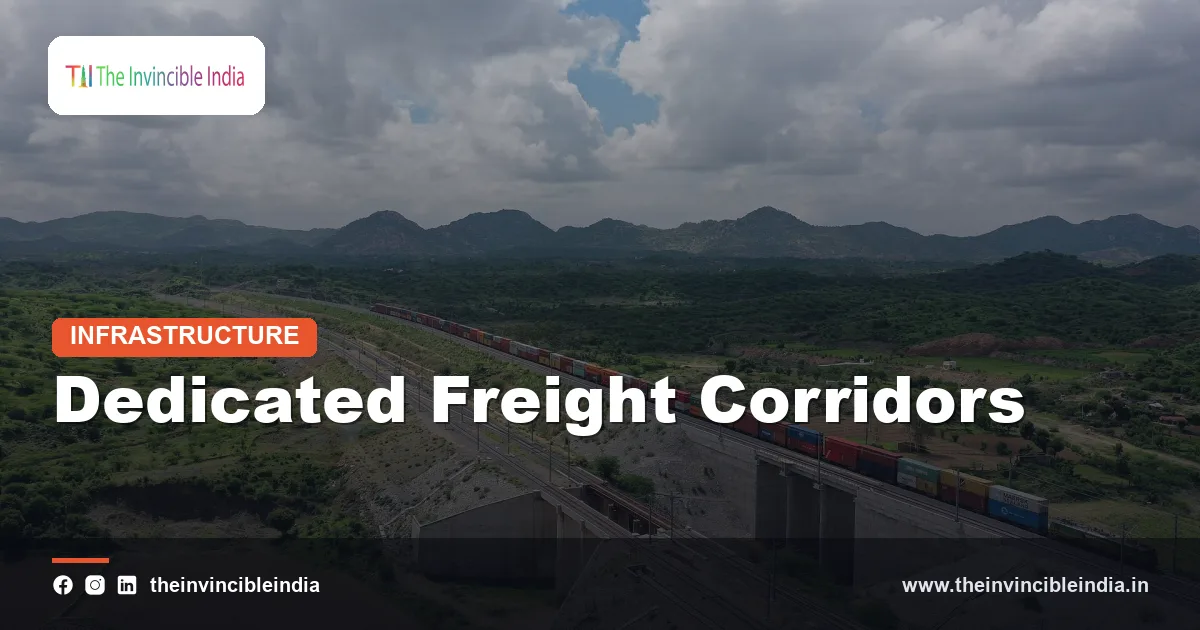
India moves an enormous amount of coal, steel, cement, food grains, fertiliser and containers by rail every day, and for decades almost all of it ran on the same tracks as passenger trains. Dedicated Freight Corridors (DFCs) are Indian Railways’ answer to that bottleneck: purpose-built, high-capacity railway lines that carry only goods trains, leaving the older network free for passengers. They are among the largest railway infrastructure projects the country has attempted since Independence.
This explainer covers why India needed Dedicated Freight Corridors, who builds them, how the Eastern and Western corridors differ, what makes the technology different from an ordinary railway line, what benefits are expected for logistics costs and industry, and where the programme stands now. Figures are approximate and dated, because project lengths and commissioning status have changed over the years. 1 October 2026
Quick Facts
| Item | Detail |
|---|---|
| What it is | High-capacity railway lines used exclusively for freight trains |
| Implementing agency | Dedicated Freight Corridor Corporation of India Limited (DFCCIL) |
| DFCCIL set up | 2006, as a special purpose vehicle under the Ministry of Railways |
| Eastern DFC | Ludhiana (Punjab) towards Sonnagar (Bihar) and Dankuni near Kolkata; roughly 1,800 km in the original plan |
| Western DFC | Dadri (near Delhi) to Jawaharlal Nehru Port near Mumbai; roughly 1,500 km |
| Main funding | World Bank (Eastern); Japan’s JICA (Western); balance from the Government of India |
| Key technology | Heavier axle loads, longer trains, electric traction and double-stack container operation on the Western corridor |
| Policy link | PM Gati Shakti National Master Plan and the National Logistics Policy |
Why India Needed Dedicated Freight Corridors
Indian Railways is one of the largest rail networks in the world, but its traffic is highly concentrated. The four metro cities are joined by a set of trunk routes, popularly known as the Golden Quadrilateral and its diagonals: Delhi, Mumbai, Chennai and Kolkata, plus the links between them. These routes make up only a small fraction of the total route length, yet they carry a disproportionately large share of both passenger and freight traffic.
By the early 2000s many of these sections were running at or beyond their rated capacity. When a line is saturated, every extra train makes the whole timetable more fragile, and a single delay can cascade for hundreds of kilometres.
The problem of mixed traffic
The core difficulty was that very different kinds of trains shared the same tracks:
- Express and mail trains travelling at relatively high speeds.
- Suburban and local passenger services on busy approaches to big cities.
- Slow, heavy goods trains that often had to wait in loops while faster trains passed.
Passenger trains have fixed timetables and political and social priority, so freight trains were routinely held back. Average freight speeds stayed low, wagon turnaround times were long, and customers had little certainty about when cargo would arrive. Adding more passenger trains was nearly impossible without squeezing freight further, and the reverse was also true.
Rail losing ground to road
As the economy grew and manufacturing and port traffic expanded, unreliable rail freight pushed many shippers towards trucks. Road transport is flexible and door-to-door, but it is more expensive per tonne-kilometre over long distances, uses more fuel and adds to congestion and emissions. The Railways’ share of national freight fell over the decades, which was a key reason planners began looking for a structural, rather than incremental, fix.
What Exactly Is a Dedicated Freight Corridor?
A Dedicated Freight Corridor is a separate pair of railway tracks laid largely alongside, but not shared with, the existing passenger network. It is designed from the start around the needs of freight rather than adapted from lines built in the colonial era. The corridor has its own stations, crossing points, signalling and control centres, and it is meant to carry only goods trains.
The idea is not simply “more track”. It is a fresh set of design standards, which allows trains that are heavier, longer and faster than anything the legacy network could take, running to a precise schedule without having to give way to passenger services.
Key design features
- Separate alignment: new tracks, bridges and embankments, built to modern geometry with gentle curves and gradients.
- Limited crossings: road and rail crossings are grade-separated wherever possible, with overbridges and underpasses to avoid delays.
- Dedicated terminals: inland container depots, freight terminals and junction stations designed for rapid loading and unloading.
- Centralised control: modern signalling and control rooms to manage train movements along the line.
DFCCIL: The Body Behind the Project
The Dedicated Freight Corridor Corporation of India Limited (DFCCIL) was set up in 2006 as a special purpose vehicle under the Ministry of Railways, registered as a company under the Companies Act. Creating a separate corporation allowed the project to be managed with its own professional structure, to raise and handle large multilateral loans, and to focus entirely on delivering the corridors rather than competing for attention with day-to-day railway operations.
DFCCIL’s responsibilities include planning and surveys, land acquisition coordination with state governments, civil construction, track laying, electrification, signalling and telecommunications. After construction, it also has a role in operating and maintaining the corridors, with Indian Railways providing the rolling stock in the form of wagons and locomotives in many cases.
Land and the engineering challenge
Building a new line across several states means acquiring large strips of land, crossing rivers, canals, highways and existing railway lines, and coordinating with many local authorities. Land acquisition and clearances were among the most time-consuming parts of the programme, which is one reason why the original completion targets slipped well beyond the first estimates.
The Two Main Corridors: Eastern and Western
The Eastern Dedicated Freight Corridor
The Eastern DFC runs along the northern and eastern industrial belt of the country. In the original plan it stretched from Ludhiana in Punjab to Dankuni, near Kolkata in West Bengal, passing through Haryana, Uttar Pradesh, Bihar and Jharkhand. Key stops and junction areas on the route include Khurja, Kanpur, Prayagraj and the Pt. Deen Dayal Upadhyaya (Mughalsarai) area, before reaching Sonnagar in Bihar.
It is sometimes described in two main portions: the long stretch from Ludhiana to Sonnagar, built with World Bank financing, and the final eastern section from Sonnagar towards Dankuni, which was taken up separately and followed a different implementation path.
What the Eastern corridor carries
The Eastern DFC runs through the coal, steel and power heartland of India. Its traffic is dominated by bulk commodities:
- Coal from mines in Jharkhand, Odisha and nearby regions to thermal power stations in the north.
- Iron and steel products, iron ore and cement.
- Food grains and fertiliser moving between producing and consuming states.
- Other bulk cargo for the many industrial clusters of the Gangetic plains.
Because the Eastern corridor mainly serves heavy bulk cargo rather than containers, its design emphasises heavy axle loads and long trains, rather than double-stack container operation.
The Western Dedicated Freight Corridor
The Western DFC links the national capital region to the country’s biggest container gateway. It runs from Dadri in Uttar Pradesh, near Delhi, to the Jawaharlal Nehru Port (JNPT) at Navi Mumbai, a distance of roughly 1,500 km. On the way it passes through Haryana, Rajasthan, Gujarat and Maharashtra, with key points around Rewari, Palanpur, Mehsana, Ahmedabad, Vadodara, Bharuch and Surat.
Japan’s international development agency, JICA, provided major financing for this corridor, and Japanese technical expertise has been part of the project. The corridor also connects to the ports of Gujarat, such as Mundra, Pipavav and Kandla, through feeder connections.
Link to the Delhi-Mumbai Industrial Corridor
The Western DFC is closely tied to the Delhi-Mumbai Industrial Corridor (DMIC), a planned belt of industrial regions, investment zones and smart cities developed along the same general alignment. The idea is that a high-capacity freight spine will make it easier for manufacturers, warehouses and logistics parks to set up near the corridor and ship goods quickly to ports and markets.
Eastern vs Western DFC at a Glance
The two corridors share the same basic concept but serve different parts of the economy. The comparison below summarises the main differences, with lengths given as approximate figures.
| Feature | Eastern DFC | Western DFC |
|---|---|---|
| Route | Ludhiana (Punjab) to Sonnagar, extending towards Dankuni near Kolkata | Dadri (near Delhi) to Jawaharlal Nehru Port, Mumbai |
| Approximate length | Around 1,300 km to Sonnagar; around 1,800 km with the Dankuni section | Around 1,500 km |
| States covered | Punjab, Haryana, Uttar Pradesh, Bihar, Jharkhand, West Bengal | Uttar Pradesh, Haryana, Rajasthan, Gujarat, Maharashtra |
| Main cargo | Coal, steel, cement, food grains, fertiliser | Containers, including double-stack, plus other goods for port-bound trade |
| Principal financier | World Bank | Japan’s JICA |
| Key linkage | Coal fields, power plants and the steel belt | Western ports and the Delhi-Mumbai Industrial Corridor |
Technical Advantages of the Corridors
The real difference between a DFC and a normal railway line lies in its engineering standards. These allow much more cargo to move per train and per day.
Heavier loads and longer trains
Dedicated Freight Corridors are built to carry a higher axle load than most of the older network, meaning each wagon can carry more cargo without damaging the track. Trains on the corridors are also planned to be much longer than the standard freight rake, with lengths of well over a kilometre, which means that a single locomotive crew can move far more tonnage.
Double-stack container trains
One of the most visible features of the Western DFC is its ability to run double-stack container trains, in which containers are stacked two high on specially designed flat wagons. This nearly doubles the number of containers carried per train. To make this possible, overhead electric wires are raised much higher than on conventional lines, and bridges and tunnels are built to a larger clearance. Double-stack operations are common in some other large countries, but they were not possible on most of the old Indian network because of limited height.
Speed and electrification
The corridors are electrified, so trains can be hauled by powerful electric locomotives rather than diesel engines. With fewer stoppages for passing passenger trains and with modern signalling, average freight speeds can rise significantly above the slow averages seen on mixed lines. Faster, more predictable transit times matter as much to shippers as headline speed.
Benefits for the Economy and Logistics Costs
India’s logistics costs, which include transport, warehousing, inventory and handling, are generally estimated to be higher as a share of GDP than in many advanced economies. Policy documents have repeatedly set a goal of bringing them down towards the levels seen in the best-performing countries. Dedicated Freight Corridors are one of the main tools for that.
- Lower cost per tonne-kilometre: heavier, longer trains and electric traction spread costs over more cargo.
- Faster and more reliable delivery: predictable transit times allow industry to hold lower inventories.
- Better port connectivity: quicker movement of containers between ports and inland markets improves export competitiveness.
- Industrial development: warehouses, logistics parks and manufacturing clusters tend to develop along high-capacity freight lines, creating jobs.
- Higher railway revenue: winning back freight from roads improves the finances of the national transporter.
Modal Shift and Passenger Capacity
From road to rail
A major goal of the programme is modal shift, meaning the movement of cargo from trucks to trains. Rail is generally more fuel-efficient than road for long-distance bulk freight and produces significantly lower greenhouse gas emissions per tonne-kilometre. Shifting a meaningful share of freight to electrified rail reduces diesel consumption, road congestion and accidents on busy highways.
India’s national rail planning documents have set the ambition of raising the Railways’ share of freight over the coming years. Whether the target is met will depend on how well the corridors are connected to factories, mines and ports through first-mile and last-mile links, and on pricing and service quality that can compete with trucking.
Freeing capacity for passenger trains
The benefits are not limited to goods. By moving the slowest and heaviest trains to their own tracks, the corridors release capacity on the old lines. That space can be used to run more passenger services, to improve punctuality and to introduce faster trains.
Modern semi-high-speed trains such as the Vande Bharat Express benefit from lines that are less congested, since they can maintain higher average speeds when they are not constantly slowed by slower traffic. In that sense, a project designed for freight can also help passengers, which is one of the less obvious but important arguments in its favour.
A timeline in brief
- 2006: DFCCIL is incorporated to plan and build the corridors.
- Late 2000s: the Eastern and Western corridors are approved and detailed planning begins.
- 2010s: funding agreements, land acquisition and civil works progress in stages, with delays.
- Around 2020 onwards: the first sections are commissioned on both corridors, and double-stack container services begin on the Western DFC.
- 2020s: further sections are completed and brought into service, while work on the remaining stretches continues.
Current Status and Future Corridors
The Eastern and Western corridors are largely commissioned, with most sections operational, although a few stretches and connections have taken longer than planned, and the status of the final links has continued to change over time. Readers should check the latest DFCCIL and Ministry of Railways updates for the exact kilometres in service.
Proposed new corridors
Planners have studied additional corridors to extend the network to other parts of the country. These typically include:
- East-West corridor: linking Kolkata towards Mumbai through central India.
- North-South corridor: linking Delhi towards Chennai.
- East Coast corridor: running along the eastern seaboard, for example from the Kharagpur region towards Vijayawada.
These are at different stages of study and approval, and none should be assumed to be certain until formally sanctioned and funded.
PM Gati Shakti and the National Logistics Policy
The corridors now fit within a broader national logistics strategy. PM Gati Shakti, launched in October 2021, is a digital master plan that brings together railways, roads, ports, airports and other infrastructure agencies on a shared platform, so that projects can be planned jointly rather than in isolation. It identifies priority railway programmes including corridors for energy, minerals and cement, for port connectivity and for high-traffic-density routes.
The National Logistics Policy, announced in September 2022, aims to reduce logistics costs, improve efficiency and strengthen coordination across ministries and states. Dedicated Freight Corridors act as the high-capacity backbone for these efforts, while Gati Shakti and the policy create the planning and regulatory environment around them.
Challenges and the Road Ahead
Large projects face real obstacles, and the DFCs are no exception.
- Delays and cost overruns: land acquisition, environmental and forest clearances, and crossings with existing lines slowed progress.
- Traffic building up: a corridor is only useful if enough cargo uses it, which depends on pricing, wagon availability and terminals.
- First-mile and last-mile connectivity: goods must reach the corridor from factories and leave it for the final destination.
- Diversifying cargo: especially on the Eastern corridor, where coal dominates, bringing in more diverse and time-sensitive freight will improve the economics.
Even so, the direction is clear. Over the coming decades the corridors are expected to reshape how goods move across the country, and to be the model for the next generation of rail infrastructure.
Conclusion
Dedicated Freight Corridors represent a shift in how India thinks about railways: instead of squeezing more traffic onto an ageing shared network, the country has built separate, modern lines optimised for goods. The Eastern corridor serves the coal and steel belt, the Western corridor serves the container trade linked to the ports and the Delhi-Mumbai Industrial Corridor, and both aim to cut costs, speed up deliveries and make freight greener. Their ultimate success will be judged by traffic volumes, reliability and how well they connect with the rest of the logistics system.
Frequently Asked Questions
What are Dedicated Freight Corridors in India?
Dedicated Freight Corridors are separate, high-capacity railway lines built only for goods trains. They run alongside the existing passenger network but do not share its tracks, so freight no longer has to wait for passenger trains and can move heavier loads at more predictable speeds.
Which agency builds and runs the DFCs?
The Dedicated Freight Corridor Corporation of India Limited (DFCCIL), set up in 2006 under the Ministry of Railways, plans and builds the corridors and has a role in operating and maintaining them. Indian Railways works alongside it for rolling stock and connections to the wider network.
What are the two main corridors?
The Eastern DFC runs from Ludhiana in Punjab towards Sonnagar in Bihar and Dankuni near Kolkata, mainly carrying coal, steel and food grains. The Western DFC runs from Dadri near Delhi to Jawaharlal Nehru Port near Mumbai and mainly carries containers.
Who funded the Eastern and Western corridors?
The Eastern DFC received substantial financing from the World Bank, while the Western DFC received major financing from Japan’s JICA, with the Government of India contributing the balance. The Western corridor is also linked to the Delhi-Mumbai Industrial Corridor.
How do the DFCs help passenger trains?
By shifting slow, heavy goods trains onto their own tracks, the corridors free up space on the older lines. Railways can then run more passenger services, improve punctuality and operate faster trains such as Vande Bharat more smoothly.
Are more freight corridors planned?
Yes, new corridors such as East-West, North-South and East Coast have been studied. They are at different stages of planning, and the National Logistics Policy and PM Gati Shakti provide the broader framework for deciding which projects move forward.
{“@context”:”https://schema.org”,”@graph”:[{“@type”:”FAQPage”,”mainEntity”:[{“@type”:”Question”,”name”:”What are Dedicated Freight Corridors in India?”,”acceptedAnswer”:{“@type”:”Answer”,”text”:”Dedicated Freight Corridors are separate, high-capacity railway lines built only for goods trains. They run alongside the existing passenger network but do not share its tracks, so freight no longer has to wait for passenger trains and can move heavier loads at more predictable speeds.”}},{“@type”:”Question”,”name”:”Which agency builds and runs the DFCs?”,”acceptedAnswer”:{“@type”:”Answer”,”text”:”The Dedicated Freight Corridor Corporation of India Limited (DFCCIL), set up in 2006 under the Ministry of Railways, plans and builds the corridors and has a role in operating and maintaining them. Indian Railways works alongside it for rolling stock and connections to the wider network.”}},{“@type”:”Question”,”name”:”What are the two main corridors?”,”acceptedAnswer”:{“@type”:”Answer”,”text”:”The Eastern DFC runs from Ludhiana in Punjab towards Sonnagar in Bihar and Dankuni near Kolkata, mainly carrying coal, steel and food grains. The Western DFC runs from Dadri near Delhi to Jawaharlal Nehru Port near Mumbai and mainly carries containers.”}},{“@type”:”Question”,”name”:”Who funded the Eastern and Western corridors?”,”acceptedAnswer”:{“@type”:”Answer”,”text”:”The Eastern DFC received substantial financing from the World Bank, while the Western DFC received major financing from Japan’s JICA, with the Government of India contributing the balance. The Western corridor is also linked to the Delhi-Mumbai Industrial Corridor.”}},{“@type”:”Question”,”name”:”How do the DFCs help passenger trains?”,”acceptedAnswer”:{“@type”:”Answer”,”text”:”By shifting slow, heavy goods trains onto their own tracks, the corridors free up space on the older lines. Railways can then run more passenger services, improve punctuality and operate faster trains such as Vande Bharat more smoothly.”}},{“@type”:”Question”,”name”:”Are more freight corridors planned?”,”acceptedAnswer”:{“@type”:”Answer”,”text”:”Yes, new corridors such as East-West, North-South and East Coast have been studied. They are at different stages of planning, and the National Logistics Policy and PM Gati Shakti provide the broader framework for deciding which projects move forward.”}}]}]}