


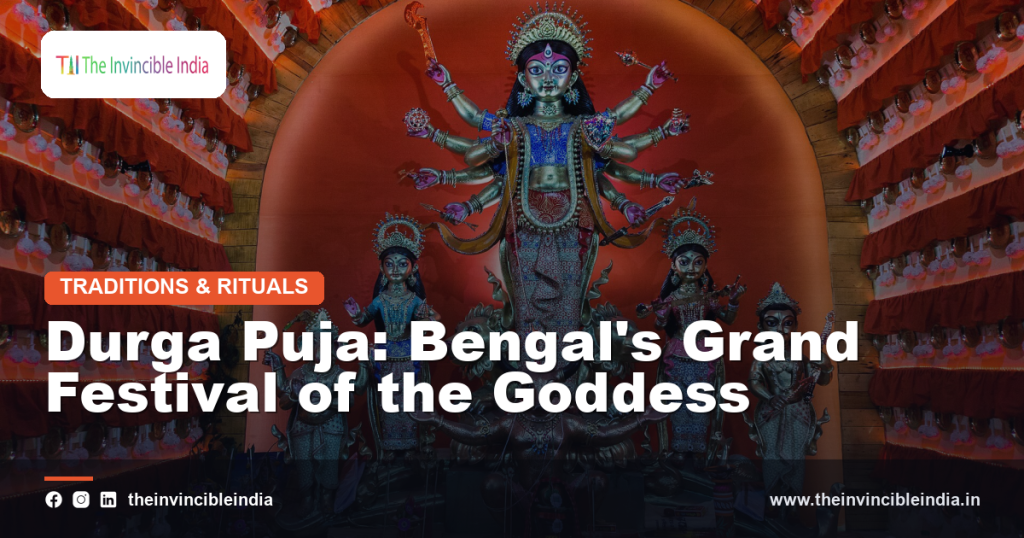
Durga Puja is one of the grandest and most magnificent festivals of India, the great celebration of the Goddess Durga observed with extraordinary splendour and devotion, above all in Bengal. Honouring the Goddess and her victory over a terrible demon, the festival transforms cities and towns into a spectacle of art, devotion and joy, with magnificent temporary structures housing beautifully crafted images of the Goddess, and days of worship, culture and celebration. A time of homecoming, community and festivity as well as devotion, Durga Puja has been recognised by UNESCO as a treasure of the intangible heritage of humanity. This guide explores the meaning, the magnificent pandals and idols, the days of the festival, the immersion and the heritage of Durga Puja, one of the most spectacular of India’s traditions.
Quick Facts
| Detail | Information |
|---|---|
| Type | A grand festival of the Goddess Durga |
| Celebrated in | Bengal above all, and beyond |
| Honours | The Goddess and her victory over the demon |
| Features | Magnificent pandals and beautifully crafted idols |
| Culmination | The immersion of the idols |
| Heritage | Recognised by UNESCO as intangible cultural heritage |
The Grand Festival of the Goddess
Durga Puja is one of the grandest and most magnificent festivals of India, the great celebration of the Goddess Durga, observed with extraordinary splendour, devotion and joy, above all in Bengal, where it is the greatest festival of the year. During the festival, the worship of the Goddess is combined with a spectacular display of art, culture, community and celebration, transforming the region into a festival of beauty and devotion. It is a time of worship, homecoming, festivity and joy for millions. As the grand festival of the Goddess Durga, celebrated with magnificent splendour and deep devotion, Durga Puja holds a place of the highest importance among the festivals of India and is the great cultural and religious festival of Bengal.
The Worship of Durga
At the heart of Durga Puja is the worship of the Goddess Durga, the mighty Divine Feminine who embodies the power of the divine to destroy evil and protect the world. The festival honours Durga as the supreme power and the loving mother, and it celebrates above all her great victory over a terrible demon, a story that expresses the triumph of good over evil. During the festival, the Goddess is worshipped with devotion, ritual and celebration. This worship of the Goddess Durga, honouring her power, her grace and her victory over evil, is the spiritual heart of the festival and connects Durga Puja to the great tradition of the worship of the Divine Feminine in India.
The Victory over the Demon
Durga Puja celebrates the great story of the Goddess Durga’s victory over a terrible demon, a tale that embodies the triumph of good over evil and lies at the heart of the festival. According to the sacred story, the demon could not be defeated by the gods, and so the Goddess was created from their combined powers and, after a mighty battle, destroyed the demon and saved the world, a victory celebrated with joy and devotion during the festival. This story gives the festival its deeper meaning. This celebration of the Goddess’s victory over the demon, embodying the triumph of good over evil, is central to the meaning of Durga Puja and a source of its spiritual power and its message of hope and righteousness.
The Magnificent Pandals
One of the most spectacular features of Durga Puja is the pandals, the magnificent temporary structures built to house the images of the Goddess and to serve as places of worship and celebration. These pandals, often elaborately designed and beautifully decorated, range from the traditional to the strikingly creative and artistic, and their design and decoration are a major part of the festival, with communities vying to create the most beautiful and impressive. Visiting the pandals is a cherished part of the celebration. These magnificent pandals, elaborately designed and beautifully decorated to house the images of the Goddess, are one of the most spectacular and beloved features of Durga Puja and a great expression of the art and creativity of the festival.
The Beautiful Idols
At the centre of the pandals are the beautifully crafted images, or idols, of the Goddess Durga, created by skilled artisans and depicting the Goddess in her glory, often slaying the demon. These images, lovingly crafted from clay and richly decorated and adorned, are works of great artistry and devotion, and they are the focus of the worship and celebration of the festival. The making of the idols is a traditional craft, and the beauty of the images is much admired. These beautiful idols of the Goddess Durga, crafted with great artistry and devotion and richly adorned, are the sacred centre of the festival and the focus of its worship, and their beauty is one of the most cherished aspects of Durga Puja.
The Making of the Idols
The creation of the images of the Goddess is a traditional craft, practised by skilled artisans who make the idols from clay in a process that is itself an important part of the festival. In particular, a famous district of artisans is renowned for crafting the images of the Goddess, working with great skill and devotion to create the beautiful idols that will be worshipped during the festival. The making of the idols, from the shaping of the clay to the final decoration, is a cherished tradition. This making of the idols of the Goddess by skilled artisans, a traditional craft carried out with great skill and devotion, is an important and beautiful part of Durga Puja and reflects the artistry and craftsmanship that go into the festival.
The Days of the Festival
Durga Puja unfolds over several days, each with its own rituals, worship and significance, building to the climax of the festival. The main days of the festival, from the sixth day to the tenth, are marked by the ceremonial worship of the Goddess, by rituals, cultural programmes and celebration, and by the gathering of families and communities, culminating in the immersion of the idols on the final day. Each day has its special observances and adds to the unfolding of the festival. This progression through the days of the festival, each with its own rituals and significance, gives Durga Puja its structure and its unfolding drama, from the worship of the Goddess to the joyous celebration and the final immersion.
Worship and Ritual
Durga Puja is marked by elaborate worship and ritual, carried out with devotion during the days of the festival to honour the Goddess. The ceremonial worship includes the offering of prayers, flowers, food and light to the Goddess, the performance of traditional rituals, and moments of special devotion and ceremony, conducted with care and reverence. These rituals are at the heart of the festival’s religious observance. This elaborate worship and ritual, carried out with devotion to honour the Goddess during the days of the festival, is the religious heart of Durga Puja and expresses the deep devotion that underlies the splendour and celebration of the festival.
A Festival of Art and Culture
Durga Puja is not only a religious festival but a great celebration of art and culture, in which the creativity, artistry and cultural life of the community are given magnificent expression. The elaborate pandals and beautiful idols are works of art, and the festival is accompanied by cultural programmes, music, performances and creativity of many kinds, making it a great cultural as well as religious occasion. The artistic dimension of the festival is one of its glories. This character as a festival of art and culture, in which the creativity and cultural life of the community find magnificent expression alongside the worship of the Goddess, is one of the most remarkable and beloved aspects of Durga Puja and a great celebration of the culture of Bengal.
A Time of Homecoming
Durga Puja is a time of homecoming, community and joy, when families come together and communities celebrate, and the festival brings a special spirit of togetherness and festivity. People return home to be with their families, dress in new and festive clothes, visit the pandals, enjoy the celebrations, and share in the joy of the festival, and the whole community is caught up in the festive spirit. This dimension of homecoming and togetherness is central to the experience of the festival. This character of Durga Puja as a time of homecoming, community and joy, when families gather and communities celebrate together, is one of the most cherished aspects of the festival and part of what makes it so beloved and eagerly awaited each year.
The Immersion
Durga Puja culminates in the immersion of the idols of the Goddess in a river or body of water, a moving ceremony that brings the festival to its close on the final day. After the days of worship and celebration, the images of the Goddess are carried in grand and emotional processions to the water, where they are immersed, symbolising the Goddess’s return to her divine abode and her husband’s home. The immersion is a moment of both celebration and poignancy, as the community bids farewell to the Goddess. This immersion of the idols, a moving and emotional ceremony that brings the festival to its close, is one of the most poignant and significant moments of Durga Puja, symbolising the departure of the Goddess after the days of her worship and celebration.
A UNESCO Heritage
In recognition of its extraordinary cultural and artistic significance, Durga Puja, as celebrated in Kolkata and beyond, has been inscribed by UNESCO on its Representative List of the Intangible Cultural Heritage of Humanity. This recognition honours the festival as a living tradition of great cultural, artistic and social importance, celebrating its magnificent art, its community spirit and its role in the cultural life of Bengal, and it affirms its value not only to India but to the heritage of all humanity. This UNESCO recognition underlines the global significance of Durga Puja. This inscription by UNESCO as an intangible cultural heritage of humanity is a great honour that reflects the extraordinary cultural and artistic significance of Durga Puja and its importance as a treasure of world heritage.
A Celebration Beyond Bengal
While Durga Puja is above all the great festival of Bengal, it is also celebrated with devotion and joy by Bengali communities and others across India and around the world, wherever they have settled. The festival has spread far beyond its Bengal heartland, and Bengali communities in cities across India and in many countries organise their own celebrations, complete with pandals, idols and cultural programmes, keeping the tradition alive far from home. This spread of the festival reflects its importance to the Bengali community and its wide appeal. This celebration of Durga Puja beyond Bengal, by communities across India and around the world, reflects the deep importance of the festival to the Bengali community and the way it has carried this magnificent tradition wherever its people have gone.
Durga Puja Today
Today Durga Puja remains one of the grandest and most magnificent festivals of India, the great celebration of the Goddess observed with extraordinary splendour, devotion and joy in Bengal and among Bengali communities around the world. The magnificent pandals and beautiful idols, the worship and ritual, the art and culture, the homecoming and community, and the moving immersion all continue to be cherished, and the festival’s recognition as a UNESCO heritage has brought it further honour. In its magnificent combination of deep devotion to the Goddess and spectacular art, culture and celebration, Durga Puja endures as one of the most beloved and spectacular festivals of India.
Sources & Further Reading
- UNESCO, Representative List of the Intangible Cultural Heritage of Humanity, on Durga Puja in Kolkata (ich.unesco.org).
- Ministry of Culture, Government of India, on the festivals of India (indiaculture.gov.in).
Frequently Asked Questions
What is Durga Puja?
Durga Puja is a grand festival of the Goddess Durga, celebrated with extraordinary splendour and devotion, above all in Bengal. It honours the Goddess and her victory over a terrible demon, and features magnificent pandals, beautiful idols, worship, art and community celebration.
What are pandals in Durga Puja?
Pandals are the magnificent temporary structures built during Durga Puja to house the images of the Goddess and serve as places of worship and celebration. Often elaborately designed and beautifully decorated, they are a spectacular and beloved feature of the festival.
What happens at the end of Durga Puja?
Durga Puja culminates in the immersion of the idols of the Goddess in a river or body of water on the final day. The images are carried in grand processions to the water and immersed, symbolising the Goddess’s return to her divine abode, in a moving and emotional ceremony.
Is Durga Puja recognised by UNESCO?
Yes. Durga Puja, as celebrated in Kolkata and beyond, has been inscribed by UNESCO on its Representative List of the Intangible Cultural Heritage of Humanity, in recognition of its extraordinary cultural, artistic and social significance.
Where is Durga Puja celebrated?
Durga Puja is above all the great festival of Bengal, but it is also celebrated with devotion and joy by Bengali communities and others across India and around the world, wherever they have settled, complete with pandals, idols and cultural programmes.