


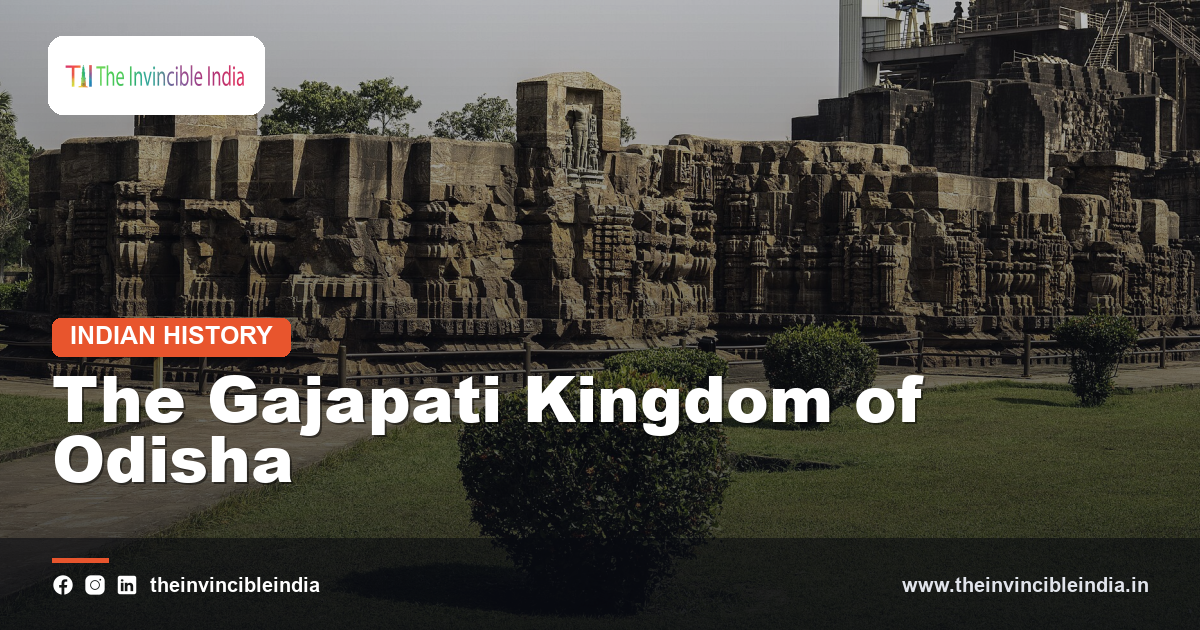
The Gajapati kingdom was a major regional power that rose to prominence in Odisha, on India’s eastern coast, during the medieval period, ruling over a territory that at times extended into neighbouring regions of eastern India. Emerging in an era when powers such as the Vijayanagara Empire dominated large parts of the southern peninsula, the Gajapati rulers built a distinct regional identity centred on Odisha’s temple traditions, coastal trade and cultural patronage. The dynasty is closely associated with the continued development of the Jagannath temple tradition in Puri and with significant architectural and artistic achievements across the region. Its rulers navigated a complex political landscape shaped by relations with neighbouring kingdoms, leaving behind a legacy closely tied to Odisha’s cultural and religious heritage today.
Quick Facts
| Detail | Information |
|---|---|
| Region | Odisha, eastern India |
| Period | Medieval era |
| Known for | Temple patronage and regional power |
| Associated site | Jagannath Temple, Puri |
| Religious tradition | Vaishnavism and Jagannath worship |
| Legacy | Odisha’s temple architecture and culture |
Origins of the Gajapati Kingdom
The Gajapati kingdom traces its origins to the medieval period in Odisha, emerging as a powerful regional dynasty that consolidated control over the area after earlier ruling houses had governed the region in preceding centuries. The title Gajapati, meaning lord of elephants, came to be closely associated with the rulers of this dynasty and reflected both a claim to martial strength and a broader tradition of royal titulature used by powerful monarchs in the region.
Odisha’s long history of earlier kingdoms and its established traditions of temple building and religious patronage provided a foundation upon which the Gajapati rulers built their own authority, combining military strength with close association with prominent religious institutions, a defining feature of Gajapati rule throughout its history.
Rise to Regional Power
The Gajapati rulers rose to regional prominence by asserting control over Odisha and expanding their influence into neighbouring areas, positioning the kingdom as one of the notable regional powers of eastern India during the medieval period. Their consolidation of power involved both military campaigns and the cultivation of alliances, a combination common among ambitious regional dynasties of the era.
As the kingdom grew stronger, its rulers increasingly presented themselves as protectors of Odisha’s religious institutions, particularly those connected with the worship of Jagannath at Puri, reinforcing their legitimacy through this close religious association and building a stable base of support within Odisha while projecting influence beyond its core territory.
Extent of Gajapati Territory
At various points during its history, the Gajapati kingdom extended its authority well beyond the core region of Odisha, reaching into parts of neighbouring territories along India’s eastern coast. The kingdom’s geographic reach fluctuated over time, expanding under strong rulers and contracting during periods of external pressure or internal difficulty, a pattern common to many regional kingdoms of the period.
Its coastal location gave the kingdom access to maritime trade routes, while its inland territories included agriculturally productive land that supported the kingdom’s economy and administration, placing it in contact, and at times competition, with other regional powers seeking influence over the same trade routes.
Administration and Governance
Governance under the Gajapati kings combined centralised royal authority with structures that allowed for local administration across the kingdom’s varied territories. As with many medieval Indian states, the king stood at the apex of the administrative system, supported by officials responsible for revenue collection, military organisation and the maintenance of order across different regions.
Temples, particularly the major religious institutions associated with Jagannath worship, also played an important administrative and economic role, managing significant landholdings and resources granted through royal patronage, a close relationship reflecting the deep integration of religious institutions into the kingdom’s political and economic life.
The Gajapatis and the Jagannath Tradition
The Gajapati dynasty is closely associated with the continued development and patronage of the Jagannath temple tradition centred at Puri, one of the most important centres of pilgrimage and worship in eastern India. Gajapati rulers took on a special role in relation to this tradition, combining political authority with religious devotion and service to the deity, a relationship that became a defining feature of the dynasty’s identity.
This close association helped strengthen the legitimacy of Gajapati rule by linking the monarchy directly to one of the most revered religious institutions in the region, and royal patronage helped sustain and expand its religious and cultural significance throughout the period.
Patronage of Temple Building
Beyond their association with the Jagannath tradition, Gajapati rulers were notable patrons of temple building and religious architecture more broadly across Odisha, contributing to the region’s rich tradition of temple construction. Royal patronage supported the maintenance, expansion and adornment of religious structures, reflecting both piety and a desire to project royal authority through visible acts of religious devotion.
Temples built or supported during this period often featured the distinctive architectural style associated with Odisha, characterised by towering spires and richly decorated exteriors, helping sustain skilled communities of architects, sculptors and craftsmen whose work contributed to Odisha’s broader artistic heritage.
Connection to Odisha's Temple Legacy
Odisha’s celebrated tradition of temple architecture, exemplified by monuments such as the Sun Temple at Konark, forms an important backdrop to the cultural environment in which the Gajapati kingdom flourished. While such landmark structures were associated with the region’s broader temple-building tradition across different periods, the architectural and artistic conventions they embodied continued to influence temple construction during the Gajapati era.
Craftsmen and architects working under Gajapati patronage drew on established regional styles, contributing to the continuity of Odisha’s distinctive temple architecture across successive dynasties, a legacy that extended well before and after the Gajapati period itself.
Relations with Neighbouring Powers
The Gajapati kingdom maintained a complex web of relationships with neighbouring powers, including dynasties to its south and west, marked at various times by conflict, alliance and diplomatic engagement. Its position along the eastern coast placed it in contact with other significant regional states of the period, and interactions with these neighbours shaped the kingdom’s fortunes, sometimes expanding its influence and at other times testing its resources.
Diplomatic marriages, military campaigns and periods of relative peace all featured in the kingdom’s dealings with its neighbours, illustrating the Gajapati kingdom’s position as an active participant in the wider political landscape of medieval India.
Military History and Conflicts
Military strength was an important foundation of Gajapati authority, supporting both the kingdom’s expansion and its ability to defend its territory against rival powers. Armies of the period typically combined infantry, cavalry and war elephants, the latter closely tied to the very title associated with the dynasty’s rulers.
Campaigns undertaken by Gajapati kings extended the kingdom’s influence at various points, while defensive efforts were required to repel incursions from neighbouring states seeking to expand at Odisha’s expense, a pattern of regional warfare characteristic of a period in which territorial control often shifted with the fortunes of individual campaigns and rulers.
Trade and the Coastal Economy
The Gajapati kingdom’s economy drew on a combination of agricultural production from its fertile inland territories and trade conducted through its access to the eastern coastline. Coastal ports under the kingdom’s control would have facilitated exchange with other regions, supporting the movement of goods along maritime routes that connected different parts of the subcontinent and beyond.
Agricultural surplus from the kingdom’s productive lands supported both the general population and the resources needed to maintain an army, administration and extensive temple establishments, illustrating the close connection between economic strength and cultural achievement during this period.
Art, Literature and Court Culture
The Gajapati period is remembered as a time of notable cultural activity in Odisha, with royal patronage extending to literature, performing arts and religious scholarship alongside temple architecture. Court culture under the Gajapati kings supported poets, scholars and artists whose work contributed to the region’s literary and artistic traditions.
Religious devotion associated with the Jagannath tradition also inspired artistic and literary expression, including works exploring devotional themes that remained influential in the region’s cultural life well beyond the Gajapati period itself, reflecting a broader pattern of rulers seeking prestige through cultural achievement.
Religious Life under the Gajapatis
Religious life under the Gajapati kings centred significantly on the worship of Jagannath, a form of Vaishnava devotion that held particular importance in Odisha and attracted patronage and participation across different levels of society. Royal support for this tradition extended beyond temple construction to include the maintenance of rituals, festivals and religious institutions associated with the deity.
Alongside this central devotional tradition, other religious practices and institutions also existed within the kingdom, reflecting the broader diversity of religious life in medieval Odisha and shaping a distinctive regional religious identity that has persisted well beyond the dynasty’s political existence.
Notable Rulers of the Dynasty
Several rulers of the Gajapati dynasty are remembered in regional historical tradition for their contributions to the kingdom’s political strength, religious patronage and cultural achievements. Accounts of these rulers, drawn from a combination of inscriptions, temple records and later historical writing, describe efforts to expand and defend the kingdom’s territory alongside sustained support for religious and cultural institutions.
While specific details about individual rulers vary in reliability across different sources, the broader picture is one of a dynasty whose leadership combined military capability with a strong commitment to religious patronage, sustaining the kingdom’s prominence for a considerable period.
Decline of the Kingdom
Like many regional kingdoms of medieval India, the Gajapati dynasty eventually experienced a decline in its political fortunes, a process shaped by a combination of internal challenges and pressure from neighbouring and emerging powers. Succession difficulties, shifting alliances and the rising strength of rival states in the surrounding region all contributed to a gradual weakening of centralised Gajapati authority over time.
As the kingdom’s political power diminished, control over Odisha and its surrounding territories eventually passed to other ruling powers, though the cultural and religious institutions associated with the Gajapati period continued to hold significance well beyond the dynasty’s political existence.
Historical Significance
The historical significance of the Gajapati kingdom lies both in its role as a major regional power in medieval eastern India and in its lasting contribution to Odisha’s religious and cultural identity. As a kingdom that combined military strength with substantial religious and artistic patronage, it exemplifies broader patterns seen across medieval Indian regional states.
Historians studying the period draw on inscriptions, temple records and architectural evidence to reconstruct the kingdom’s history, given the limitations of surviving textual sources, and this combination of political, religious and cultural significance ensures the kingdom retains an important place in the study of medieval Indian history.
The Gajapati Legacy Today
The Gajapati legacy today is most visibly preserved in Odisha’s temple traditions, particularly the continuing prominence of Jagannath worship at Puri, which remains one of the most significant centres of pilgrimage in India. Temples and religious institutions associated with the dynasty’s patronage continue to function as active centres of worship, drawing visitors and devotees to this day.
Historians and scholars of Odisha’s regional history continue to study the Gajapati period for its contributions to political administration, temple architecture and religious life, and the dynasty remains a significant chapter in the layered history that continues to shape Odisha’s identity today.
Sources & Further Reading
- Ministry of Culture, Government of India (indiaculture.gov.in).
- Archaeological Survey of India (asi.nic.in).
Frequently Asked Questions
What was the Gajapati kingdom?
It was a major medieval regional power based in Odisha, on India’s eastern coast, known for its military strength and close association with temple traditions.
What does the title Gajapati mean?
The title translates roughly to lord of elephants and was used by the rulers of this Odisha-based dynasty.
How is the dynasty connected to the Jagannath temple?
Gajapati rulers were closely associated with the Jagannath tradition at Puri, serving as patrons and protectors of its rituals and institutions.
What is the kingdom remembered for today?
It is remembered chiefly for its temple patronage, contribution to Odisha’s architectural heritage, and lasting association with Jagannath worship.
Why did the kingdom eventually decline?
A combination of succession difficulties, shifting alliances and pressure from rising neighbouring powers gradually weakened centralised Gajapati authority.