


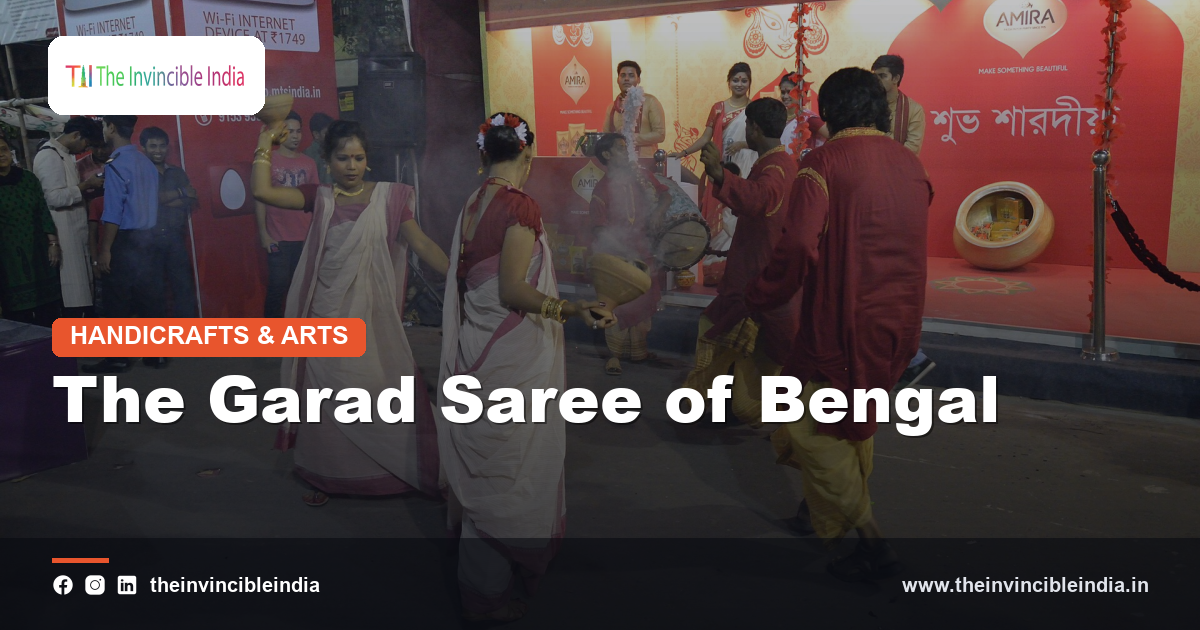
Few garments say as much about Bengali culture as the Garad saree, a graceful silk with a pale body and a bold red border. It is worn for pujas, weddings and family rituals, and it has long symbolised purity, auspiciousness and quiet elegance. Woven in the silk-rearing districts of West Bengal, the Garad belongs to a rich regional heritage that also includes the celebrated Baluchari saree and the cool cotton tant. Its close cousin, the Korial, shares much of the same spirit. This guide looks at the origins, materials, weaving, design, ritual meaning and care of the Garad saree.
Quick Facts
| Detail | Information |
|---|---|
| Craft | Handwoven silk saree |
| Region | West Bengal |
| Fibre | Pure silk |
| Traditional look | Off-white body with a red border |
| Related cloth | Korial silk saree |
| Typical use | Pujas, weddings and ceremonies |
The Garad Saree in Bengali Life
In Bengal, the Garad saree is more than a piece of clothing; it is a cultural symbol. Its pale body and red border are recognised at once, and the garment is especially associated with Durga Puja, Lakshmi Puja, weddings and other auspicious occasions. Women of several generations may wear a Garad saree for the same ritual, which gives the textile a strong feeling of continuity.
The saree is admired for its simplicity. It does not rely on dense ornament or heavy weight but on the beauty of fine silk, a clean border and proportion. Its place in Bengali life shows how a modest design can acquire profound meaning when it is tied to ritual, memory and the shared customs of a community.
Silk Traditions of Bengal
Bengal has a long tradition of silk cultivation and weaving, centred in districts such as Murshidabad and areas around Bishnupur. Mulberry silk farming, the reeling of cocoons and the weaving of silk fabrics have supported many families, and the region became known for cloth of high quality that found buyers far beyond its borders.
The Garad saree emerges from this background of sericulture and skilled craftsmanship. The soft, lustrous silk of the region gives the saree its characteristic feel, and the techniques used to process and weave it have been refined across generations. The Garad is thus one expression of a wider silk culture that has shaped the economy and aesthetic life of the Bengal countryside.
Understanding Garad and Korial
The names Garad and Korial are often mentioned together, and they are closely related. Both are traditional Bengali silk sarees associated with ritual wear, and both are prized for their soft texture and simple, dignified appearance. Distinctions between the two are usually explained in terms of their weave, finish and traditional uses, though the terms can be applied with slight variation from place to place.
In general, the Garad is recognised by its pale body and its red border, often a solid band at the edge. The Korial is a related silk with its own traditions of weaving and finishing. Readers who wish to be precise are best advised to ask the weaver or seller how the terms are used locally, since regional usage may differ.
Origins and Historical Roots
Since the exact origins of the Garad saree are not documented in a single authoritative account, it is best to describe its history in general terms. Silk weaving in Bengal is ancient in character, and the region’s weavers produced fine textiles that were valued in local courts and trading networks. The Garad developed as a practical and ritual garment within this environment.
Its form, a pale ground with a red edge, reflects the colour symbolism widely found across Indian tradition, where white suggests purity and red stands for auspiciousness and life. Over time the saree became associated with specific family ceremonies, and its form remained remarkably steady. The history of the Garad is therefore also a history of custom, where the garment and the ritual shaped one another.
Raw Silk, Degumming and Preparation
The making of a Garad saree begins with silk thread. After cocoons are reeled, the thread may be degummed to remove sericin, the natural gum that coats raw silk and makes it stiff. Degumming gives the yarn its soft and shining quality, and the degree of treatment affects how the finished cloth feels and drapes.
Once the yarn is ready, it is twisted, dyed where needed and wound for weaving. The border colour, most often red, is prepared separately so that it remains strong and even. This preparation requires patience and judgement, because the softness of the final saree depends on how carefully the silk is handled, and small errors at this stage can affect the entire fabric.
Weaving on the Handloom
Garad sarees are traditionally woven on handlooms by skilled artisans. The weaver arranges the warp on the loom, selects the weft and passes the shuttle through the shed in a steady rhythm, forming the fabric thread by thread. A clean, even border is one of the marks of quality, and it must be woven with consistent tension so that the edge lies flat.
Because the body of the saree is usually plain or lightly patterned, there is little room to hide flaws, and technical skill is obvious in the finish. The finished cloth is typically soft, light and comfortable to wear. The care taken on the loom explains why a well-woven Garad can be worn for many years while retaining its fluid, graceful drape.
The Red Border and Its Symbolism
The red border of the Garad saree is its most recognisable feature and carries strong symbolic meaning. In many Indian traditions red stands for auspiciousness, marriage and the power of the feminine, and it is used widely in sacred and festive contexts. Against the white or cream body, the border forms a simple but striking frame.
The width of the border may vary, and some sarees carry narrow accents or additional stripes, yet the overall effect remains restrained and dignified. This contrast of white and red is deeply familiar to Bengal, appearing in ritual dress and festive settings alike. The border therefore does more than decorate the saree; it links the garment to shared symbols of purity and celebration.
Hand-Painted and Block-Printed Designs
Although the classic Garad is plain, the silk ground lends itself well to additional decoration. Artisans and designers have long embellished such silks with hand-painted motifs or block prints, using flowers, leaves, birds and other forms drawn from nature and traditional art. These embellishments add variety while keeping the essential character of the saree intact.
Hand-painting requires a steady hand and a good sense of composition, since each motif must sit well on the fabric and across the pallu. Block printing uses carved wooden blocks to repeat patterns with a pleasing handmade quality. These decorative methods extend the Garad tradition, showing how a simple cloth can serve as a canvas for different forms of artistry.
Garad in Durga Puja and Family Rituals
Durga Puja is the greatest festival of Bengal, and dress has a central place in its celebration. The Garad saree, with its white and red palette, is regarded as a fitting garment for rituals such as the offering of anjali and the final observances of the festival. Many women wear it during the days of worship as a mark of devotion and tradition.
Beyond Durga Puja, Garad is worn at weddings, at auspicious family ceremonies and on other religious occasions. The clothing forms part of the visual language of Bengali ritual, in which colour and simplicity express reverence. The saree therefore becomes a quiet participant in sacred time, connecting the wearer to a long line of women who have dressed in the same manner.
Bengal Weaving Beyond Garad
The Garad is one of many textile traditions of Bengal. The region also produces the airy cotton tant, the narrative Baluchari, the intricate Jamdani and the rich Kantha embroidery, each with its own history and character. Together they form a remarkable tapestry of craftsmanship that reflects the creativity of the Bengali countryside.
Seen alongside these textiles, the Garad stands out for its calm simplicity. It does not attempt the complex pictorial effects of the Baluchari or the floating patterns of the Jamdani, yet it possesses its own elegance. Appreciating the Garad within this wider context allows readers to see Bengal as a region where many weaving voices coexist, each contributing to a shared cultural identity.
Artisans and Weaving Communities
The makers of Garad sarees belong to weaving families and cooperatives who have practised silk craftsmanship for generations. Their work involves reeling, dyeing, warping and weaving, and each stage depends on experience passed down by demonstration and practice. Women often contribute to preparation, while weaving may be done by several members of the household.
These communities live with the uncertainties of a craft economy, where raw material prices and market demand can change. Their dedication sustains a tradition that might otherwise fade. Supporting the artisans by buying authentic products and respecting their labour helps maintain not only a livelihood but also a body of knowledge that forms part of India’s living cultural heritage.
Choosing an Authentic Garad Saree
Shoppers looking for a genuine Garad saree should examine the fabric for softness, even colour and a neat border. Real silk feels smooth and slightly cool, and it tends to drape fluidly. The edges should be firm and clean, and the red of the border should be even without patches or bleeding.
It is good practice to buy from reputable handloom outlets, cooperatives or government emporiums where the origin of the cloth is stated clearly. Asking about the weaver, the silk and the method of decoration is entirely appropriate. A careful approach helps ensure that the saree is authentic, and it also encourages fair dealing with the craftspeople who stand behind the product.
Draping the Garad Saree
The Garad is commonly draped in the Bengali style, in which the saree is wrapped without pleats at the waist in the same manner as other sarees of the region, and the pallu is brought over the shoulder. Many women also carry the keys or fasten a small bunch at the end, a charming and traditional detail. The soft fall of the silk makes the drape look fluid and graceful.
Because the saree is light and gentle on the body, it is comfortable for long ceremonial days. The wearer typically chooses a simple blouse, often in red or white, and modest jewellery such as gold and conch-shell bangles. These choices respect the quiet nature of the saree and preserve the sense of tradition that surrounds it.
Caring for a Garad Silk Saree
Silk is a delicate natural fibre, and a Garad saree rewards careful handling. Dry cleaning is widely recommended, particularly for hand-painted or printed pieces, and strong detergents or hot water should be avoided. The red border, in particular, can be sensitive to moisture and should be protected from prolonged wetting.
After use, the saree should be aired in the shade and then folded neatly in soft cotton or muslin. Keeping it away from damp, insects and direct sunlight protects the fabric. With such care a Garad can remain beautiful for decades, and many families preserve a cherished saree for special occasions over many generations.
Challenges and Sustaining the Craft
The silk weaving communities of Bengal face challenges common to handloom producers across India. Cheaper machine-made imitations, fluctuating silk prices and changing consumer habits can reduce demand for handwoven cloth. Younger generations sometimes move to other occupations, which raises questions about the future transmission of skill.
Efforts to sustain the craft include cooperative marketing, design training and handloom exhibitions. Awareness among buyers also matters, since informed choices direct income to genuine artisans. The survival of the Garad tradition depends on this shared responsibility, and each purchase of an authentic saree contributes in a small but real way to the continuity of a beloved Bengali heritage.
Modern Interpretations and Contemporary Wear
Designers today reinterpret the Garad for modern life, experimenting with lighter weights, new colour accents and contemporary motifs while keeping the soul of the saree intact. Some pieces are designed for office and cultural events rather than strictly ritual wear, and the traditional fabric is also used for stoles, scarves and dress material.
These updates help introduce the textile to new audiences without abandoning its character. The best adaptations respect the craft by using genuine silk and fair production practices. Through thoughtful innovation the Garad remains a living garment, relevant to young wearers as well as those who have worn it for decades, and it demonstrates that tradition and modern taste can coexist comfortably.
The Garad Saree Today
Today the Garad saree continues to embody the elegance of Bengal, appearing at festivals, weddings and family gatherings with the same grace it has long possessed. Its soft silk, pale body and red border speak of purity, celebration and cultural belonging, and they remain instantly recognisable to people across the region and beyond.
For wearers, the saree offers comfort, dignity and a connection to tradition. For weavers, it provides livelihood and pride in craft. Choosing an authentic Garad is an act of respect for this shared heritage, and it helps ensure that a simple, beautiful cloth will continue to accompany the most meaningful moments of Bengali life for generations to come.
Sources & Further Reading
- Ministry of Culture, Government of India (indiaculture.gov.in).
- Development Commissioner (Handlooms), Ministry of Textiles, Government of India.
Frequently Asked Questions
What is a Garad saree?
A Garad saree is a traditional Bengali silk saree, typically off-white or cream with a red border. It is widely worn for pujas, weddings and other auspicious occasions.
What is the difference between Garad and Korial sarees?
Both are closely related Bengali silk sarees used for ritual wear. The terms are sometimes applied with local variation, so it is best to ask the weaver or seller how they are used in their region.
Why is the Garad saree worn during Durga Puja?
Its white and red palette carries associations of purity and auspiciousness, which suit worship and festive rituals. It has become part of the traditional dress of Bengali celebration.
Can a Garad saree have printed or painted designs?
Yes, the plain silk ground is often embellished with hand-painted motifs or block prints. These decorative forms add variety while keeping the traditional character of the saree.
How should a Garad silk saree be looked after?
Dry cleaning is generally recommended, and the saree should be kept away from strong detergents, dampness and direct sunlight. Store it folded in soft cotton or muslin to protect the silk and the red border.