


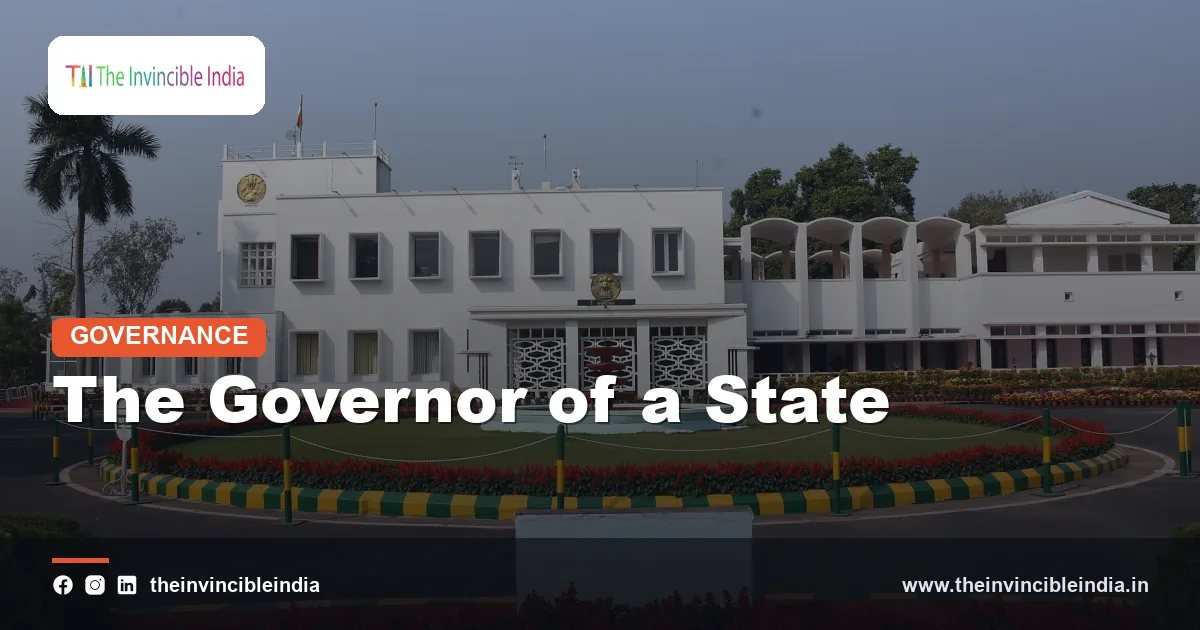
Every Indian state has a head who sits at the top of its constitutional structure but rarely appears in the daily headlines of governance, until a hung assembly, a delayed bill or a recommendation of President’s Rule puts the office in focus. The Governor of a state is the constitutional head of the state executive, the state-level counterpart of the President of India, and the person in whose name all executive action of the state government is formally taken.
The office sits at the meeting point of two ideas that India’s Constitution tries to hold together: parliamentary democracy, where real power rests with an elected government, and a federal structure, where the Union keeps a presence in the states. That double character explains why the Governor is described both as a dignified figurehead and, at times, as a lightning rod for Centre-state friction. This explainer covers how the office works, what powers it carries, where discretion begins and what the Supreme Court and expert commissions have said about it.
Quick Facts: The Governor of a State at a Glance
| Feature | Detail |
|---|---|
| Constitutional location | Part VI, Chapter II (The Executive), Articles 153 to 162 |
| Appointed by | The President, by a warrant under hand and seal (Article 155); in practice on the advice of the Union government |
| Term of office | Five years, but the Governor holds office during the pleasure of the President (Article 156) |
| Qualifications | Citizen of India, at least 35 years of age (Article 157) |
| Oath administered by | The Chief Justice of the High Court of the state (Article 159) |
| Executive power | Vested in the Governor (Article 154), exercised on the aid and advice of the Council of Ministers (Article 163) |
| Ordinance-making power | Article 213, when the legislature is not in session |
| Pardoning power | Article 161, for offences against laws on which the state’s executive power extends |
| One Governor, two states | Permitted since the Constitution (Seventh Amendment) Act, 1956 |
The Constitutional Position of the Governor
Article 153 provides that there shall be a Governor for each state, and a proviso added by the Seventh Amendment in 1956 allows one person to be appointed Governor of two or more states. Article 154 vests the executive power of the state in the Governor, who exercises it directly or through officers subordinate to him. Article 162 then sets the extent of that power: it runs to matters on which the state legislature can make laws, subject to the limits the Constitution places in favour of the Union.
The Governor is also an integral part of the state legislature. Under Article 168, the legislature of a state consists of the Governor and the Legislative Assembly, together with a Legislative Council in the states that have one. This is why a bill cannot become law until the Governor has dealt with it, and why the Governor opens and addresses the legislature.
Articles 153 to 162 at a glance
| Article | Subject |
|---|---|
| 153 | Governors of states |
| 154 | Executive power of the state |
| 155 | Appointment of the Governor |
| 156 | Term of office, resignation and the President’s pleasure |
| 157 and 158 | Qualifications and conditions of the office |
| 159 | Oath or affirmation |
| 160 | Discharge of functions in contingencies |
| 161 | Power to grant pardons, reprieves, remissions and commutations |
| 162 | Extent of the executive power of the state |
The Constituent Assembly debated whether the Governor should be elected by the people. It chose appointment instead, partly to avoid creating a second popularly mandated centre of authority that could rival the Chief Minister.
Appointment, Tenure and Qualifications
Under Article 155, the Governor is appointed by the President by a warrant under hand and seal. Because the President acts on the advice of the Union Council of Ministers, the Union government effectively chooses Governors. Unlike the President, the Governor is neither elected by an electoral college nor chosen through any special parliamentary procedure.
Qualifications and conditions
Article 157 requires that the appointee be a citizen of India and at least 35 years old. Article 158 adds that the Governor must not be a member of Parliament or of any state legislature, and if such a member is appointed, the seat is deemed vacated on the date of taking office. The Governor cannot hold any other office of profit, is entitled to an official residence without paying rent, and cannot have emoluments reduced during the term. Where one person serves two states, the emoluments are shared in a proportion the President decides.
Term and removal
The normal term is five years from the date of entering office, but Article 156 makes that term subject to the pleasure of the President. There is no impeachment procedure for a Governor. A Governor may resign by writing to the President and continues in office until a successor takes charge. Article 160 lets the President make provisions for the discharge of a Governor’s functions in any contingency not covered in the Constitution. The Oath under Article 159, administered by the Chief Justice of the High Court, binds the Governor to preserve, protect and defend the Constitution and the law, and to devote himself to the service and well-being of the people of the state.
Executive Powers of the Governor
All executive action of a state government is expressed to be taken in the name of the Governor. The Governor performs a series of important appointments and acts that keep the machinery of the state running.
- Chief Minister and ministers: Under Article 164, the Governor appoints the Chief Minister, and appoints the other ministers on the Chief Minister’s advice. Ministers hold office during the Governor’s pleasure, but the Council of Ministers is collectively responsible to the Legislative Assembly.
- Advocate General: The Governor appoints the Advocate General of the state under Article 165.
- Constitutional bodies: The Governor appoints the chairman and members of the State Public Service Commission and the State Election Commissioner, and he appoints members of the State Finance Commission.
- Judicial officers: District judges are appointed, posted and promoted by the Governor in consultation with the High Court under Article 233. The President consults the Governor when appointing High Court judges.
- Rules of business: The Governor makes rules for the convenient transaction of state government business and its allocation among ministers (Article 166).
Under Article 167, the Chief Minister must communicate to the Governor all decisions of the Council of Ministers relating to administration and legislative proposals, and furnish any information the Governor asks for. The Governor can also require that a matter decided by one minister be considered by the whole Council.
Legislative Powers: Sessions, Bills and Ordinances
As part of the legislature, the Governor has several key powers over how it meets and what it passes.
Summoning, proroguing and dissolving
Under Article 174, the Governor summons the House or Houses of the state legislature, prorogues them and may dissolve the Legislative Assembly. No more than six months may pass between two sittings. Under Article 176, the Governor addresses the first session after each general election and the first session of every year. The address is prepared by the government and sets out its policy. The Governor also nominates one-sixth of the members of the Legislative Council from among people with special knowledge in literature, science, art, the cooperative movement and social service.
Assent to bills
When a bill passed by the legislature reaches the Governor under Article 200, the Governor may assent to it, withhold assent, return it (if it is not a money bill) with a message asking for reconsideration, or reserve it for the President’s consideration. If the House passes the bill again, with or without amendments, the Governor cannot withhold assent. Certain bills, such as those that would endanger the position of the High Court, must be reserved. Under Article 201, the President then assents, withholds assent or directs the Governor to return the bill.
Ordinances under Article 213
When the legislature is not in session and the Governor is satisfied that immediate action is needed, he can promulgate an ordinance with the same force as an Act of the legislature. It must be laid before the Assembly and expires six weeks after the legislature reassembles, unless disapproved earlier. In some cases the Governor needs the President’s instructions first. The Supreme Court has held that repeated re-promulgation of ordinances without placing them before the legislature is a fraud on the Constitution.
Financial, Judicial and Pardoning Powers
Article 202 requires the Governor to cause the annual financial statement, the state budget, to be laid before the legislature. Money bills and certain financial bills cannot be introduced without the Governor’s recommendation. The Contingency Fund of the State is held at the disposal of the Governor, who can authorise advances from it for unforeseen expenditure pending the legislature’s approval.
The pardoning power under Article 161
Article 161 empowers the Governor to grant pardons, reprieves, respites or remissions of punishment, or to suspend, remit or commute a sentence, for offences against any law to which the executive power of the state extends. The power is narrower than the President’s under Article 72 in two important ways. The Governor cannot pardon a sentence of death, although he may suspend, remit or commute it, and the power does not extend to punishments imposed by court martial.
The Supreme Court has held that the pardoning power is exercised by the Governor on the advice of the state government, and that its exercise is open to limited judicial review if it is arbitrary, mala fide or based on irrelevant grounds. Article 192 also gives the Governor a quasi-judicial role: if a question arises about whether a member of the state legislature has become disqualified, the Governor decides it, after obtaining the opinion of the Election Commission, which is binding.
Aid and Advice or Discretion: Understanding Article 163
Article 163(1) says there shall be a Council of Ministers with the Chief Minister at its head to aid and advise the Governor in the exercise of his functions, except in so far as the Governor is by or under the Constitution required to exercise his functions in his discretion. That final clause is the heart of the controversy. Article 163(2) says that if any question arises whether a matter is one in which the Governor must act in his discretion, the Governor’s decision is final, and the validity of anything done is not to be questioned on the ground that he ought or ought not to have acted in his discretion. Article 163(3) bars courts from inquiring into what advice, if any, the ministers gave.
In Shamsher Singh v State of Punjab (1974), a seven-judge Bench held that the Governor is a constitutional head who acts on the aid and advice of the Council of Ministers in all matters except those where the Constitution gives him discretion. The word “discretion” in Article 163 is therefore not a licence to run a parallel government. Unlike Article 74 for the President, Article 163 has no clause that lets the Governor ask the ministers to reconsider their advice, which has contributed to debate about the nature of his powers in practice.
Discretionary Powers in Practice
Where the Constitution or established convention leaves room for the Governor’s own judgment, the following situations arise most often.
| Situation | What the Governor decides | Key limits or conventions |
|---|---|---|
| Hung Assembly | Whom to invite as Chief Minister (Article 164) | Choice should reflect who can command a majority; ultimately tested on the floor of the House |
| Loss of majority | Whether to dismiss a ministry or dissolve the Assembly | Floor test is the accepted mode of testing confidence |
| Failure of constitutional machinery | Report to the President recommending President’s Rule (Article 356) | Subject to judicial review; Bommai (1994) requires material backing the report |
| Bills | Whether to reserve a bill for the President (Article 200) | Compulsory reservation in some cases; delay is questioned by courts |
| Special responsibilities | Administration of Scheduled and Tribal Areas, and special duties under Article 371 provisions for certain states | Discretion defined by the Fifth and Sixth Schedules and specific articles |
Choosing a Chief Minister in a hung Assembly
The Constitution says only that the Governor appoints the Chief Minister. The Sarkaria Commission suggested an order of preference: first, a party or pre-poll alliance with a clear majority; second, the largest single party, which should be invited and asked to prove its majority; third, a post-election coalition whose partners all join the government; and fourth, a post-election alliance with some partners joining and others supporting from outside. The Chief Minister need not be a legislator at appointment, but must become a member within six months.
Recommending President’s Rule
Article 356 allows the President to take over state government if satisfied that it cannot be carried on in accordance with the Constitution, usually on the Governor’s report. Parliament must approve the proclamation within two months. It lasts six months at first and can be extended in six-month steps up to a maximum of three years, subject to conditions added by the 44th Amendment.
The Governor as Chancellor and Other Special Roles
In most states the Governor is the ex officio Chancellor of state universities. This role does not come from the Constitution; it comes from the statutes that created each university. As Chancellor, the Governor presides over convocations, can appoint Vice-Chancellors in many states, usually from a panel recommended by a search committee, and may exercise certain visitorial powers. Because these functions are statutory, a state legislature can amend the law to give them to someone else, and some states have attempted this, leading to disputes about whether the Chancellor acts in his own judgment or on the advice of the government.
Other special responsibilities
- Fifth Schedule: The Governor reports on the administration of Scheduled Areas and can direct that a particular Act of Parliament or the state legislature shall not apply, or apply with modifications, in such areas.
- Sixth Schedule: In Assam, Meghalaya, Tripura and Mizoram, the Governor has important powers over autonomous district and regional councils, including the power to define and alter areas.
- Article 371 provisions: For certain states, the Governor has special responsibilities for matters such as regional development boards.
- Ceremonial leadership: The Governor hosts state functions, administers oaths to ministers and represents the state on public occasions.
Governor, President and Lieutenant Governor: How They Compare
The Governor is often compared with the President, because the constitutional design is similar: a head of state who acts on ministerial advice. The differences matter, though.
| Feature | Governor of a state | President of India |
|---|---|---|
| How chosen | Appointed by the President | Elected by an electoral college (Article 54) |
| Term and removal | Five years, at the President’s pleasure; no impeachment | Five years; removable only by impeachment (Article 61) |
| Ordinance power | Article 213 (state subjects) | Article 123 (Union subjects) |
| Pardoning power | Cannot pardon death sentences or court-martial punishments | Can pardon death sentences and court-martial punishments (Article 72) |
| Discretionary powers | Some, under Article 163 and the Schedules | Very limited, mainly in a hung Parliament |
| Emergency, military and diplomatic powers | None | Yes |
Lieutenant Governor of a Union Territory
A Lieutenant Governor is appointed by the President to administer certain Union Territories, such as Delhi, Puducherry, the Andaman and Nicobar Islands, Ladakh and Jammu and Kashmir. The office is an agent of the Union government for governing the territory, rather than the head of a federal state. The Lieutenant Governor of Delhi acts under Article 239AA, and the Supreme Court has held that, except for matters in which discretion is explicitly provided, the Lieutenant Governor is bound by the aid and advice of the elected government. Some other Union Territories are run by Administrators who may be civil servants, and the Governor of a neighbouring state sometimes holds additional charge.
Centre’s Agent or Constitutional Head? The Debate
Critics argue that because Governors are chosen by the Union government and can be removed at the Presidential pleasure, they lean towards the party in power at the Centre, especially when a different party governs the state. Supporters respond that the office is a constitutional one, not employment under the Union, and that the Governor is a necessary link that keeps the federal system working. In Hargovind Pant v Raghukul Tilak (1979), the Supreme Court said that the Governor’s office is not an employment under the Central government and is not subordinate to it.
Typical points of friction
- Delay in giving assent to bills or in reserving them for the President.
- Choices made in hung Assemblies about whom to invite and how much time to give.
- Public disagreements with the state government over speeches, appointments or university administration.
- Use of Article 356 reports in the early decades of the Republic, when state governments were dismissed in significant numbers.
What the Commissions recommended
The Sarkaria Commission, which reported in 1988, recommended that the Governor be an eminent person from outside the state, detached from local politics and not recently active in party politics, and that the Chief Minister, the Vice-President and the Speaker of the Lok Sabha be consulted in the choice. It also advised that the Governor’s tenure should not be cut short except for compelling reasons. The Punchhi Commission (reported in 2010) suggested removing the doctrine of pleasure, and proposed that a Governor could be removed only through a resolution of the state legislature. It also suggested a fixed time frame for assent to bills and that Governors should not serve as university Chancellors. The National Commission to Review the Working of the Constitution (2002) proposed a committee to select Governors. These remain recommendations and have not been adopted as constitutional changes.
Key Supreme Court Observations on the Governor’s Role
Over seven decades, the Supreme Court has shaped how the Governor’s powers are understood.
- Shamsher Singh (1974): The Governor is a constitutional head and acts on ministerial advice except where discretion is given.
- S.R. Bommai v Union of India (1994): The proclamation of President’s Rule is subject to judicial review; majority should be tested on the floor of the House and not by the Governor’s subjective view.
- Rameshwar Prasad v Union of India (2006): The dissolution of the Bihar Assembly in 2005, based on a Governor’s report, was held unconstitutional because the report did not rest on proper material.
- B.P. Singhal v Union of India (2010): Although the Governor holds office during pleasure, the power to remove cannot be exercised arbitrarily or merely because the Union government has changed.
- Nabam Rebia v Deputy Speaker (2016): A Constitution Bench held that the Governor’s discretion under Article 163 is limited and that he cannot, on his own, advance or summon the Assembly session without the aid and advice of ministers, except in narrow circumstances.
- Subhash Desai (2023): A Governor can call for a floor test only where there is objective material to doubt the government’s majority, and disputes within a political party do not by themselves justify it.
Timelines for assent
In a 2023 Punjab case, the Court said that a Governor cannot sit indefinitely on bills and that if assent is withheld, the bill must be returned to the House with a message. In 2025, a Bench hearing a Tamil Nadu matter fixed time limits for action on bills and reasoned that continued inaction could be reviewed by courts. The matter was then referred to a larger Bench under Article 143. In its advisory opinion, the Court indicated that courts cannot impose rigid timelines or treat bills as deemed assented, though prolonged and unexplained inaction by a Governor remains open to limited judicial review.
Conclusion
The Governor is best understood as a constitutional head with a small but real zone of discretion. In ordinary times the office is a symbol of continuity, signing off government decisions, opening legislatures and performing duties of the state’s executive. In unusual times, such as a fractured mandate or a standoff over legislation, the office is tested and the courts, commissions and conventions help define its limits. Because these questions go to the heart of Indian federalism, the debate over the Governor’s role is likely to continue. Last updated: 1 October 2026.
Frequently Asked Questions
Who appoints the Governor of a state in India?
The Governor is appointed by the President of India by a warrant under hand and seal, under Article 155. Since the President acts on the advice of the Union Council of Ministers, the Union government effectively decides who is appointed. Unlike the President, the Governor is not elected.
How long is the term of a Governor, and can the Governor be removed?
The term is five years, but under Article 156 the Governor holds office during the pleasure of the President, so he can be removed or transferred earlier. There is no impeachment process. The Supreme Court has held that the power to remove cannot be used arbitrarily or without compelling reasons.
What are the discretionary powers of a Governor?
The main areas are choosing a Chief Minister when no party has a clear majority, deciding on dissolving or not dissolving the Assembly in certain situations, recommending President’s Rule under Article 356, and reserving bills for the President’s consideration. The Governor also has special responsibilities for Scheduled and Tribal Areas. In most other matters, he acts on the aid and advice of the Council of Ministers.
Can a Governor refuse assent to a bill?
Under Article 200, a Governor can assent, withhold assent, reserve the bill for the President, or return it (other than a money bill) for reconsideration. If the legislature passes the bill again, the Governor cannot withhold assent. The Supreme Court has said that a Governor cannot keep bills pending indefinitely.
Can a Governor grant pardons?
Yes, under Article 161, a Governor can grant pardons, reprieves, respites and remissions, and suspend, remit or commute sentences, for offences against state-related laws. The Governor cannot pardon a death sentence or a court-martial punishment, and the power is normally exercised on the advice of the state government.
What is the difference between a Governor and a Lieutenant Governor?
A Governor heads a state and is a constitutional head within a federal structure. A Lieutenant Governor is appointed by the President to administer a Union Territory such as Delhi or Puducherry and acts more as the Union’s representative there. In Delhi, the Supreme Court has held that the Lieutenant Governor is bound by the elected government’s advice except in matters where he has discretion.
{“@context”:”https://schema.org”,”@graph”:[{“@type”:”FAQPage”,”mainEntity”:[{“@type”:”Question”,”name”:”Who appoints the Governor of a state in India?”,”acceptedAnswer”:{“@type”:”Answer”,”text”:”The Governor is appointed by the President of India by a warrant under hand and seal, under Article 155. Since the President acts on the advice of the Union Council of Ministers, the Union government effectively decides who is appointed. Unlike the President, the Governor is not elected.”}},{“@type”:”Question”,”name”:”How long is the term of a Governor, and can the Governor be removed?”,”acceptedAnswer”:{“@type”:”Answer”,”text”:”The term is five years, but under Article 156 the Governor holds office during the pleasure of the President, so he can be removed or transferred earlier. There is no impeachment process. The Supreme Court has held that the power to remove cannot be used arbitrarily or without compelling reasons.”}},{“@type”:”Question”,”name”:”What are the discretionary powers of a Governor?”,”acceptedAnswer”:{“@type”:”Answer”,”text”:”The main areas are choosing a Chief Minister when no party has a clear majority, deciding on dissolving or not dissolving the Assembly in certain situations, recommending President’s Rule under Article 356, and reserving bills for the President’s consideration. The Governor also has special responsibilities for Scheduled and Tribal Areas. In most other matters, he acts on the aid and advice of the Council of Ministers.”}},{“@type”:”Question”,”name”:”Can a Governor refuse assent to a bill?”,”acceptedAnswer”:{“@type”:”Answer”,”text”:”Under Article 200, a Governor can assent, withhold assent, reserve the bill for the President, or return it (other than a money bill) for reconsideration. If the legislature passes the bill again, the Governor cannot withhold assent. The Supreme Court has said that a Governor cannot keep bills pending indefinitely.”}},{“@type”:”Question”,”name”:”Can a Governor grant pardons?”,”acceptedAnswer”:{“@type”:”Answer”,”text”:”Yes, under Article 161, a Governor can grant pardons, reprieves, respites and remissions, and suspend, remit or commute sentences, for offences against state-related laws. The Governor cannot pardon a death sentence or a court-martial punishment, and the power is normally exercised on the advice of the state government.”}},{“@type”:”Question”,”name”:”What is the difference between a Governor and a Lieutenant Governor?”,”acceptedAnswer”:{“@type”:”Answer”,”text”:”A Governor heads a state and is a constitutional head within a federal structure. A Lieutenant Governor is appointed by the President to administer a Union Territory such as Delhi or Puducherry and acts more as the Union’s representative there. In Delhi, the Supreme Court has held that the Lieutenant Governor is bound by the elected government’s advice except in matters where he has discretion.”}}]}]}