


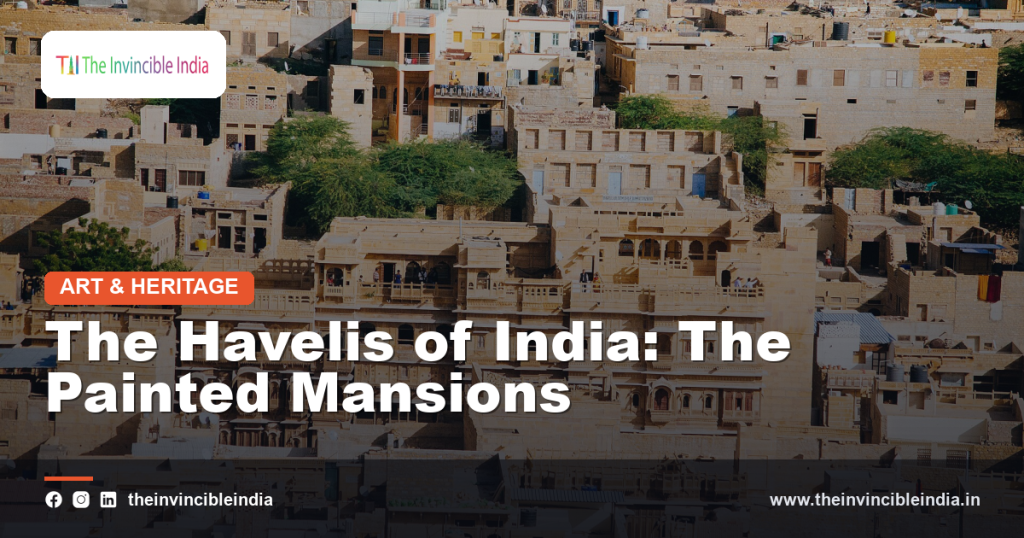
The havelis of India are among the most colourful and distinctive buildings in the country, grand mansions built by wealthy merchant families and adorned with elaborate carving and painted frescoes. Arranged around one or more courtyards for privacy, light and coolness, these homes combine fine craftsmanship in wood, stone and pigment with the practical needs of a large household, and their painted facades often depict scenes of mythology, royalty and everyday life alongside the geometric patterns familiar from India’s painting traditions. Concentrated especially in Rajasthan, above all the Shekhawati region and towns such as Jaisalmer, the havelis form a rich and colourful heritage. This guide explores their architecture, decoration, famous examples and heritage.
Quick Facts
| Detail | Information |
|---|---|
| Type | The painted merchant mansions of India |
| Builders | Wealthy merchant and trading families |
| Regions | Especially Rajasthan, notably Shekhawati and Jaisalmer |
| Famous example | Patwon ki Haveli of Jaisalmer |
| Features | Courtyards, carved facades and painted frescoes |
| Heritage | A colourful tradition of domestic art and architecture |
The Painted Mansions of India
The havelis of India are among the most distinctive and colourful buildings in the country, grand mansions built by wealthy merchant and trading families to display their prosperity and taste. Combining fine architecture with elaborate painted decoration, these homes were designed not only for comfortable and private family living but also as a public statement of the family’s wealth and standing in the community. Their painted facades still catch the eye of every passerby. As richly decorated homes built to combine private comfort with public display, the havelis of India occupy a cherished place in the country’s architectural heritage and remain among its most colourful and photographed monuments.
What Is a Haveli
A haveli is a large traditional townhouse or mansion, typically built around one or more internal courtyards that provide light, ventilation and a private, sheltered space away from the street. The rooms of the haveli open onto these courtyards rather than directly onto the outside world, giving the family privacy and coolness in a hot climate, while the outward-facing walls and gateways present an often richly decorated face to the surrounding street. This courtyard plan is the defining structure of the haveli. This form of the haveli, built around private courtyards and presenting a decorated face to the world, is fundamental to the tradition and shaped the character of merchant architecture across northern India.
The Merchant Patrons
The havelis of India were built above all by merchant and trading families who had grown wealthy through commerce, often along the trade routes that crossed the deserts and plains of the region. As their fortunes grew, these families built grand family homes to house their extended households and to proclaim their success, commissioning the finest craftsmen in carving and painting available to decorate their mansions. The haveli thus became a visible record of mercantile prosperity. This role of merchant families as the great patrons of haveli architecture explains the wealth of fine craftsmanship found in these buildings and their concentration in the trading towns of the region.
Courtyard Design
The courtyard lies at the heart of every haveli, a private open space around which the rooms of the house are arranged, providing light, air and a sheltered place for family life away from the public street. Larger havelis often have two or more courtyards, separating the public reception areas from the private family quarters, so that guests could be entertained without disturbing the routines of household life. This layered privacy was central to the design. This courtyard-centred design of the haveli, balancing openness within the home with privacy from the outside world, reflects both practical wisdom and social custom in the architecture of merchant families.
Facades and Frescoes
The outward-facing walls of the finest havelis are covered in elaborate frescoes, painted directly onto the plaster in bright natural pigments to depict deities, royal processions, hunting scenes, floral patterns and even, in later examples, motifs drawn from the wider world such as trains and steamships. These paintings turned the haveli’s facade into a vivid public gallery, displaying the family’s wealth, taste and awareness of the world to every passerby. Their colours have endured remarkably well in the dry desert climate. This tradition of facade frescoes is the single most distinctive feature of the haveli and the reason these mansions are often described as open-air picture galleries.
Woodwork and Carved Doorways
Alongside their painted walls, the havelis are celebrated for their finely carved woodwork, especially the elaborate doors, balconies, brackets and window screens that adorn their facades and courtyards. Skilled craftsmen carved intricate floral, geometric and figurative patterns into heavy wooden doors and jharokha balconies, work that could take months or years to complete and that added another layer of splendour to the mansion. This carved woodwork remains one of the haveli’s most admired features. This tradition of fine woodwork and carved doorways complements the painted frescoes of the haveli, together making it one of the richest expressions of decorative craftsmanship in Indian domestic architecture.
Havelis of Shekhawati
The Shekhawati region of Rajasthan is famed above all other places for the density and splendour of its painted havelis, earning it a reputation as an open-air gallery of mural art. Built by merchant families who prospered through trade and later through business in the growing cities of colonial India, the havelis of Shekhawati are covered from base to parapet in vivid frescoes, making the towns of the region a uniquely rich concentration of this painted architecture. Few places anywhere match this density of decorated mansions. This Shekhawati tradition of painted havelis is celebrated as one of the great treasures of Rajasthan’s architectural and artistic heritage.
Patwon ki Haveli of Jaisalmer
Among the most famous of all Indian havelis is Patwon ki Haveli in Jaisalmer, a cluster of finely carved mansions built by a prosperous merchant family in golden sandstone that seems to glow in the desert light. Renowned for its intricate stone carving rather than painted fresco, its balconies, arches and screens display an extraordinary richness of craftsmanship, making it one of the most celebrated haveli complexes in the country and a highlight of the city of Jaisalmer. Its golden stone sets it apart from the painted havelis of Shekhawati. This Patwon ki Haveli of Jaisalmer, with its extraordinary carved sandstone facades, stands among the finest examples of haveli architecture found anywhere in India.
Havelis of Rajasthan Beyond Shekhawati
Beyond Shekhawati and Jaisalmer, fine havelis can be found across Rajasthan, in towns and cities where merchant and noble families built grand mansions in their own regional styles. Bikaner, Jodhpur and other towns each possess havelis of considerable beauty, often combining local materials such as red or golden sandstone with the carved and painted decoration typical of the broader tradition, reflecting the wealth spread across the trading towns of the region. This wide distribution shows how deeply the tradition took root. This presence of fine havelis across many towns of Rajasthan confirms the haveli as one of the defining architectural traditions of the region as a whole.
Havelis of Gujarat and the North
The haveli tradition also flourished beyond Rajasthan, notably in Gujarat and parts of northern India, where merchant and trading communities built their own distinctive versions of the painted and carved mansion. These havelis often show regional variations in material, ornament and layout, reflecting local styles of woodwork and painting, yet they share the same essential purpose of housing an extended merchant family in comfort while displaying its prosperity to the world. This wider spread enriches the overall tradition. This presence of the haveli tradition in Gujarat and other regions beyond Rajasthan demonstrates the broad appeal of this style of merchant architecture across northern and western India.
Themes of Haveli Painting
The painted frescoes of the havelis draw on a wide range of themes, from religious and mythological scenes depicting deities and epic stories to images of royal processions, hunting parties, festivals and daily life within the household and its town. Later havelis, painted as trade and travel widened the horizons of merchant families, also began to include scenes of trains, motor cars, aeroplanes and Europeans, a charming record of a changing world seen through local eyes. These varied themes reveal the interests and outlook of their patrons. This rich variety of themes in haveli painting makes these mansions a valuable visual record of the culture, beliefs and changing world of the communities that built them.
Social Life Within the Haveli
Within its courtyards, the haveli housed the full life of an extended family, with separate areas often reserved for men and women, for entertaining guests, and for the daily business of running a large household. Family celebrations, religious observances and the rhythms of trade and domestic life all found their place within the haveli’s rooms and courtyards, making it far more than simply an impressive facade. Its architecture quietly shaped the patterns of daily family life. This rich social life sheltered within the walls of the haveli is an essential part of its heritage, reminding us that these mansions were homes as well as monuments of art.
Decline of the Haveli Tradition
As trade routes shifted and many merchant families moved to the growing cities of colonial and later independent India in search of new opportunities, numerous havelis were left empty or only partly occupied, and without regular upkeep their painted walls and carved woodwork began to suffer from neglect and the passage of time. Some havelis were abandoned entirely, their frescoes fading under sun, rain and dust, a loss keenly felt by later generations. This decline threatened an irreplaceable artistic heritage. This decline of the haveli tradition, as families moved away and left their ancestral mansions behind, represents a significant loss to India’s architectural and artistic heritage that later conservation efforts have sought to address.
Restoration and Heritage Tourism
In recent decades, growing recognition of their artistic value has brought new attention to the havelis, with conservation projects, heritage tourism and, in some cases, sympathetic owners restoring these mansions and their fragile frescoes. Several havelis have been converted into museums, guesthouses or cultural centres, generating income that helps fund their upkeep while allowing visitors to appreciate their architecture and painted decoration at first hand. This combination of restoration and tourism has proved a valuable model. This work of restoration and heritage tourism is playing a vital role in preserving the havelis of India and ensuring their painted walls survive for future generations to admire.
Havelis as Living Museums
Many of the finest surviving havelis now function as living museums, their rooms furnished with period objects and their walls displaying carefully preserved or restored frescoes, offering visitors a vivid sense of merchant life in earlier centuries. These preserved interiors, alongside the painted and carved exteriors, allow the haveli to be appreciated as a complete work of domestic art and architecture rather than a mere historical curiosity. Walking through their courtyards feels like stepping back in time. This role of the haveli as a living museum of merchant life and craftsmanship adds great value to the cultural tourism of the towns where these mansions survive.
The Havelis of India Today
Today the havelis of India are celebrated as one of the country’s most colourful and distinctive architectural traditions, admired for their painted facades, carved woodwork and the glimpse they offer into the life of merchant families of earlier centuries. From the frescoed towns of Shekhawati to the carved sandstone of Patwon ki Haveli in Jaisalmer, these mansions continue to attract visitors, artists and scholars from around the world. Their walls remain a vivid record of prosperity, art and daily life. As a rich and colourful heritage of domestic art and architecture, the havelis of India endure among the most delightful and photogenic treasures of the country’s cultural landscape.
Sources & Further Reading
- Ministry of Culture, Government of India, on the heritage architecture of Rajasthan (indiaculture.gov.in).
- Archaeological Survey of India, on historic havelis and mansions (asi.nic.in).
Frequently Asked Questions
What is a haveli?
A haveli is a large traditional Indian townhouse or mansion, typically built around one or more internal courtyards, and often decorated with fine carved woodwork and, in many regions, elaborate painted frescoes on its outward-facing walls.
Who built the havelis of India?
Havelis were built chiefly by wealthy merchant and trading families, especially in Rajasthan, who used these grand mansions to house their extended households and to display their prosperity and taste to the community through fine architecture and decoration.
Why is Shekhawati famous for havelis?
Shekhawati is famous for the exceptional density and splendour of its painted havelis, built by merchant families and covered in vivid frescoes depicting mythology, royalty and daily life, earning the region a reputation as an open-air gallery of mural art.
What makes Patwon ki Haveli in Jaisalmer special?
Patwon ki Haveli is celebrated for its extraordinary carved golden sandstone facades rather than painted fresco, with intricately worked balconies, arches and screens that make it one of the finest examples of haveli architecture in India.
What happened to many havelis over time?
As merchant families moved to growing cities in search of new opportunities, many havelis were left empty or under-maintained, causing their frescoes and woodwork to deteriorate, though restoration and heritage tourism efforts have since helped preserve numerous examples.