


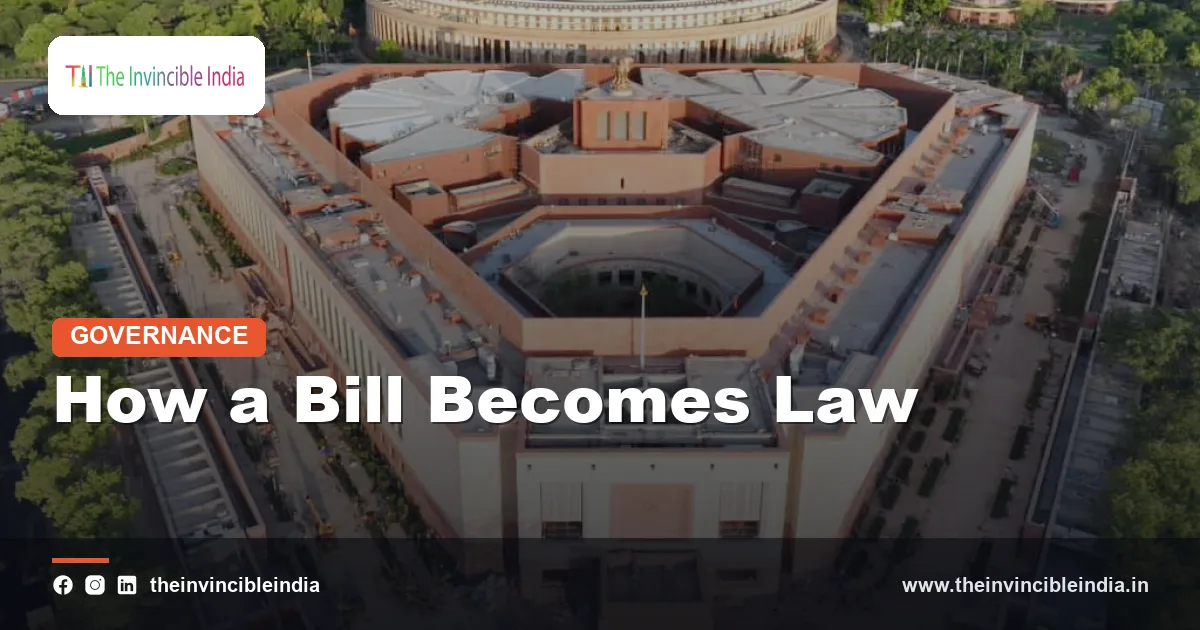
Every rule that governs daily life in India, from the way taxes are collected to the age at which one may drive, began as a proposal placed before Parliament. Understanding how a bill becomes a law is one of the most useful pieces of civic knowledge for a citizen, a student or a competitive-exam aspirant, because it shows where authority sits in the Indian republic and how it is checked.
In simple terms, a bill is a draft of a proposed law. It turns into an Act only after it has cleared both Houses of Parliament, the Lok Sabha and the Rajya Sabha, and has received the assent of the President of India. This explainer walks through each step of that journey, the different kinds of bills, the special rules for money bills, the constitutional tools for resolving deadlocks, and the role of ordinances and parliamentary committees.
Quick Facts
| Topic | Legislative procedure for making a law in India |
|---|---|
| Law-making body | Parliament of India: the President, the Lok Sabha and the Rajya Sabha |
| Key constitutional provisions | Articles 107 to 111 (ordinary procedure), Article 117 (financial bills), Article 123 (ordinances), Article 368 (constitutional amendment) |
| Main types of bills | Ordinary, Money, Financial, and Constitutional Amendment bills |
| Stages in each House | Introduction (first reading), second reading, third reading |
| Deadlock solution | Joint sitting of both Houses under Article 108, presided over by the Speaker |
| Rajya Sabha time limit on a money bill | 14 days to return it with recommendations |
| Final step | Assent of the President under Article 111, followed by publication in the Gazette of India |
What Is a Bill, and How Is It Different from an Act?
A bill is a proposal for legislation in its draft form. It has no legal force while it is being debated, amended or voted upon. Only when it has been passed by Parliament and assented to by the President does it acquire the status of an Act, which is enforceable law binding on citizens, institutions and governments.
Every bill is accompanied by a Statement of Objects and Reasons, which explains why the law is needed. Where a bill involves public spending, it also carries a financial memorandum estimating the expenditure. If the bill delegates power to the executive to frame rules, a memorandum on delegated legislation is attached as well. These documents allow members and the public to judge the purpose and consequences of the proposal before they vote.
Bills, Acts and the Constitution
Parliament makes laws on subjects listed in the Union List and, along with state legislatures, on the Concurrent List. It can also legislate on matters not mentioned in any list, under its residuary powers. Any law it passes must remain within the limits of the Constitution, and the Supreme Court and High Courts can strike down a law that violates constitutional provisions. This is why the legislative process is only one half of the story: judicial review acts as a check after the Act is in force.
Types of Bills in India
The Constitution recognises several categories of bills, and the procedure differs slightly for each. The table below summarises the main distinctions.
| Type of bill | Where it can be introduced | Role of the Rajya Sabha | Joint sitting possible? |
|---|---|---|---|
| Ordinary bill | Either House | Full powers to pass, amend or reject | Yes (Article 108) |
| Money bill (Article 110) | Only Lok Sabha, on the President’s recommendation | Recommendatory only; 14 days | No |
| Financial bill, Category I (Article 117(1)) | Only Lok Sabha, on the President’s recommendation | Full powers, like an ordinary bill | Yes |
| Financial bill, Category II (Article 117(3)) | Either House | Full powers | Yes |
| Constitutional Amendment bill (Article 368) | Either House | Must pass by special majority | No |
Ordinary Bills
Any bill that is not a money bill, a financial bill or a constitutional amendment bill is an ordinary bill. It may start in either House, must be passed by both, and needs a simple majority of members present and voting in each. The vast majority of legislation on subjects such as education, environment, criminal law and commerce falls into this category.
Financial Bills
Financial bills deal with taxation, expenditure or borrowing in a broader way. Category I bills contain provisions on the matters listed in Article 110 along with other matters, so they are not pure money bills. Category II bills merely involve expenditure from the Consolidated Fund of India. The Rajya Sabha keeps its full powers over both kinds.
Government Bills and Private Member Bills
Bills are also classified by who brings them. A Government Bill is introduced by a minister, and it reflects the policy of the ruling government. Because the government commands a majority in the Lok Sabha in most situations, these bills have a much better chance of passing. Notice of a Government Bill is required, and the minister moves the motion for leave to introduce it.
A Private Member Bill is introduced by any member of Parliament who is not a minister. Such bills are usually taken up on Friday afternoons, when time is set aside for private members’ business. Members must give notice of their intention, and the bill has to be listed by the House in the ballot or the order of business. Private member bills seldom become law, since limited time is available and governments generally prefer to pursue their own legislative agenda. However, they serve a real purpose by drawing attention to public issues and prompting the government to respond, and a few have influenced later legislation.
- Government bills carry the backing of the executive and take priority in the House schedule.
- Private member bills highlight concerns of individual members, including those from opposition parties.
- Both categories follow the same three-reading procedure once introduced.
The Three Readings: How a Bill Moves Through One House
Stage One: Introduction and First Reading
The legislative journey formally begins when a member seeks the permission of the House to introduce the bill. The member moves a motion for leave to introduce, and the Speaker of the Lok Sabha or the Chairman of the Rajya Sabha puts it to the House. If the motion is adopted, the member introduces the bill by reading its title. This is called the first reading.
No debate on the contents of the bill takes place at this point, though a brief discussion may occur if the introduction itself is opposed, for example on the ground that the House lacks the competence to legislate on the subject. After introduction, the bill is published in the Gazette of India so that members and the public can study it.
Special Conditions for Introduction
- A money bill or a Category I financial bill can be introduced only with the recommendation of the President.
- Bills on certain state matters, such as forming new states or altering state boundaries, need the President’s prior recommendation, and the President refers them to the affected state legislature for its views.
- Constitutional amendment bills may be introduced in either House, but never in a state legislature.
Stage Two: Second Reading and the Committee Stage
The second reading is the most detailed stage. It has two parts. In the first, the House discusses the general principles of the bill, and members may raise concerns about its broad approach. At the end of this discussion, the member in charge of the bill may move one of four motions: that the bill be taken into consideration at once, that it be referred to a Select Committee of the House, that it be referred to a Joint Committee of both Houses, or that it be circulated to gather public opinion.
Referral to Committees
Committees give detailed scrutiny outside the noise of the floor of the House. Since 1993, India has had Departmentally Related Standing Committees, which examine subjects linked to particular ministries, and bills can be referred to them by the Speaker or the Chairman. Ad hoc Select or Joint Committees may also be set up for a single bill. Their members come from different parties, and they can hear experts, government officials and stakeholders before submitting a report. The House is not bound to accept the recommendations, but a well-reasoned committee report often shapes the final text.
Clause-by-Clause Consideration
Once the bill is taken up for consideration, each clause is discussed and put to vote. Members can propose amendments, which are decided by simple majority. The enacting formula, the title and the long title are also adopted. Only after this line-by-line examination is complete does the bill move forward to its final stage.
Stage Three: The Third Reading and Final Vote
At the third reading, the debate is confined to whether the bill should be passed or rejected. Detailed arguments and fresh amendments are not permitted, apart from formal or verbal corrections. The member in charge moves that the bill be passed, and the House votes.
An ordinary bill is passed by a simple majority of members present and voting, provided the quorum requirement of one-tenth of the total membership is met. If votes are equal, the presiding officer exercises a casting vote. When a bill is passed, the presiding officer authenticates it and sends it to the other House with a message.
| Stage | What happens | Key point |
|---|---|---|
| 1. Introduction (first reading) | Leave to introduce is sought; bill is read by title and published in the Gazette | No discussion on merits |
| 2. Second reading, part one | General discussion on principles | Motion to consider, refer to committee, or circulate |
| 3. Committee scrutiny | Standing, Select or Joint Committee examines the bill | Report submitted to the House |
| 4. Second reading, part two | Clause-by-clause consideration and amendments | Each clause voted upon |
| 5. Third reading | Final debate and vote on passing the bill | Only acceptance or rejection |
| 6. Other House | Same three stages repeated | Amendments need agreement of the first House |
| 7. Presidential assent | President assents, withholds or returns the bill | Article 111 |
| 8. Gazette notification | Act is published and comes into force | On assent or on a notified date |
Passage Through the Second House and Joint Sittings
A bill passed by the House of origin, whether the Lok Sabha or the Rajya Sabha, is then sent to the other House, where the whole process of three readings is repeated. The second House has four choices. It may pass the bill as it is, pass it with amendments, reject it outright, or simply not act on it.
- If it passes the bill without amendments, the bill is considered passed by Parliament and moves to the President.
- If it passes the bill with amendments, the bill goes back to the House of origin, which may accept or reject those amendments.
- If it rejects the bill, or keeps it pending for more than six months, a disagreement is said to exist between the Houses.
What Happens When a Lok Sabha Dissolves
The life of a bill is tied to the life of the Houses. A bill pending in the Lok Sabha lapses when it is dissolved, and so does a bill passed by the Lok Sabha but pending in the Rajya Sabha. Since the Rajya Sabha is a permanent House and is never dissolved, a bill that originated there and is pending in it does not lapse, and a bill already passed by both Houses that awaits the President’s assent also survives. The government sometimes reintroduces a lapsed bill in the new Lok Sabha.
Resolving Disagreements: The Joint Sitting Under Article 108
Because the Constitution gives the Rajya Sabha nearly equal powers over ordinary bills, deadlocks are possible. To break them, Article 108 provides for a joint sitting of both Houses. This can happen if the second House rejects the bill, if the Houses finally disagree about amendments, or if more than six months pass without the second House passing it.
The President may notify the Houses to meet in a joint sitting, and the sitting is presided over by the Speaker of the Lok Sabha. In the Speaker’s absence, the Deputy Speaker presides, and failing that, the Deputy Chairman of the Rajya Sabha. The Chairman of the Rajya Sabha does not preside. At the joint sitting, the bill is decided by a majority of the total members of both Houses present and voting. Because the Lok Sabha has far more members than the Rajya Sabha, its numbers usually prevail.
Limits and Examples
- A joint sitting is available only for ordinary bills and Category I and II financial bills.
- It cannot be used for money bills or constitutional amendment bills.
- Joint sittings have been held only a handful of times in India’s parliamentary history, in 1961 (the Dowry Prohibition Bill), in 1978 (the Banking Service Commission Repeal Bill) and in 2002 (the Prevention of Terrorism Bill).
The rarity of joint sittings shows that negotiation and compromise usually settle differences between the Houses well before such a step becomes necessary.
Money Bills: A Special Procedure
Money bills are treated differently because the Constitution treats control over the public purse as a privilege of the directly elected House. Under Article 110, a bill is a money bill if it deals only with matters such as imposing or abolishing a tax, regulating borrowing by the government, the custody and withdrawal of money from the Consolidated Fund or the Contingency Fund of India, or appropriation of money from the Consolidated Fund. Common examples are the Appropriation Bill and the Finance Bill that follow the Union Budget.
How a Money Bill Moves
- It can be introduced only in the Lok Sabha, and only on the recommendation of the President.
- The Speaker certifies whether a bill is a money bill, and this decision is final under Article 110(3). It cannot be questioned in any court or in either House.
- After the Lok Sabha passes it, the bill goes to the Rajya Sabha, which has only recommendatory power. It can suggest changes but cannot reject or amend the bill.
- The Rajya Sabha must return the bill within 14 days of receiving it. The Lok Sabha may accept or reject any recommendation.
- If the Rajya Sabha does not return the bill within 14 days, it is deemed to have been passed by both Houses in the form the Lok Sabha passed it.
This arrangement follows the principle that the government is answerable to the Lok Sabha, so the elected House should have the last word on taxation and spending. Since the Speaker’s certificate is decisive, the classification of a bill as a money bill is a significant procedural power.
Constitutional Amendment Bills Under Article 368
The Constitution can be amended only through the special procedure in Article 368. An amendment bill can be introduced in either House of Parliament, but not in a state legislature. It must be passed in each House by a special majority, meaning a majority of the total membership of that House and at least two-thirds of the members present and voting.
If the amendment seeks to change certain federal features of the Constitution, such as the representation of states in Parliament, the distribution of legislative powers between the Union and the states, or the amendment procedure itself, it must also be ratified by the legislatures of at least half of the states. After that, the bill goes to the President, who is bound to give assent following the 24th Constitutional Amendment of 1971. There is no provision for a joint sitting, so both Houses must independently agree.
The Supreme Court, in the landmark Kesavananda Bharati case of 1973, held that Parliament may amend the Constitution but cannot alter its basic structure. This doctrine places a judicial limit on constitutional amendments even after they have cleared every parliamentary hurdle.
The President’s Assent Under Article 111
When a bill has been passed by both Houses, it is presented to the President. Under Article 111, the President can declare that assent is given, declare that assent is withheld, or, in the case of a bill that is not a money bill, return it with a message asking both Houses to reconsider it or a part of it.
Types of Veto
- Absolute veto: the President withholds assent, and the bill ends. In practice this is rare, since the President acts on the advice of the Council of Ministers, which enjoys the confidence of the Lok Sabha.
- Suspensive veto: the President returns the bill for reconsideration. If both Houses pass it again, with or without amendments, the President must give assent. The veto thus only delays the process. It does not apply to money bills, and the power does not extend to constitutional amendment bills, which the President must assent to.
- Pocket veto: the Constitution does not fix any time limit within which the President must decide. If the President simply neither assents nor returns the bill, it stays pending indefinitely, which is described as a pocket veto. It is widely associated with the Indian Post Office (Amendment) Bill of 1986, on which the President took no action.
Money bills are a special case: the President may give or withhold assent but cannot send the bill back, since it has already been introduced on the President’s own recommendation.
Ordinances: Temporary Law-Making Under Article 123
When Parliament is not in session and there is an urgent need for a law, Article 123 allows the President to promulgate an ordinance. The President does so only on the advice of the Council of Ministers, and only when satisfied that circumstances require immediate action. An ordinance has the same force and effect as an Act of Parliament, and it can be made on any subject on which Parliament can legislate.
Safeguards on Ordinances
- An ordinance must be laid before both Houses when Parliament reassembles.
- It ceases to operate at the expiry of six weeks from the reassembly of Parliament, or earlier if both Houses pass resolutions disapproving of it.
- It cannot be used to amend the Constitution.
- The Supreme Court has held that repeatedly re-promulgating ordinances without placing them before the legislature is a constitutional fraud on the legislative process.
Governors of states have a similar power under Article 213 when the state legislature is not in session. Ordinances are meant to be a limited emergency tool, and the regular route through both Houses remains the norm.
From Assent to Act: Gazette Notification, Commencement and Committees
After the President’s assent, the bill becomes an Act. It is given an Act number and year, and it is published in the Gazette of India, the official record of the Government of India. This publication is the formal notification of the law to the public.
An Act does not always begin working on the day it is passed. Its own commencement clause decides when it comes into force. Some Acts take effect from the date of assent or publication. Others say they will apply from a date to be fixed by the Central Government through a notification in the Gazette, and different provisions may be brought into force on different dates. Many Acts also authorise the government to frame rules and regulations, which fill in the operational details.
Laws in the States
State legislatures follow a comparable process, with the Governor giving assent under Article 200. The Governor may reserve certain bills for the consideration of the President under Article 201. Where a state has a Legislative Council, its role is advisory in nature compared with that of the Rajya Sabha, and the Legislative Assembly holds the stronger position.
The Role of Parliamentary Committees
Parliament has limited time on the floor, so committees do much of the working scrutiny. They are often called mini-legislatures because they allow members to examine bills in depth and often in a less partisan manner than plenary debates.
- Departmentally Related Standing Committees: set up in 1993, they cover groups of ministries and examine bills, budgets and policy issues.
- Select Committees: constituted for a specific bill by one House, and dissolved after they report.
- Joint Committees: made up of members from both Houses for a single bill or issue.
- Financial committees: the Public Accounts Committee, the Estimates Committee and the Committee on Public Undertakings monitor government spending.
Committee reports are laid before the House, and they carry great persuasive weight. They increase transparency, enable expert testimony, and help improve the quality of the final law.
Conclusion
The route by which a bill becomes law in India reflects the balance built into the Constitution. Ordinary bills need the support of both Houses, money bills give primacy to the Lok Sabha, constitutional amendments demand a special majority, and the President’s assent completes the formal process. Committees, joint sittings and judicial review add checks and give room for deliberation. Knowing these steps helps citizens follow debates in Parliament and understand how a proposal becomes a binding law. Last reviewed: 29 September 2026.
Frequently Asked Questions
What are the main stages of how a bill becomes a law in India?
A bill is introduced (first reading), discussed generally and examined clause by clause, often after committee scrutiny (second reading), and put to a final vote (third reading). It then goes through the same stages in the other House, receives the President’s assent under Article 111, and is published in the Gazette as an Act.
What is the difference between a money bill and an ordinary bill?
A money bill deals only with the matters listed in Article 110, such as taxation and government spending. It can be introduced only in the Lok Sabha, and the Rajya Sabha can only make recommendations within 14 days. An ordinary bill can start in either House, and the Rajya Sabha has full powers to amend or reject it.
Who decides whether a bill is a money bill?
The Speaker of the Lok Sabha certifies whether a bill is a money bill. Under Article 110(3), the Speaker’s decision on this question is final and cannot be challenged in either House or before a court of law.
What happens if the Lok Sabha and the Rajya Sabha disagree on a bill?
Under Article 108, the President may summon a joint sitting of both Houses to resolve the deadlock on an ordinary or financial bill. The Speaker of the Lok Sabha presides, and the bill is decided by a majority of members present and voting. Joint sittings cannot be held for money bills or constitutional amendment bills.
Can the President refuse to sign a bill?
Under Article 111, the President can assent to a bill, withhold assent, or return a bill that is not a money bill for reconsideration. If Parliament passes the returned bill again, the President must assent. There is no time limit for the President to decide, which is why a pocket veto is possible in theory. In practice, the President acts on the advice of the Council of Ministers.
What is an ordinance, and how long does it last?
An ordinance is a temporary law issued by the President under Article 123 when Parliament is not in session and urgent action is needed. It must be laid before Parliament after reassembly, and it ceases to operate six weeks from the date Parliament reassembles, unless it is approved earlier by an Act or disapproved by both Houses.
{“@context”:”https://schema.org”,”@graph”:[{“@type”:”FAQPage”,”mainEntity”:[{“@type”:”Question”,”name”:”What are the main stages of how a bill becomes a law in India?”,”acceptedAnswer”:{“@type”:”Answer”,”text”:”A bill is introduced (first reading), discussed generally and examined clause by clause, often after committee scrutiny (second reading), and put to a final vote (third reading). It then goes through the same stages in the other House, receives the President’s assent under Article 111, and is published in the Gazette as an Act.”}},{“@type”:”Question”,”name”:”What is the difference between a money bill and an ordinary bill?”,”acceptedAnswer”:{“@type”:”Answer”,”text”:”A money bill deals only with the matters listed in Article 110, such as taxation and government spending. It can be introduced only in the Lok Sabha, and the Rajya Sabha can only make recommendations within 14 days. An ordinary bill can start in either House, and the Rajya Sabha has full powers to amend or reject it.”}},{“@type”:”Question”,”name”:”Who decides whether a bill is a money bill?”,”acceptedAnswer”:{“@type”:”Answer”,”text”:”The Speaker of the Lok Sabha certifies whether a bill is a money bill. Under Article 110(3), the Speaker’s decision on this question is final and cannot be challenged in either House or before a court of law.”}},{“@type”:”Question”,”name”:”What happens if the Lok Sabha and the Rajya Sabha disagree on a bill?”,”acceptedAnswer”:{“@type”:”Answer”,”text”:”Under Article 108, the President may summon a joint sitting of both Houses to resolve the deadlock on an ordinary or financial bill. The Speaker of the Lok Sabha presides, and the bill is decided by a majority of members present and voting. Joint sittings cannot be held for money bills or constitutional amendment bills.”}},{“@type”:”Question”,”name”:”Can the President refuse to sign a bill?”,”acceptedAnswer”:{“@type”:”Answer”,”text”:”Under Article 111, the President can assent to a bill, withhold assent, or return a bill that is not a money bill for reconsideration. If Parliament passes the returned bill again, the President must assent. There is no time limit for the President to decide, which is why a pocket veto is possible in theory. In practice, the President acts on the advice of the Council of Ministers.”}},{“@type”:”Question”,”name”:”What is an ordinance, and how long does it last?”,”acceptedAnswer”:{“@type”:”Answer”,”text”:”An ordinance is a temporary law issued by the President under Article 123 when Parliament is not in session and urgent action is needed. It must be laid before Parliament after reassembly, and it ceases to operate six weeks from the date Parliament reassembles, unless it is approved earlier by an Act or disapproved by both Houses.”}}]}]}