


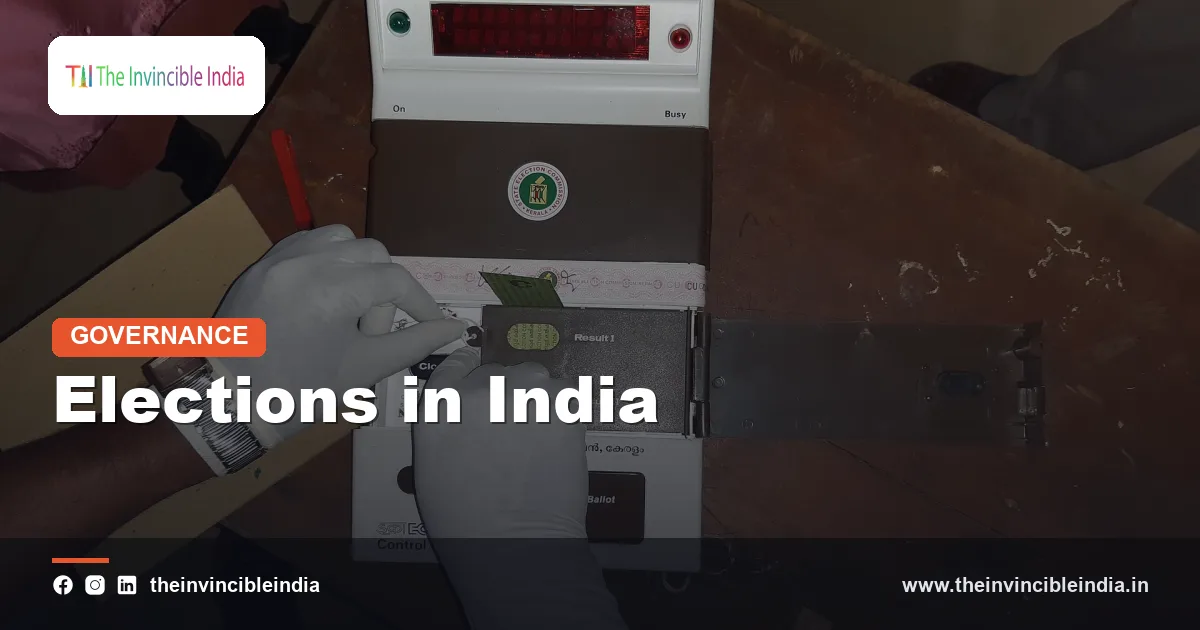
Every few years, a country of well over a billion people walks to the polls, and the world watches. Elections in India are among the largest peaceful administrative exercises ever attempted: hundreds of millions of citizens, lakhs of polling stations, millions of polling staff and security personnel, and a voting process that stretches across deserts, mountains, forests, islands and megacities. Behind this enormous effort stands a single independent constitutional authority, the Election Commission of India.
This guide explains how the system works from the ground up. It covers who runs the polls, who can vote, how seats are won, what the Model Code of Conduct does, how Electronic Voting Machines and VVPAT function, and what happens from the announcement of a schedule to the declaration of results. It also looks at the debates and challenges that surround the process, presented in a neutral and factual way. Last updated: 29 September 2026.
| Quick Facts | Details |
|---|---|
| Election body | Election Commission of India (ECI), a permanent constitutional body |
| Constitutional basis | Article 324 of the Constitution |
| Established | 25 January 1950 (celebrated as National Voters’ Day since 2011) |
| Composition | Chief Election Commissioner plus other Election Commissioners |
| Voting age | 18 years (lowered from 21 by the 61st Amendment, 1988) |
| Voting system | First-past-the-post for the Lok Sabha and State Legislative Assemblies |
| Lok Sabha elected seats | 543, with a simple majority of 272 needed to govern |
| Voting technology | Electronic Voting Machines (EVMs) with VVPAT paper slips |
| First general election | 1951-52, held over several months under universal adult suffrage |
The World’s Largest Democracy and the Scale of Its Elections
India adopted its Constitution on 26 January 1950 and chose, from day one, to give every adult citizen the right to vote. This was a bold decision. At the time, the vast majority of the population was poor and unable to read or write, and many older democracies had extended the vote gradually over generations. India’s first general election, held over several months in 1951-52, involved roughly 170 million eligible voters. Party symbols were used on ballot boxes so that voters who could not read could still choose their candidate.
Today the electorate is close to a billion registered voters, which is why elections in India are routinely called the largest democratic exercise on Earth. The scale shapes everything about how polls are run.
- Polling is organised in phases so that security forces and officials can be moved from one region to another.
- Polling stations are set up so that voters do not have to travel far, including in remote hamlets and high-altitude villages.
- Millions of government employees, on election duty, temporarily work under the supervision of the Election Commission.
- Counting is usually completed in a single day, after all phases have ended.
The democratic contract is layered. Citizens vote for their village or city councils, their state legislatures and the national Parliament, and each layer follows its own calendar and rules.
The Election Commission of India: A Constitutional Watchdog
The Election Commission of India (ECI) is the authority that supervises, directs and controls the preparation of electoral rolls and the conduct of elections. It was established on 25 January 1950, a day before the Republic itself began, and that date is now observed as National Voters’ Day to encourage enrolment and participation. Its first Chief Election Commissioner was Sukumar Sen, who oversaw the first general election.
Article 324 and its reach
Article 324 vests the superintendence, direction and control of elections in the Commission. Its remit covers elections to Parliament, to the State Legislatures, and to the offices of the President and Vice-President. Elections to panchayats and municipalities are handled separately by State Election Commissions, created after the 73rd and 74th Amendments of 1992.
Composition and independence
The ECI consists of a Chief Election Commissioner (CEC) and such other Election Commissioners as the President may fix. For most of its early history it was a single-member body. It became multi-member briefly in 1989 and permanently, with a three-member structure, in 1993. Decisions are taken by majority when members differ. Several features protect its independence:
- The CEC can be removed only in the manner and on the grounds applicable to a Supreme Court judge.
- Other Election Commissioners can be removed only on the recommendation of the CEC.
- Service conditions of the CEC cannot be altered to his or her disadvantage after appointment.
- The Commission’s expenses are met from central funds, and it can request whatever staff it needs from the government during elections.
The process for appointing commissioners has been the subject of legislation and court discussion in recent years, so it is best to check the latest law for details. Commissioners serve a fixed term of six years or until the age of 65, whichever comes first.
Powers in practice
The Commission announces poll schedules, recognises political parties, allots symbols, enforces the Model Code of Conduct, appoints election observers, monitors campaign expenditure, and can postpone or countermand a poll if free and fair conditions are threatened. During the electoral period, the officials who run the polls, from district magistrates to police officers, are effectively under its control.
Universal Adult Suffrage and Who Can Vote
Article 326 of the Constitution guarantees elections to the Lok Sabha and State Assemblies on the basis of adult suffrage. Article 325 adds that no person can be excluded from the general electoral roll on grounds of religion, race, caste or sex. In other words, one adult means one vote, and every vote carries equal weight.
The original voting age was 21. The 61st Constitutional Amendment of 1988, which took effect in 1989, lowered it to 18, bringing a large cohort of young people into the electorate. To be eligible today, a person must:
- Be a citizen of India.
- Be at least 18 years old on the relevant qualifying date.
- Be ordinarily resident in the constituency where the name is registered.
- Not be disqualified by law, for instance on grounds of unsoundness of mind or certain corrupt practices.
Voting is a right, not a legal duty; it is not compulsory at the national level. Overseas Indian citizens who have not acquired citizenship elsewhere can also register as voters in their place of ordinary residence in India. Service voters, such as members of the armed forces, can vote through special arrangements, and postal ballots and facilities for senior citizens and persons with disabilities have been expanded in recent years.
Types of Elections in India
India runs several different kinds of elections, each with its own electorate and method. The table below gives a simple overview.
| Election | Who votes | Method | Term |
|---|---|---|---|
| Lok Sabha (House of the People) | All registered voters, directly | First-past-the-post in single-member constituencies | 5 years unless dissolved earlier |
| Rajya Sabha (Council of States) | Elected members of State Legislative Assemblies | Single transferable vote (proportional representation) | 6 years; one-third retire every two years |
| State Legislative Assembly (Vidhan Sabha) | All registered voters, directly | First-past-the-post | 5 years unless dissolved earlier |
| Legislative Council (in some states) | Mixed: MLAs, local bodies, graduates, teachers | Indirect, single transferable vote in parts | 6 years; one-third retire every two years |
| President | Elected members of Parliament and State Assemblies (electoral college) | Single transferable vote, secret ballot | 5 years |
| Vice-President | Members of both Houses of Parliament | Single transferable vote, secret ballot | 5 years |
| Panchayats and Municipalities | Local registered voters | Mostly first-past-the-post, run by State Election Commissions | 5 years |
The Lok Sabha and Vidhan Sabha are the two places where voters have direct influence, and the party or coalition that commands a majority in the Lok Sabha forms the Union government. The Rajya Sabha is a permanent house that is never dissolved. Some seats in it are filled by nomination by the President, drawn from fields such as literature, science, art and social service.
First-Past-the-Post, Constituencies and Delimitation
For the Lok Sabha and State Assemblies, India uses the first-past-the-post (FPTP) system, also known as plurality voting. The country is divided into single-member constituencies, and the candidate who secures more votes than anyone else wins the seat, even without an absolute majority of votes in that constituency. The Lok Sabha has 543 elected seats, and a party or alliance needs 272 to command a simple majority. A party’s share of seats can therefore differ noticeably from its share of the national vote, which is a well-known feature of FPTP.
Delimitation
Drawing constituency boundaries is called delimitation, and it is carried out by an independent Delimitation Commission under Articles 82 and 170. Delimitation exercises were held in 1952, 1963, 1973 and 2002. The 42nd Amendment froze the allocation of seats among states on the basis of the 1971 Census, and the freeze was later extended, so the state-wise distribution of seats has stayed stable for decades while boundaries within states were redrawn in 2002-08. Under Article 329, the orders of the Delimitation Commission cannot be questioned in a court of law, which keeps this technical work insulated from litigation.
Reserved constituencies
To ensure representation for historically disadvantaged communities, some seats are reserved. In the Lok Sabha, 84 seats are reserved for Scheduled Castes (SC) and 47 for Scheduled Tribes (ST), under Articles 330 and 332 for the Assemblies. In a reserved seat, every voter in the constituency votes, but only candidates from the reserved category can contest. The Nari Shakti Vandan Adhiniyam of 2023 (the 106th Amendment) provides for one-third reservation for women in the Lok Sabha and State Assemblies, to take effect after the next delimitation exercise.
The Electoral Roll and Voter ID (EPIC)
No one can vote without being on the electoral roll. The roll is prepared and updated under the Representation of the People Act, 1950, which deals with registration, while the Representation of the People Act, 1951 governs the actual conduct of elections, qualifications and disqualifications of candidates, and election disputes.
Registration and revision
Eligible citizens apply for enrolment through a prescribed form, either online through the Commission’s portals or on paper at the local Electoral Registration Officer. The rolls are revised regularly, and a special summary revision is carried out before major elections to add newly eligible voters, delete names of deceased or shifted electors, and correct errors. Draft rolls are published so that citizens can file claims and objections.
The voter ID card
The Elector’s Photo Identity Card, or EPIC, was introduced in the 1990s to reduce impersonation. The card carries a photograph and a unique number. On polling day, however, the EPIC is not the only accepted proof of identity; a voter whose name is on the roll can also use one of several alternative photo documents specified by the Commission. Digital versions of the voter ID have also been introduced for convenience.
Every voter’s name is marked on a certified copy of the roll at the polling station, and an indelible ink mark, used since the 1962 general election, is applied to the finger of the person who has voted to prevent repeat voting.
How a General Election Unfolds: Phases and Timeline
A general election is triggered when the Lok Sabha completes its five-year term or is dissolved earlier. The Commission then announces the schedule, generally at a press conference, and this announcement brings the Model Code of Conduct into effect. Recent general elections have been held in seven phases spread over several weeks, with different states and union territories going to the polls on different dates.
- Announcement: The Commission declares the dates of notification, nomination, scrutiny, withdrawal, polling and counting.
- Notification: The formal notice inviting nominations is issued for each phase.
- Nomination and scrutiny: Candidates file papers; the Returning Officer examines them.
- Withdrawal: Candidates may step back within a fixed window, after which the final list is published.
- Campaign period: Rallies, door-to-door outreach and media advertising continue until 48 hours before the close of polling.
- Polling: Voting takes place phase by phase.
- Counting and results: All votes are counted on a single day, and results are declared constituency by constituency.
Phasing is driven by practical needs: the availability of central armed police forces, the terrain and weather, the calendar of festivals and examinations, and the need to move EVMs safely. State Assembly elections follow a similar pattern, sometimes in a single phase for smaller states.
Nomination, Campaigning and the Model Code of Conduct
Becoming a candidate
To contest the Lok Sabha or a State Assembly, a person must be an Indian citizen, at least 25 years old, and registered as a voter. The minimum age for the Rajya Sabha is 30. Candidates file nomination papers supported by proposers, pay a security deposit, and submit an affidavit with details about criminal cases, assets, liabilities and educational qualifications. This disclosure rule follows Supreme Court directions of the early 2000s and allows voters to make informed choices. Political parties are classified as national, state or unrecognised, and the Commission allots symbols accordingly.
The Model Code of Conduct
The Model Code of Conduct (MCC) is a set of guidelines, agreed to by political parties, that governs the behaviour of parties, candidates and governments during the election period. It traces its origins to the Kerala Assembly elections of 1960 and has since been refined by the Commission. It is not a statute, but its enforcement has considerable practical force. It comes into effect when the schedule is announced and remains in place until results are declared. Its main principles include:
- Parties must not appeal to voters on caste or communal lines, or use places of worship for campaigning.
- Bribing voters or intimidating them is prohibited.
- The ruling party must not use official machinery, vehicles or funds for campaigning.
- The government cannot announce new schemes or projects that could influence voters once the code is in force.
- Rallies and processions require prior permission, and loudspeaker use is regulated.
Campaign spending is monitored by expenditure observers, and each candidate must maintain accounts within limits set by the Commission. Section 126 of the Representation of the People Act bars campaigning during the last 48 hours before polling ends, known as the silence period.
Polling Day: EVMs, VVPAT and NOTA
On polling day, a Presiding Officer heads a team at each polling station. Voters queue up, have their identity checked against the roll, have their finger inked, sign the register and then vote in a screened compartment, maintaining a secret ballot.
Electronic Voting Machines
India moved from paper ballots to Electronic Voting Machines after an experimental use in a Kerala by-election in 1982. EVMs were used across the country in all constituencies in the 2004 general election. The machine has two units: a Ballot Unit, on which the voter presses the button next to their preferred candidate’s name and symbol, and a Control Unit, operated by the Presiding Officer. The machines are made by public-sector manufacturers, are not connected to any network, and run on a battery. Candidates or their agents witness the sealing of the machines and their random allotment to polling stations.
VVPAT
The Voter Verifiable Paper Audit Trail (VVPAT) is a printer attached to the EVM. When a vote is cast, a slip showing the serial number, name and symbol of the chosen candidate is displayed for about seven seconds behind a transparent window before falling into a sealed box. VVPAT was first used in a by-election in 2013, after a Supreme Court judgment, and has been used with all EVMs in general elections since 2019. During counting, slips from a randomly selected number of polling stations in each constituency are matched with the electronic tally.
NOTA
NOTA, or “None of the Above”, was introduced following a 2013 Supreme Court verdict in the PUCL case. It lets a voter formally reject all candidates while still keeping the vote secret. However, NOTA votes have no impact on the result: even if NOTA receives the most votes, the candidate with the highest number of votes among the actual contestants is declared elected.
Counting, Results and Government Formation
Counting takes place under the supervision of the Returning Officer, in the presence of candidates or their representatives. Postal ballots are counted first, followed by EVM totals, round by round. Once all rounds are complete and the VVPAT verification is done, the Returning Officer declares the winner and issues a certificate of election. The Commission’s results portal updates trends in real time, and the final tally is published constituency by constituency.
After a general election, the President invites the leader of the party or coalition that appears to command a majority in the Lok Sabha to form the government, and the leader is appointed Prime Minister. If no party has a majority, coalition building or a minority government may follow, and the majority must be proved on the floor of the House. Disputes about the election of a member are handled through election petitions before the relevant High Court, and appeals can go to the Supreme Court.
The anti-defection law in brief
To provide stability to elected governments, the 52nd Amendment of 1985 added the Tenth Schedule, commonly called the anti-defection law. A legislator can be disqualified for voluntarily giving up membership of the party on whose ticket they were elected, or for voting against the party’s direction on a vote of confidence and similar motions. The law allows a merger if at least two-thirds of a legislature party agrees to it. The Speaker or Chairman decides on disqualification, and, following the Supreme Court’s decision in the Kihoto Hollohan case of 1992, those decisions can be reviewed by courts.
Challenges and Ongoing Debates
A large, complex system inevitably faces challenges, and India’s electoral process is no exception. Commonly discussed issues, presented here without judgement, include the following.
- Money power: Election campaigns are expensive, and the sources and transparency of political funding remain a subject of continuing reform proposals.
- Criminalisation of politics: Some candidates face pending criminal cases, and courts have responded by requiring disclosure and, in certain cases, issuing directions on candidacy.
- Misinformation and paid news: The spread of false information online and the practice of paid content in media have prompted the Commission to issue advisories and set up monitoring cells.
- Voter turnout and migration: Turnout differs across regions and groups, and migrant workers can find it hard to vote in their home constituencies.
- Women’s representation: The 2023 amendment addresses the long-standing gap between women’s participation as voters and their share among legislators.
- Frequency of polls: A proposal to hold Lok Sabha and Assembly elections together, often called “One Nation, One Election”, has been debated for its potential costs and benefits.
- Trust in technology: Questions raised about EVMs have been examined by courts and the Commission, which has responded with the VVPAT and public demonstrations.
Conclusion
Elections in India combine constitutional principle with logistical scale. The Election Commission, created under Article 324, works with lakhs of officials to ensure that each adult citizen can cast a secret ballot, that constituencies are drawn fairly, that parties follow a common code and that results are announced transparently. The system is not free of debate, but its longevity, from the first general election of 1951-52 to the present, shows how deeply the habit of voting has taken root. For any citizen, understanding these steps makes participation more meaningful and scrutiny more informed.
Frequently Asked Questions
Who conducts elections in India?
The Election Commission of India, a constitutional body created under Article 324, supervises elections to Parliament, State Legislatures and the offices of President and Vice-President. Local body elections are conducted by State Election Commissions. The Commission was established on 25 January 1950.
What is the minimum age to vote in India?
The minimum voting age is 18 years. It was lowered from 21 by the 61st Constitutional Amendment in 1988. A voter must also be an Indian citizen and be registered on the electoral roll of the constituency where he or she ordinarily resides.
How many seats are needed to form a government in the Lok Sabha?
The Lok Sabha has 543 elected seats, so a party or coalition needs at least 272 to have a simple majority. The President invites the leader who appears able to command that majority to form the government.
What is NOTA and does it affect the result?
NOTA means “None of the Above” and was introduced after a 2013 Supreme Court ruling. It allows voters to reject every candidate while keeping the ballot secret. It does not affect the outcome, because the candidate with the most votes among the actual contestants still wins.
What are EVMs and VVPAT?
Electronic Voting Machines record votes electronically using a Ballot Unit and a Control Unit and are not connected to any network. The VVPAT is an attached printer that displays a slip with the chosen candidate’s name and symbol for a few seconds before it drops into a sealed box. The slips can be used to verify the electronic count.
What is the Model Code of Conduct?
The Model Code of Conduct is a set of guidelines, agreed by political parties and enforced by the Election Commission, that regulates the conduct of parties, candidates and governments. It comes into force when the election schedule is announced and remains until the results are declared.
{“@context”:”https://schema.org”,”@graph”:[{“@type”:”FAQPage”,”mainEntity”:[{“@type”:”Question”,”name”:”Who conducts elections in India?”,”acceptedAnswer”:{“@type”:”Answer”,”text”:”The Election Commission of India, a constitutional body created under Article 324, supervises elections to Parliament, State Legislatures and the offices of President and Vice-President. Local body elections are conducted by State Election Commissions. The Commission was established on 25 January 1950.”}},{“@type”:”Question”,”name”:”What is the minimum age to vote in India?”,”acceptedAnswer”:{“@type”:”Answer”,”text”:”The minimum voting age is 18 years. It was lowered from 21 by the 61st Constitutional Amendment in 1988. A voter must also be an Indian citizen and be registered on the electoral roll of the constituency where he or she ordinarily resides.”}},{“@type”:”Question”,”name”:”How many seats are needed to form a government in the Lok Sabha?”,”acceptedAnswer”:{“@type”:”Answer”,”text”:”The Lok Sabha has 543 elected seats, so a party or coalition needs at least 272 to have a simple majority. The President invites the leader who appears able to command that majority to form the government.”}},{“@type”:”Question”,”name”:”What is NOTA and does it affect the result?”,”acceptedAnswer”:{“@type”:”Answer”,”text”:”NOTA means “None of the Above” and was introduced after a 2013 Supreme Court ruling. It allows voters to reject every candidate while keeping the ballot secret. It does not affect the outcome, because the candidate with the most votes among the actual contestants still wins.”}},{“@type”:”Question”,”name”:”What are EVMs and VVPAT?”,”acceptedAnswer”:{“@type”:”Answer”,”text”:”Electronic Voting Machines record votes electronically using a Ballot Unit and a Control Unit and are not connected to any network. The VVPAT is an attached printer that displays a slip with the chosen candidate’s name and symbol for a few seconds before it drops into a sealed box. The slips can be used to verify the electronic count.”}},{“@type”:”Question”,”name”:”What is the Model Code of Conduct?”,”acceptedAnswer”:{“@type”:”Answer”,”text”:”The Model Code of Conduct is a set of guidelines, agreed by political parties and enforced by the Election Commission, that regulates the conduct of parties, candidates and governments. It comes into force when the election schedule is announced and remains until the results are declared.”}}]}]}