


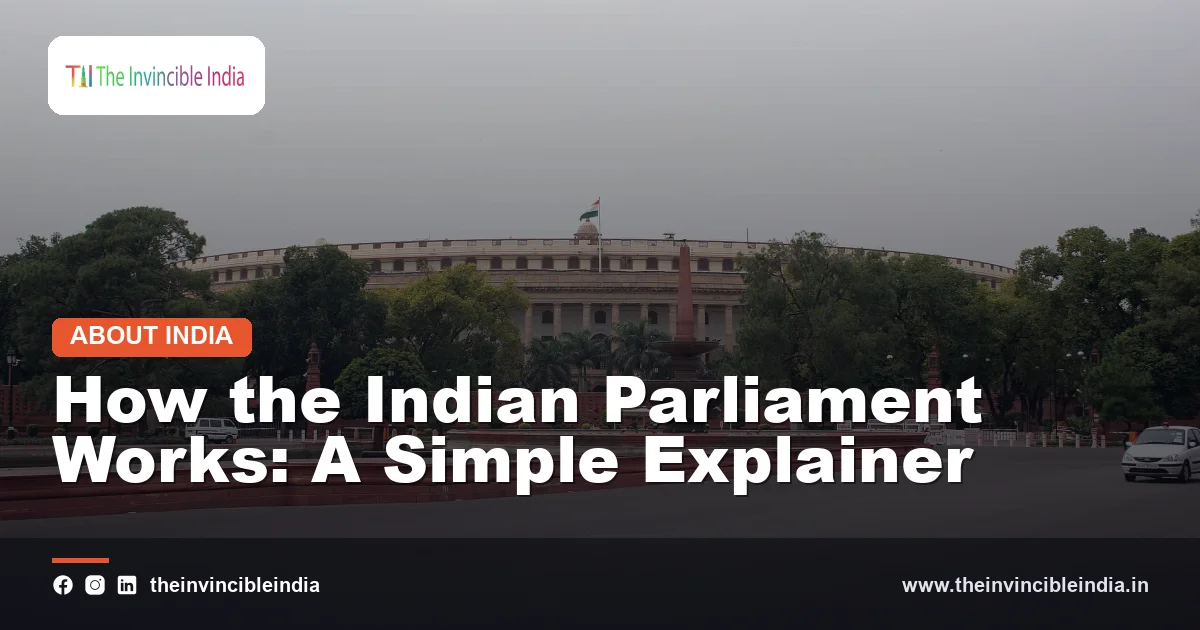
India is the world’s largest democracy, and at the very heart of its system of governance lies the Parliament. Understanding how the Indian Parliament works helps make sense of how the country’s laws are made, how the government is held to account, and how the will of more than a billion people is represented. This detailed guide offers a clear, simple explainer of the structure, functions and workings of the Indian Parliament.
Quick Facts
| Type | Bicameral (two houses) + the President |
| Lower house | Lok Sabha (House of the People) — up to 543 members |
| Upper house | Rajya Sabha (Council of States) — up to 245 members |
| Constitution in force | Since 26 January 1950 |
The Structure of Parliament
The Indian Parliament is bicameral, meaning it consists of two houses — the Lok Sabha (House of the People) and the Rajya Sabha (Council of States) — along with the President of India, who is a constituent part of Parliament though not a member of either house. This structure, laid out in the Constitution that came into effect in 1950, is designed to balance the direct will of the people with the representation of India’s many states and union territories.
The Lok Sabha (Lower House)
The Lok Sabha is the more powerful of the two houses and the one closest to the people. It can have up to 543 elected members, chosen directly by citizens through general elections held every five years, with each member representing a geographical constituency. The party or coalition that commands a majority in the Lok Sabha forms the government, and its leader becomes the Prime Minister. Proceedings are presided over by the Speaker, who maintains order and decides important procedural questions. The Lok Sabha has special powers over money bills and the survival of the government.
The Rajya Sabha (Upper House)
The Rajya Sabha represents the states and union territories of India. It can have up to 245 members, most of whom are elected by the elected members of the state legislative assemblies, with a small number nominated by the President for their distinguished contributions to fields such as art, science and social service. Unlike the Lok Sabha, the Rajya Sabha is a permanent house that is never fully dissolved; one-third of its members retire every two years, and members serve six-year terms. The Vice-President of India serves as its ex-officio chairman.
How a Law Is Made
A proposed law begins its life as a “bill.” To become law, a bill must generally be passed by both houses of Parliament and then receive the assent of the President, after which it becomes an “Act.” A bill passes through several stages in each house — introduction (first reading), detailed discussion and voting (second and third readings) — and is often examined closely by parliamentary committees. Money bills, which concern taxation and government spending, can only be introduced in the Lok Sabha, which holds the primary authority over them.
Sessions of Parliament
Parliament meets in sessions through the year, traditionally three: the Budget Session (spring), the Monsoon Session (mid-year) and the Winter Session. During these sessions, members debate and pass legislation, question the government, and discuss issues of national importance. The government presents the annual Union Budget during the Budget Session, one of the most significant events in the parliamentary calendar.
Key Functions of Parliament
Parliament performs several vital functions beyond making laws. It controls the nation’s finances by approving the budget and authorising government spending and taxation. It holds the executive accountable through debates, questions and various procedural tools. It represents the diverse interests and aspirations of the country’s people and regions. And it can amend the Constitution, within the limits laid down by the courts, allowing the framework of governance to evolve over time.
Tools to Hold the Government Accountable
Members of Parliament have powerful tools to scrutinise the government. During Question Hour, ministers must answer questions from members on the working of their departments. Zero Hour allows members to raise urgent matters without prior notice. Motions such as the adjournment motion, calling-attention motion and, most significantly, the no-confidence motion (which can bring down a government that loses the confidence of the Lok Sabha) ensure that the executive remains answerable to the elected representatives of the people.
Parliamentary Committees
Much of Parliament’s detailed work is done through committees, which examine bills, budgets and the working of government departments in depth, away from the glare of the main debates. These committees, made up of members from across parties, allow for more careful, expert and less partisan scrutiny, and play a crucial behind-the-scenes role in the functioning of Indian democracy.
The New Parliament Building
In 2023, India inaugurated a new, larger, triangular Parliament building to accommodate the growing needs of the world’s largest democracy, replacing the historic circular Parliament House (Sansad Bhavan) built during the colonial era. The new building, part of the redevelopment of the central vista in New Delhi, symbolises the continuity and evolution of India’s democratic institutions.
Why It Matters
Parliament is the cornerstone of India’s democracy. It ensures that the power to make laws and govern rests with representatives elected by the people, and that the government remains accountable to the nation. By balancing the voice of the people through the Lok Sabha with the representation of the states through the Rajya Sabha, and by upholding the Constitution, Parliament safeguards the democratic and federal character of the Republic of India.
The Role of the President
Although the President of India is the constitutional head of state and a part of Parliament, the role is largely ceremonial in the day-to-day working of government, with real executive power exercised by the Council of Ministers led by the Prime Minister. The President’s parliamentary functions are nonetheless important: summoning and proroguing sessions, addressing Parliament, giving assent to bills so they become law, and, in certain circumstances, returning a bill for reconsideration. The President is elected by an electoral college of members of Parliament and the state legislatures.
Parliament and Federalism
India is a union of states, and Parliament operates within a federal framework in which powers are divided between the central government and the states. The Constitution sets out subjects on which Parliament can legislate, subjects reserved for the states, and a concurrent list on which both can act. The Rajya Sabha, representing the states, plays a special role in protecting the federal balance. This division of powers allows India to govern its vast diversity while maintaining national unity.
Elections to Parliament
Members of the Lok Sabha are chosen through general elections, among the largest democratic exercises in the world, in which hundreds of millions of citizens vote to elect their representatives from geographical constituencies. Conducted by the independent Election Commission of India, these elections are held at least every five years. Members of the Rajya Sabha are elected indirectly by the elected members of the state legislative assemblies. This combination of direct and indirect election shapes the character of the two houses.
The Speaker and Parliamentary Discipline
The Speaker of the Lok Sabha holds a position of great authority and responsibility, presiding over debates, maintaining order, deciding points of procedure, and determining whether a bill is a money bill. The Speaker is expected to act impartially. Parliament also operates under rules such as the anti-defection law, which discourages elected members from switching parties, helping to maintain stability and party discipline in the house.
Landmark Moments in Parliament
Over the decades, the Indian Parliament has been the stage for many historic moments — from Jawaharlal Nehru’s famous “Tryst with Destiny” speech on the eve of independence, to the passage of landmark legislation on rights, reservations, the economy and social reform, to dramatic debates and votes of confidence that have shaped the nation’s course. These moments illustrate how Parliament serves as the central forum in which India’s democratic choices are debated and decided.
How Citizens Can Engage
Parliament belongs to the people, and citizens can engage with it in several ways. They elect their representatives, can follow debates through live broadcasts and official records, may petition Parliament and its committees, and can contact their members of Parliament to raise concerns. An informed and engaged citizenry is essential to a healthy democracy, and understanding how Parliament works is the first step towards participating meaningfully in the world’s largest democratic system.
The Two Houses Compared
The two houses of Parliament differ in important ways. The Lok Sabha is directly elected by the people, has a fixed five-year term unless dissolved earlier, and holds the decisive power over money bills and the formation of government. The Rajya Sabha is largely indirectly elected by the states, is a permanent body with members serving six-year staggered terms, and acts as a chamber of review that represents the interests of the states. Together, they ensure that legislation is carefully considered from both a popular and a federal perspective before it becomes law.
Parliament and the Judiciary
India’s democracy rests on a separation of powers between the legislature (Parliament), the executive (the government) and the judiciary (the courts). While Parliament makes the laws, the judiciary, headed by the Supreme Court, interprets them and can strike down laws that violate the Constitution through the power of judicial review. This system of checks and balances ensures that no single branch becomes too powerful and that the fundamental rights of citizens are protected, even against the will of a parliamentary majority.
The Cornerstone of Democracy
The Indian Parliament, for all its occasional drama and debate, remains the cornerstone of the world’s largest democracy. It gives more than a billion people a voice in how they are governed, provides a forum for resolving the nation’s differences through discussion rather than force, and holds those in power accountable. Understanding how it works is essential for every citizen, because a strong, functioning Parliament is the surest guarantee of a free, just and democratic India.
A Living Democratic Institution
For all its complexity, the Indian Parliament is best understood as a living institution that continues to evolve with the nation it serves. From the historic first sittings after independence to the inauguration of a new Parliament building in 2023, it has adapted to changing times while upholding the enduring principles of representative democracy. It stands as a remarkable achievement — giving a vast, diverse population a peaceful, constitutional means to govern itself — and remains an inspiring example of democracy at the largest scale the world has ever known.
Frequently Asked Questions
What are the two houses of the Indian Parliament?
The two houses are the Lok Sabha (House of the People) and the Rajya Sabha (Council of States).
How many members are in the Lok Sabha?
The Lok Sabha can have up to 543 directly elected members, serving five-year terms.
How does a bill become a law in India?
A bill must be passed by both houses of Parliament and receive the President’s assent to become an Act.
Which house is permanent?
The Rajya Sabha is a permanent house that is never fully dissolved; one-third of its members retire every two years.
Who presides over the Lok Sabha and Rajya Sabha?
The Speaker presides over the Lok Sabha, while the Vice-President is the ex-officio chairman of the Rajya Sabha.