


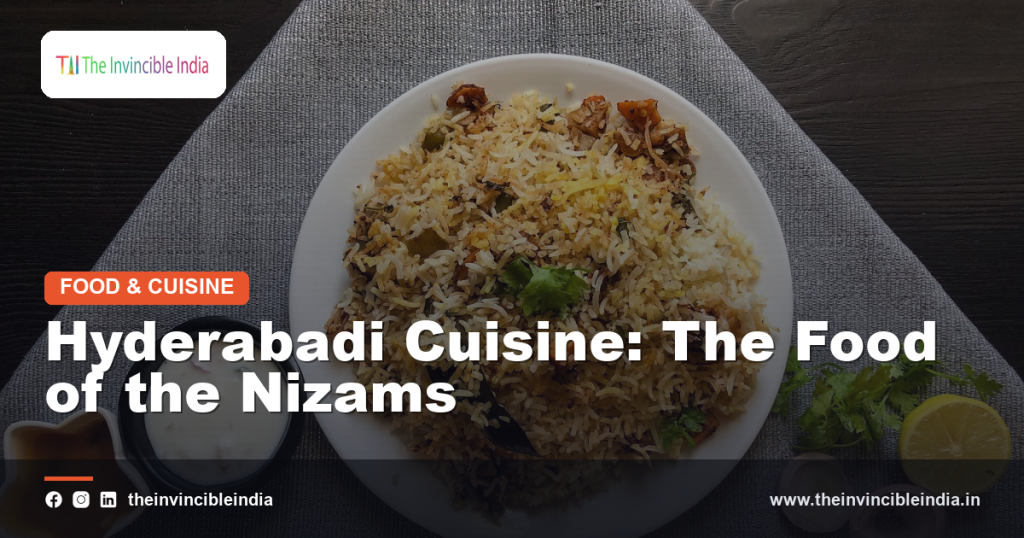
Hyderabadi cuisine is the royal and richly fragrant food of the Nizams, a magnificent culinary tradition that grew up in the court and kitchens of Hyderabad and remains one of the most celebrated cuisines of India. Born of a remarkable blending of Mughlai royal cooking with the local Telugu and Deccani food of the region, Hyderabadi cuisine is famous the world over for its biryani, its haleem and its rich, spiced and deeply layered dishes. Slow cooking, careful spicing and the legacy of a royal kitchen give this cuisine its distinctive character, much as the Mughlai tradition shaped it. This guide explores Hyderabadi cuisine, its history, its famous dishes and its enduring place in India’s food heritage.
Quick Facts
| Detail | Information |
|---|---|
| Type | The royal cuisine of Hyderabad and the Deccan |
| Rooted in | The court kitchens of the Nizams |
| Famous for | Biryani, haleem and rich, spiced dishes |
| Influences | Mughlai, Turkish, Arab and Telugu Deccani food |
| Signature technique | Slow dum cooking in sealed vessels |
| Character | Fragrant, richly spiced and deeply layered |
The Food of the Nizams
Hyderabadi cuisine is the royal and richly fragrant food that grew up in the court and kitchens of the Nizams, the rulers of Hyderabad, and it remains one of the most distinctive and celebrated cuisines of India. The Nizams maintained kitchens of great refinement, where cooks developed elaborate dishes of subtlety and richness for the royal table, and this legacy of royal patronage gave Hyderabadi food its lasting character of care, complexity and grandeur. As the food of the Nizams, prepared with the skill and patience of a royal kitchen, Hyderabadi cuisine carries forward a proud culinary heritage, and its dishes still reflect the refinement and richness that once graced the tables of Hyderabad’s rulers, making it one of the most admired regional cuisines of the country.
A Meeting of Cultures
Hyderabadi cuisine is above all a remarkable meeting of cultures, blending the Mughlai cooking brought by the Persianate courts with the local Telugu and Deccani food of the region. This fusion combined the rich meats, dum cooking and aromatic spicing of Mughlai and Turkish-Persian tradition with the tangy, chilli-forward and tamarind-soured flavours of local Deccani cooking, producing a cuisine unlike any other in India. The result is a food tradition of unusual depth, in which royal refinement meets regional boldness. This blending of cultures is the very heart of Hyderabadi food, and the balance it strikes between richness and heat, between Persian subtlety and Deccani spice, remains the defining quality of the cuisine to this day.
The Famous Hyderabadi Biryani
The most famous dish of Hyderabadi cuisine, and one of the most celebrated biryanis in all of India, is the Hyderabadi biryani, in which marinated meat and fragrant rice are layered and slow-cooked together. Unlike biryanis in which meat and rice are cooked separately, the Hyderabadi style is known for the kacchi technique, where raw marinated meat is layered with partly cooked rice and then sealed and cooked together, allowing the flavours to mingle deeply as the dish steams to completion. The result is a biryani of remarkable depth and fragrance. This famous Hyderabadi biryani, layered and slow-cooked to perfection, has carried the name of the city’s cuisine across India and the world as a byword for excellent biryani.
The Art of Dum Cooking
Central to Hyderabadi cuisine is the art of dum cooking, in which food is sealed in a heavy vessel and cooked slowly over gentle heat so that it steams in its own fragrant juices. This technique, often finished by sealing the pot’s lid with dough so that no aroma escapes, allows meats and rice to cook gently and evenly while every spice and flavour infuses deeply into the dish, producing food of exceptional tenderness and fragrance. Dum cooking demands patience and skill. This art of dum cooking, the slow sealing and steaming that lies behind the biryani and many other Hyderabadi dishes, is one of the defining techniques of the cuisine, and it is this patient, gentle method that gives Hyderabadi food its celebrated depth of flavour.
The Rich Haleem
Among the most beloved dishes of Hyderabadi cuisine is haleem, a rich and hearty stew of meat, lentils and pounded wheat, slow-cooked for many hours until it becomes a thick, smooth and deeply savoury dish. Haleem is especially associated with the season of Ramzan, when it is prepared and enjoyed widely across the city, though it is relished at other times as well, garnished with fried onions, coriander, mint and a squeeze of lime. Its slow cooking gives it a uniquely comforting texture. This rich haleem, thick, hearty and deeply savoury, has become one of the most celebrated dishes to carry the name of Hyderabad, admired for the patience and skill that its long, slow cooking demands.
The Fiery Mirchi ka Salan
A distinctive and much-loved accompaniment of Hyderabadi cuisine is mirchi ka salan, a tangy and richly spiced curry made from large green chillies cooked in a sauce of peanuts, sesame and tamarind. Traditionally served alongside biryani, this curry balances the richness of the rice dish with its own tangy, nutty and gently fiery character, and it exemplifies the Deccani side of Hyderabadi cooking with its bold use of chilli and souring agents. Its flavour is unlike any other curry of India. This fiery mirchi ka salan, tangy, nutty and served alongside biryani, is one of the signature accompaniments of Hyderabadi cuisine and a favourite expression of its distinctive Deccani flavour.
Baghare Baingan and Vegetable Dishes
Hyderabadi cuisine is also known for its excellent vegetable dishes, among which baghare baingan, small brinjals cooked in a spiced peanut and sesame gravy, is especially celebrated. This dish, tangy with tamarind and rich with ground peanuts and sesame, shows the same Deccani character found in mirchi ka salan, and it demonstrates that Hyderabadi cooking, though famous for its meat dishes, also possesses a fine tradition of vegetarian cookery. Careful spicing gives these dishes their distinctive depth. This dish of baghare baingan, and the wider tradition of Hyderabadi vegetable cookery that it represents, shows the versatility of the cuisine, whose skilful spicing enriches vegetables as memorably as it enriches meat.
Kebabs and Meat Dishes
Hyderabadi cuisine offers a fine array of kebabs and meat dishes beyond its famous biryani and haleem, reflecting the meat-rich Mughlai and Turkish inheritance of the Nizami court. Skewered and pan-cooked kebabs, richly spiced meat curries known as marag, and other slow-cooked preparations all form part of this tradition, each dish marinated and spiced with the care characteristic of the cuisine. These meat dishes reveal the refinement of the old royal kitchens. This array of kebabs and meat dishes, marinated and cooked with the patience typical of Hyderabadi cuisine, reflects its Mughlai and Turkish inheritance and shows the depth of a meat cookery tradition that extends well beyond its most famous dishes.
The Sweetness of Khubani ka Meetha
Hyderabadi cuisine closes its meals with distinctive sweets, among which khubani ka meetha, a dessert of stewed dried apricots served with cream or custard, is especially beloved. This sweet, tangy and fragrant dessert reflects the Persian and Central Asian influence on Hyderabadi cooking, in which dried fruit is used to create a dessert both refreshing and rich. Its balance of tartness and sweetness is distinctive. This dessert of khubani ka meetha, its tangy stewed apricots offering a fragrant and refreshing finish to a rich meal, is one of the most characteristic sweets of Hyderabadi cuisine and a fine expression of its Persian-influenced dessert tradition.
Double ka Meetha and Festive Sweets
Another beloved Hyderabadi sweet is double ka meetha, a rich bread pudding of fried bread slices soaked in sweetened, saffron-scented milk and garnished with nuts, prepared especially for festive occasions and celebrations. This dessert, luxurious and fragrant, shows the same royal richness that marks the cuisine’s savoury dishes, and it is a favourite at weddings and festive gatherings across Hyderabad. Its preparation demands care and patience. This double ka meetha, rich, fragrant and reserved for festive occasions, together with the wider tradition of Hyderabadi sweets it represents, shows how the cuisine’s love of richness and careful preparation extends fully into its desserts.
Irani Chai and Osmania Biscuits
A cherished part of Hyderabadi food culture beyond formal meals is the tradition of Irani chai, a strong, milky tea served in the city’s historic Irani cafés, enjoyed together with the crumbly, semi-sweet Osmania biscuit. This pairing, born of the Persian and Iranian communities who settled in the city, has become an everyday ritual for Hyderabadis, enjoyed at any hour in cafés that have themselves become city institutions. This simple pairing carries deep local affection. This tradition of Irani chai and Osmania biscuits, an everyday ritual born of the city’s Persian heritage, is a cherished and distinctly Hyderabadi custom that shows how the cuisine’s history lives on in the smallest daily pleasures.
The Spices of Hyderabad
Hyderabadi cuisine is built upon a distinctive use of spices, combining the warm, aromatic spices of Mughlai cooking with the fiery chillies and tangy souring agents of Deccani tradition. Cardamom, cloves, cinnamon and saffron lend fragrance and warmth, while dried red chillies, tamarind and sesame bring the tangy heat characteristic of the region’s own cooking, and the careful balancing of these two spice traditions is what gives Hyderabadi food its unique character. This balance of spice is the cuisine’s signature. This distinctive spicing of Hyderabadi cuisine, balancing fragrant Mughlai warmth with fiery Deccani tang, is the foundation of the cuisine’s flavour and one of the qualities that most clearly distinguishes it from other regional Indian cuisines.
The Nizami Feast
The grandest expression of Hyderabadi cuisine is the Nizami feast, an elaborate spread of many courses that recalls the hospitality and grandeur of the old royal court. Such feasts traditionally bring together biryani, haleem, kebabs, rich curries, vegetable dishes and a range of desserts, served with a generosity and ceremony that reflects the courtly origins of the cuisine, and they remain the standard for grand hospitality in Hyderabad to this day. This grandeur of the feast preserves royal tradition. This Nizami feast, an elaborate spread recalling the hospitality and grandeur of the old royal court, remains the grandest expression of Hyderabadi cuisine and a living reminder of the refined culinary culture the Nizams once cultivated.
Hyderabadi Cuisine Beyond the City
Though rooted in Hyderabad, this cuisine has travelled far beyond the city, with its biryani and haleem now enjoyed and celebrated across India and among Indian communities around the world. Restaurants specialising in Hyderabadi food are found in cities across the country and abroad, and the name of Hyderabad has become almost synonymous with excellent biryani, carrying the reputation of the cuisine well beyond the borders of the Deccan. This spread reflects the cuisine’s wide appeal. This travel of Hyderabadi cuisine far beyond the city of its origin, carried by its famous biryani and haleem, shows how thoroughly this regional food has won admirers across India and the world.
A Living Culinary Heritage
Hyderabadi cuisine endures today as a living culinary heritage, passed down through generations of families and cooks who continue to prepare its dishes with the same care and patience that marked the kitchens of the Nizams. Home cooks, restaurants and the historic Irani cafés of the city all keep this tradition alive, ensuring that the recipes, techniques and flavours developed over centuries continue to be enjoyed rather than merely remembered. This living continuity is the cuisine’s greatest strength. This survival of Hyderabadi cuisine as a living heritage, actively cooked and enjoyed rather than confined to memory, ensures that the rich culinary legacy of the Nizams continues to flourish in the kitchens and cafés of Hyderabad today.
Hyderabadi Cuisine Today
Today Hyderabadi cuisine stands as one of India’s most celebrated and distinctive regional food traditions, its biryani and haleem known and loved far beyond the city of their origin. The rich blend of Mughlai refinement and Deccani boldness, the patient art of dum cooking, and the enduring rituals of Irani chai and the Nizami feast all continue to define this cuisine, carrying forward the legacy of the royal kitchens that first shaped it. Its fame continues to grow each year. As the royal food of the Nizams, fragrant, richly spiced and steeped in history, Hyderabadi cuisine remains one of the great treasures of India’s culinary heritage and a proud symbol of the city of Hyderabad.
Sources & Further Reading
- Ministry of Tourism, Government of India, on the cuisines of India (tourism.gov.in).
- Culinary references on the food traditions of Hyderabad and the Deccan.
Frequently Asked Questions
What is Hyderabadi cuisine?
Hyderabadi cuisine is the royal food tradition that grew up in the court kitchens of the Nizams of Hyderabad, blending Mughlai and Turkish-Persian cooking with local Telugu and Deccani flavours. It is famous above all for its biryani and haleem and for its rich, deeply spiced dishes.
What makes Hyderabadi biryani different?
Hyderabadi biryani is famous for the kacchi technique, in which raw marinated meat is layered with partly cooked rice and then sealed and slow-cooked together using the dum method. This allows the flavours to mingle deeply, giving the biryani its distinctive depth and fragrance.
What is haleem?
Haleem is a rich, hearty stew of meat, lentils and pounded wheat, slow-cooked for many hours until thick and smooth. It is especially associated with the season of Ramzan in Hyderabad and is garnished with fried onions, coriander, mint and lime before serving.
What is mirchi ka salan?
Mirchi ka salan is a tangy, richly spiced curry made from large green chillies cooked in a sauce of peanuts, sesame and tamarind. It is traditionally served alongside Hyderabadi biryani, its tangy, nutty flavour balancing the richness of the rice dish.
What sweets are famous in Hyderabadi cuisine?
Hyderabadi cuisine is known for distinctive sweets such as khubani ka meetha, a dessert of stewed dried apricots, and double ka meetha, a rich bread pudding soaked in saffron-scented milk. Both reflect the Persian-influenced richness of the cuisine’s dessert tradition.