


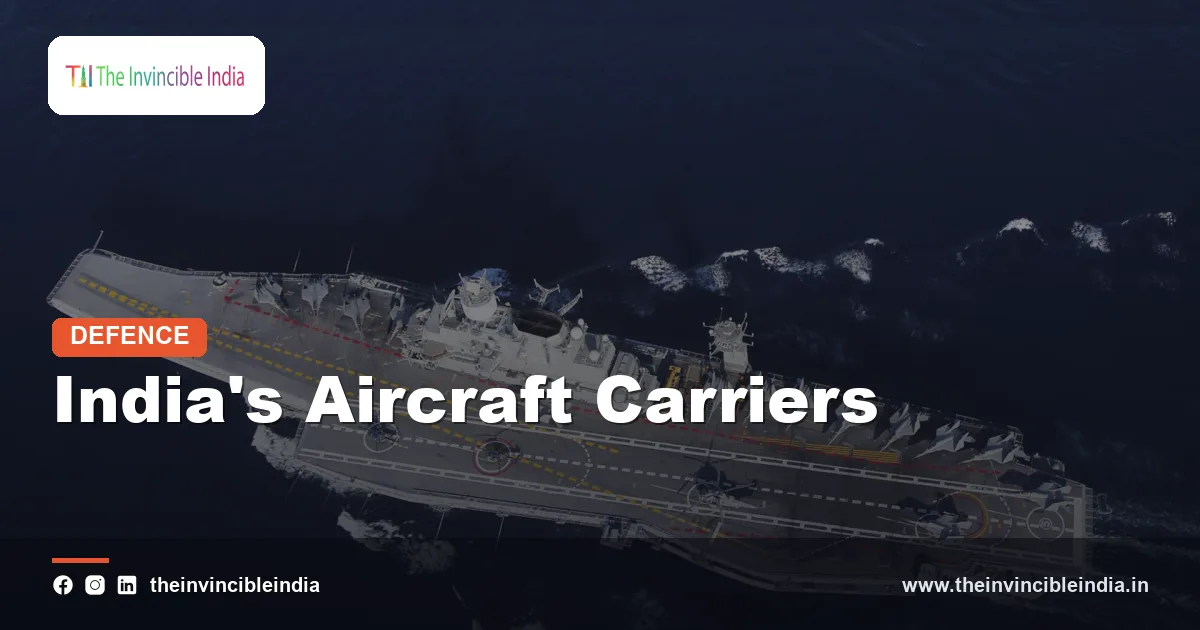
For a country with a coastline of more than 7,500 kilometres, about 1,300 islands and a trade lifeline that runs almost entirely across the sea, naval power is not a luxury. At the heart of that power sit the aircraft carriers: floating airbases that let a navy carry its own air force far from home shores. India has operated carriers for more than six decades, longer than most countries in the world, and today it is among a small group of nations that can design and build one at home.
The story runs from a British-built ship that served in the 1971 war, through a veteran that outlasted its original navy, a rebuilt Russian giant, and finally to the modern INS Vikrant, commissioned in 2022. This explainer covers how carriers work, why India uses a ski-jump deck, the history of each ship, the aircraft they fly, the debate over a third carrier and the arguments for and against carriers in the age of missiles.
Quick Facts
| Topic | Detail |
|---|---|
| First Indian carrier | INS Vikrant (R11), commissioned 4 March 1961 |
| Second carrier | INS Viraat, commissioned 12 May 1987 (ex-HMS Hermes) |
| Current carriers | INS Vikramaditya (2013) and INS Vikrant (2022) |
| First indigenous carrier | INS Vikrant (IAC-1), built at Cochin Shipyard, commissioned 2 September 2022 |
| Launch configuration | STOBAR (Short Take-Off But Arrested Recovery) with ski-jump |
| Main carrier fighter today | MiG-29K, with Rafale-M and the twin-engine deck-based fighter planned |
| Typical displacement | Around 45,000 tonnes for the two current carriers |
| Proposed third carrier | IAC-2 / “INS Vishal”, still a matter of debate |
What Is an Aircraft Carrier and Why Does It Matter?
An aircraft carrier is a warship built around a long flight deck from which fixed-wing aircraft and helicopters take off and land. Instead of depending on a friendly airfield, a navy with aircraft carriers brings its own airfield to the area of operations, anywhere in international waters. The ship becomes a sovereign piece of territory that can move several hundred kilometres in a day.
The idea behind it
Land-based aircraft are limited by range and by the need for permission to use foreign bases. A carrier removes both limits. Its aircraft can patrol the sea, strike targets ashore, defend ships from air attack and hunt submarines, all from a single platform. This is why carriers are often described as the most visible symbol of a “blue-water navy”, meaning a fleet able to operate far from its home coast for long periods.
What a carrier is not
A carrier does not sail alone. It is large, expensive and a high-value target, so it relies on a protective group of escorts. The concept of the Carrier Battle Group, discussed below, is therefore inseparable from the ship itself.
The Carrier Battle Group Concept
A Carrier Battle Group (CBG) is a task force built around one carrier, with surface and sub-surface ships arranged in layers to protect it and extend its reach. The carrier is the centrepiece, but the group is the real fighting unit.
Typical components
- The carrier with its air wing of fighters, helicopters and early-warning aircraft.
- Destroyers and frigates providing air defence, anti-submarine screening and anti-ship firepower.
- Submarines operating ahead of or alongside the group for stealth and scouting.
- Fleet support ships such as tankers and replenishment vessels that keep the group at sea without returning to port.
Layered defence
The outer layer is held by aircraft and submarines, the middle layer by long-range missile destroyers, and the inner layer by short-range missiles and close-in guns. India’s Visakhapatnam-class destroyers, Kolkata-class destroyers and Shivalik-class frigates are among the ships that typically form escort screens around Indian carriers. Operating a CBG demands years of training, since coordination between ships, aircraft and shore-based surveillance must work as a single system.
STOBAR vs CATOBAR: How Aircraft Leave the Deck
Launching a heavy jet from a deck only a few hundred metres long is the central engineering problem of carrier design. Navies solve it in three main ways, and the choice shapes the entire ship.
STOBAR, India’s current choice
STOBAR stands for Short Take-Off But Arrested Recovery. Aircraft take off under their own engine power, helped by an upward-curving ramp at the bow called a ski-jump, which tilts the aircraft into the air at a safe climb angle. On return, a hook under the aircraft catches one of several arrestor wires stretched across the deck, stopping it in a very short distance. Both INS Vikramaditya and the new INS Vikrant use this arrangement.
CATOBAR, used by the US and France
CATOBAR means Catapult Assisted Take-Off But Arrested Recovery. A steam or electromagnetic catapult hurls the aircraft down the deck, allowing heavier loads of fuel and weapons and faster launch rates. The United States Navy and the French Navy use catapults on their larger carriers.
STOVL, the older Indian approach
INS Viraat flew Sea Harrier jets, which could take off and land vertically or after a short run. This Short Take-Off Vertical Landing method needs the least deck equipment but limits aircraft payload and range.
| Method | How it works | Strength | Limitation |
|---|---|---|---|
| STOVL | Short run or vertical landing | Simple and cheap | Limited payload and range |
| STOBAR | Ski-jump launch, arrested landing | No catapult needed, lower cost | Reduced weapon and fuel load at take-off |
| CATOBAR | Catapult launch, arrested landing | Heavier aircraft, faster sorties | Complex, costly, larger ship |
INS Vikrant (R11): India’s First Carrier
India’s carrier story began soon after Independence, when the Navy decided it needed air power at sea. The ship that became the original INS Vikrant was laid down in Britain during the Second World War as HMS Hercules, a Majestic-class light fleet carrier. Construction was suspended when the war ended, and the incomplete hull remained unfinished for years until India purchased it and had it completed.
Commissioning and early service
The ship was commissioned into the Indian Navy on 4 March 1961. It carried Sea Hawk fighter-bombers, Alizé anti-submarine aircraft and helicopters. With a displacement of roughly 20,000 tonnes, it was modest by modern standards but transformative for a young navy, giving India a power-projection capability that few developing nations then possessed.
Why it was important
Vikrant made India one of the first Asian countries to operate a carrier and gave the Navy decades of experience in deck operations, aircrew training and air-sea coordination. That experience carried straight through to the later ships, and many of its veterans trained a new generation of naval aviators.
Vikrant in the 1971 War
The 1971 war with Pakistan was the carrier’s defining moment. During the conflict that led to the creation of Bangladesh, INS Vikrant was deployed in the Bay of Bengal, where its aircraft helped enforce a naval blockade of what was then East Pakistan.
What the carrier did
- Its Sea Hawk fighter-bombers struck military and port targets, including facilities around Chittagong, Cox’s Bazar and Khulna, supporting the effort to cut off supply and escape routes by sea.
- Its Alizé aircraft patrolled for submarines and enemy shipping.
- Its presence forced Pakistan to divert effort to finding and threatening the carrier, which stretched its naval resources.
Legacy of the war
The ship’s contribution was recognised with gallantry awards to its crew. The campaign showed that sea power, and carrier aviation in particular, could shape the outcome of a land conflict by isolating the theatre. The lesson stayed with Indian naval planners and strengthened the case for keeping carriers in the fleet.
Vikrant’s Decline and Retirement
By the 1970s and 1980s, the ageing ship needed repeated refits to remain useful. It was modernised to operate newer aircraft, including Sea Harrier jets, but its machinery and structure were by then decades old. The Navy decommissioned INS Vikrant in January 1997 after about 36 years of service.
The ship was afterwards preserved for some years as a museum in Mumbai, but the cost of maintenance and her deteriorating condition ended that plan, and the hull was eventually sold and dismantled. Its name, however, was not forgotten. When India built its first home-grown carrier, the Navy chose to revive the famous name, which is why the story is often told as one “from Vikrant to Vikrant”.
INS Viraat: The Long-Serving Veteran
India’s second carrier had an even longer career than its first. INS Viraat was originally HMS Hermes, a Centaur-class carrier that entered Royal Navy service in 1959 and served as flagship of the British task force in the 1982 Falklands campaign. India bought the ship in the mid-1980s, and it was commissioned as INS Viraat on 12 May 1987.
Service in India
Viraat operated Sea Harrier fighters and a mix of anti-submarine and utility helicopters. It took part in numerous exercises and operations, including deployments during the tense standoff of 2001-02 when the armed forces were mobilised along the border. Its presence ensured that, for the long years between Vikrant’s retirement and the arrival of the next carrier, India always had at least one flat-top at sea.
Retirement
Viraat was decommissioned in March 2017. Counting its British service, it was among the longest-serving warships in the world, with a career stretching beyond half a century. Its extended life was a result of repeated refits and careful maintenance by Indian engineers.
INS Vikramaditya: A Russian Giant Rebuilt
When Viraat began to age, India needed a larger, more capable carrier. The answer came from Russia. The Soviet-era carrier Admiral Gorshkov, originally a Kiev-class ship equipped with a mix of missile and aircraft capabilities, was offered to India in the 1990s. A formal agreement followed in 2004, under which the ship would be extensively rebuilt in Russia.
The conversion
The conversion was far more than a refit. The forward missile deck was cleared, a ski-jump was built at the bow, arrestor wires were fitted, and the ship’s propulsion and electronics were substantially replaced. The project suffered delays and cost increases, and it took until 2013 to complete. INS Vikramaditya was commissioned on 16 November 2013 at Severodvinsk, with a displacement of roughly 45,000 tonnes.
Capability
Vikramaditya is a full STOBAR carrier and operates MiG-29K fighters, Kamov helicopters for anti-submarine and early-warning roles and other helicopters. It gave India its first modern carrier capable of operating a true multirole fighter, and it served as the Navy’s flagship carrier for the better part of a decade.
The New INS Vikrant (IAC-1): India’s First Indigenous Carrier
The new INS Vikrant, known during construction as Indigenous Aircraft Carrier-1 (IAC-1), is the most important milestone in Indian naval shipbuilding. It was designed by the Navy’s own Directorate of Naval Design and built by Cochin Shipyard Limited in Kerala. The keel was laid in 2009, the ship was launched in 2013 and, after a long programme of harbour and sea trials, it was commissioned on 2 September 2022.
Key features
- A displacement of around 45,000 tonnes and a length of over 260 metres.
- A STOBAR layout with a ski-jump and arrestor wires.
- Gas-turbine propulsion and an air wing of around 30 aircraft, including fighters and helicopters.
- A very large share of indigenous content, including warship-grade steel and many systems sourced from Indian industry.
Why it matters
Very few countries have designed and built their own carriers. By joining that club, India demonstrated mastery of complex warship design, integration and large-scale shipbuilding. The project supported a wide supply chain of Indian firms and gave the country a platform consistent with the “Aatmanirbhar Bharat” goal of self-reliance in defence. With Vikrant and Vikramaditya in service together, the Indian Navy could, for the first time, field two operational carriers.
India’s Carriers at a Glance
| Carrier | Origin | Years in Indian service | Notable |
|---|---|---|---|
| INS Vikrant (R11) | British-built Majestic-class (ex-HMS Hercules) | 1961 to 1997 | First Indian carrier; key role in the 1971 war |
| INS Viraat | Ex-HMS Hermes, Centaur-class | 1987 to 2017 | One of the world’s longest-serving warships; flew Sea Harriers |
| INS Vikramaditya | Ex-Soviet/Russian Admiral Gorshkov, rebuilt | 2013 to present | First carrier to operate MiG-29K; STOBAR conversion |
| INS Vikrant (IAC-1) | Indigenous, Cochin Shipyard | 2022 to present | India’s first home-built carrier; Aatmanirbhar milestone |
The Carrier Air Wing: From MiG-29K to Rafale-M and TEDBF
A carrier is only as good as the aircraft on its deck. The air wing is the weapon, and the ship is the delivery system.
MiG-29K, the present workhorse
The MiG-29K is a carrier-capable variant of the Russian fighter, with folding wings, a strengthened undercarriage and an arrestor hook. It flies from both Indian carriers. Alongside it fly Kamov-31 helicopters for airborne early warning, MH-60R multi-role helicopters for anti-submarine work and locally built helicopters for utility and search-and-rescue tasks.
Rafale-M, the interim step
Because the MiG-29K fleet has faced availability and support challenges, India has moved to induct the Rafale-M, the naval version of the French Rafale, as an interim fighter. It is a proven carrier jet, although designed for catapult launch, and its integration into the Indian STOBAR environment is a point of close technical attention.
TEDBF, the home-grown future
The Twin Engine Deck Based Fighter, or TEDBF, is being developed by India’s Aeronautical Development Agency. As a larger, twin-engine design built specifically for carrier use, it is meant to become the long-term mainstay of the air wing. Separately, the naval variant of the Tejas light combat aircraft has completed ski-jump and arrested-landing trials, proving that an indigenous fighter can operate from a carrier deck, even if it is not the final fighter of choice.
The Debate Over a Third Carrier: IAC-2 and INS Vishal
With two carriers in service, naval planners have long argued for a third. The Navy’s stated reasoning is simple: a carrier must regularly go into long maintenance cycles, so having only two means one may be unavailable at any time, and having three raises the chance that at least two are ready, one on each seaboard.
The proposal
The proposed ship, called IAC-2 or INS Vishal, has been discussed as a larger vessel of perhaps 65,000 tonnes. The most important question is its type. The Navy has leaned towards a CATOBAR design with electromagnetic catapults, which could launch heavier aircraft, early-warning planes and drones. Nuclear propulsion has also been considered, since it would give almost unlimited endurance.
Arguments on both sides
- For a larger carrier: greater range, heavier loads, more sorties and compatibility with the most capable aircraft.
- For a repeat of the existing design: lower cost, faster delivery, proven shipyard experience and less technological risk.
- Against more carriers at all: the money might be better spent on submarines, missiles and surface escorts.
The decision rests on defence budgets, strategic priorities and technology readiness, and has not been settled in a public, final form.
Why Carriers Matter to India
India sits at the centre of the Indian Ocean, through which a very large share of the world’s oil and container trade passes. The Navy’s mission is shaped by that geography.
Strategic roles
- Power projection: carrier aircraft can reach targets and influence events across the Indian Ocean Region without needing foreign bases.
- Sea control: a carrier-based air wing helps protect shipping lanes and deny them to an adversary.
- Deterrence and diplomacy: a visiting carrier group signals presence, reassures partners and builds goodwill through joint exercises.
- Humanitarian assistance and disaster relief (HADR): the large deck, hangar and helicopters can support relief and evacuation after cyclones, tsunamis and earthquakes.
A growing regional picture
As more navies expand their presence in the Indian Ocean, India’s ability to keep a credible, flexible force at sea has become a core pillar of its maritime strategy. Carriers are the most visible part of that effort, but they work alongside submarines, long-range patrol aircraft and shore-based surveillance.
The Counter-Argument and the Global Comparison
Not every analyst agrees that carriers are the best use of limited defence funds. The criticisms are worth understanding.
Cost
A carrier is one of the most expensive items a navy can own. The ship itself is only part of the bill: aircraft, escorts, supply ships, training and long-term maintenance multiply the total. Critics argue that these sums could buy a larger number of submarines or missile-armed ships.
Vulnerability
Modern anti-ship ballistic and cruise missiles, quiet submarines and drones have changed the threat picture. A carrier is large and hard to hide, and defending it requires a sophisticated layered screen. Sceptics note that one successful hit could mean a heavy loss of life, equipment and prestige.
The defenders’ reply
Supporters respond that a well-defended carrier group is very difficult to target, that no other platform offers the same mix of flexibility and reach, and that denying the use of carriers to oneself would simply cede the sea to others. The debate is likely to continue as technology evolves.
How India Compares with Other Carrier Navies
The carrier club is small, and its members differ greatly in scale.
- United States: operates by far the largest carrier fleet, with large nuclear-powered supercarriers using catapults and carrying around 70 to 90 aircraft each.
- China: began with Liaoning, a rebuilt ex-Soviet hull, followed by the home-built Shandong and the catapult-equipped Fujian, launched in 2022. It is expanding its carrier force rapidly.
- Others: France, the United Kingdom, Italy, Spain and Russia also operate carriers or carrier-type ships, usually in smaller numbers.
India’s carriers are medium-sized and conventionally powered, with smaller air wings than American supercarriers, yet they are well matched to the Navy’s regional focus. What sets India apart is the combination of a long carrier tradition and, since 2022, a locally designed and built ship.
Conclusion
From the first INS Vikrant of 1961 to the new INS Vikrant of 2022, India’s carriers trace a clear arc from borrowed hulls to indigenous design. The Navy moved from British-built ships to a Russian conversion and finally to a ship built in Kerala by Indian engineers. Future choices, including the aircraft on deck and the possible third carrier, will determine how this capability evolves. What is already clear is that the carrier has become a lasting part of India’s maritime identity and its role in the Indian Ocean.
Frequently Asked Questions
How many aircraft carriers does India have?
India currently operates two carriers, INS Vikramaditya, commissioned in 2013, and the indigenously built INS Vikrant, commissioned in 2022. Earlier carriers, the original Vikrant and Viraat, have been retired.
Which is India’s first indigenous aircraft carrier?
The new INS Vikrant (IAC-1) is India’s first indigenously built carrier. It was designed by the Navy’s Directorate of Naval Design, built at Cochin Shipyard Limited in Kerala and commissioned on 2 September 2022.
What is the difference between STOBAR and CATOBAR?
In a STOBAR carrier, aircraft take off using their own engines with the help of a ski-jump ramp and land using arrestor wires. In a CATOBAR carrier, a catapult launches the aircraft, which allows heavier loads and faster launch rates but needs a larger, more complex ship.
Which fighters fly from Indian carriers?
The MiG-29K is the main carrier fighter today. India is bringing in the Rafale-M as an interim measure and is developing a twin-engine deck-based fighter, the TEDBF, for the long term.
Why did the original INS Vikrant matter?
The original Vikrant, commissioned in 1961, was India’s first carrier. It played an important role in the 1971 war by helping enforce a naval blockade of East Pakistan, and it gave the Navy decades of carrier experience before retiring in 1997.
Will India build a third aircraft carrier?
A third carrier, called IAC-2 or INS Vishal, has been proposed and discussed, with debate over whether it should be larger and catapult-equipped. As of now, the matter depends on budget, strategy and technology decisions rather than a settled public programme.
{“@context”:”https://schema.org”,”@graph”:[{“@type”:”FAQPage”,”mainEntity”:[{“@type”:”Question”,”name”:”How many aircraft carriers does India have?”,”acceptedAnswer”:{“@type”:”Answer”,”text”:”India currently operates two carriers, INS Vikramaditya, commissioned in 2013, and the indigenously built INS Vikrant, commissioned in 2022. Earlier carriers, the original Vikrant and Viraat, have been retired.”}},{“@type”:”Question”,”name”:”Which is India’s first indigenous aircraft carrier?”,”acceptedAnswer”:{“@type”:”Answer”,”text”:”The new INS Vikrant (IAC-1) is India’s first indigenously built carrier. It was designed by the Navy’s Directorate of Naval Design, built at Cochin Shipyard Limited in Kerala and commissioned on 2 September 2022.”}},{“@type”:”Question”,”name”:”What is the difference between STOBAR and CATOBAR?”,”acceptedAnswer”:{“@type”:”Answer”,”text”:”In a STOBAR carrier, aircraft take off using their own engines with the help of a ski-jump ramp and land using arrestor wires. In a CATOBAR carrier, a catapult launches the aircraft, which allows heavier loads and faster launch rates but needs a larger, more complex ship.”}},{“@type”:”Question”,”name”:”Which fighters fly from Indian carriers?”,”acceptedAnswer”:{“@type”:”Answer”,”text”:”The MiG-29K is the main carrier fighter today. India is bringing in the Rafale-M as an interim measure and is developing a twin-engine deck-based fighter, the TEDBF, for the long term.”}},{“@type”:”Question”,”name”:”Why did the original INS Vikrant matter?”,”acceptedAnswer”:{“@type”:”Answer”,”text”:”The original Vikrant, commissioned in 1961, was India’s first carrier. It played an important role in the 1971 war by helping enforce a naval blockade of East Pakistan, and it gave the Navy decades of carrier experience before retiring in 1997.”}},{“@type”:”Question”,”name”:”Will India build a third aircraft carrier?”,”acceptedAnswer”:{“@type”:”Answer”,”text”:”A third carrier, called IAC-2 or INS Vishal, has been proposed and discussed, with debate over whether it should be larger and catapult-equipped. As of now, the matter depends on budget, strategy and technology decisions rather than a settled public programme.”}}]}]}