


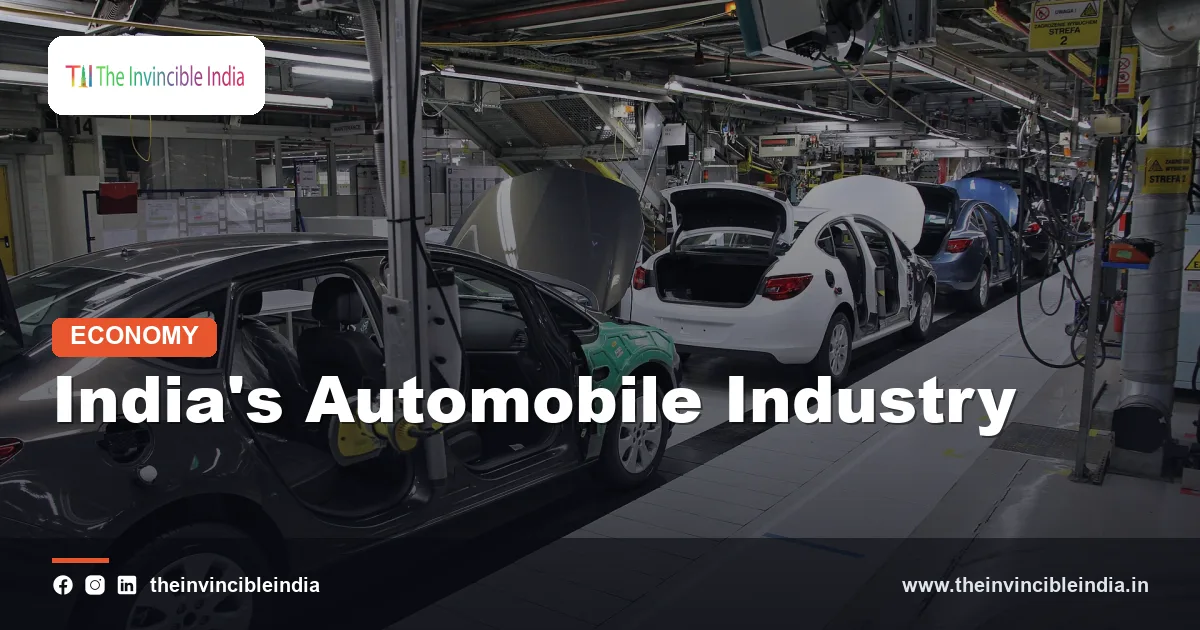
The India automobile industry is one of the largest and most influential manufacturing sectors in the world. Every day, millions of motorcycles, scooters, cars, trucks, tractors and three-wheelers roll out of factories from Chennai to Gurugram, and the sector supports a vast web of suppliers, dealers, financiers, mechanics and drivers. It is a pillar of Indian manufacturing, contributing meaningfully to GDP, industrial output, exports and employment.
This explainer traces how a country that once waited years for a scooter or an Ambassador car became the world’s biggest two-wheeler market and one of its leading car markets. It covers the history, the major segments and companies, the supplier ecosystem and industrial clusters, the shift towards electric vehicles, and the challenges that will shape the next phase of growth.
| Quick Facts | Details |
|---|---|
| Position in two-wheelers and three-wheelers | Largest market in the world by volume |
| Position in passenger vehicles | Among the top three markets globally by annual sales |
| Market leader in cars | Maruti Suzuki (Maruti Udyog was set up in 1981) |
| Landmark car launch | Maruti 800, launched in December 1983 |
| Turning point | Economic liberalisation of 1991 opened the sector to global makers |
| Tractors | Mahindra is the world’s largest tractor maker by volume |
| Landmark overseas deal | Tata Motors acquired Jaguar Land Rover in 2008 |
| Emission norms | Bharat Stage VI introduced nationwide from April 2020 |
| Industry bodies | SIAM (vehicles) and ACMA (components) |
Why the India Automobile Industry Matters
Few industries touch as many parts of the economy as automobiles. A single vehicle contains thousands of components made from steel, aluminium, rubber, plastic, glass, copper and increasingly electronics and software. Each of those inputs comes from another industry, so when vehicle sales rise, demand ripples through metals, chemicals, logistics, finance and insurance. This is why economists call the automobile sector a strong multiplier in the manufacturing economy.
Contribution to the economy
- GDP and manufacturing: The sector accounts for a significant share of national GDP and a still larger share of manufacturing GDP.
- Employment: It provides direct and indirect jobs to many millions of people, spanning factory workers, engineers, component suppliers, dealership staff, drivers and repair mechanics.
- Exports: India ships motorcycles, scooters, three-wheelers, passenger cars and components to markets across Africa, Latin America, South Asia, the Middle East and Europe.
- Tax revenue: Vehicles and fuel are a major source of indirect tax revenue for both the Centre and the states.
Mobility and daily life
Beyond statistics, vehicles shape how Indians live and work. A motorcycle lets a salaried worker commute from a distant suburb, a small truck connects a farmer to a mandi, and an auto-rickshaw or e-rickshaw gives a family its livelihood. Vehicle ownership is among the clearest markers of rising household incomes, which is why auto sales are watched closely as an indicator of consumer confidence.
A Brief History: From Licence Raj to Global Hub
The story of the Indian car industry is really a story of policy. For decades after Independence, the sector was tightly regulated, and that shaped everything from the cars people drove to how long they waited for them.
The protected era before 1991
After Independence, the government encouraged domestic production through licensing, import restrictions and high tariffs. Two cars dominated the roads. The Hindustan Ambassador, produced by Hindustan Motors from the late 1950s and based on a British Morris design, became the vehicle of officials, taxi drivers and the well-off. The Premier Padmini, built by Premier Automobiles under licence from Fiat, was the favourite of Mumbai’s taxis and many middle-class families. Choice was limited, waiting lists were long and technology changed slowly. On two wheels, Bajaj scooters, Vespa-based models and Royal Enfield motorcycles were the household names.
Maruti and the motorised middle class
The real break came in the early 1980s. Maruti Udyog was established in 1981 and entered a partnership with Japan’s Suzuki. The Maruti 800, launched in December 1983, was small, fuel-efficient, affordable and reliable, and it put a car within reach of the growing middle class. Suzuki gradually took a larger role, and the company eventually became Maruti Suzuki, which has remained the country’s largest carmaker ever since.
The 1991 reforms
The economic liberalisation of 1991 removed many licensing barriers and welcomed foreign investment. In the years that followed, global manufacturers set up shop in India: Hyundai, Honda, Toyota, Ford, General Motors and later Kia, MG and others. Competition forced every player to improve quality, expand model ranges and cut costs, and Indian buyers gained choices that earlier generations could hardly imagine.
The Scale of the India Automobile Industry
By volume, India is the largest two-wheeler and three-wheeler market on the planet, and it ranks among the top three markets for passenger vehicles. It is also one of the leading producers of commercial vehicles and by far the largest producer of tractors in the world. Taken together, only a handful of countries manufacture more vehicles in a year.
What drives demand
- A young, growing population with rising aspirations and first-time vehicle buyers entering the market every year.
- Low vehicle penetration compared with developed economies, which leaves substantial room for growth in car and two-wheeler ownership.
- Accessible finance through banks and non-banking lenders, which has made instalment-based buying the norm.
- Rural demand, which depends heavily on monsoons, crop prices and farm incomes.
- Improving roads and expressway networks, which encourage the use of personal and commercial vehicles.
Production for the world
India is not only a large consumer but also a manufacturing base. Several global companies use their Indian plants to build vehicles and engines for export, taking advantage of skilled engineers, a deep supplier network and competitive costs.
Two-Wheelers: The Backbone of Indian Mobility
If one segment defines the India automobile industry, it is the two-wheeler. Motorcycles and scooters account for the overwhelming majority of vehicles sold in the country, and they are often a family’s first motorised purchase.
The big players
- Hero MotoCorp: Born from the Hero Honda joint venture of 1984, which split in the early 2010s, it remains among the largest two-wheeler makers on Earth.
- Honda Motorcycle and Scooter India: Strong in scooters such as the Activa and in commuter motorcycles.
- TVS Motor: A Chennai-based company with a wide range from mopeds to premium motorcycles and electric scooters.
- Bajaj Auto: Famed for the Chetak scooter in the past and the Pulsar motorcycle line, and a major exporter.
- Royal Enfield: Part of Eicher Motors, dominant in the mid-size cruiser and classic motorcycle space.
- Suzuki, Yamaha and others: Smaller but established players.
Why two-wheelers dominate
They are affordable, fuel-efficient, easy to park and ideal for crowded cities and rural roads alike. Because they are often bought on credit and depend on household incomes, their sales also act as a barometer of rural prosperity.
Passenger Vehicles: Cars, SUVs and Changing Tastes
The passenger vehicle segment, which includes cars, utility vehicles and vans, has changed dramatically since the days of the Ambassador. Small hatchbacks long dominated sales, but buyers have steadily moved towards compact SUVs and larger utility vehicles as incomes have risen.
Leading manufacturers
- Maruti Suzuki: The long-standing leader, with an extensive sales and service network reaching small towns.
- Hyundai Motor India: Present since the late 1990s and a consistent number two or three, known for a strong product mix.
- Tata Motors: A home-grown player that has strengthened its position with SUVs and a leading role in electric cars.
- Mahindra and Mahindra: A specialist in sport utility vehicles with a strong rural and urban following.
- Kia and Toyota: Kia arrived in India in 2019 and quickly built a sizeable share, while Toyota Kirloskar is strong in MPVs and hybrids.
- Honda, Renault, Skoda-Volkswagen, MG and others: Serving particular niches and price points.
Premium and luxury
German brands such as Mercedes-Benz, BMW and Audi have long assembled cars locally, while the premium segment has grown alongside the number of high-income households.
Commercial Vehicles, Tractors and Three-Wheelers
Beyond personal vehicles, India’s economy runs on goods carriers, buses and farm machines.
Commercial vehicles
Trucks and buses move most of India’s freight and a large share of its passengers. Tata Motors, which began in 1945 as a locomotive and truck maker, and Ashok Leyland, founded in the late 1940s, are the traditional leaders, joined by Mahindra, Eicher-Volvo and others. Demand for trucks tracks economic activity: construction, mining, infrastructure projects and the movement of goods all feed into it. The introduction of the Goods and Services Tax in 2017, which removed many state-border checks, also changed logistics and encouraged larger, more efficient trucks.
Tractors
Agriculture still employs a large part of the population, and India is the world’s biggest tractor market. Mahindra is the world’s largest tractor maker by volume, with others such as Sonalika, TAFE, Escorts Kubota and John Deere India also prominent. Tractor sales respond closely to rainfall, harvests and minimum support prices.
Three-wheelers
Auto-rickshaws, cargo carriers and e-rickshaws provide last-mile transport in cities and towns. Bajaj Auto and Piaggio are among the best-known makers, and India is both the largest market and a significant exporter of three-wheelers.
Segments and leaders at a glance
| Segment | Notable Makers | Key Role |
|---|---|---|
| Two-wheelers | Hero MotoCorp, Honda, TVS, Bajaj, Royal Enfield | Largest segment by volume; first vehicle for millions |
| Passenger vehicles | Maruti Suzuki, Hyundai, Tata, Mahindra, Kia, Toyota | Cars and SUVs; growth in utility vehicles |
| Commercial vehicles | Tata Motors, Ashok Leyland, Mahindra, Eicher | Freight and public transport backbone |
| Tractors | Mahindra, Sonalika, TAFE, Escorts Kubota | Farm mechanisation; world’s largest market |
| Three-wheelers | Bajaj, Piaggio, Mahindra, e-rickshaw makers | Last-mile passenger and cargo mobility |
The Auto Component Ecosystem and Industrial Clusters
A carmaker is only as good as its suppliers. India has a large and sophisticated auto components industry, represented by the Automotive Component Manufacturers Association (ACMA), which makes everything from engines, transmissions and brakes to seats, lighting and electronics. Many component makers supply both Indian assembly lines and global carmakers abroad, and the sector has emerged as a significant exporter in its own right.
Where the vehicles are made
- Chennai and surrounding Tamil Nadu: Often called the “Detroit of India”, this hub hosts Hyundai, Ford’s former plant, Renault-Nissan, BMW, Daimler and numerous suppliers, with its ports aiding exports.
- NCR, Gurugram and Manesar: The Delhi-Haryana belt is home to Maruti Suzuki’s main plants and Hero MotoCorp, supported by a dense cluster of vendors.
- Pune and Chakan: A long-established engineering centre with Tata Motors, Bajaj Auto, Mercedes-Benz and Volkswagen.
- Gujarat, including Sanand: Gained prominence when the Tata Nano plant moved there in 2008, and now hosts several carmakers.
- Karnataka, Andhra Pradesh and the East: Toyota near Bengaluru, Kia in Anantapur and growing activity elsewhere.
Why clusters matter
Locating suppliers near assembly plants cuts logistics costs and enables just-in-time production. The cluster model also builds a local skilled workforce and supports small and medium enterprises that serve larger firms.
Exports and Global Footprint
Exports have become a major growth engine. Indian two-wheelers are common on roads in Africa, Latin America and South and Southeast Asia, while three-wheelers serve markets where compact commercial transport is vital. Passenger cars, led by Maruti Suzuki and Hyundai among others, are shipped in significant numbers to Africa, the Middle East, Latin America and neighbouring countries.
Indian companies abroad
The most celebrated overseas deal remains Tata Motors’ 2008 purchase of Jaguar Land Rover from Ford. At the time, it was a bold step for an Indian industrial house, as it brought two famed British marques under Indian ownership and gave Tata access to advanced design, engineering and global luxury markets. Other Indian groups, including Mahindra with its acquisitions in tractors, motorcycles and design, and component firms like Motherson, have likewise expanded globally.
Policy support
The government’s Automotive Mission Plan documents and trade policy have encouraged exports, while free trade agreements and the manufacturing push under the “Make in India” initiative have sought to make India a reliable global sourcing hub.
The Electric Vehicle Revolution
The biggest shift in the India automobile industry today is the move towards electric mobility. Concerns about air pollution, crude oil imports and climate change have driven policymakers and manufacturers to bet on electric vehicles, or EVs.
Government support
- FAME scheme: The Faster Adoption and Manufacturing of Electric Vehicles scheme, launched in 2015 and expanded in its second phase from 2019, provided purchase incentives, with a focus on two-wheelers, three-wheelers, buses and charging infrastructure.
- PLI for automobiles and auto components: The production-linked incentive scheme approved in 2021 rewards companies for domestic manufacturing of advanced automotive technology products.
- PLI for Advanced Chemistry Cell batteries: Aimed at building domestic battery manufacturing capacity to reduce import dependence.
- State policies and GST cuts: Many states offer registration waivers and subsidies, and EVs attract a much lower rate of GST than petrol or diesel vehicles.
Where EVs are growing fastest
Electric two-wheelers and three-wheelers have led the transition because they are smaller, need smaller batteries and are cheaper to run. Start-ups such as Ola Electric and Ather Energy have joined established names like TVS, Bajaj and Hero in the electric scooter market. E-rickshaws, which spread rapidly across cities, are now a common sight. In cars, Tata Motors took an early lead with electric models, and Mahindra, MG and others have followed, while electric buses are increasingly used by city transport agencies.
Challenges Facing the Industry
Despite its strengths, the sector must navigate several tough challenges at once.
Technology and regulation
- Cleaner norms: India leapfrogged from Bharat Stage IV to Bharat Stage VI in April 2020, skipping BS-V. The shift required heavy investment in engines, fuel quality and exhaust systems, and pushed up vehicle prices.
- The EV transition: Companies must invest in electric platforms while continuing to sell petrol, diesel, CNG and hybrid vehicles for years to come.
Supply chain and market risks
- Cyclical demand: Auto sales swing with interest rates, fuel prices, festive seasons, rural incomes and economic sentiment.
- Semiconductor shortages: The global chip shortage of 2021 and 2022 disrupted production and lengthened waiting periods for many models.
- Battery and mineral imports: India relies on imports for battery cells and critical minerals such as lithium, which raises supply-chain concerns.
- Charging infrastructure: Public chargers remain limited outside major cities, and apartment-dwellers often lack home charging.
- Affordability: Electric vehicles generally cost more upfront, and many buyers worry about resale value and battery life.
- Intense competition: New entrants, global brands and domestic start-ups compete fiercely on price, features and technology.
Jobs, skills and the road ahead
The industry’s long-term story depends heavily on people. Engineers, designers, technicians, battery specialists and software developers are in rising demand, and traditional skills such as engine tuning and machining must evolve alongside the shift to electric drivetrains. Industrial training institutes, engineering colleges and company-run academies are working to prepare workers for this change.
Emerging priorities
- Vehicle scrappage: A voluntary scrappage policy introduced in 2021 aims to retire old, polluting vehicles and spur demand for new ones.
- Alternative fuels: Interest in CNG, ethanol blending, flex-fuel engines, hybrids and green hydrogen is growing alongside EVs.
- Connected and safer cars: Features such as airbags, safety ratings and driver-assistance systems are becoming standard expectations.
- Research and design: Global firms increasingly set up engineering and development centres in India.
Because millions of livelihoods depend on this sector, its transition must balance climate goals with job security for workers in traditional engine and component businesses.
Conclusion
From the unhurried Ambassador to the compact Maruti 800, from the licence era to a market crowded with global brands, the India automobile industry has transformed in a few decades. It now stands as one of the largest manufacturers and markets in the world, a leader in two-wheelers, three-wheelers and tractors, and a growing exporter of cars and components. The next chapter will be written by electric mobility, cleaner fuels, local battery manufacturing and the ability of the supplier ecosystem to adapt. How well it handles these changes will matter not just for carmakers but for jobs, trade and the broader Indian economy. Last reviewed: 1 October 2026.
Frequently Asked Questions
How big is the India automobile industry globally?
India is the world’s largest market for two-wheelers and three-wheelers by volume, and it ranks among the top three markets for passenger vehicles. It is also the largest tractor producer and a significant manufacturer of commercial vehicles and auto components.
Which company leads the Indian car market?
Maruti Suzuki has been the largest passenger vehicle maker for decades. It began as Maruti Udyog in 1981 and launched the Maruti 800 in 1983. Hyundai, Tata Motors, Mahindra, Kia and Toyota are among its main competitors.
What was the Ambassador and why is it famous?
The Hindustan Ambassador was a car made by Hindustan Motors from the late 1950s and based on a British Morris design. For decades it was the dominant car on Indian roads and a symbol of government and taxi travel, until liberalisation brought a wider range of choices.
Why was 1991 important for Indian automobiles?
The 1991 economic reforms reduced licensing controls and opened the economy to foreign investment. Global manufacturers entered India in the following years, which increased competition, quality and consumer choice.
What is the government doing to promote electric vehicles?
The government has used the FAME scheme for demand incentives, production-linked incentive schemes for automobiles, components and Advanced Chemistry Cell batteries, and lower GST on EVs. States also provide their own subsidies and tax benefits.
What are the biggest challenges for the sector?
Key challenges include the transition to electric vehicles, stricter emission norms such as BS-VI, cyclical demand, semiconductor supply disruptions, dependence on imported battery cells and minerals, limited charging infrastructure and strong competition.
{“@context”:”https://schema.org”,”@graph”:[{“@type”:”FAQPage”,”mainEntity”:[{“@type”:”Question”,”name”:”How big is the India automobile industry globally?”,”acceptedAnswer”:{“@type”:”Answer”,”text”:”India is the world’s largest market for two-wheelers and three-wheelers by volume, and it ranks among the top three markets for passenger vehicles. It is also the largest tractor producer and a significant manufacturer of commercial vehicles and auto components.”}},{“@type”:”Question”,”name”:”Which company leads the Indian car market?”,”acceptedAnswer”:{“@type”:”Answer”,”text”:”Maruti Suzuki has been the largest passenger vehicle maker for decades. It began as Maruti Udyog in 1981 and launched the Maruti 800 in 1983. Hyundai, Tata Motors, Mahindra, Kia and Toyota are among its main competitors.”}},{“@type”:”Question”,”name”:”What was the Ambassador and why is it famous?”,”acceptedAnswer”:{“@type”:”Answer”,”text”:”The Hindustan Ambassador was a car made by Hindustan Motors from the late 1950s and based on a British Morris design. For decades it was the dominant car on Indian roads and a symbol of government and taxi travel, until liberalisation brought a wider range of choices.”}},{“@type”:”Question”,”name”:”Why was 1991 important for Indian automobiles?”,”acceptedAnswer”:{“@type”:”Answer”,”text”:”The 1991 economic reforms reduced licensing controls and opened the economy to foreign investment. Global manufacturers entered India in the following years, which increased competition, quality and consumer choice.”}},{“@type”:”Question”,”name”:”What is the government doing to promote electric vehicles?”,”acceptedAnswer”:{“@type”:”Answer”,”text”:”The government has used the FAME scheme for demand incentives, production-linked incentive schemes for automobiles, components and Advanced Chemistry Cell batteries, and lower GST on EVs. States also provide their own subsidies and tax benefits.”}},{“@type”:”Question”,”name”:”What are the biggest challenges for the sector?”,”acceptedAnswer”:{“@type”:”Answer”,”text”:”Key challenges include the transition to electric vehicles, stricter emission norms such as BS-VI, cyclical demand, semiconductor supply disruptions, dependence on imported battery cells and minerals, limited charging infrastructure and strong competition.”}}]}]}