


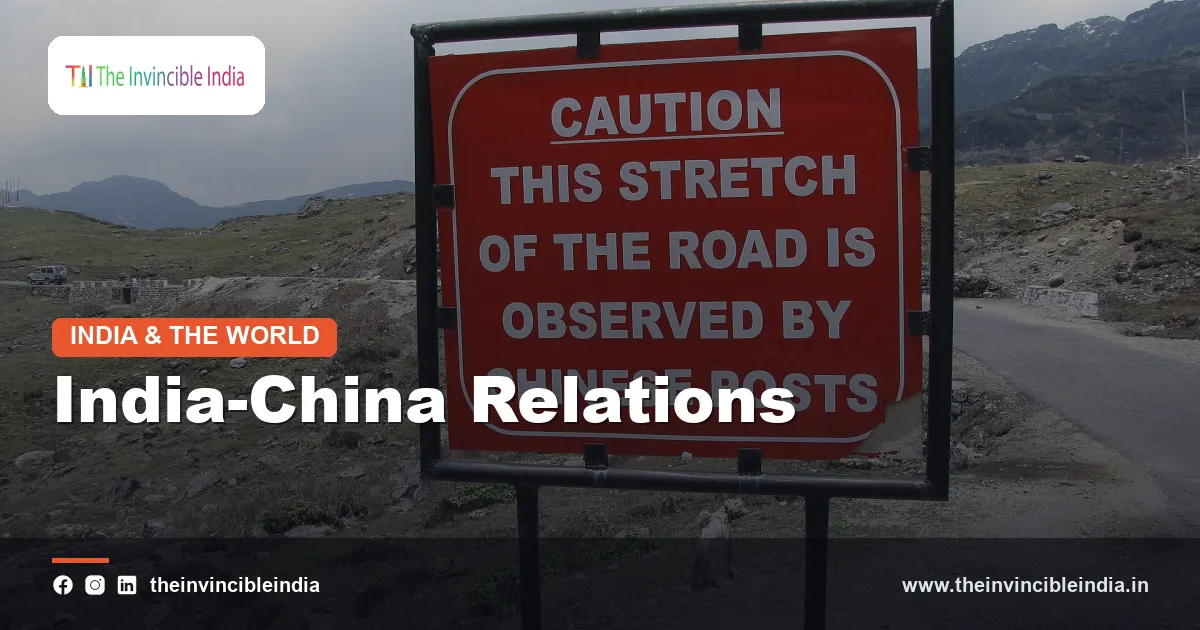
India-China relations are among the most consequential bilateral ties in the world. The two countries are the most populous nations on Earth, neighbours along one of the longest and highest land frontiers anywhere, and heirs to two of the oldest continuous civilisations. Their contacts stretch back to the era of Buddhism, the Silk Road and maritime trade, yet the modern relationship has been shaped far more by twentieth-century politics, an unsettled boundary and a rivalry for influence across Asia.
What makes the relationship distinctive is that cooperation, competition and conflict all exist side by side. The two sit together in forums such as BRICS and the Shanghai Cooperation Organisation, trade goods worth well over US$100 billion a year, and cooperate on global issues like climate negotiations. At the same time, they have fought a war, faced repeated military standoffs, and disagree on borders, water, regional influence and the status of Tibet. This overview explains how the relationship evolved and why it matters.
| Quick Facts | Key Detail |
|---|---|
| Recognition of the PRC by India | Recognised the People’s Republic of China at the end of 1949, among the first non-communist countries to do so |
| Formal diplomatic ties | Established on 1 April 1950 |
| Panchsheel Agreement | Signed 29 April 1954 (trade and intercourse with the Tibet Region of China) |
| Sino-Indian War | October to November 1962 |
| Disputed frontier | Un-demarcated Line of Actual Control (LAC), roughly 3,400 km long by Indian reckoning |
| Major standoffs | Doklam (2017) and Galwan Valley (June 2020) |
| Shared multilateral platforms | BRICS, Shanghai Cooperation Organisation, G20 |
| Economic link | China is one of India’s largest trading partners, with a large trade deficit for India |
Two Asian Giants: The Big Picture
Both India and China emerged from long periods of foreign domination in the late 1940s. India became independent in 1947, and the People’s Republic of China was proclaimed in 1949. Each set out to rebuild a vast, poor and diverse society, and each saw itself as a natural leader of the post-colonial world. That shared starting point produced early warmth, but it also planted the seeds of rivalry, because two rising powers in the same region inevitably compete for space, prestige and security.
Geography adds to the complexity. The Himalayas, once a formidable barrier, became a contested frontier after China took control of Tibet in the early 1950s and the buffer between the two states disappeared. Today the relationship is best understood through several overlapping lenses:
- Security: an unresolved boundary and a heavy military presence on both sides.
- Economy: deep commercial links alongside worries about dependence.
- Regional influence: competition in South Asia and the Indian Ocean.
- Global order: a shared interest in a multipolar world, but very different partnerships.
Seeing these lenses together helps explain why headlines about the relationship can swing between talks and tension so quickly. A stable trade relationship can coexist with a military standoff, and a friendly summit can coexist with a disagreement at the United Nations.
The Early Years: Recognition, Bhai-Bhai and Panchsheel
Recognition and “Hindi-Chini Bhai-Bhai”
India was one of the first countries outside the communist bloc to recognise the People’s Republic of China, doing so at the close of 1949, and the two exchanged formal diplomatic relations on 1 April 1950. Indian leaders backed Beijing’s claim to China’s seat at the United Nations and argued that a stable Asia required China’s inclusion in international affairs. This period was marked by an optimistic vision of Asian solidarity, championed by Jawaharlal Nehru.
The mood of the decade was captured in the slogan “Hindi-Chini Bhai-Bhai”, meaning “Indians and Chinese are brothers”. Cultural delegations, visits by leaders and friendly public statements were common through the mid-1950s. Both countries also took part in the 1955 Asian-African Conference at Bandung in Indonesia, a landmark meeting of newly independent nations that laid the groundwork for what later became the Non-Aligned Movement.
The Panchsheel Agreement of 1954
The Panchsheel Agreement was signed in Beijing on 29 April 1954. Formally titled the Agreement on Trade and Intercourse between the Tibet Region of China and India, it recognised the new situation in Tibet and set out arrangements for trade, pilgrimage and the movement of traders. Its preamble contained the Five Principles of Peaceful Coexistence, known in India as Panchsheel:
- Mutual respect for each other’s territorial integrity and sovereignty.
- Mutual non-aggression.
- Mutual non-interference in each other’s internal affairs.
- Equality and mutual benefit.
- Peaceful coexistence.
These ideas became a reference point for Indian foreign policy and were later echoed in declarations of the non-aligned world. The agreement was set to last eight years and lapsed in 1962, the same year the two countries went to war. Critics have often pointed out that the treaty did not address the boundary question at all, and that this silence later proved costly. Even so, the Five Principles continue to be cited by both governments as an ideal framework for relations between states.
Why the goodwill did not last
Beneath the warm language, some fundamental questions were left unresolved. India inherited boundaries drawn in the colonial period, while China questioned the legitimacy of several of them. Beijing’s consolidation of control over Tibet, and India’s decision to shelter the Dalai Lama in 1959, added sharp new tensions. The friendship of the 1950s thus rested on diplomacy and goodwill rather than on a settled frontier.
Tibet and the Dalai Lama Factor
Tibet sits at the heart of the strategic relationship. For centuries it served as a buffer between the Indian subcontinent and China, and India inherited certain colonial-era privileges there, including trade agencies and postal facilities. After the Chinese military entered Tibet in 1950 and the region was brought under Beijing’s authority, India gradually accepted the new reality. In the 1954 agreement, India recognised the Tibet Region as part of China.
The picture changed in March 1959, when a revolt in Lhasa was followed by the flight of the 14th Dalai Lama, who crossed into India and was granted asylum. Tens of thousands of Tibetans followed. The Tibetan government-in-exile is based at Dharamshala in Himachal Pradesh, and India hosts a large Tibetan refugee community.
Successive Indian governments have stated that they regard the Tibet Autonomous Region as part of the People’s Republic of China, while also maintaining that the Dalai Lama is a revered religious figure who is not permitted to conduct political activity from Indian soil. China, for its part, watches India’s handling of Tibetan affairs closely, and issues such as the succession of the Dalai Lama remain sensitive. The Tibet question also matters for a practical reason: several of the great rivers of South Asia rise on the Tibetan plateau, which gives the region enormous strategic and ecological weight.
The 1962 Sino-Indian War
By the late 1950s, disagreements over the boundary in Ladakh and the eastern Himalaya had hardened. China built a road through Aksai Chin linking Xinjiang and Tibet, which India discovered only after it was under way. India adopted what was called the “forward policy”, setting up small border posts in disputed areas. Talks between the two prime ministers in 1960 failed to bridge the gap.
On 20 October 1962, Chinese forces launched coordinated attacks in both the western sector and the eastern sector, then known as the North-East Frontier Agency. The fighting lasted about a month. Indian forces, fighting in extreme terrain and short of preparation, suffered heavy setbacks. On 21 November 1962, China announced a unilateral ceasefire and withdrew from parts of the territory it had advanced into in the east, while retaining control of Aksai Chin.
Lasting impact
The war left a deep mark on India. It led to a major expansion and modernisation of the armed forces, a rethinking of defence spending and infrastructure in border areas, and lasting public distrust of Chinese intentions. Diplomatic ties were downgraded, and ambassadors were not exchanged again until 1976. The experience is often described as a defining lesson that shaped Indian security thinking for decades. For China, the war reinforced its control over the strategically vital route through Aksai Chin.
The Boundary Dispute and the Line of Actual Control
The India-China boundary has never been fully delineated or demarcated on the ground. In its place stands the Line of Actual Control, or LAC, which separates the areas each side administers. The two countries do not share a common understanding of exactly where the LAC runs in some places, and this ambiguity is why patrols sometimes come face to face. India regards the frontier as about 3,400 km in length, while Chinese descriptions of the length are shorter.
The frontier is conventionally divided into three sectors.
| Sector | Indian Territory Involved | Nature of the Dispute |
|---|---|---|
| Western | Ladakh (Union Territory) | China controls Aksai Chin, which India claims as part of Ladakh; differing perceptions of the LAC exist at several other points |
| Middle | Himachal Pradesh and Uttarakhand | The least contested stretch, with limited differences over a few pockets |
| Eastern | Sikkim and Arunachal Pradesh | China claims much of Arunachal Pradesh, calling it “South Tibet”; the Sikkim boundary is based on an 1890 convention |
Aksai Chin and the western sector
Aksai Chin is a high, sparsely populated plateau of roughly 38,000 square kilometres that India considers part of Ladakh. China administers it, and a highway running through it connects Xinjiang with Tibet. In 1963, Pakistan also handed over the Shaksgam Valley to China under a boundary agreement, a transfer India rejects because it regards the area as part of Jammu and Kashmir.
Arunachal Pradesh and the McMahon Line
In the east, the border follows the McMahon Line, drawn during the 1913-14 Simla Conference and named after the British official Henry McMahon. India regards it as the legal boundary. China has never accepted the Simla Convention and argues that Tibet lacked the authority to sign a treaty. Beijing claims a large portion of Arunachal Pradesh, which India firmly rejects, treating the state as an integral part of the country. Disputes occasionally surface in the form of stapled visas for residents of the state or attempts to rename places there.
Keeping the Peace: Confidence-Building Agreements
After the freeze that followed 1962, relations slowly thawed. Ambassadors were restored in 1976, and a visit to Beijing by Prime Minister Rajiv Gandhi in 1988 marked a turning point. The two sides agreed to keep the boundary question separate from other areas of cooperation and to build ties even before a final settlement. A Joint Working Group was set up to discuss the boundary.
A series of agreements in the following decades aimed to keep the frontier calm:
- 1993: Agreement on the Maintenance of Peace and Tranquillity along the LAC.
- 1996: Agreement on Confidence Building Measures in the Military Field along the LAC, which included limits on the use of force and on military exercises near the line.
- 2003 onwards: The mechanism of Special Representatives to explore a framework for a boundary settlement.
- 2005: Agreement on Political Parameters and Guiding Principles for the settlement of the boundary question.
- 2013: Border Defence Cooperation Agreement, providing for communication between the two militaries.
Under these arrangements, patrols are expected to avoid violence, and firearms and explosives are generally not used near the line. This is why confrontations have typically involved pushing, stone-throwing or improvised weapons rather than gunfire. The system worked reasonably well for decades, though it never removed the underlying disagreement, and the absence of an agreed LAC on maps means that each incident has to be handled through hotlines, flag meetings and diplomatic channels.
Periodic Standoffs: Doklam and Galwan
Even with these mechanisms, tensions surfaced from time to time. Earlier episodes included clashes at Nathu La in 1967 and a standoff at Sumdorong Chu in the mid-1980s, and there were face-offs in Depsang in 2013 and Chumar in 2014. Two later incidents stand out.
Doklam, 2017
In June 2017, Indian troops moved to stop Chinese workers from extending a road in the Doklam plateau, an area at the trijunction of India, China and Bhutan. Bhutan and China both claim the area, and India acted in support of Bhutan and out of concern for its own security near the narrow Siliguri Corridor, which links the north-eastern states to the rest of the country. The standoff lasted about 73 days and ended in late August 2017 after diplomatic talks, with both sides announcing disengagement from the site.
The Galwan Valley clash, 2020
In 2020, tensions rose along the LAC in eastern Ladakh, including at Pangong Tso and other locations. On 15 June 2020, a violent clash took place in the Galwan Valley, resulting in the deaths of 20 Indian soldiers. China later acknowledged that some of its own personnel had also died. It was the first fatal clash between the two armies in decades and drew sharp public and political reactions in both countries.
Afterwards, both sides moved additional troops and equipment to the region. Military and diplomatic talks, including many rounds of Corps Commander-level meetings, led to phased disengagement from several friction points. Officials on both sides have continued to hold discussions on de-escalation and the restoration of patrolling arrangements.
The Economic Dimension
Economic ties have grown steadily since the early 2000s and became a pillar of the relationship even as the boundary issue remained unresolved. China is now one of India’s largest trading partners, and bilateral trade has exceeded US$100 billion in recent years. India’s imports from China are far larger than its exports, creating a substantial trade deficit in China’s favour.
What India buys and sells
- Imports from China: electronics, machinery, telecom equipment, chemicals, pharmaceutical ingredients, solar components and other industrial inputs.
- Exports to China: raw materials such as iron ore and other minerals, along with some agricultural products, chemicals and marine goods.
Concerns and responses
India worries that heavy reliance on Chinese supply chains, especially for active pharmaceutical ingredients, electronics and solar equipment, is a strategic vulnerability. It has also complained about limited access for Indian goods and services in the Chinese market. After the Galwan clash, India blocked a number of Chinese mobile applications, tightened scrutiny of investment proposals from countries sharing a land border with it, and increased checks on certain imports.
At the same time, New Delhi has promoted domestic manufacturing through schemes such as Make in India, Atmanirbhar Bharat and production-linked incentives, aiming to reduce dependence and attract global supply chains. The balance between economic pragmatism and security caution remains one of the key policy questions on both sides.
Strategic Competition in South Asia and Beyond
The rivalry extends well beyond the border. Much of it plays out in India’s neighbourhood and in the Indian Ocean.
China-Pakistan ties and CPEC
China and Pakistan maintain a close partnership, often described as an “all-weather” friendship. Its centrepiece is the China-Pakistan Economic Corridor (CPEC), a network of roads, energy and port projects linking Xinjiang with the port of Gwadar. Because parts of CPEC pass through Gilgit-Baltistan, which is part of the territory of Jammu and Kashmir under Pakistan’s control (often referred to in India as Pakistan-occupied Kashmir, or PoK), India objects on the grounds of sovereignty.
The String of Pearls and India’s responses
The phrase “String of Pearls” is commonly used to describe China’s growing network of ports and facilities around the Indian Ocean, including Gwadar in Pakistan, Hambantota in Sri Lanka, Chittagong in Bangladesh, Kyaukpyu in Myanmar and a naval support base in Djibouti. India has responded by strengthening its naval capabilities, developing the tri-service Andaman and Nicobar Command, deepening ties with island states, building the Chabahar port in Iran and pursuing its “Act East” policy and maritime security initiatives.
Belt and Road Initiative
Launched in 2013, China’s Belt and Road Initiative (BRI) is a large infrastructure and connectivity programme. India has not joined it, chiefly because its flagship corridor passes through territory India claims, and it has also raised concerns about debt sustainability and transparency in such projects.
Water, nuclear clubs and global forums
Several major rivers, including the Brahmaputra (known in Tibet as the Yarlung Tsangpo), the Sutlej and the Indus, originate on the Tibetan plateau. India, as a lower riparian, is concerned about dams and diversions upstream. The two countries have an Expert Level Mechanism on trans-border rivers and agreements on sharing flood-season hydrological data, though there is no comprehensive water-sharing treaty. Diplomatic friction has also emerged in international bodies:
- Nuclear Suppliers Group (NSG): India applied for membership in 2016, and China argued that criteria applying to countries outside the Non-Proliferation Treaty should be settled first, effectively blocking consensus.
- UN sanctions listings: China placed technical holds for several years on proposals to list Pakistan-based militant leaders, including Masood Azhar, under the UN Security Council’s 1267 sanctions regime, before the listing was agreed in 2019.
- UN Security Council reform: China has been cautious about India’s claim to a permanent seat.
Cooperation Amid Rivalry: BRICS, SCO and the Quad
Despite the friction, India and China regularly sit at the same table. Both are founding members of BRICS, the grouping that also includes Brazil, Russia and South Africa, and both are members of the Shanghai Cooperation Organisation, which India joined as a full member in 2017. They also participate in the G20 and in the New Development Bank, and India is a member of the China-initiated Asian Infrastructure Investment Bank. On climate change and trade negotiations, the two have often coordinated positions as large developing economies.
Yet their strategic partnerships differ. India is a member of the Quad, an informal grouping with the United States, Japan and Australia that focuses on a free and open Indo-Pacific, and China views it with suspicion. India also maintains a long-standing partnership with Russia and pursues what it calls strategic autonomy. Leaders have also held informal summits, such as those at Wuhan in 2018 and Mamallapuram in 2019, showing that dialogue continues even in difficult periods.
People-to-people links
Other channels include the Kailash Mansarovar Yatra, border trade through Nathu La that resumed in 2006, and the historical memory of Buddhism, which travelled from India to China and left a shared cultural legacy. Chinese travellers such as Faxian and Xuanzang visited India centuries ago and left detailed accounts.
Timeline of key developments
| Year | Event |
|---|---|
| 1949-50 | India recognises the PRC; diplomatic relations established |
| 1954 | Panchsheel Agreement signed |
| 1959 | Dalai Lama granted asylum in India |
| 1962 | Sino-Indian War; ceasefire on 21 November |
| 1976 | Ambassadors restored |
| 1988 | Visit to Beijing by the Indian Prime Minister opens a new phase |
| 1993 and 1996 | Agreements on peace along the LAC and on military confidence-building |
| 2005 | Agreement on guiding principles for a boundary settlement |
| 2013 | Border Defence Cooperation Agreement |
| 2017 | Doklam standoff |
| 2020 | Galwan Valley clash and military build-up in eastern Ladakh |
Conclusion
The relationship between India and China cannot be reduced to a single word such as friendship or hostility. It is a layered partnership-cum-rivalry in which trade, diplomacy, shared membership of global forums, an unresolved frontier and competing regional visions all matter at once. The boundary settlement remains the central open question, and until it is resolved the LAC will require careful management.
For students, analysts and general readers alike, the key is to see how these threads connect: history explains the mistrust, geography explains the stakes, and economics explains why neither side can simply walk away. How the two Asian giants manage their differences will shape not only South Asia but also the wider international order in the decades ahead.
Frequently Asked Questions
What was the Panchsheel Agreement?
The Panchsheel Agreement was a treaty signed on 29 April 1954 between India and China on trade and intercourse with the Tibet Region of China. Its preamble set out the Five Principles of Peaceful Coexistence, including mutual respect for sovereignty, non-aggression and non-interference. It lapsed in 1962, but the principles are still widely cited.
What is the Line of Actual Control?
The Line of Actual Control (LAC) is the de facto boundary separating Indian-controlled and Chinese-controlled territory. It is not fully demarcated on maps or on the ground, and the two countries hold differing perceptions of its alignment in certain areas, which is why face-offs can occur.
Why did the 1962 war happen?
The war grew out of a disputed boundary in the western sector, where China had built a road through Aksai Chin, and the eastern sector along the McMahon Line. Rising tension over Tibet and India’s forward posts added to the friction. China attacked on 20 October 1962 and declared a unilateral ceasefire on 21 November.
What happened at Doklam and Galwan?
Doklam in 2017 was a roughly 73-day standoff at the India-China-Bhutan trijunction over Chinese road construction, resolved through diplomacy. Galwan in June 2020 was a violent clash in eastern Ladakh in which 20 Indian soldiers died, and it was followed by a military build-up and later rounds of disengagement talks.
Why has India not joined the Belt and Road Initiative?
India objects mainly because the flagship China-Pakistan Economic Corridor runs through areas of Jammu and Kashmir under Pakistan’s control, which India considers its own territory. India has also raised concerns about transparency and debt sustainability in such projects.
Are India and China trading partners despite the tensions?
Yes. China is one of India’s biggest trading partners, and trade has exceeded US$100 billion in recent years. However, India runs a large trade deficit and has taken steps to reduce dependence on certain Chinese imports while encouraging domestic manufacturing.
{“@context”:”https://schema.org”,”@graph”:[{“@type”:”FAQPage”,”mainEntity”:[{“@type”:”Question”,”name”:”What was the Panchsheel Agreement?”,”acceptedAnswer”:{“@type”:”Answer”,”text”:”The Panchsheel Agreement was a treaty signed on 29 April 1954 between India and China on trade and intercourse with the Tibet Region of China. Its preamble set out the Five Principles of Peaceful Coexistence, including mutual respect for sovereignty, non-aggression and non-interference. It lapsed in 1962, but the principles are still widely cited.”}},{“@type”:”Question”,”name”:”What is the Line of Actual Control?”,”acceptedAnswer”:{“@type”:”Answer”,”text”:”The Line of Actual Control (LAC) is the de facto boundary separating Indian-controlled and Chinese-controlled territory. It is not fully demarcated on maps or on the ground, and the two countries hold differing perceptions of its alignment in certain areas, which is why face-offs can occur.”}},{“@type”:”Question”,”name”:”Why did the 1962 war happen?”,”acceptedAnswer”:{“@type”:”Answer”,”text”:”The war grew out of a disputed boundary in the western sector, where China had built a road through Aksai Chin, and the eastern sector along the McMahon Line. Rising tension over Tibet and India’s forward posts added to the friction. China attacked on 20 October 1962 and declared a unilateral ceasefire on 21 November.”}},{“@type”:”Question”,”name”:”What happened at Doklam and Galwan?”,”acceptedAnswer”:{“@type”:”Answer”,”text”:”Doklam in 2017 was a roughly 73-day standoff at the India-China-Bhutan trijunction over Chinese road construction, resolved through diplomacy. Galwan in June 2020 was a violent clash in eastern Ladakh in which 20 Indian soldiers died, and it was followed by a military build-up and later rounds of disengagement talks.”}},{“@type”:”Question”,”name”:”Why has India not joined the Belt and Road Initiative?”,”acceptedAnswer”:{“@type”:”Answer”,”text”:”India objects mainly because the flagship China-Pakistan Economic Corridor runs through areas of Jammu and Kashmir under Pakistan’s control, which India considers its own territory. India has also raised concerns about transparency and debt sustainability in such projects.”}},{“@type”:”Question”,”name”:”Are India and China trading partners despite the tensions?”,”acceptedAnswer”:{“@type”:”Answer”,”text”:”Yes. China is one of India’s biggest trading partners, and trade has exceeded US$100 billion in recent years. However, India runs a large trade deficit and has taken steps to reduce dependence on certain Chinese imports while encouraging domestic manufacturing.”}}]}]}