


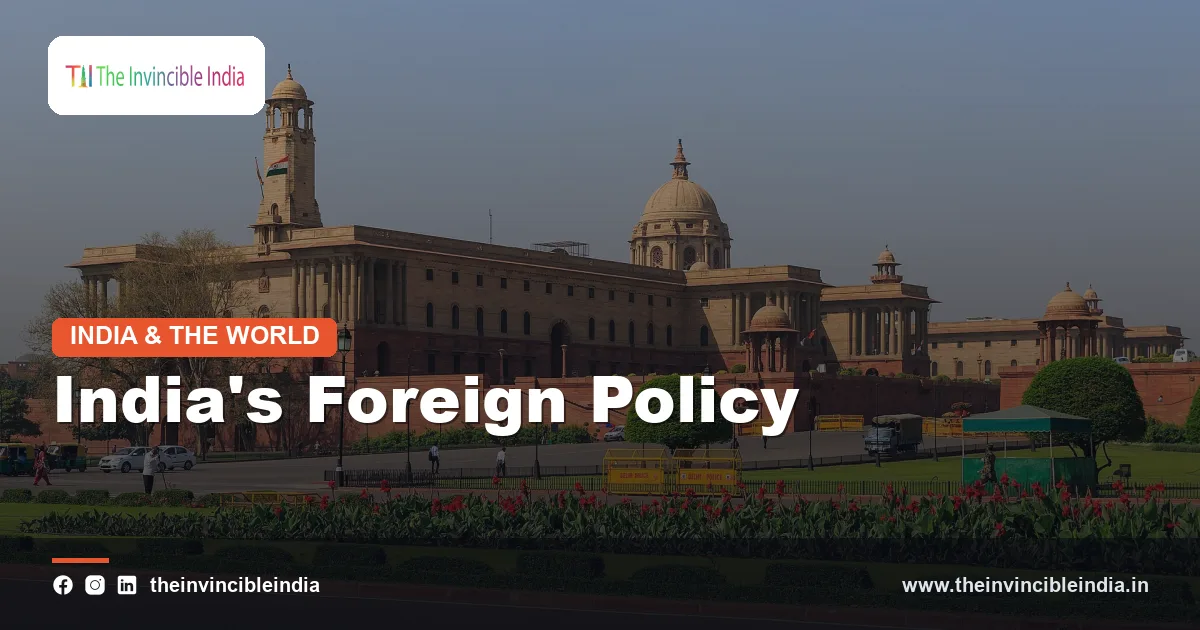
India foreign policy is the set of principles, institutions and choices through which the country engages with the rest of the world. Born out of a long anti-colonial struggle, it began in 1947 with a simple aim: protect a newly independent, poor and diverse nation while giving it room to grow, without being pulled into anyone else’s quarrel. Over seven decades that aim has stayed constant, even as the methods have changed dramatically.
The journey is often summed up as a shift from non-alignment to multi-alignment. In the Cold War, India refused to join either superpower bloc and helped build the Non-Aligned Movement. Today it works with many partners at once, joining groupings as different as the Quad and BRICS. This guide explains how that evolution happened, who makes the decisions, and what ideas hold the whole story together. It was last reviewed on 29 September 2026.
Quick Facts
| Topic | Key Fact |
|---|---|
| Constitutional basis | Article 51 (Directive Principles) urges the promotion of international peace and security; foreign affairs is in the Union List |
| Nodal ministry | Ministry of External Affairs (MEA), led by the External Affairs Minister |
| Civil service | Indian Foreign Service (IFS) |
| Panchsheel | Five Principles of Peaceful Coexistence, articulated in 1954 with China |
| First NAM summit | Belgrade, 1961 |
| Landmark treaty | Indo-Soviet Treaty of Peace, Friendship and Cooperation, August 1971 |
| Economic pivot | Liberalisation from 1991; Look East policy from the early 1990s |
| G20 presidency | India held the presidency in 2023; leaders met in New Delhi in September 2023 |
Foundations of India Foreign Policy
The roots of Indian external behaviour run deeper than 1947. Ancient texts such as Kautilya’s Arthashastra discuss statecraft in terms of the mandala, a circle of neighbours and their neighbours, and stress that a ruler must judge friends and rivals by interest, not sentiment. Centuries of maritime trade with West Asia, Africa and South-East Asia also gave the subcontinent a habit of outward engagement.
The freedom movement’s legacy
The modern foundation was laid by the national movement. Leaders opposed colonialism and racial discrimination everywhere, supported other freedom struggles, and valued non-violence as a political method. Even before independence, in 1947, Jawaharlal Nehru convened the Asian Relations Conference in Delhi, signalling that a free India would speak for the colonised world.
The constitutional mandate
The Constitution does not contain a detailed foreign-policy code, but Article 51 directs the State to promote international peace and security, maintain just and honourable relations between nations, respect international law and treaty obligations, and encourage settlement of disputes by arbitration. Entry 10 of the Union List places foreign affairs squarely with Parliament, and Article 253 lets Parliament legislate to implement treaties. Together, these provisions make external relations a Union subject.
Who Makes Foreign Policy: MEA, President, Prime Minister and EAM
Foreign policy is an executive function, shaped by several actors with distinct roles.
- The President: the constitutional head of state, who accredits ambassadors, receives foreign envoys and formally signs treaties, acting on the advice of the Council of Ministers.
- The Prime Minister: the political leader who sets the broad direction, represents India at summits and often shapes the personal diplomacy between leaders. Nehru held the External Affairs portfolio himself until his death in 1964, which shows how closely the office and the subject were once tied.
- The External Affairs Minister (EAM): the Cabinet minister in charge of the Ministry of External Affairs, who manages day-to-day diplomacy and negotiates with counterparts.
- The Foreign Secretary and the IFS: career diplomats who staff embassies, high commissions and missions to bodies such as the United Nations.
Other institutions contribute: the National Security Council system, the Ministries of Defence, Commerce and Finance, and Parliament, which debates and ratifies laws that flow from treaties. Because India is a parliamentary democracy, these processes are open to public and legislative scrutiny.
The Nehruvian Era and Non-Alignment
When India became independent, the world was splitting into two camps: the United States-led bloc built around NATO and the Soviet-led bloc that later formed the Warsaw Pact. Newly free, economically weak and wary of new dependence, India chose neither. Nehru called this approach non-alignment: independence in judging each issue on its merits.
What non-alignment meant
It did not mean neutrality or isolation. India took active positions, mediated in the Korean War, supported decolonisation in Asia and Africa, and later contributed peacekeepers to UN missions such as the Congo. What it refused was formal military alliance. India accepted aid and technology from both sides while keeping its decisions its own.
The Non-Aligned Movement
The Non-Aligned Movement grew from the Asian-African Conference at Bandung in 1955, which brought together newly independent states. It took formal shape at the Belgrade summit in 1961. India’s Nehru, Egypt’s Gamal Abdel Nasser, Yugoslavia’s Josip Broz Tito, Ghana’s Kwame Nkrumah and Indonesia’s Sukarno are regarded as the founding leaders. The movement gave smaller states a collective voice on decolonisation, disarmament and economic fairness, and it grew to include well over a hundred members.
Panchsheel and the Early Idealism
In 1954, India and China signed an agreement on trade and intercourse in the Tibet region, whose preamble set out the Five Principles of Peaceful Coexistence, known as Panchsheel. They were:
- Mutual respect for each other’s territorial integrity and sovereignty
- Mutual non-aggression
- Mutual non-interference in each other’s internal affairs
- Equality and mutual benefit
- Peaceful coexistence
The principles were later echoed in the Bandung declaration and became a reference point for many developing countries. India’s early idealism was tested, however. The border war with China in 1962 exposed the limits of trust and military preparedness, and led to a sober rethinking of defence and diplomacy. Wars with Pakistan in 1965 and 1971 further reminded policymakers that security required strength as well as principle.
Strategic Autonomy and Core Principles
If one idea links every era, it is strategic autonomy: the freedom to take decisions in the national interest without being bound to any bloc or great power. Non-alignment was its Cold War form; multi-alignment is its present one.
Enduring principles
- Sovereignty and territorial integrity: respect for borders and opposition to external interference.
- Non-interference: India traditionally avoids commenting on or intervening in the internal affairs of others, and expects the same in return.
- Multipolarity: a preference for a world with several centres of power rather than domination by one or two.
- Peaceful settlement of disputes: negotiation and international law over force, while maintaining credible defence.
- Counter-terrorism: firm opposition to terrorism and support for global cooperation against it.
- Development first: foreign policy as a tool to attract investment, technology, energy and markets for growth.
- Nuclear restraint: after tests in 1974 and 1998, India adopted a doctrine of credible minimum deterrence and no first use.
Key Phases and Doctrines: A Timeline
Indian policy has moved through recognisable phases, each responding to changes in the world and at home.
| Period | Phase or Doctrine | Essence |
|---|---|---|
| 1947-1962 | Nehruvian non-alignment | Independence from blocs, Panchsheel, Afro-Asian solidarity |
| 1962-1971 | Realist adjustment | Stronger defence after the 1962 war; closer ties with the Soviet Union |
| 1971 | Indo-Soviet Treaty | Friendship treaty signed in August 1971, on the eve of the Bangladesh war |
| 1991 onwards | Economic diplomacy | Liberalisation; trade, investment and technology at the centre of ties |
| 1990s | Look East | Deeper links with ASEAN and East Asia |
| 1996-1997 | Gujral Doctrine | Generosity and non-reciprocity towards smaller neighbours |
| 1998 | Nuclear tests | Declared nuclear weapon state with minimum deterrence |
| 2005-2008 | India-US nuclear deal | Civil nuclear cooperation and a wider strategic partnership |
| 2014 onwards | Act East, Neighbourhood First | Upgraded East Asia engagement and a regional-first approach |
The 1971 treaty and the Cold War tilt
By 1971, India faced a crisis in East Pakistan, refugee inflows, and a Washington-Beijing thaw that worried Delhi. The Treaty of Peace, Friendship and Cooperation with the USSR provided diplomatic and material assurance. Critics saw it as a tilt away from non-alignment; supporters saw it as a pragmatic guarantee during a war that led to the birth of Bangladesh.
After 1991
The end of the Cold War and India’s own economic crisis in 1991 transformed policy. Reforms opened the economy, and diplomacy followed, with commerce, technology and energy security joining strategic concerns. Look East, launched in the early 1990s, sought closer ties with Southeast Asia and became the more action-oriented Act East policy in 2014, covering connectivity, security and cultural links.
The Gujral Doctrine
Named after I. K. Gujral, who served as Foreign Minister and then Prime Minister in the mid-1990s, it held that India should not ask for reciprocity from smaller neighbours in South Asia, should not allow its territory to be used against them, and should resolve differences peacefully and bilaterally.
From Non-Alignment to Multi-Alignment
The 2008 civil nuclear agreement with the United States marked a turning point. After the nuclear tests of 1998 India had faced sanctions; the deal, followed by an exemption from the Nuclear Suppliers Group in 2008, brought it back into the global nuclear mainstream and signalled a broader partnership. Since then, Indian diplomacy has been described as multi-alignment: building issue-based partnerships with many countries, including those that disagree with one another.
Multi-alignment differs from Cold War non-alignment because the world is no longer divided into two camps. Power is spread across the United States, China, Europe, Russia, Japan and rising middle powers, and India engages each on specific interests.
Key groupings and partnerships
| Grouping | Members | Main Focus |
|---|---|---|
| Quad | India, United States, Japan, Australia | Free and open Indo-Pacific, maritime security, technology, health and infrastructure |
| BRICS | Originally Brazil, Russia, India, China, South Africa; since expanded | Emerging-economy cooperation, development finance, reform of global institutions |
| SCO | Founded by China, Russia and four Central Asian states; India joined as a full member in 2017 | Regional security, counter-terrorism, Eurasian connectivity |
| G20 | Major advanced and emerging economies plus the European Union and African Union | Global economic coordination and development |
| BIMSTEC | Bay of Bengal states of South and South-East Asia | Regional connectivity and trade |
| ASEAN-led forums | ASEAN members with dialogue partners including India | Act East, trade, security dialogue |
How the groupings fit together
The Quad, in its present form revived in 2017, is a coordination platform rather than a military alliance. BRICS and the SCO, by contrast, bring India together with Russia and China. India’s presence in both sets of forums illustrates the multi-alignment logic: cooperate where interests converge, and stay independent where they do not. The SCO, launched in 2001, and BRICS, whose first summit was in 2009, both expanded India’s diplomatic options beyond the West.
The Global South, Soft Power and Vishwaguru
India has long presented itself as a voice for developing countries. In recent years this has been expressed through the idea of the Global South and through civilisational phrases such as Vasudhaiva Kutumbakam, the Sanskrit expression for “the world is one family”. India’s 2023 G20 presidency adopted the theme “One Earth, One Family, One Future” in that spirit, and it prioritised issues such as development finance, climate action and digital public infrastructure. The African Union was welcomed as a permanent G20 member during that summit.
Vishwaguru: aspiration and framing
The word Vishwaguru, meaning “teacher of the world”, is an aspirational label often used in public debate to describe a hoped-for role of moral and intellectual leadership. It is best understood as a political and cultural framing rather than an official doctrine.
Tools of outreach
- Development partnerships: lines of credit, training programmes and capacity building across Africa, Asia and beyond.
- International Solar Alliance: launched with France in 2015 at the Paris climate conference.
- Humanitarian assistance: disaster relief and medical supplies to partners in need.
- Culture and yoga: the UN’s International Day of Yoga, observed on 21 June since 2015, was proposed by India.
Relations with Major Powers and the Gulf
Each major relationship is shaped by both shared interests and differences.
The United States
Ties were once cool during the Cold War, but grew steadily after the 1990s, backed by trade, technology, defence cooperation and strong people-to-people links. The 2008 nuclear deal gave this a strategic base, and the two countries now cooperate in the Indo-Pacific and in emerging technology.
Russia
The relationship dates to the Soviet era and remains important, particularly in defence supplies, energy and cooperation at the UN. India describes the partnership as time-tested and has kept it even as it builds new ones.
China
China is both a major trading partner and a strategic challenge. The two countries share a long, partly undefined boundary along the Line of Actual Control, and disputes have periodically led to tension after the 1962 war. Talks continue through diplomatic and military channels, and India generally seeks stable ties while safeguarding border security.
Europe, Japan and the Gulf
The European Union and Japan are important economic and technology partners. The Gulf region matters for energy, trade, security and above all the very large Indian community working there, whose remittances are a valuable source of support for many households. India has expanded engagement with the Gulf Cooperation Council states and West Asia more widely.
Neighbourhood First, SAGAR and South Asia
Stable neighbours are the first requirement of Indian security and growth. The Neighbourhood First approach, formalised from 2014, emphasises connectivity, trade, energy links and people-to-people ties with South Asian countries. SAGAR, which stands for Security and Growth for All in the Region and was articulated in 2015, focuses on the Indian Ocean: maritime safety, disaster response, and cooperation with island and coastal states.
Snapshots of key neighbours
- Pakistan: relations have been shaped by Partition, wars, the Kashmir question and cross-border terrorism. Agreements such as the Indus Waters Treaty of 1960 and the Simla Agreement of 1972 form part of the historical framework.
- Bangladesh: India’s support in 1971 is central to the shared history. The 1996 Ganga water-sharing treaty and the 2015 Land Boundary Agreement are important milestones in ties.
- Nepal: bound by an open border and the 1950 Treaty of Peace and Friendship, with deep cultural, religious and economic links.
- Sri Lanka: a close maritime neighbour; ties involve trade, fishing rights, development projects and memories of the 1987 Indo-Lanka Accord.
- Bhutan, Maldives, Myanmar and Afghanistan: each of these neighbours has its own distinct partnership shaped by geography, security and development needs.
Regional bodies such as SAARC, founded in 1985, have been slowed by political differences, so India has also turned to BIMSTEC and sub-regional arrangements to keep cooperation moving.
The Diaspora as a Foreign-Policy Asset
The Indian diaspora is among the largest in the world, spread across North America, the Gulf, Europe, Africa, the Caribbean and Asia-Pacific. It contributes to Indian foreign policy in several ways.
- Remittances: India is consistently among the largest recipients of money sent home by overseas workers.
- Soft power: cuisine, cinema, festivals and yoga reach global audiences through diaspora communities.
- Economic and political links: entrepreneurs and professionals build investment, technology and business bridges, and community leaders often strengthen ties with host governments.
- Institutional recognition: Pravasi Bharatiya Divas is observed on 9 January to mark Mahatma Gandhi’s return from South Africa in 1915, and schemes such as Overseas Citizen of India give long-term links to people of Indian origin.
The MEA also runs consular services and emergency evacuations, which have become a visible part of modern diplomacy when citizens are caught in crises abroad.
India at the United Nations and Multilateral Priorities
India was a founding member of the United Nations in 1945 and has long viewed the body as a forum for decolonisation, disarmament and development. It has been among the largest contributors of personnel to UN peacekeeping and has served several terms as a non-permanent member of the Security Council.
The permanent seat question
India argues that the Security Council, whose five permanent members (the United States, United Kingdom, France, Russia and China) reflect the balance of power of 1945, no longer represents today’s world. It seeks a permanent seat, citing its population, economy, democratic record and peacekeeping contribution. India works with Brazil, Germany and Japan in a group known as the G4, and supports expansion in both permanent and non-permanent categories. Reform requires broad agreement and Charter amendment, and remains contested because some states oppose adding new permanent members.
Other multilateral priorities
- Reform of global financial and trade institutions so that developing countries have a stronger say.
- Climate action combined with climate justice and finance for developing states.
- A comprehensive global framework against terrorism.
- Peaceful and open use of the Indian Ocean, outer space and cyberspace.
Conclusion
The story of India foreign policy is one of continuity in purpose and flexibility in method. Autonomy, sovereignty and development have stayed constant, while the tools have moved from Panchsheel and the Non-Aligned Movement to economic diplomacy, Act East, the Quad, BRICS and a growing role for the Global South. Understanding this arc helps readers make sense of why India can work with rival groupings at once, and why it insists on deciding its own course.
Frequently Asked Questions
What is India’s foreign policy based on?
It rests on national interest, strategic autonomy, sovereignty, non-interference, peaceful settlement of disputes and development. Article 51 of the Constitution provides the guiding directive on international peace and security.
What is the Non-Aligned Movement?
The Non-Aligned Movement is a group of states that chose not to join either major power bloc during the Cold War. It emerged from the Bandung Conference of 1955 and held its first summit at Belgrade in 1961, with India, Egypt, Yugoslavia, Ghana and Indonesia among its founding leaders.
What is Panchsheel?
Panchsheel are the Five Principles of Peaceful Coexistence, set out in the 1954 India-China agreement on Tibet. They stress mutual respect for sovereignty, non-aggression, non-interference, equality and peaceful coexistence.
What is multi-alignment?
Multi-alignment describes India’s practice of partnering with many countries and groupings at once, based on specific issues and interests. It allows India to be part of forums such as the Quad and also BRICS and the SCO, while retaining strategic autonomy.
What is the difference between Look East and Act East?
Look East, begun in the early 1990s, focused mainly on economic ties with South-East Asia and ASEAN. Act East, announced in 2014, is broader and more action-oriented, adding connectivity, defence and strategic cooperation with East Asia and the Indo-Pacific.
Does India have a permanent seat on the UN Security Council?
No. India has served as a non-permanent member several times and seeks permanent membership as part of wider Security Council reform. It works with the G4 group to press for expansion, though reform needs wide agreement among UN members.
{“@context”:”https://schema.org”,”@graph”:[{“@type”:”FAQPage”,”mainEntity”:[{“@type”:”Question”,”name”:”What is India’s foreign policy based on?”,”acceptedAnswer”:{“@type”:”Answer”,”text”:”It rests on national interest, strategic autonomy, sovereignty, non-interference, peaceful settlement of disputes and development. Article 51 of the Constitution provides the guiding directive on international peace and security.”}},{“@type”:”Question”,”name”:”What is the Non-Aligned Movement?”,”acceptedAnswer”:{“@type”:”Answer”,”text”:”The Non-Aligned Movement is a group of states that chose not to join either major power bloc during the Cold War. It emerged from the Bandung Conference of 1955 and held its first summit at Belgrade in 1961, with India, Egypt, Yugoslavia, Ghana and Indonesia among its founding leaders.”}},{“@type”:”Question”,”name”:”What is Panchsheel?”,”acceptedAnswer”:{“@type”:”Answer”,”text”:”Panchsheel are the Five Principles of Peaceful Coexistence, set out in the 1954 India-China agreement on Tibet. They stress mutual respect for sovereignty, non-aggression, non-interference, equality and peaceful coexistence.”}},{“@type”:”Question”,”name”:”What is multi-alignment?”,”acceptedAnswer”:{“@type”:”Answer”,”text”:”Multi-alignment describes India’s practice of partnering with many countries and groupings at once, based on specific issues and interests. It allows India to be part of forums such as the Quad and also BRICS and the SCO, while retaining strategic autonomy.”}},{“@type”:”Question”,”name”:”What is the difference between Look East and Act East?”,”acceptedAnswer”:{“@type”:”Answer”,”text”:”Look East, begun in the early 1990s, focused mainly on economic ties with South-East Asia and ASEAN. Act East, announced in 2014, is broader and more action-oriented, adding connectivity, defence and strategic cooperation with East Asia and the Indo-Pacific.”}},{“@type”:”Question”,”name”:”Does India have a permanent seat on the UN Security Council?”,”acceptedAnswer”:{“@type”:”Answer”,”text”:”No. India has served as a non-permanent member several times and seeks permanent membership as part of wider Security Council reform. It works with the G4 group to press for expansion, though reform needs wide agreement among UN members.”}}]}]}