


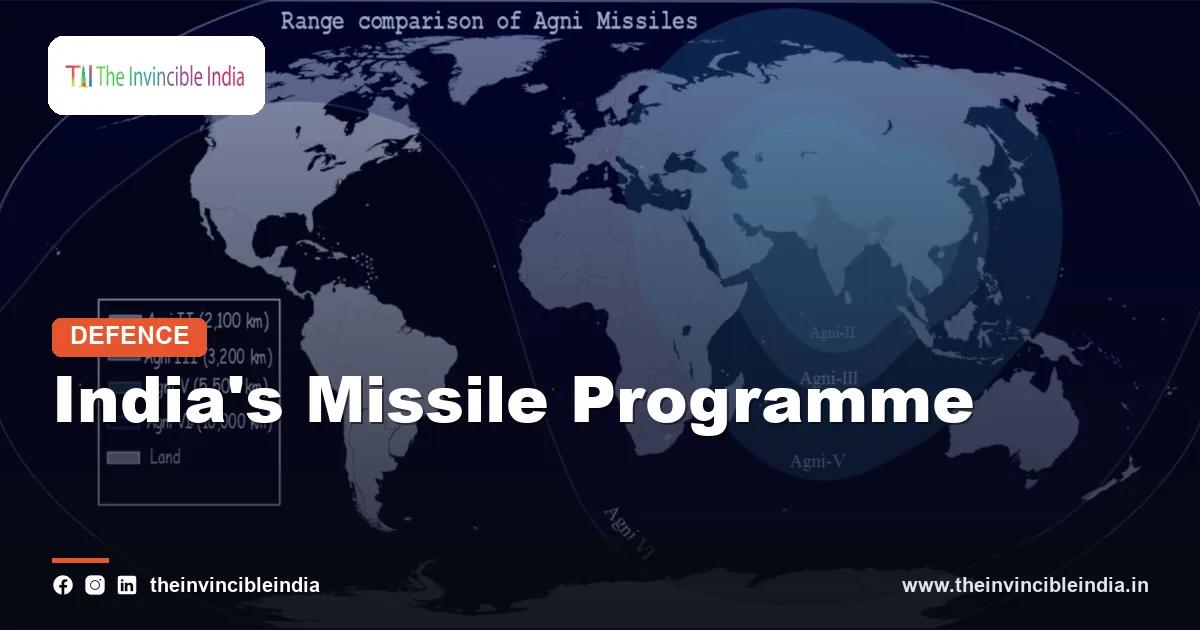
The India missile programme is one of the most important pillars of the country’s strategic and technological self-reliance. Led by the Defence Research and Development Organisation (DRDO) together with public-sector partners and industry, it has grown from a handful of imported-technology experiments in the 1960s and 1970s into a full spectrum of indigenous ballistic missiles, cruise missiles, air-defence interceptors, anti-tank weapons and submarine-launched systems.
The story is closely tied to the name of Dr A. P. J. Abdul Kalam, often called the “Missile Man of India”, who led the Integrated Guided Missile Development Programme launched in 1983. This explainer walks through how the programme was organised, what each major missile family does, how systems such as Agni, Prithvi, Akash and BrahMos fit into India’s defence planning, and what the doctrine of credible minimum deterrence means in practice.
Quick Facts
| Aspect | Details |
|---|---|
| Lead agency | Defence Research and Development Organisation (DRDO), established in 1958 |
| Flagship umbrella programme | Integrated Guided Missile Development Programme (IGMDP), launched in 1983 |
| Programme architect | Dr A. P. J. Abdul Kalam, the “Missile Man of India” |
| Five original IGMDP systems | Prithvi, Agni, Akash, Trishul and Nag |
| Principal missile laboratory | Defence Research and Development Laboratory (DRDL), Hyderabad |
| Joint venture cruise missile | BrahMos, developed with Russia and named after the Brahmaputra and Moskva rivers |
| Nuclear doctrine | Credible minimum deterrence and No First Use |
| Key test facilities | Integrated Test Range at Chandipur and Abdul Kalam Island, both in Odisha |
Origins and Organisation of India’s Missile Effort
India’s interest in rocketry and guided weapons is older than the missile programme itself. Space research in the 1960s, led by Vikram Sarabhai and the Indian Space Research Organisation, built launch-vehicle skills that later helped defence engineers. In parallel, the DRDO, founded in 1958 by bringing together existing technical establishments, began building expertise in propulsion, guidance, control and materials.
Early efforts
Before the IGMDP, India experimented with a project informally known as Project Devil, which aimed to reverse-engineer a Soviet surface-to-air missile and to develop a liquid-fuelled surface-to-surface missile. The project did not deliver a fielded weapon, but it trained a generation of scientists and highlighted the need for a properly structured national plan.
The institutional backbone
- DRDO defines requirements together with the armed forces, runs the laboratories and coordinates industry production partners.
- DRDL, Hyderabad is the lead centre for tactical and strategic missile design and integration.
- Research Centre Imarat (RCI) works on avionics, navigation and guidance systems.
- Defence public-sector and private firms, including Bharat Dynamics Limited, manufacture missiles in series.
- The three services act as users, providing operational feedback and conducting user trials.
The Integrated Guided Missile Development Programme (IGMDP)
By the early 1980s, India’s defence planners concluded that developing missiles one project at a time was slow and wasteful. The answer was a coordinated national umbrella, and the Integrated Guided Missile Development Programme was approved in 1983 under the leadership of Dr A. P. J. Abdul Kalam, who had earlier worked on India’s satellite launch vehicle programme at ISRO.
Five systems, one framework
The IGMDP was conceived to develop five missile families covering different roles, so that laboratories, test ranges and production lines could be shared rather than duplicated:
- Prithvi, a short-range surface-to-surface ballistic missile.
- Agni, a longer-range ballistic missile family, first launched as a technology demonstrator.
- Akash, a medium-range surface-to-air missile.
- Trishul, a short-range surface-to-air missile.
- Nag, a third-generation anti-tank guided missile.
Legacy of the programme
The IGMDP was formally declared complete in 2008. Not every system was equally successful; Trishul, for instance, was later wound down as a full development effort. Yet the programme created something more valuable than any single missile: a national ecosystem of designers, test facilities, propellant plants, guidance laboratories and manufacturers that continues to develop new systems today. Many of the engineers who trained under it went on to lead later projects, which is why the IGMDP is still described as the foundation of the India missile programme.
The Agni Family of Ballistic Missiles
Agni is the best-known name in Indian missilery. The first Agni flight in 1989 was a technology demonstrator, designed to prove re-entry, guidance and control for a longer-range vehicle. It has since evolved into a family of missiles, mostly solid-fuelled, each entry addressing a different range requirement.
From Agni-I to Agni-V
- Agni-I is a medium-range, single-stage solid-fuelled missile designed for regional targets.
- Agni-II is a two-stage missile with a longer reach, first tested in 1999.
- Agni-III and Agni-IV extend the range into the intermediate class, with improved guidance and lighter composite structures.
- Agni-V is a three-stage, canister-launched missile in the “over 5,000 km class”, first tested in 2012, which gives India intercontinental-class reach.
- Agni-P (Prime) is a newer-generation missile that replaces older variants with advanced composites, improved navigation and a more compact, canister-launched design.
Mobility and survivability
Modern Agni missiles are designed to be launched from road-mobile and rail-mobile platforms and from sealed canisters. This makes them harder to detect and target in advance, and it shortens preparation time. Reports of tests involving multiple independently targetable re-entry vehicle (MIRV) technology on Agni-class missiles reflect the direction of development, though technical details remain closely held.
Prithvi and the Short-Range Ballistic Missile Line
Prithvi was the first missile to emerge from the IGMDP, with its initial flight test in 1988. Named after the Sanskrit word for Earth, it is a single-stage, liquid-fuelled surface-to-surface missile that entered service with the Indian Army and later the Indian Air Force.
Variants and roles
- Prithvi-I was designed for the Army in a short-range, battlefield-support role.
- Prithvi-II serves mainly with the Air Force, with a somewhat longer range and a flexible payload.
- Dhanush, a ship-launched derivative, extended the concept to naval use.
Solid-fuel successors
Liquid propellants take time to load and are difficult to store on a vehicle. For this reason DRDO later developed solid-fuelled short-range systems such as Prahaar and the Pralay quasi-ballistic missile, along with Shaurya, a canister-launched missile of the tactical strategic class. These systems show a broader design shift towards quick reaction, road mobility and higher accuracy at shorter ranges.
BrahMos: The Supersonic Cruise Missile
BrahMos is a landmark of international defence cooperation. It is produced by BrahMos Aerospace, a joint venture between DRDO and Russia’s NPO Mashinostroyeniya, set up in 1998. The name combines the Brahmaputra of India and the Moskva of Russia. The first test flight took place in 2001 from the Chandipur range.
What makes BrahMos different
Unlike ballistic missiles, which follow a high arc, a cruise missile flies within the atmosphere under continuous power. BrahMos uses a ramjet engine that lets it fly at nearly three times the speed of sound, making it one of the fastest operational cruise missiles in the world. Its speed and low-altitude flight give defenders little time to react.
Launch platforms
- Land-based mobile launchers for Army regiments.
- Ship-launched versions fitted on frontline warships of the Indian Navy.
- Air-launched versions carried by the Su-30MKI fighter, first tested in 2017.
- Submarine-launched versions, first demonstrated from a submerged platform in 2013.
India’s entry into the Missile Technology Control Regime in 2016 allowed longer-range variants to be pursued, and BrahMos has also become an export product, with the Philippines among its first foreign customers.
Air Defence and Ballistic Missile Defence
A missile shield is as important as a strike capability. Akash, developed under the IGMDP, is a medium-range surface-to-air missile that uses a ramjet-rocket propulsion system and a phased-array radar, allowing it to engage several targets at the same time. It has been inducted by both the Army and the Air Force.
A layered network
- Akash and its newer versions provide area defence over medium ranges.
- Quick-reaction surface-to-air missiles (QRSAM) protect moving formations of armoured forces.
- Medium-range SAM systems, developed with Israeli partners, defend naval and land assets.
- Astra, an air-to-air missile with beyond-visual-range capability, equips fighter aircraft.
India also imports advanced long-range air-defence systems, which operate alongside indigenous missiles in a layered architecture. The overall aim is to make sure that no single system carries the entire burden of defending the airspace.
Ballistic Missile Defence Programme
Alongside offensive missiles, DRDO has developed a two-tier Ballistic Missile Defence (BMD) system to counter incoming ballistic threats. The idea is to catch the target twice, at different altitudes, to raise the chance of a successful interception.
Two tiers
- Prithvi Air Defence (PAD), an exo-atmospheric interceptor, engages targets outside the atmosphere. It was first tested in 2006.
- Advanced Air Defence (AAD), an endo-atmospheric interceptor, engages targets within the atmosphere at lower altitudes. It followed in late 2007.
Components of the shield
Interceptors work only with long-range radars, command-and-control networks and fast data links. The BMD programme therefore includes tracking radars, mission-control centres and launchers. Later phases have focused on tackling longer-range threats, and the interceptor technology has also been relevant to other areas of research, most notably the 2019 anti-satellite test.
Anti-Tank and Subsonic Cruise Missiles: Nag, Helina and Nirbhay
Armoured warfare remains central to land operations, and anti-tank guided missiles are essential to counter tanks and fortified positions. The Nag, the fifth IGMDP system, is a third-generation “fire-and-forget” missile that uses an imaging infrared seeker to lock on to a target and then follow it without further guidance from the operator.
Variants
- Nag (land-based) is fired from a tracked carrier called NAMICA, giving it protection and mobility.
- Helina is the helicopter-launched version, intended for attack helicopters such as the Advanced Light Helicopter Dhruv in its armed role.
- Follow-on developments, including a next-generation Nag and air-launched derivatives, emphasise longer range and improved seekers.
Why it matters
The top-attack profile of the Nag lets the warhead strike the most thinly armoured part of a tank. Developing this technology domestically reduced dependence on imported anti-tank missiles and broadened the base of guidance and seeker technology within the country.
Nirbhay and India’s Long-Range Cruise Missiles
The Nirbhay is a long-range subsonic cruise missile designed for land-attack missions. Unlike BrahMos, it flies at a lower speed but for a far longer distance, using a small turbofan engine and terrain-following navigation to fly at low altitude. Its development began after the IGMDP, and the first flight test was conducted in 2013.
Subsonic versus supersonic
The two cruise-missile philosophies complement each other. A supersonic missile such as BrahMos offers speed and shorter reaction time for the enemy, while a subsonic missile such as Nirbhay offers extended reach, a lighter airframe and lower cost. Together they give planners a choice of tools for different targets.
Further development
Nirbhay has also acted as a stepping stone for indigenous engine development and for successor programmes, including a long-range land-attack cruise missile and work on hypersonic flight, where a scramjet-powered demonstrator vehicle was flight-tested in 2020.
The K-Family and the Sea-Based Leg of the Triad
A nuclear triad consists of land-based, air-based and sea-based delivery systems. The sea-based leg is the hardest to build, because it requires a nuclear-powered ballistic missile submarine and a missile compact enough to be launched from beneath the water.
K-15 and K-4
- K-15 (Sagarika) is a shorter-range submarine-launched ballistic missile that was the first in the line.
- K-4 is an intermediate-range missile of roughly 3,500 km class, designed for Arihant-class submarines.
- K-5 and later versions are under development for even longer reach.
Submarines and assured response
INS Arihant, India’s first indigenously built nuclear-powered ballistic missile submarine, was inducted in 2016, with follow-on boats such as INS Arighaat entering service later. Because a submerged submarine is very hard to find, a sea-based deterrent provides a survivable second-strike capability, which is the central reason for building it.
Doctrine and Strategic Context: Minimum Deterrence, No First Use and Mission Shakti
Missiles are tools; doctrine explains how a state intends to use them. India conducted nuclear tests in 1974 and again in May 1998 at Pokhran, and it soon set out a doctrine that was formally adopted in 2003.
Core principles
- Credible minimum deterrence means holding enough capability to inflict unacceptable damage in retaliation, but not engaging in an arms race.
- No First Use (NFU) means India will not be the first to use nuclear weapons, but will respond to any nuclear attack with massive retaliation.
- Civilian control places decisions on nuclear use with the political leadership through the Nuclear Command Authority.
- Non-use against non-nuclear states is stated as a policy commitment.
How missiles support the doctrine
Survivable, mobile missiles on land and sea make an adversary’s first strike less likely to succeed. This is why so much programme effort has gone into canisterisation, solid propellants, rail and road mobility and submarine launch capability.
Mission Shakti: The Anti-Satellite Test
On 27 March 2019, India conducted Mission Shakti, an anti-satellite test in which a ballistic missile defence interceptor destroyed an Indian satellite in low Earth orbit at an altitude of roughly 300 km. India became the fourth country to demonstrate such a capability, after the United States, Russia and China.
Why it is linked to the missile programme
The interceptor used in the test drew on technology developed for the two-tier BMD system, showing how a missile defence programme can yield spin-off capabilities in space. The test was carried out in a low orbit so that debris would decay quickly, and the government stressed that the programme was defensive and did not violate international law.
Broader significance
Mission Shakti highlights that missile technology, space technology and cyber and electronic systems are increasingly intertwined, and that defence planning must treat space as an operational domain.
Laboratories, Test Ranges and Systems at a Glance
Missiles must be tested repeatedly under realistic conditions. India uses a network of ranges chiefly on the eastern coast, where flight paths run out over the Bay of Bengal.
Key facilities
- Integrated Test Range, Chandipur (Odisha) supports short-range and tactical missile tests, including many of the early BrahMos and Akash flights.
- Abdul Kalam Island (formerly Wheeler Island), Odisha is the main site for long-range ballistic missile launches, renamed in 2015 in honour of the scientist.
- Pokhran and other desert ranges support certain land-based tests, while naval trials use ships and submarines in offshore areas.
- DRDL Hyderabad, RCI, and other DRDO laboratories design and integrate the systems before flight trials.
Before any test, authorities issue notices to airmen and mariners to keep flight paths and impact areas clear.
Major Missile Systems at a Glance
| Name | Type | Role |
|---|---|---|
| Prithvi | Short-range ballistic missile | Battlefield and tactical strike |
| Agni-I to Agni-IV | Medium to intermediate-range ballistic missile | Strategic deterrence on land |
| Agni-V | Intercontinental-class ballistic missile | Long-range strategic deterrence |
| Agni-P | New-generation ballistic missile | Canister-launched strategic and tactical use |
| BrahMos | Supersonic cruise missile | Precision strike from land, sea, air and submarine |
| Nirbhay | Subsonic cruise missile | Long-range land attack |
| Akash | Surface-to-air missile | Medium-range air defence |
| PAD and AAD | Ballistic missile interceptors | Two-tier missile defence |
| Nag and Helina | Anti-tank guided missile | Destroying armoured vehicles |
| K-15 and K-4 | Submarine-launched ballistic missiles | Sea-based second-strike capability |
Conclusion
The India missile programme shows how a long-term national effort can convert scarce resources into strategic capability. From the vision of the IGMDP in 1983 to the Agni-V, BrahMos, BMD and submarine-launched systems of today, the programme has placed India among the small group of countries with a full suite of missile technologies. Its future direction, including hypersonic systems, longer-range interceptors and more accurate guidance, will build on the same foundation of indigenous design, rigorous testing and civilian oversight. Last updated: 29 September 2026.
Frequently Asked Questions
Who is called the Missile Man of India?
Dr A. P. J. Abdul Kalam is known as the Missile Man of India. He led the Integrated Guided Missile Development Programme from 1983 and later served as the Scientific Adviser to the Prime Minister and as the 11th President of India.
What are the five missiles developed under the IGMDP?
The five systems are Prithvi, Agni, Akash, Trishul and Nag. They cover short-range and longer-range ballistic missiles, medium-range and short-range surface-to-air missiles, and a third-generation anti-tank missile.
What makes BrahMos special?
BrahMos is a ramjet-powered supersonic cruise missile that flies at nearly three times the speed of sound. It is a joint venture between DRDO and Russia, and it can be launched from land, ships, aircraft and submarines.
Does the Agni-V have intercontinental range?
Agni-V is described as being in the “over 5,000 km class”, which gives it intercontinental-class reach. It is a three-stage, solid-fuelled, canister-launched missile. Exact figures are not officially disclosed.
What is India’s nuclear doctrine?
India follows a doctrine of credible minimum deterrence with a No First Use policy. It means that India maintains a limited but survivable arsenal, will not be the first to use nuclear weapons, and will retaliate massively if attacked with them.
What was Mission Shakti?
Mission Shakti was an anti-satellite test conducted on 27 March 2019, in which a missile defence interceptor destroyed a satellite in low Earth orbit. India thus became the fourth country to demonstrate this capability.
{“@context”:”https://schema.org”,”@graph”:[{“@type”:”FAQPage”,”mainEntity”:[{“@type”:”Question”,”name”:”Who is called the Missile Man of India?”,”acceptedAnswer”:{“@type”:”Answer”,”text”:”Dr A. P. J. Abdul Kalam is known as the Missile Man of India. He led the Integrated Guided Missile Development Programme from 1983 and later served as the Scientific Adviser to the Prime Minister and as the 11th President of India.”}},{“@type”:”Question”,”name”:”What are the five missiles developed under the IGMDP?”,”acceptedAnswer”:{“@type”:”Answer”,”text”:”The five systems are Prithvi, Agni, Akash, Trishul and Nag. They cover short-range and longer-range ballistic missiles, medium-range and short-range surface-to-air missiles, and a third-generation anti-tank missile.”}},{“@type”:”Question”,”name”:”What makes BrahMos special?”,”acceptedAnswer”:{“@type”:”Answer”,”text”:”BrahMos is a ramjet-powered supersonic cruise missile that flies at nearly three times the speed of sound. It is a joint venture between DRDO and Russia, and it can be launched from land, ships, aircraft and submarines.”}},{“@type”:”Question”,”name”:”Does the Agni-V have intercontinental range?”,”acceptedAnswer”:{“@type”:”Answer”,”text”:”Agni-V is described as being in the “over 5,000 km class”, which gives it intercontinental-class reach. It is a three-stage, solid-fuelled, canister-launched missile. Exact figures are not officially disclosed.”}},{“@type”:”Question”,”name”:”What is India’s nuclear doctrine?”,”acceptedAnswer”:{“@type”:”Answer”,”text”:”India follows a doctrine of credible minimum deterrence with a No First Use policy. It means that India maintains a limited but survivable arsenal, will not be the first to use nuclear weapons, and will retaliate massively if attacked with them.”}},{“@type”:”Question”,”name”:”What was Mission Shakti?”,”acceptedAnswer”:{“@type”:”Answer”,”text”:”Mission Shakti was an anti-satellite test conducted on 27 March 2019, in which a missile defence interceptor destroyed a satellite in low Earth orbit. India thus became the fourth country to demonstrate this capability.”}}]}]}