


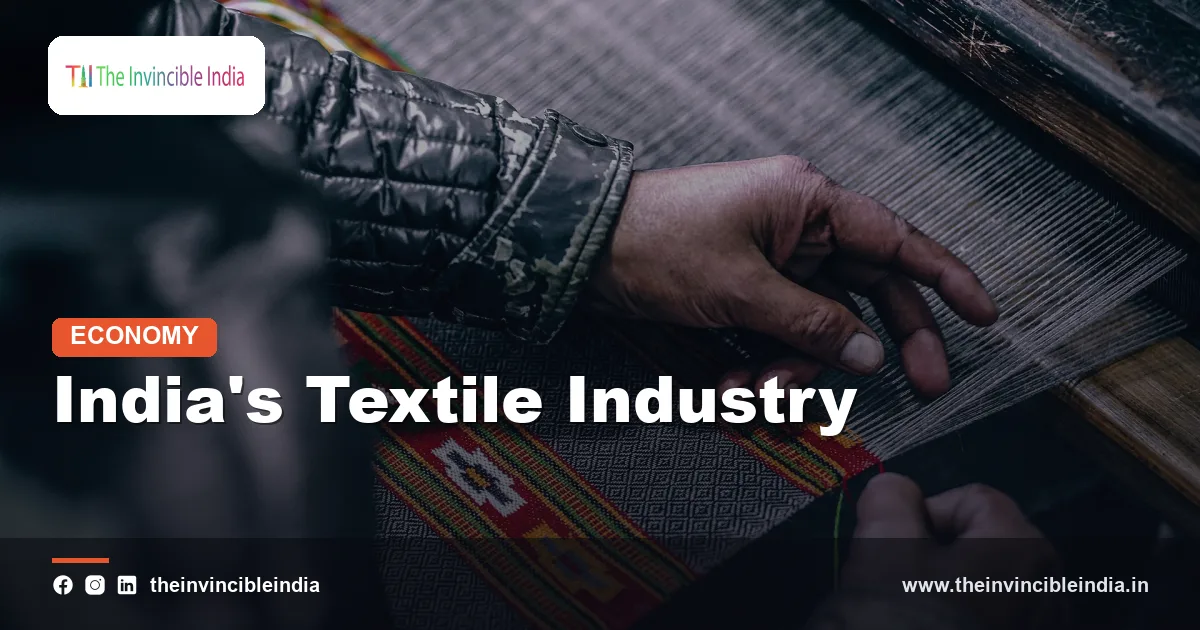
The India textile industry is among the oldest and most widely spread economic activities in the country. Long before modern factories existed, Indian weavers were spinning cotton, dyeing it in fast colours and sending finished cloth to markets in Rome, Arabia, South-East Asia and later Europe. Today the sector stretches from cotton fields and silk farms to power looms, spinning mills, export-oriented garment units and village handlooms.
What makes the industry special is its sheer breadth. It is one of the largest employers in India, second only to agriculture, and it connects farmers, artisans, factory workers, designers and exporters in a single chain. This explainer walks through its history, its value chain, its clusters, the policies that support it and the challenges it faces as global competition intensifies.
| Aspect | Detail |
|---|---|
| Sector | Textiles and apparel, covering fibres, yarn, fabric, processing, garments, home textiles and technical textiles |
| Nodal ministry | Ministry of Textiles, Government of India |
| Employment rank | Second-largest source of employment after agriculture |
| Fibre strengths | Cotton, jute, silk and a large wool and man-made fibre base |
| Silk distinction | Produces all four commercial silks: mulberry, tasar, eri and muga |
| Two broad segments | Organised mill and large-manufacturing sector, and the decentralised handloom, powerloom and khadi sector |
| Famous clusters | Tiruppur, Surat, Ludhiana, Panipat, Bhiwandi, Bhilwara |
| Key schemes | PM MITRA parks, PLI for man-made fibre and technical textiles, Amended Technology Upgradation Fund Scheme |
| National Handloom Day | 7 August every year |
A Heritage Woven Over Millennia
Cotton was cultivated and woven in the Indian subcontinent as far back as the Indus Valley Civilisation. Cotton fibres and spindle whorls have been found at ancient sites, and the skill of producing fine, light cloth was already well developed more than four thousand years ago. Ancient Indian texts refer to weaving, dyeing and the use of silk, wool and linen-like fibres, showing that textiles were part of everyday life and ritual.
Indian cloth became a premium global commodity. Fine muslins, especially those associated with Dhaka in the Bengal region, were so delicate that they were praised in many courts of the world. Printed and painted cottons known as calicoes and chintz, the dyed fabrics of Gujarat and the Coromandel coast, and the brocades of Banaras were carried by Arab, Persian, Chinese and later European traders. Indian indigo and other natural dyes were prized for their strength and fastness.
Colonial disruption and the Swadeshi response
- Under colonial rule, India was increasingly turned into a supplier of raw cotton for British mills while imported machine-made cloth flooded local markets, hurting traditional weavers.
- The first modern cotton mills came up in the nineteenth century, with Bombay emerging as a major centre and often described as the “Cottonopolis of India”. Ahmedabad later became known as the “Manchester of India”.
- The Swadeshi movement, launched on 7 August 1905, encouraged people to use Indian-made cloth. Mahatma Gandhi later made the spinning wheel and khadi powerful symbols of self-reliance and the freedom struggle.
After Independence, textiles stayed at the heart of industrial planning, and the sector has since combined modern mills with a living craft tradition.
The Value Chain of the India Textile Industry
The textile sector is best understood as a chain of linked stages. Each stage adds value to the one before it, and each employs different kinds of workers, machines and skills. One of India’s biggest advantages is that it has a presence at every link, from raw material to finished product.
| Stage | What happens | Typical output |
|---|---|---|
| Fibre | Natural fibres are grown or reared; man-made fibres are produced from chemicals or cellulose | Raw cotton, jute, silk cocoons, wool, polyester, viscose |
| Spinning | Fibres are cleaned, combed and twisted into continuous strands | Yarn and thread |
| Weaving and knitting | Yarn is interlaced on looms or looped on knitting machines | Woven and knitted fabric |
| Processing | Fabric is bleached, dyed, printed and finished | Coloured, printed, finished fabric |
| Garmenting and made-ups | Cutting, stitching, embroidery and packaging | Apparel, home textiles, accessories |
| Technical textiles | Specialised fabrics engineered for function rather than looks | Medical, agricultural, protective and industrial textiles |
This integrated structure means a shirt sold abroad can, in principle, begin as cotton grown in an Indian field and be spun, woven, dyed and stitched without leaving the country. Few nations can claim that depth.
Fibres: Natural and Man-Made
Fibre is the foundation of the entire chain, and India works with a wide basket of them.
Natural fibres
- Cotton: India has one of the largest areas under cotton in the world and is among the top producers, vying with China for the leading position. Cotton is grown mainly in Gujarat, Maharashtra, Telangana, Karnataka, Andhra Pradesh, Madhya Pradesh, Rajasthan, Haryana and Punjab, on black soils and irrigated plains.
- Jute: Often called the “golden fibre”, jute is grown mostly in West Bengal, with Bihar and Assam also contributing. It goes into sacking, packaging, carpets and increasingly into eco-friendly bags and décor.
- Silk: India is one of the leading silk producers and is the only country that produces all four commercial varieties: mulberry, tasar, eri and muga. Muga, a golden silk, is unique to Assam.
- Wool: Sheep rearing in Rajasthan, Jammu and Kashmir, Himachal Pradesh and parts of the south supports woollen yarn, carpets and blankets, while Himalayan fibres such as pashmina are prized worldwide.
Man-made fibres
Man-made fibres include polyester, viscose, nylon and acrylic. Globally these now account for a larger share of fibre use than cotton, and demand is growing for sportswear, athleisure, industrial uses and blended fabrics. India produces substantial quantities of viscose and polyester, but its mix still leans more heavily towards cotton than that of many rivals, which is a strategic issue discussed later.
Spinning, Weaving and Knitting
Spinning turns fibre into yarn, and India has one of the largest spinning capacities in the world. Cotton yarn is a major product in its own right and is exported to garment makers in other countries as well as supplied to domestic weavers. Spinning is relatively capital-intensive and concentrated in states such as Tamil Nadu, Gujarat, Maharashtra and Andhra Pradesh.
Fabric formation takes two main routes.
- Weaving: Yarn is interlaced at right angles on looms. This can be done on a traditional handloom, on a semi-automatic or automatic powerloom, or in a large composite mill with shuttleless looms.
- Knitting: Loops of yarn are formed by machines to make stretchable fabric used in T-shirts, innerwear, hosiery and sportswear. Knitwear is a particular strength of southern clusters.
Where India’s fabric comes from
A striking feature is that a great part of woven fabric in India comes not from big mills but from the powerloom sector, with the handloom sector adding a smaller but culturally precious share. Large mills, which once dominated, now account for a limited portion of cloth output. This pattern sets India apart from countries where fabric making is dominated by a few giant factories.
Processing, Garments and Technical Textiles
After fabric is made, it usually needs processing. Bleaching, dyeing, printing and finishing give cloth its colour, feel and performance. Processing houses in Surat, Ahmedabad, Tiruppur, Bhilwara and Jaipur handle bulk orders, while hand block printing, bandhani tie-dye and batik remain living traditions in Rajasthan and Gujarat. Because processing uses a lot of water and chemicals, it is also where environmental pressure is greatest.
Apparel and made-ups
The garment stage is the most labour-intensive and the one that connects India to global brands and retailers. Ready-made garments, home textiles such as bed linen and towels, and carpets and floor coverings all fall in this stage. Garment manufacturing has been a gateway to formal jobs for many women and first-generation workers.
Technical textiles
Technical textiles are engineered for performance. They include medical items such as surgical dressings and masks, geotextiles for roads and embankments, agrotextiles such as shade nets, protective clothing, filtration fabrics and automotive components. Compared with traditional clothing, this segment is small in India, but it is considered a high-growth frontier and now has a dedicated mission and policy push.
Two Faces: The Organised and the Decentralised Sectors
The Indian textile story has two distinct halves that sit side by side.
The organised sector
This includes composite mills, large spinning units and modern garment factories. These units have registered operations, formal employment, higher capital investment and a stronger presence in exports. They are generally the main suppliers to large global brands that demand scale, compliance and consistent quality.
The decentralised sector
The decentralised sector is vast and varied, and is made up of:
- Handlooms: Cloth woven by hand without electricity, often in household units. Handloom weaving is one of the largest cottage industries in India and supports weavers and allied workers, a large proportion of whom are women.
- Powerlooms: Small and medium units running electric looms, typically in clusters, supplying much of the country’s fabric.
- Khadi and village industries: Hand-spun and hand-woven cloth promoted by the Khadi and Village Industries Commission (KVIC), a statutory body that began functioning in 1957.
- Handicrafts: Embroidery, zari work, carpets and other craft textiles produced by artisans across the country.
This sector provides livelihoods in villages and small towns where few other jobs exist, which is why textile policy always balances modernisation with protection of artisans.
Famous Textile Clusters
Indian textiles are strongly geographical. Entire towns have specialised in a product for generations, building a local ecosystem of yarn suppliers, machine makers, dyers, traders and skilled workers.
| Cluster | State | Known for |
|---|---|---|
| Tiruppur | Tamil Nadu | Cotton knitwear, T-shirts and innerwear; a leading export hub |
| Surat | Gujarat | Synthetic and man-made fabrics, sarees, dress material and zari |
| Ludhiana | Punjab | Woollen hosiery, knitwear and winter garments |
| Panipat | Haryana | Home furnishings, carpets, blankets and recycled yarn |
| Bhiwandi | Maharashtra | One of the largest powerloom centres in the country |
| Bhilwara | Rajasthan | Suiting and shirting fabrics, often called the textile city of Rajasthan |
| Erode and Karur | Tamil Nadu | Cotton fabrics, bed linen, towels and home textiles |
| Coimbatore | Tamil Nadu | Spinning mills, once nicknamed the “Manchester of South India” |
These clusters matter because they allow small firms to compete by sharing skills, suppliers and infrastructure.
Heritage Weaves and Handloom Treasures
If clusters are the industrial face of Indian textiles, heritage weaves are the cultural face. Many of these are protected through the Geographical Indications system, which recognises products tied to a particular place and method.
- Banarasi silk: Rich brocades with gold and silver thread from Varanasi.
- Kanjeevaram: Heavy, durable silk sarees with temple borders from Kanchipuram in Tamil Nadu.
- Chanderi: Light silk-cotton fabric from Madhya Pradesh.
- Pochampally ikat: Tie-dyed yarn woven into geometric patterns in Telangana.
- Bandhani and Patola: Tie-dye and double-ikat traditions of Gujarat and Rajasthan.
- Paithani: Silk sarees from Maharashtra with peacock and lotus motifs.
- Pashmina and Kani: Fine Himalayan wool and hand-woven shawls from Kashmir.
- Muga and Eri silk: Assam’s unique natural silks.
National Handloom Day is observed every year on 7 August, recalling the 1905 Swadeshi movement, to honour weavers. The Handloom Mark and India Handloom Brand labels help buyers recognise authentic handwoven goods.
Economic Role: Jobs, Output and Exports
The industry is important to India in three major ways. First, it is a significant contributor to manufacturing output and to the overall economy. Second, it is among the largest providers of employment, running from skilled factory work to home-based weaving. Third, it earns a considerable part of India’s merchandise export income.
What India exports
- Ready-made garments sold to the United States, European Union, United Kingdom, the Gulf and other markets.
- Cotton yarn, fabric and made-ups such as bed sheets, towels and curtains.
- Man-made textiles and yarn.
- Handloom products, carpets and handicrafts.
- Jute goods and silk products.
Because the chain is domestic, a rupee of export revenue in textiles tends to create more local value and jobs than in industries that depend heavily on imported inputs. The industry is also less dependent on advanced technology at entry level, making it a natural starting point for industrialisation.
Policy Support for the Sector
The Ministry of Textiles, supported by bodies such as the Office of the Textile Commissioner, the Textiles Committee, the Cotton Corporation of India and KVIC, designs and runs the main policy framework. Several schemes stand out.
- PM MITRA: The Pradhan Mantri Mega Integrated Textile Region and Apparel parks scheme aims to build large, modern parks that bring spinning, weaving, processing and garmenting into one location with plug-and-play infrastructure, cutting logistics costs.
- Production Linked Incentive (PLI): A scheme approved for man-made fibre apparel, fabrics and technical textiles, rewarding additional production and investment to build scale.
- Amended Technology Upgradation Fund Scheme (ATUFS): Offers capital investment support to modernise machinery in weaving, processing and garmenting.
- National Technical Textiles Mission: Promotes research, standards and adoption of technical textiles.
- Handloom and handicraft support: Schemes that provide design help, marketing platforms, raw material access, skill training and branding for weavers and artisans.
- KVIC programmes: Support for khadi production, spinners, weavers and rural employment.
- Skilling: The Samarth scheme trains workers for the organised segments of the industry.
Together these policies try to do three things at once: expand scale, raise technology and protect the livelihoods of traditional producers.
Challenges Facing the Industry
Despite its strengths, the industry confronts serious pressures.
Competition and market access
Countries such as Bangladesh and Vietnam have captured large shares of the global garment trade through scale, lower costs and preferential trade access to major buyers. Free trade agreements that give rivals duty-free entry can leave Indian exporters at a disadvantage, which is why trade deals are a central concern for the sector.
The man-made fibre gap
The world is moving steadily towards man-made fibres, while India’s strength historically lies in cotton. Building depth in polyester, viscose and specialised fibres, along with the capacity to produce technical textiles, is essential to remain relevant in global markets.
Scale, productivity and fragmentation
- Many units are small and fragmented, so they find it hard to match the scale of factories elsewhere.
- Productivity, access to credit and technology adoption vary widely across the decentralised sector.
- Raw material price swings, especially in cotton, can squeeze margins.
Sustainability and weaver distress
Global buyers increasingly demand traceable, water-efficient and low-carbon production, which means investment in effluent treatment, recycling and cleaner dyes. Meanwhile, handloom and powerloom weavers face competition from cheaper machine imitations, uneven incomes and an ageing workforce, as younger people sometimes leave the craft for steadier work.
Women, Rural Livelihoods and the Road Ahead
The social importance of the industry is as great as its economic one. Textiles and garments employ a notable proportion of women, in weaving households, embroidery clusters, self-help groups and modern factories alike. Spinning, finishing and stitching can be done close to home, giving women access to income without long migration. Rural artisans, many from small and marginalised communities, rely on weaving and craft as their main livelihood.
The national aim is to raise India’s share of global textile and apparel trade by modernising capacity, deepening the man-made fibre and technical textile base, building integrated parks and promoting brand India for handlooms and craft. If it succeeds, the sector can generate large numbers of jobs while keeping its heritage alive.
Conclusion
The India textile industry is both a heritage and a growth story. It carries the memory of Indus-era cotton and Dhaka muslin, the symbolism of the charkha and khadi, and the energy of modern clusters like Tiruppur and Surat. Its complete value chain, huge employment base and cultural variety give it a rare combination of strengths. Whether it can widen its share of world trade will depend on how well it scales up, shifts to man-made and technical fibres, wins market access and treats its weavers and workers fairly.
Frequently Asked Questions
Why is the textile industry so important to India?
It is one of the largest employers in the country, second only to agriculture, and it spans farmers, artisans, factory workers and exporters. It also contributes meaningfully to manufacturing output and export earnings, and it provides livelihoods in rural and semi-urban areas.
What is the value chain of the Indian textile industry?
The chain starts with fibre such as cotton, jute, silk, wool or man-made fibres, which is spun into yarn. The yarn is woven or knitted into fabric, processed through dyeing and printing, and finally made into garments, home textiles or technical textiles. India has a presence at every stage.
Which are the major textile clusters in India?
Tiruppur is famous for knitwear, Surat for synthetic fabrics and sarees, Ludhiana for woollens, Panipat for home furnishings and recycled yarn, Bhiwandi for powerlooms, and Bhilwara for suiting fabrics. Many other towns, such as Erode, Karur and Coimbatore, are also important.
What is the difference between the organised and decentralised textile sectors?
The organised sector consists of large mills and modern factories with formal employment and strong export links. The decentralised sector includes handlooms, powerlooms, khadi and handicrafts, run by small units and households, and it employs millions, many of them women and rural artisans.
What government schemes support the textile industry?
Key initiatives include PM MITRA mega textile parks, the Production Linked Incentive scheme for man-made fibre and technical textiles, the Amended Technology Upgradation Fund Scheme, and the National Technical Textiles Mission. Handloom and khadi producers are supported through the Ministry of Textiles programmes and the Khadi and Village Industries Commission.
What are the biggest challenges facing Indian textiles?
Competition from countries like Bangladesh and Vietnam, limited depth in man-made fibres, fragmented small-scale production, and trade agreements that favour rivals are major concerns. Sustainability requirements and distress among handloom and powerloom weavers add further pressure.
{“@context”:”https://schema.org”,”@graph”:[{“@type”:”FAQPage”,”mainEntity”:[{“@type”:”Question”,”name”:”Why is the textile industry so important to India?”,”acceptedAnswer”:{“@type”:”Answer”,”text”:”It is one of the largest employers in the country, second only to agriculture, and it spans farmers, artisans, factory workers and exporters. It also contributes meaningfully to manufacturing output and export earnings, and it provides livelihoods in rural and semi-urban areas.”}},{“@type”:”Question”,”name”:”What is the value chain of the Indian textile industry?”,”acceptedAnswer”:{“@type”:”Answer”,”text”:”The chain starts with fibre such as cotton, jute, silk, wool or man-made fibres, which is spun into yarn. The yarn is woven or knitted into fabric, processed through dyeing and printing, and finally made into garments, home textiles or technical textiles. India has a presence at every stage.”}},{“@type”:”Question”,”name”:”Which are the major textile clusters in India?”,”acceptedAnswer”:{“@type”:”Answer”,”text”:”Tiruppur is famous for knitwear, Surat for synthetic fabrics and sarees, Ludhiana for woollens, Panipat for home furnishings and recycled yarn, Bhiwandi for powerlooms, and Bhilwara for suiting fabrics. Many other towns, such as Erode, Karur and Coimbatore, are also important.”}},{“@type”:”Question”,”name”:”What is the difference between the organised and decentralised textile sectors?”,”acceptedAnswer”:{“@type”:”Answer”,”text”:”The organised sector consists of large mills and modern factories with formal employment and strong export links. The decentralised sector includes handlooms, powerlooms, khadi and handicrafts, run by small units and households, and it employs millions, many of them women and rural artisans.”}},{“@type”:”Question”,”name”:”What government schemes support the textile industry?”,”acceptedAnswer”:{“@type”:”Answer”,”text”:”Key initiatives include PM MITRA mega textile parks, the Production Linked Incentive scheme for man-made fibre and technical textiles, the Amended Technology Upgradation Fund Scheme, and the National Technical Textiles Mission. Handloom and khadi producers are supported through the Ministry of Textiles programmes and the Khadi and Village Industries Commission.”}},{“@type”:”Question”,”name”:”What are the biggest challenges facing Indian textiles?”,”acceptedAnswer”:{“@type”:”Answer”,”text”:”Competition from countries like Bangladesh and Vietnam, limited depth in man-made fibres, fragmented small-scale production, and trade agreements that favour rivals are major concerns. Sustainability requirements and distress among handloom and powerloom weavers add further pressure.”}}]}]}