


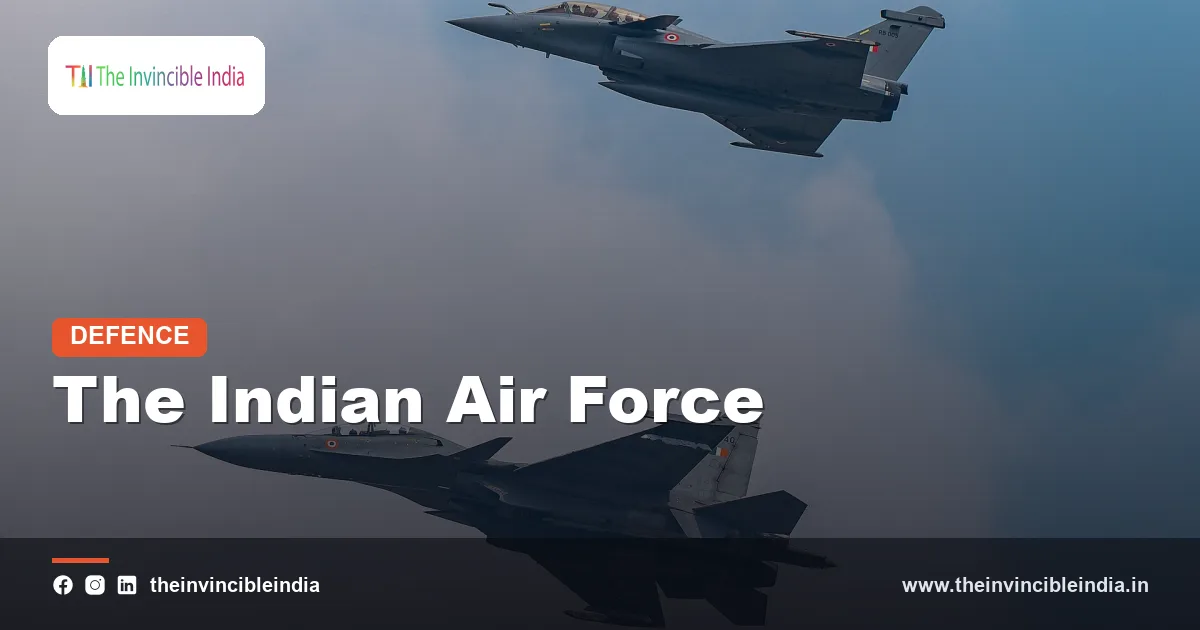
The Indian Air Force (IAF) is the aerial warfare arm of the Indian Armed Forces and one of the largest air forces in the world. Its job is to secure Indian airspace, support the Army and Navy in joint operations, and carry out air operations of every kind, from high-altitude patrols over the Himalayas to relief flights after floods and earthquakes. Its motto, taken from the Bhagavad Gita, is “Nabhah Sparsham Diptam”, usually translated as “Touch the Sky with Glory”.
Constitutionally, the President of India is the Supreme Commander of the armed forces, while the day-to-day command of the air force rests with the Chief of the Air Staff, an officer of the rank of Air Chief Marshal. This explainer walks through how the IAF began, how it is organised, what aircraft it flies, the wars and missions that shaped it, and the indigenous programmes that are changing its future.
Quick Facts: The Indian Air Force at a glance
| Feature | Detail |
|---|---|
| Established | 8 October 1932 (celebrated as Air Force Day every year) |
| Motto | Nabhah Sparsham Diptam (Touch the Sky with Glory) |
| Supreme Commander | The President of India |
| Head of the Force | Chief of the Air Staff (Air Chief Marshal) |
| Parent Ministry | Ministry of Defence, Government of India |
| Headquarters | Air Headquarters (Vayu Bhawan), New Delhi |
| Commands | Seven: five operational and two functional |
| “Royal” prefix | Used from 1945 until India became a republic in 1950 |
| Aerobatic team | Surya Kiran |
What the Indian Air Force Does
The IAF’s official mission is to defend the nation and its airspace against any threat, and to give air support to the land and naval forces. In practice that translates into a broad list of duties that modern air power is expected to perform.
Core roles
- Air defence: Guarding Indian airspace through fighter patrols, radar networks and surface-to-air missile systems.
- Offensive and strike operations: Attacking enemy air bases, command centres, supply lines and military targets, and providing close air support to ground troops.
- Reconnaissance and surveillance: Gathering intelligence using aircraft, unmanned systems and airborne early warning platforms.
- Strategic and tactical airlift: Moving troops, equipment and supplies quickly, including to remote and high-altitude locations.
- Humanitarian assistance and disaster relief (HADR): Rescue, evacuation and relief supply in floods, cyclones, earthquakes and other emergencies.
Why air power matters
India has long land borders in mountainous terrain, a vast coastline and a large exclusive economic zone. Air power gives the country speed and reach across all of these. It can move a battalion across the country in hours, watch a border that would take days to patrol on foot, and respond to a natural disaster before roads are reopened.
History of the Indian Air Force
The IAF was formally established on 8 October 1932, under British rule, as an auxiliary air force of the Royal Air Force. Its first flight was formed at Drigh Road in Karachi in April 1933 with a handful of aircraft and a small number of Indian pilots. The date of 8 October is still marked as Air Force Day, with a parade and air display held annually.
The Second World War years
During the Second World War the IAF grew from a small force into a combat arm that flew in the Burma campaign, supporting Allied operations against Japanese forces. Its contribution was recognised in 1945, when King George VI granted it the prefix “Royal”, and it became the Royal Indian Air Force.
Independence and the republic
After independence in 1947 the force was divided between India and the new state of Pakistan, and the Royal Indian Air Force continued under Indian control. When India became a republic on 26 January 1950, the “Royal” prefix was dropped and the service became simply the Indian Air Force. The Air Force Act, 1950 provides the statutory framework that governs the service.
Milestones at a glance
| Year | Milestone |
|---|---|
| 1932 | Indian Air Force established on 8 October |
| 1933 | First operational flight formed at Karachi |
| 1945 | Granted the “Royal” prefix |
| 1947-48 | First major operations in Jammu and Kashmir |
| 1950 | “Royal” prefix dropped as India becomes a republic |
| 1961 | Air support in the liberation of Goa |
| 1965 and 1971 | Air operations in wars with Pakistan |
| 1999 | Operation Safed Sagar in the Kargil conflict |
| 2019 | Air strike at Balakot |
Structure and Chain of Command
At the top of the structure is the President of India as Supreme Commander. Policy and civilian oversight come through the Ministry of Defence, while the Chief of the Air Staff heads the service and is supported by Vice Chief and Deputy Chief officers and a set of principal staff officers at Air Headquarters in New Delhi. Below that, operations are run through regional and functional commands.
Chief of the Air Staff
The Chief of the Air Staff (CAS) is responsible for operational readiness, training, planning and modernisation. The rank of Air Chief Marshal is the highest in regular service. The rank of Marshal of the Indian Air Force is a ceremonial five-star rank, conferred only once so far, on Arjan Singh, the hero of the 1965 war.
Tri-service integration
The IAF works closely with the Army and Navy through joint doctrines, exercises and integrated commands. India’s Chief of Defence Staff, a post created in 2019, has the task of promoting jointness among the three services, and the Department of Military Affairs sits within the Ministry of Defence to support this. The IAF continues to retain its own chain of command for its aircraft and bases.
The Seven Commands of the IAF
The IAF is organised into seven commands. Five are operational commands, each responsible for a geographic area of the country, and two are functional commands responsible for training and maintenance. Each command is headed by an Air Officer Commanding-in-Chief, of the rank of Air Marshal.
| Command | Type | Headquarters |
|---|---|---|
| Western Air Command | Operational | New Delhi |
| Eastern Air Command | Operational | Shillong |
| Central Air Command | Operational | Prayagraj |
| South Western Air Command | Operational | Gandhinagar |
| Southern Air Command | Operational | Thiruvananthapuram |
| Training Command | Functional | Bengaluru |
| Maintenance Command | Functional | Nagpur |
Operational commands
The Western Air Command looks after the northern and western frontiers, while the Eastern Air Command covers the north-east and the border with China, Bhutan, Myanmar and Bangladesh. The Central Air Command covers the central heartland and supports the other commands, and the South Western Air Command covers Rajasthan, Gujarat and the western seaboard. The Southern Air Command guards the peninsula and the Indian Ocean region and works closely with the Navy.
Functional commands
Training Command is responsible for the flying and technical training of officers and airmen. Maintenance Command keeps the fleet flying by managing repair, overhaul, stores and logistics across the force. Without these two commands, the front-line units could not sustain their operations.
Aircraft and Equipment of the IAF
The IAF operates a varied fleet that reflects decades of purchases from different countries, alongside a growing number of Indian-built platforms. Rather than a single type, its strength lies in a mix of aircraft assigned to different jobs. Exact numbers change with new inductions and retirements, so the table below describes types rather than counts.
| Category | Well-known examples |
|---|---|
| Multirole and air-superiority fighters | Dassault Rafale, Sukhoi Su-30MKI, Mirage 2000, MiG-29 |
| Indigenous fighters | HAL Tejas (Light Combat Aircraft) |
| Ground-attack aircraft | SEPECAT Jaguar |
| Transport aircraft | C-17 Globemaster III, C-130J Super Hercules, Ilyushin IL-76, Antonov An-32 |
| Attack and heavy-lift helicopters | Boeing AH-64E Apache, Boeing CH-47F Chinook, HAL Prachand (LCH) |
| Utility helicopters | HAL Dhruv, Mi-17 variants |
| Trainers | Pilatus PC-7 Mk II, BAE Hawk, HAL HTT-40 |
| Force multipliers | IL-78 aerial refuellers, AEW&C and AWACS aircraft |
Fighters
The Sukhoi Su-30MKI, assembled in India by Hindustan Aeronautics Limited (HAL), is the backbone of the fighter fleet. The French-made Rafale entered service in the last decade and adds long-range precision and beyond-visual-range capability. The Mirage 2000 has been a reliable strike platform for decades, and the upgraded MiG-29 continues in the air-defence role. The MiG-21, which served the IAF for many decades and earned a reputation in several wars, was retired in 2025.
Transport and helicopters
Heavy transports such as the C-17 Globemaster III and the C-130J Super Hercules give India a strategic airlift capability, including the ability to operate from short and high-altitude runways. On the rotary side, the Apache is a modern attack helicopter, the Chinook lifts heavy loads such as artillery, and the indigenous Dhruv is a workhorse for utility and rescue tasks.
Force Multipliers and Support Aircraft
Fighters alone do not win air battles. A force multiplier is an asset that makes every other aircraft more effective, and the IAF has invested steadily in them.
Airborne early warning and control
Airborne Early Warning and Control (AEW&C) aircraft, often called AWACS, carry powerful radars that can see far beyond ground-based systems, detect low-flying targets and guide fighters towards them. The IAF flies AWACS platforms based on the Russian IL-76 and has also developed indigenous AEW&C systems in cooperation with the Defence Research and Development Organisation (DRDO).
Mid-air refuelling
Aerial refuelling tankers such as the IL-78 extend the range and endurance of fighters and transports. A fighter that can refuel in flight can reach deeper targets, stay on patrol longer and be deployed across long distances without stopping.
Other support systems
- Ground-based radars and integrated air-defence networks that feed a common air picture.
- Surface-to-air missile systems for point and area defence of bases and cities.
- Unmanned aerial vehicles for surveillance and reconnaissance.
- Electronic warfare and communications systems that protect aircraft and disrupt enemy sensors.
Squadrons and the Strength Debate
The basic fighting unit of an air force is the squadron, a formation of aircraft with pilots and ground crew, typically commanded by a Group Captain or Wing Commander. A fighter squadron usually operates somewhere in the region of a couple of dozen aircraft at full strength, and squadrons are grouped into wings and stations.
Sanctioned versus actual strength
The IAF has a sanctioned strength, meaning the number of squadrons the government has approved as necessary for national defence. For many years this figure has been discussed in defence circles as being higher than the number of squadrons actually available, mainly because older aircraft such as the MiG-21 have been phased out faster than replacements have arrived. This gap is the centre of a long-running public debate on defence preparedness.
How the gap is being addressed
- Induction of new aircraft such as the Rafale.
- Production of the Tejas Mk1A in larger numbers.
- Upgrades to existing fleets to extend their service life.
- Development of next-generation fighters under domestic programmes.
Because the actual number changes as aircraft are inducted and retired, it is best to treat any single figure with caution and check the latest official statements.
Notable Operations and Wars
The IAF has played a part in every major conflict India has fought since independence, and in many missions that were never part of a war.
1947-48: Jammu and Kashmir
In October 1947, the IAF airlifted troops to Srinagar in the first hours of the Kashmir campaign, a decision that shaped the outcome on the ground. Transport aircraft, both military and requisitioned civilian, flew in soldiers and supplies to a small airfield in difficult conditions.
1965 and 1971
The 1965 war saw large-scale air combat and strikes on air bases on both sides. In the 1971 war, the IAF flew many sorties in both the eastern and western theatres. In the east it gained air superiority over what was then East Pakistan and supported the rapid advance of the Army; in the west it supported operations such as the defence of Longewala. Flying Officer Nirmal Jit Singh Sekhon received the Param Vir Chakra posthumously for defending the Srinagar air base in December 1971, the only IAF officer to receive that honour.
Kargil 1999: Operation Safed Sagar
During the 1999 Kargil conflict, the IAF launched Operation Safed Sagar to support the Army in clearing intruders from high peaks. Pilots had to fly at extreme altitude, in thin air and difficult mountain weather, and the Mirage 2000 with laser-guided bombs proved effective against fortified positions.
2019 and after
On 26 February 2019, the IAF carried out an air strike in Balakot in Pakistan’s Khyber Pakhtunkhwa province, following a terror attack on a security convoy in Pulwama in Jammu and Kashmir. It was the first time in decades that the IAF crossed the Line of Control and struck across the international border. Such operations have underlined the growing role of precision strike and long-range air power in India’s security planning.
Humanitarian Assistance and Disaster Relief
Outside wartime, the IAF is often the first responder to a natural calamity. Its helicopters and transport aircraft can reach places cut off by landslides, flood water or damaged roads.
Typical HADR tasks
- Airlifting stranded civilians and pilgrims from flooded or landslide-hit areas.
- Delivering food, medicines, tents and rescue teams, including National Disaster Response Force (NDRF) personnel.
- Evacuating Indian nationals from conflict zones abroad.
- Aerial survey and damage assessment.
- Firefighting support and casualty evacuation from remote areas.
Examples
Examples include large relief efforts after the 2004 Indian Ocean tsunami, the Gujarat earthquake of 2001, the Uttarakhand floods of 2013, and the Kerala floods of 2018. The IAF has also flown relief missions abroad, including to neighbouring countries hit by earthquakes and cyclones. The Operation Meghdoot airlift in Siachen and the Operation Cactus response in the Maldives in 1988 show the range of tasks it has undertaken.
Indigenous Programmes and Make in India
For decades India relied heavily on imported aircraft. A major shift is under way towards designing and building military aircraft at home, supported by the “Make in India” and “Atmanirbhar Bharat” initiatives.
HAL Tejas
The Tejas Light Combat Aircraft is a single-engine, lightweight, multirole fighter developed by the Aeronautical Development Agency and built by HAL. It first flew in 2001 and joined the IAF in the following decade. The improved Tejas Mk1A carries more advanced radar, electronic warfare systems and weapons, and is intended to replace the ageing fleet of older fighters.
AMCA
The Advanced Medium Combat Aircraft (AMCA) is India’s planned fifth-generation stealth fighter. It is designed to have low radar visibility, advanced sensors and internal weapons bays, and it is expected to follow the Tejas as the next major indigenous fighter.
Other indigenous efforts
- HAL Prachand, a light combat helicopter designed for high-altitude operations.
- HAL Dhruv, an advanced light helicopter in service with all three services.
- HAL HTT-40, a basic trainer aircraft.
- Indigenous missiles, radars and electronic warfare systems developed by the DRDO.
- Private-sector production of transport aircraft under public-private partnerships.
Training, NDA and Special Units
Becoming an IAF officer involves demanding selection and training. Flying branch officers enter through several routes, including the National Defence Academy (NDA) at Khadakwasla near Pune, the Combined Defence Services Examination and the Air Force Common Admission Test (AFCAT).
The training pipeline
- Cadets spend time at the NDA, which is a joint tri-service institution, or enter directly through other exams.
- Officer training for flying and ground duty branches is conducted at the Air Force Academy at Dundigal near Hyderabad.
- Pilots progress from basic trainers to advanced jet trainers before joining operational fighter or transport units.
- Airmen are trained at specialised technical and non-technical training establishments run by Training Command.
Surya Kiran and Garud
The Surya Kiran aerobatic team, flying the BAE Hawk, is one of the most recognisable faces of the IAF and performs at air shows in India and abroad. The Garud Commando Force, raised in the early 2000s, is the IAF’s special forces unit, tasked with airfield protection, counter-terrorism, and combat search and rescue.
Ranks in the Indian Air Force
The IAF has three broad categories of personnel: commissioned officers, junior commissioned officers (JCOs) and non-commissioned ranks. The rank structure is similar to that of the Royal Air Force, from which it originally developed.
Commissioned officers (highest to lowest)
- Marshal of the Indian Air Force (ceremonial)
- Air Chief Marshal
- Air Marshal
- Air Vice Marshal
- Air Commodore
- Group Captain
- Wing Commander
- Squadron Leader
- Flight Lieutenant
- Flying Officer
Other ranks
Junior commissioned officers hold the ranks of Master Warrant Officer, Warrant Officer and Junior Warrant Officer. Below them are non-commissioned ranks such as Sergeant, Corporal, Leading Aircraftman and Aircraftman. Airmen form the technical backbone of the force, keeping aircraft, radars and weapons in working order.
Conclusion
From a small auxiliary force of 1932 to one of the world’s largest air forces, the Indian Air Force has grown through wars, humanitarian missions and technological change. Its seven commands, mixed fleet of imported and indigenous aircraft, and focus on training make it a central pillar of India’s defence. The future depends on how quickly programmes like the Tejas Mk1A and the AMCA mature, and on how well the force integrates new technology such as unmanned systems and advanced sensors. Last reviewed: 29 September 2026.
Frequently Asked Questions
When was the Indian Air Force established, and what is Air Force Day?
The Indian Air Force was established on 8 October 1932 and its first operational flight was formed in 1933. Air Force Day is celebrated every year on 8 October, usually with a parade and air display near Delhi or at another major air base.
Who commands the Indian Air Force?
The President of India is the Supreme Commander of the armed forces. The IAF itself is headed by the Chief of the Air Staff, an Air Chief Marshal, who works under the Ministry of Defence from Air Headquarters in New Delhi.
How many commands does the IAF have?
The IAF has seven commands. Five are operational: Western, Eastern, Central, South Western and Southern. Two are functional: Training Command in Bengaluru and Maintenance Command in Nagpur.
What does the IAF motto mean?
The motto “Nabhah Sparsham Diptam” comes from the eleventh chapter of the Bhagavad Gita. It is commonly translated as “Touch the Sky with Glory” and reflects the force’s aspiration of excellence in air power.
Which aircraft does the Indian Air Force fly?
The IAF operates a mix of aircraft, including multirole fighters such as the Rafale, Su-30MKI, Mirage 2000 and MiG-29, the indigenous Tejas, transport aircraft such as the C-17 and C-130J, and helicopters such as the Apache, Chinook and Dhruv. The exact numbers change as new aircraft are inducted and old ones are retired.
What is the Garud Commando Force?
Garud is the special forces unit of the IAF. Its personnel are trained for airbase defence, counter-terrorism, special operations and combat search and rescue, and they are often deployed in support of both military and disaster-relief missions.
{“@context”:”https://schema.org”,”@graph”:[{“@type”:”FAQPage”,”mainEntity”:[{“@type”:”Question”,”name”:”When was the Indian Air Force established, and what is Air Force Day?”,”acceptedAnswer”:{“@type”:”Answer”,”text”:”The Indian Air Force was established on 8 October 1932 and its first operational flight was formed in 1933. Air Force Day is celebrated every year on 8 October, usually with a parade and air display near Delhi or at another major air base.”}},{“@type”:”Question”,”name”:”Who commands the Indian Air Force?”,”acceptedAnswer”:{“@type”:”Answer”,”text”:”The President of India is the Supreme Commander of the armed forces. The IAF itself is headed by the Chief of the Air Staff, an Air Chief Marshal, who works under the Ministry of Defence from Air Headquarters in New Delhi.”}},{“@type”:”Question”,”name”:”How many commands does the IAF have?”,”acceptedAnswer”:{“@type”:”Answer”,”text”:”The IAF has seven commands. Five are operational: Western, Eastern, Central, South Western and Southern. Two are functional: Training Command in Bengaluru and Maintenance Command in Nagpur.”}},{“@type”:”Question”,”name”:”What does the IAF motto mean?”,”acceptedAnswer”:{“@type”:”Answer”,”text”:”The motto “Nabhah Sparsham Diptam” comes from the eleventh chapter of the Bhagavad Gita. It is commonly translated as “Touch the Sky with Glory” and reflects the force’s aspiration of excellence in air power.”}},{“@type”:”Question”,”name”:”Which aircraft does the Indian Air Force fly?”,”acceptedAnswer”:{“@type”:”Answer”,”text”:”The IAF operates a mix of aircraft, including multirole fighters such as the Rafale, Su-30MKI, Mirage 2000 and MiG-29, the indigenous Tejas, transport aircraft such as the C-17 and C-130J, and helicopters such as the Apache, Chinook and Dhruv. The exact numbers change as new aircraft are inducted and old ones are retired.”}},{“@type”:”Question”,”name”:”What is the Garud Commando Force?”,”acceptedAnswer”:{“@type”:”Answer”,”text”:”Garud is the special forces unit of the IAF. Its personnel are trained for airbase defence, counter-terrorism, special operations and combat search and rescue, and they are often deployed in support of both military and disaster-relief missions.”}}]}]}