


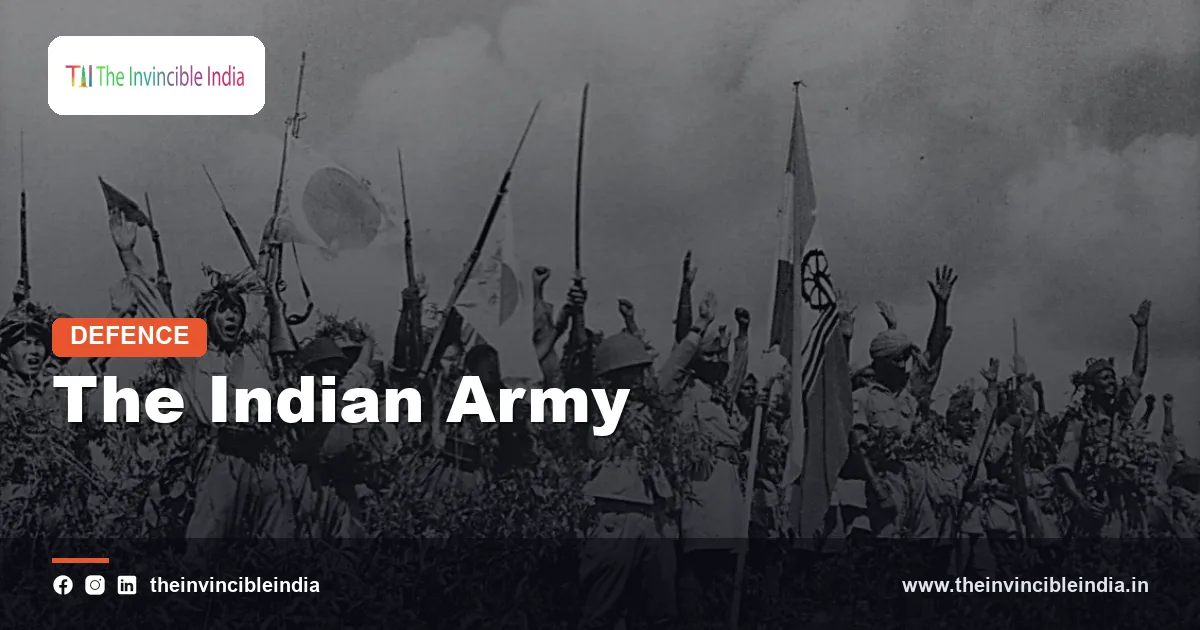
The Indian Army is the land component and by far the largest branch of the Indian Armed Forces, responsible for defending the country’s territory on land, securing its borders and supporting civil authorities in times of crisis. With a heritage that stretches back to the colonial-era armies of the East India Company, it has grown into one of the largest standing armies in the world, fighting five major conflicts since Independence and serving in some of the harshest terrain on Earth, from the Siachen Glacier to the deserts of Rajasthan.
This guide explains how the force is organised and how it came to be. It covers the chain of command, the seven commands, the hierarchy of field formations from corps down to section, the arms and services, the famous regiments, ranks, gallantry awards, the wars that shaped the force, and the reforms now under way through the Chief of Defence Staff and proposed theatre commands.
Last updated: 29 September 2026
Quick Facts
| Feature | Details |
|---|---|
| Branch of | Indian Armed Forces (land warfare component) |
| Supreme Commander | The President of India (Article 53 of the Constitution) |
| Head of the force | Chief of Army Staff (COAS), a four-star General |
| Parent ministry | Ministry of Defence, headed by the civilian Defence Minister |
| Army Day | 15 January, marking Cariappa’s taking over as first Indian Commander-in-Chief in 1949 |
| Organisation | Seven commands: six operational commands and the training command, ARTRAC |
| Highest gallantry award | Param Vir Chakra (instituted in 1950) |
| Field Marshals | Only two: K. M. Cariappa and S. H. F. J. Manekshaw |
The Indian Army in the Constitutional Framework
Civilian control of the military is a cornerstone of Indian democracy. Article 53 of the Constitution vests the supreme command of the Defence Forces in the President, who exercises this authority in accordance with law and on the advice of the Union Council of Ministers. In practice, policy and administration flow through the Ministry of Defence under the Defence Minister, while the professional head of the land forces is the Chief of Army Staff.
Chief of Army Staff and Army Headquarters
The COAS is a four-star General appointed by the government for a fixed tenure or until a prescribed retirement age, whichever comes first. He is assisted by the Vice Chief of Army Staff and a team of principal staff officers, including the Deputy Chiefs of Army Staff, the Adjutant General, the Quartermaster General, the Master General of Ordnance and the Military Secretary. Army Headquarters in New Delhi issues policy and directives; the commands convert them into operational plans.
Role and tasks
- Defending the nation against external aggression and safeguarding territorial integrity.
- Counter-insurgency and counter-terrorism operations, particularly in Jammu and Kashmir and parts of the Northeast.
- Aid to civil authority during riots, floods, earthquakes and other emergencies.
- Contributing troops to United Nations peacekeeping missions.
- Guarding the Line of Control and the Line of Actual Control, working alongside paramilitary forces.
Historical Roots: From Presidency Armies to a Unified Force
The story of the modern Indian Army begins with the trading companies of Europe. In the eighteenth century the East India Company raised its own troops, many of them Indian sepoys drilled on European lines, to protect its trading posts. Three separate Presidency armies grew up around Bengal, Madras and Bombay, and by the mid-1700s these forces had become instruments of conquest as well as defence. Some infantry regiments still trace their lineage to units of this era, and the Madras Regiment is widely regarded as among the oldest.
After 1857 and the unified army of 1895
The uprising of 1857 led the British Crown to take over direct rule from the Company and to reorganise the army thoroughly. Recruitment shifted towards groups classified as “martial races”, a policy that has been widely criticised by historians. The three Presidency armies continued for decades, but in 1895 they were brought under a single Indian Army, divided into four commands: Bengal, Madras, Bombay and Punjab. It is this consolidation that is often cited as the starting point of the modern institution.
World wars and colonial service
Indian soldiers served in large numbers in both World Wars, in Europe, the Middle East, Africa and Southeast Asia. Well over a million Indians served overseas in the First World War, and more than two million volunteered in the Second, making it one of the largest volunteer forces in history. Tens of thousands lost their lives, and many earned the Victoria Cross and other honours. This experience produced a generation of battle-hardened Indian officers who would later lead the army of an independent nation.
The Indian National Army
Separately, the Indian National Army, raised from prisoners of war and expatriates in Southeast Asia under Subhas Chandra Bose during the Second World War, fought alongside Japanese forces. It was not part of the British Indian Army and was not carried into the post-Independence force, but its story remains a significant chapter in India’s struggle for freedom.
Independence, Partition and the Making of a National Army
On 15 August 1947 India became independent, and the British Indian Army was divided between India and the new state of Pakistan. Units were allocated largely on religious and regional lines, assets and equipment were apportioned, and officers chose which country to serve. Gorkha regiments were split between India and the United Kingdom under the 1947 Tripartite Agreement. The Indian Army inherited the regimental traditions, institutions and much of the staff structure of its predecessor, but it had to fight a war in Kashmir almost immediately.
Cariappa and Army Day
For the first months of independence the top post remained with British officers. On 15 January 1949, General K. M. Cariappa took over from General Sir Francis Butcher to become the first Indian Commander-in-Chief of the Indian Army. That date is now celebrated every year as Army Day, with a parade in New Delhi and events in cantonments across the country to honour serving soldiers, veterans and the fallen. The title Commander-in-Chief was later replaced by Chief of Army Staff in 1955, and the President became the nominal head of all three services.
Integration and consolidation
The early years also saw the army help integrate the princely states, including the 1948 operation in Hyderabad, and lead the 1961 liberation of Goa. The Territorial Army was created in 1949 as a part-time volunteer force. Over the following decades the army modernised its doctrine, created new corps and commands, and expanded its training institutions.
Commands of the Indian Army
The Indian Army is organised into seven commands, each led by a Lieutenant General. Six are operational commands that hold geographical responsibility for defence, while the seventh, the Army Training Command (ARTRAC), is responsible for doctrine and training. The commands answer directly to Army Headquarters and are subdivided into corps, divisions and lower formations.
| Command | Headquarters | General area of responsibility |
|---|---|---|
| Northern Command | Udhampur | Jammu and Kashmir, Ladakh, Siachen and the Line of Control |
| Western Command | Chandimandir | Punjab, Haryana, Himachal Pradesh and adjoining border areas |
| South Western Command | Jaipur | Rajasthan and Gujarat, including desert border sectors |
| Southern Command | Pune | Peninsular India and parts of the western desert region; large logistics and training role |
| Central Command | Lucknow | Central India, Uttar Pradesh, Uttarakhand and the central sector of the northern border |
| Eastern Command | Kolkata | Eastern and northeastern India, including Sikkim, Arunachal Pradesh and the border with China, Myanmar and Bangladesh |
| Army Training Command (ARTRAC) | Shimla | Training, doctrine and combat development |
The South Western Command was created in the early 2000s to sharpen focus on the desert theatre, and ARTRAC was set up in 1991. Every command has its own headquarters staff, and each includes corps of strike, holding or mountain forces suited to the terrain. India also has a tri-service Andaman and Nicobar Command that sits outside the army’s own chain of commands.
Field Formations: From Corps to Section
Below the command level, the army fights through a well-defined ladder of formations. Understanding the ladder is the easiest way to make sense of how thousands of soldiers move as one force.
| Formation | Typical commander | Composition |
|---|---|---|
| Corps | Lieutenant General | Two or more divisions plus supporting corps troops |
| Division | Major General | Several brigades, artillery, engineers, signals and logistics |
| Brigade | Brigadier | Three or more battalions with supporting units |
| Battalion (regiment in armour and artillery) | Colonel or Lieutenant Colonel | Several companies, roughly a thousand personnel in an infantry battalion |
| Company (squadron or battery) | Major | Several platoons |
| Platoon (troop in armour) | Lieutenant or Junior Commissioned Officer | Several sections |
| Section | Havildar or Naik | The smallest tactical group of about ten soldiers |
Types of corps and divisions
Corps in the army fall into several groups. Strike corps, largely mechanised, are designed for offensive thrusts. Holding corps guard the border and hold ground until reinforcements arrive. Mountain divisions and mountain strike formations are specialised for high-altitude warfare. Terminology also varies with the arm: an armoured unit is called a regiment and its sub-units are squadrons and troops, while artillery regiments are made up of batteries.
Integrated battle groups and flexibility
Modern doctrine increasingly stresses flexibility, with smaller combined-arms groups that mix infantry, armour, artillery and support elements so that they can be assembled quickly for a specific mission. The idea is to reduce the time between decision and action and to fight effectively in varied terrain.
Arms and Services
The army is traditionally divided into combat arms, which fight the enemy directly, and services, which keep the force supplied, mobile, healthy and connected. Between them they form a single integrated machine.
Combat arms
- Infantry: the backbone of the army, holding ground and closing with the enemy. Infantry is organised into regiments with distinct regional and cultural identities.
- Mechanised Infantry: infantry carried into battle in armoured vehicles, formed as a separate regiment in 1979.
- Armoured Corps: tank and reconnaissance units that provide shock, firepower and mobility on the plains and deserts.
- Regiment of Artillery: guns, howitzers, rockets and missiles that deliver indirect fire; it is often called the “God of War”.
- Army Air Defence: separated from artillery in the 1990s, it protects troops and installations from air attack.
- Army Aviation Corps: raised in 1986, it operates helicopters for reconnaissance, transport and attack tasks.
Supporting arms
- Corps of Engineers: builds bridges, roads and fortifications and clears minefields. Its famous groups include the Bengal, Madras and Bombay Sappers.
- Corps of Signals: provides communications, from field radios to satellite links.
- Intelligence Corps and Corps of Military Police: gather information and maintain discipline and traffic control.
Services
The Army Service Corps handles supplies and transport. The Army Ordnance Corps manages stores and ammunition, while the Corps of Electronical and Mechanical Engineers repairs and maintains equipment. The Army Medical Corps and Army Dental Corps look after health, and the Remount and Veterinary Corps cares for animals such as mules and dogs. The Judge Advocate General’s branch, the Army Education Corps and the Pioneer Corps fill out the support system.
Famous Regiments and Their Traditions
Unlike many armies, the Indian Army retains a regimental system in which soldiers spend most of their careers within a single regiment. Each has its own battle cry, colours and history, and these traditions build fierce loyalty and morale. Many were raised by recruiting from particular regions or communities, though several today are mixed.
- Gorkha Rifles: recruited mainly from Nepali-speaking communities, renowned for the khukri and battle cry “Jai Mahakali, Ayo Gorkhali”.
- Rajput Regiment and Rajputana Rifles: traditional recruiting from Rajasthan and neighbouring regions, with a long combat record.
- Sikh Regiment and Sikh Light Infantry: among the most highly decorated units of the army, with a proud heritage dating from the colonial period.
- Maratha Light Infantry: drawn from Maharashtra and carrying the legacy of Shivaji’s warriors.
- Punjab Regiment: one of the oldest and most decorated infantry regiments.
- Madras Regiment: often described as the oldest infantry regiment of the army.
- Jat, Dogra, Garhwal, Kumaon, Mahar, Assam and Naga regiments: each with distinguished honours and strong regional roots.
- Parachute Regiment and its special forces: airborne and elite units for rapid, high-risk missions.
- Brigade of the Guards, Grenadiers and Jammu and Kashmir Rifles: further examples of the diversity of the infantry.
The old “martial races” theory of recruitment has been officially set aside in favour of merit and all-India representation in most parts of the force, and newer regiments and reforms continue to broaden the base of the army. Recruitment schemes such as the Agnipath scheme, launched in 2022, have also changed how soldiers join the ranks.
Ranks, Insignia and Gallantry Awards
The army has a clear, graded rank structure, and the insignia are worn on the shoulders or collar so that a soldier’s status can be recognised instantly.
Commissioned officers
- Field Marshal (ceremonial five-star rank)
- General
- Lieutenant General
- Major General
- Brigadier
- Colonel
- Lieutenant Colonel
- Major
- Captain
- Lieutenant
Junior Commissioned Officers and other ranks
Between the officers and the rank and file are the Junior Commissioned Officers: Subedar Major, Subedar and Naib Subedar. Non-commissioned ranks include Havildar, Naik and Lance Naik. The entry-level soldier is a Sepoy, though the designation differs by arm: Rifleman in the rifle regiments, Gunner in artillery, Sapper in engineers and Signalman in the Signals.
The two Field Marshals
Field Marshal is a ceremonial five-star rank awarded for exceptional service and, unlike other ranks, it is held for life. Only two officers have received it. Sam Manekshaw, who led the army during the 1971 war, was promoted in January 1973, while K. M. Cariappa was honoured with the rank in 1986.
Gallantry awards
The highest recognition for valour in the face of the enemy is the Param Vir Chakra, instituted in 1950 and first awarded to Major Somnath Sharma for his stand near Srinagar in 1947. Next in order come the Maha Vir Chakra and the Vir Chakra. For gallantry that does not involve direct combat with the enemy, the equivalent decorations are the Ashoka Chakra, Kirti Chakra and Shaurya Chakra. Other honours such as the Sena Medal and mentions in despatches recognise service across a soldier’s career.
Major Wars and Operations
The Indian Army has fought a series of wars since 1947. Each one shaped its doctrine, equipment and self-image.
| Year | Conflict | Key features |
|---|---|---|
| 1947-48 | First Kashmir War | Troops airlifted to Srinagar in October 1947 after tribal raiders and Pakistani-backed forces entered Jammu and Kashmir; ceasefire effective 1 January 1949 |
| 1962 | Sino-Indian War | Fighting in Ladakh and the Northeast; a painful setback that led to major reform and modernisation |
| 1965 | Indo-Pakistani War | Large-scale tank and infantry battles; ended with the Tashkent Declaration in 1966 |
| 1971 | Bangladesh Liberation War | Rapid campaign in the east; Pakistani forces surrendered in Dhaka on 16 December 1971, leading to the creation of Bangladesh |
| 1999 | Kargil War (Operation Vijay) | High-altitude action to evict intruders from heights along the Line of Control; victory declared on 26 July, now Kargil Vijay Diwas |
The 1971 war and the birth of Bangladesh
The 1971 war is usually regarded as the army’s most decisive victory. Following a humanitarian crisis in East Pakistan and the flight of millions of refugees into India, the army, working closely with the Air Force, the Navy and the Mukti Bahini, advanced rapidly towards Dhaka. The Instrument of Surrender was signed on 16 December 1971, and the campaign led to the emergence of Bangladesh as an independent nation. The Simla Agreement followed in 1972.
Kargil and other operations
The Kargil conflict of 1999 was fought at altitudes above 15,000 feet, where troops had to climb steep slopes under fire. Earlier, Operation Meghdoot in 1984 established Indian control over the Siachen Glacier, the highest battlefield in the world. The army has also carried out prolonged counter-insurgency campaigns and, more recently, targeted cross-border operations against terrorist launch pads.
Peacekeeping, Humanitarian Aid and Disaster Relief
Beyond war-fighting, the army is one of India’s most trusted institutions in moments of crisis. Its soldiers are frequently the first on the scene after natural disasters, using their discipline, equipment and logistics to save lives.
United Nations peacekeeping
India has been one of the largest contributors of troops to UN peacekeeping since the early 1950s, when it sent a medical unit and later a custodian force to Korea. Indian soldiers have since served in the Congo, Lebanon, Cyprus, Somalia, Sudan, South Sudan and many other places, earning a reputation for professionalism. The Indian Army also deployed the Indian Peace Keeping Force in Sri Lanka from 1987 to 1990, though that was a bilateral, not a UN, mission.
Disaster relief and civil aid
- Rescue operations during major floods, cyclones and earthquakes, including the 2001 Gujarat earthquake and the 2013 Uttarakhand floods.
- Building temporary bridges, restoring roads and setting up field hospitals.
- Community programmes in remote and border areas, such as schools, medical camps and infrastructure under Operation Sadbhavana in Jammu and Kashmir.
- Assistance to civil authorities during law and order breakdowns, when called in under the law.
Chief of Defence Staff and the Push for Theatre Commands
Historically, the Army, Navy and Air Force each operated under their own chiefs with limited formal integration. In August 2019 the government announced the creation of a Chief of Defence Staff (CDS), and General Bipin Rawat became the first to hold the post in January 2020. The CDS is a four-star officer who acts as the principal military adviser to the Defence Minister and heads the new Department of Military Affairs within the Ministry of Defence.
Why theaterisation matters
A key task of the CDS is to promote jointness among the services and to steer the creation of integrated theatre commands. Under such a model, forces from all three services in a geographical area would operate under a single commander instead of separate service chains. Proponents argue that this improves efficiency, reduces duplication and prepares the force for modern multi-domain warfare, including cyber and space. Debates about how many theatres should exist and how assets should be shared are ongoing, so the final shape of the plan may change. What is clear is that the Indian Army will remain the largest component of any such integrated structure.
Training and institutions
Officers are trained at institutions such as the National Defence Academy in Khadakwasla, the Indian Military Academy in Dehradun, established in 1932, and the Officers Training Academy in Chennai. Specialised schools and colleges, including the Defence Services Staff College at Wellington, prepare officers for staff and command roles.
Frequently Asked Questions
Who is the Supreme Commander of the Indian Army?
The President of India is the Supreme Commander of all three services, including the army, under Article 53 of the Constitution. The day-to-day professional head of the army is the Chief of Army Staff, who works under the Ministry of Defence.
Why is Army Day celebrated on 15 January?
Army Day marks 15 January 1949, when General K. M. Cariappa took over as the first Indian Commander-in-Chief from the last British chief, General Sir Francis Butcher. The day honours soldiers and veterans and is celebrated with parades and events.
How many commands does the Indian Army have?
The army has seven commands. Six are operational: Northern, Western, South Western, Southern, Central and Eastern. The seventh is the Army Training Command, or ARTRAC, based in Shimla, which looks after doctrine and training.
What is the difference between a corps, a division and a brigade?
A corps is the largest field formation, usually commanded by a Lieutenant General and made up of two or more divisions. A division, led by a Major General, contains several brigades, and a brigade is commanded by a Brigadier and typically comprises three or more battalions with supporting units.
Who are India’s Field Marshals?
Only two officers have held the ceremonial five-star rank of Field Marshal: K. M. Cariappa, honoured in 1986, and Sam Manekshaw, promoted in January 1973. The rank is held for life and is not part of the regular promotion ladder.
What are the Army’s highest gallantry awards?
The Param Vir Chakra is the highest wartime gallantry award, followed by the Maha Vir Chakra and the Vir Chakra. For acts of bravery away from direct combat with the enemy, the corresponding awards are the Ashoka Chakra, Kirti Chakra and Shaurya Chakra.
{“@context”:”https://schema.org”,”@graph”:[{“@type”:”FAQPage”,”mainEntity”:[{“@type”:”Question”,”name”:”Who is the Supreme Commander of the Indian Army?”,”acceptedAnswer”:{“@type”:”Answer”,”text”:”The President of India is the Supreme Commander of all three services, including the army, under Article 53 of the Constitution. The day-to-day professional head of the army is the Chief of Army Staff, who works under the Ministry of Defence.”}},{“@type”:”Question”,”name”:”Why is Army Day celebrated on 15 January?”,”acceptedAnswer”:{“@type”:”Answer”,”text”:”Army Day marks 15 January 1949, when General K. M. Cariappa took over as the first Indian Commander-in-Chief from the last British chief, General Sir Francis Butcher. The day honours soldiers and veterans and is celebrated with parades and events.”}},{“@type”:”Question”,”name”:”How many commands does the Indian Army have?”,”acceptedAnswer”:{“@type”:”Answer”,”text”:”The army has seven commands. Six are operational: Northern, Western, South Western, Southern, Central and Eastern. The seventh is the Army Training Command, or ARTRAC, based in Shimla, which looks after doctrine and training.”}},{“@type”:”Question”,”name”:”What is the difference between a corps, a division and a brigade?”,”acceptedAnswer”:{“@type”:”Answer”,”text”:”A corps is the largest field formation, usually commanded by a Lieutenant General and made up of two or more divisions. A division, led by a Major General, contains several brigades, and a brigade is commanded by a Brigadier and typically comprises three or more battalions with supporting units.”}},{“@type”:”Question”,”name”:”Who are India’s Field Marshals?”,”acceptedAnswer”:{“@type”:”Answer”,”text”:”Only two officers have held the ceremonial five-star rank of Field Marshal: K. M. Cariappa, honoured in 1986, and Sam Manekshaw, promoted in January 1973. The rank is held for life and is not part of the regular promotion ladder.”}},{“@type”:”Question”,”name”:”What are the Army’s highest gallantry awards?”,”acceptedAnswer”:{“@type”:”Answer”,”text”:”The Param Vir Chakra is the highest wartime gallantry award, followed by the Maha Vir Chakra and the Vir Chakra. For acts of bravery away from direct combat with the enemy, the corresponding awards are the Ashoka Chakra, Kirti Chakra and Shaurya Chakra.”}}]}]}