


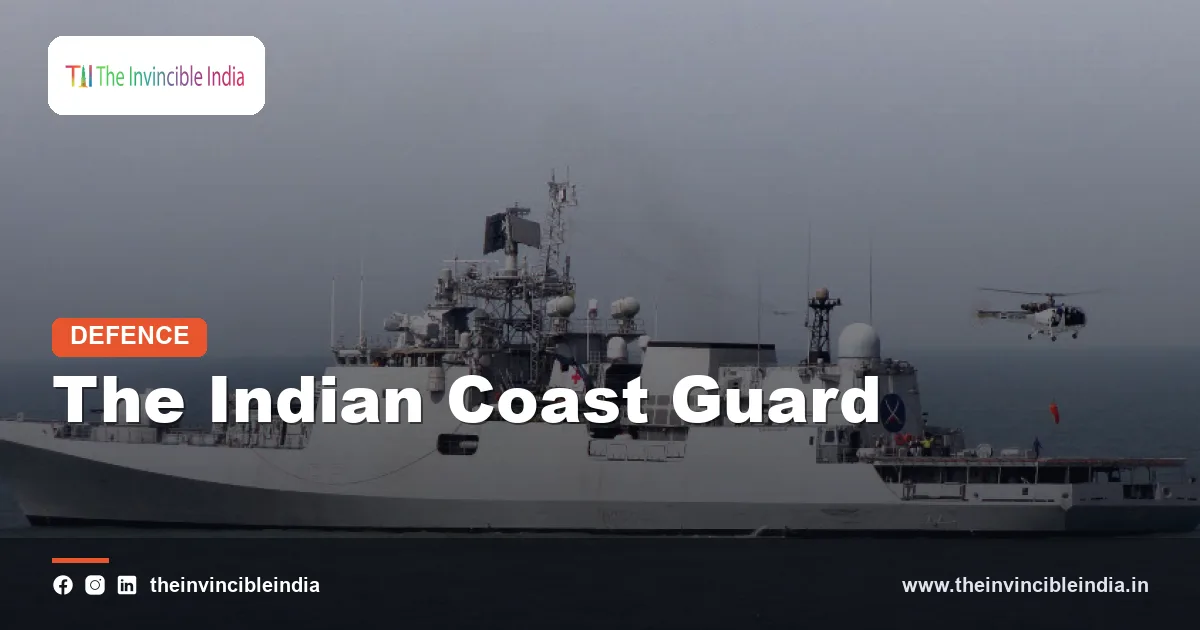
The Indian Coast Guard (ICG) is the maritime law-enforcement and search-and-rescue arm of the Union of India. Working under the Ministry of Defence, it guards the country’s territorial waters and its vast Exclusive Economic Zone, rescues people in distress at sea, fights marine pollution and stops illegal activity on the water. With a coastline of more than 7,500 kilometres and hundreds of islands, India needs a dedicated service for these constabulary and humanitarian tasks, and the Coast Guard fills exactly that role.
Many people assume the Coast Guard is simply a smaller version of the Navy. It is not. The two forces have separate charters, separate chains of command and different day-to-day priorities, even though they train together and share the same sea. This article explains what the service does, how it came into being, how it is organised, what ships and aircraft it uses and why its importance grew sharply after the 26/11 Mumbai attacks of 2008.
| Item | Detail |
|---|---|
| Full name | Indian Coast Guard (ICG) |
| Established | 1 February 1977 (Coast Guard Day is marked every year on this date) |
| Statutory basis | Coast Guard Act, 1978 |
| Parent ministry | Ministry of Defence, Government of India |
| Head of the force | Director General Indian Coast Guard (DGICG), based at Coast Guard Headquarters, New Delhi |
| Motto | Vayam Rakshamah (We Protect) |
| Regional commands | North-West, West, East, North-East, and Andaman & Nicobar |
| Ship prefix | ICGS (Indian Coast Guard Ship) |
| Area of responsibility | Territorial sea, contiguous zone and Exclusive Economic Zone |
What the Indian Coast Guard Is
The Coast Guard is an armed force of the Union, a status declared in its founding law. That means its personnel are uniformed, disciplined and trained to use force when the law permits. Yet its primary purpose is not to fight wars. It exists to protect India’s maritime interests, enforce maritime law and help those in danger on the water. In this sense it is closer to the coast guards of countries such as the United States, Japan and the United Kingdom than to a conventional navy.
The force operates in the waters over which India exercises sovereignty or sovereign rights. Under India’s Maritime Zones Act of 1976, which reflects the international law of the sea, these include:
- Territorial sea: extending up to 12 nautical miles from the baseline, where India enjoys full sovereignty.
- Contiguous zone: extending up to 24 nautical miles, where India may act to prevent breaches of customs, fiscal, immigration and sanitary laws.
- Exclusive Economic Zone (EEZ): extending up to 200 nautical miles, where India holds exclusive rights over living and non-living resources such as fish, oil and gas.
The EEZ is enormous, covering an area of sea comparable in size to the country’s land territory. Watching over such a space requires ships, aircraft, shore stations and constant coordination, which is why the Coast Guard has steadily grown in strength since its creation.
History and Origins of the Coast Guard
The problem that led to its creation
In the decades after Independence, India’s long coastline had no single agency to look after routine sea-going law enforcement. Smuggling of goods such as gold and electronic items across the western seaboard was a serious concern in the 1960s and early 1970s. The discovery of offshore oil in the Bombay High field, together with the growing number of fishing boats and the need to protect them, added new pressures. The Navy was the only force with capable ships, but its energies were meant for defence against external threats, not for chasing small smugglers or tackling oil spills.
The committees
The government studied the question in the early 1970s. The Nag Chaudhuri Committee examined the need for a maritime force to handle non-military tasks, while the Rustamji Committee, headed by the police officer K. F. Rustamji, looked closely at the requirement for the protection of offshore assets and the enforcement of law at sea. Their recommendations pointed to the need for a separate, dedicated agency instead of loading these duties on the Navy or on customs and police forces alone.
From interim force to statute
The Indian Coast Guard was formally established on 1 February 1977 as an interim arrangement, beginning modestly with a small number of ships transferred from the Navy. To give it a firm legal footing, Parliament passed the Coast Guard Act in 1978. This law defined the force, its powers and its functions and confirmed its position as an armed force of the Union. Since then the service has expanded steadily in ships, aircraft, bases and manpower.
Key milestones at a glance
| Period | Milestone |
|---|---|
| Early 1970s | Committees study the need for a maritime force for offshore protection and law enforcement |
| 1976 | Maritime Zones Act defines India’s territorial sea, contiguous zone and EEZ |
| 1 February 1977 | Indian Coast Guard formally established |
| 1978 | Coast Guard Act gives the force its statutory basis |
| 1980s onwards | Steady growth of the fleet, with new stations along both coasts and the islands |
| 2008 | 26/11 Mumbai attacks lead to a major overhaul of coastal security |
| 2010s onwards | Emphasis on indigenously built vessels and greater coastal surveillance |
Organisation and Command Structure
The head of the service is the Director General Indian Coast Guard, commonly written as DGICG, who works from Coast Guard Headquarters in New Delhi. The Director General is supported by senior officers who look after operations, personnel, material, policy and planning. Officers of the force follow a rank structure that broadly mirrors the naval one, starting from Assistant Commandant and rising through Deputy Commandant, Commandant, Deputy Inspector General and Inspector General up to Additional Director General and Director General.
Regional commands
For operational control, the coastline and island territories are divided into five regions, each headed by a senior officer. Below them sit Coast Guard Districts and Coast Guard Stations, which are the working bases from which ships, boats and aircraft actually go out to sea.
| Regional command | General area of responsibility |
|---|---|
| North-West | Gujarat coast and adjoining waters of the Arabian Sea, including the sensitive sea border with Pakistan |
| West | Maharashtra, Goa, Karnataka and Kerala coasts, including Mumbai and the offshore oil fields |
| East | Tamil Nadu, Andhra Pradesh and Puducherry coasts, including the Palk Strait and Bay of Bengal waters |
| North-East | Odisha and West Bengal coasts, including the Sundarbans approaches and the northern Bay of Bengal |
| Andaman & Nicobar | The island chain in the Bay of Bengal and Andaman Sea, close to important international shipping lanes |
The Lakshadweep group in the Arabian Sea and other island territories are covered through stations and detachments that fall under these regional structures. Coast Guard Air Stations and Air Enclaves, attached to major airfields, support the flying units that give the service its wide reach.
Charter of Duties
The Coast Guard Act sets out the functions of the force. Together they form a practical charter that tells the service what it must do every day.
| Duty | What it means in practice |
|---|---|
| Safety of offshore installations | Protecting artificial islands, oil rigs, platforms and terminals and the people working on them |
| Protection of fishermen | Guarding fishing communities, assisting boats in trouble and warning them of bad weather |
| Marine environment | Preserving and protecting the marine environment and controlling pollution, including oil spills |
| Law enforcement | Assisting customs and other authorities in anti-smuggling operations and enforcing maritime laws |
| Search and rescue | Rescuing life and property at sea, including from ships in distress |
| Scientific data collection | Gathering data on oceans and weather and supporting related research |
The Act also gives Coast Guard officers powers of search, seizure and arrest in the relevant maritime zones, so that offenders detected at sea can be dealt with lawfully. In addition, the government can direct that the Coast Guard work under the operational control of the Navy in times of war, when the two forces would operate as a combined maritime shield.
Search and Rescue, Pollution Control and Disaster Response
Search and rescue at sea
Search and rescue, usually shortened to SAR, is the most visible and emotionally powerful part of the work. India has agreed under international conventions to provide SAR coverage over a very large ocean region, and the Coast Guard is the national coordinating authority for maritime SAR. It runs Maritime Rescue Coordination Centres and sub-centres along the coast that receive distress calls, analyse the position and send help.
How a rescue typically works
- A distress signal reaches a rescue coordination centre by radio, satellite alert, phone or a report from another vessel.
- The centre works out the likely position of the vessel or person, taking wind and current into account.
- The nearest suitable ship, boat or aircraft is directed to the scene, and merchant ships in the area may also be asked to help.
- Helicopters may hoist survivors and carry them to hospitals, while ships tow damaged vessels to safety.
Medical evacuations from ships and islands are another regular task. When a sailor or a fisherman falls seriously ill far from land, a Coast Guard aircraft or ship can reach them faster than any other agency. Over the years the force has saved a very large number of lives, and this humanitarian record is a major reason for public respect toward the service.
Protecting the marine environment
A busy coastline brings pollution risks. Tankers pass close to Indian waters every day, ports handle large volumes of oil and chemicals, and offshore installations produce hydrocarbons. An accident can quickly damage beaches, mangroves, coral reefs and fishing grounds. The Coast Guard is designated as the central coordinating authority for responding to oil spills in Indian waters and maintains a national plan for oil spill disaster contingencies.
Tools for pollution response
- Pollution response vessels: specially equipped ships that carry booms, skimmers and dispersants to contain and clean up spilled oil.
- Aerial surveillance: aircraft that spot illegal discharges from ships and map the spread of a spill.
- Exercises and training: regular drills with ports, oil companies and other agencies, so that responders know their roles before a real emergency.
- Regional cooperation: joint exercises with neighbouring countries to prepare for spills that cross borders.
Beyond spills, the service also tries to prevent illegal dumping, watch over protected marine areas and support wider efforts to conserve the ocean.
Disaster response and humanitarian work
India’s coastline is regularly struck by cyclones, especially in the Bay of Bengal and, increasingly, the Arabian Sea. The Coast Guard is a key part of the national response. Before a storm, it broadcasts warnings, calls fishing boats back to harbour and positions ships and aircraft for rescue. After the storm has passed, it searches for missing boats, evacuates stranded people and delivers relief material to islands and coastal villages that are cut off.
The force has also taken part in the response to the 2004 Indian Ocean tsunami, floods in coastal districts and many rescues from sinking ships and burning vessels. Its role is not limited to Indian waters, since it has helped mariners of several nationalities. International cooperation, including visits to friendly countries and joint exercises, has extended its reputation as a professional maritime service.
Fleet and Indigenous Shipbuilding
The Coast Guard operates a mixed fleet, sized and shaped for the different kinds of work it does. Every ship carries the prefix ICGS. The exact numbers change as new vessels join and old ones retire, so it is more useful to understand the types than to memorise figures.
Surface vessels
- Advanced offshore patrol vessels: the largest and most capable ships, designed for long patrols in the EEZ, and often carrying a helicopter and heavy weapons.
- Offshore patrol vessels: mid-sized ships used for extended patrols, escorts, rescue and law enforcement further from the coast.
- Fast patrol vessels: quicker ships suited to coastal patrolling and chasing suspect boats.
- Interceptor boats and inshore patrol vessels: small, very fast craft used near the coast to stop smugglers and to check fishing boats.
- Pollution control vessels: ships fitted with equipment to tackle oil spills.
- Air cushion vehicles (hovercraft): craft that skim over water, mudflats and marshes, and are particularly useful in shallow creeks and coastal wetlands.
Aircraft
The air wing of the Coast Guard consists of fixed-wing surveillance aircraft, notably the Dornier type, and several classes of helicopters. Aircraft carry out long-range surveillance, spot pollution, look for missing boats and airlift casualties. Helicopters operate from shore bases and from ships that have flight decks, giving the force a flexible reach over the sea.
Indigenous shipbuilding
Most of the recent vessels of the Coast Guard have been designed and built in India, in line with the government’s push for self-reliance in defence. Shipyards in the public and private sectors, including Goa Shipyard Limited, Hindustan Shipyard Limited, Cochin Shipyard Limited and private yards such as Larsen & Toubro, have delivered patrol vessels and interceptor boats to the service.
This approach has several advantages. It keeps design knowledge inside the country, supports skilled jobs in coastal towns and reduces dependence on foreign suppliers for spare parts and repairs. Indigenous content in weapons, engines and electronics has also gradually risen, so that a large share of the new fleet can now be built, maintained and upgraded at home. For a service that must be ready round the clock, easy access to local repair and supply is a real operational benefit.
Law Enforcement: Smuggling, Piracy and Illegal Fishing
Enforcing the law was one of the reasons the force was created, and it remains central to its identity. The Coast Guard works closely with the customs authorities, the police and other agencies to stop the movement of contraband by sea, including narcotics, arms and other prohibited goods. Its patrols also deter illegal fishing by foreign vessels inside the EEZ and check fishing boats for compliance with rules.
Other enforcement roles
- Anti-piracy and armed robbery: patrolling busy sea lanes and responding to threats to merchant ships.
- Illegal migration: watching for unauthorised boats trying to land on Indian shores.
- Maritime boundary vigilance: keeping a watch on the international maritime boundary line, where fishermen from neighbouring countries sometimes stray across.
- Boarding and inspection: stopping and checking suspicious vessels under the powers given by law.
These tasks call for tact as much as strength. Because many of those met at sea are ordinary fishermen, the force must balance firmness with humanity.
Coastal Security After 26/11
The terrorist attacks on Mumbai in November 2008 were carried out by attackers who reached the city by sea. The event exposed gaps in India’s coastal defences and led to a fundamental rethink of how the coast is protected. A more structured system followed, often described as a three-tier security grid.
The three tiers
- Inner layer: coastal and marine police stations, backed by patrol boats, watch the shallow waters close to the shore and the landing points.
- Middle layer: the Coast Guard patrols the territorial waters and beyond, and also coordinates with the state marine police in coastal security matters.
- Outer layer: the Navy, which has overall responsibility for maritime security, guards the deeper seas and the wider approaches.
Several other measures accompanied this grid. Joint operation centres were set up so that different agencies could share information. Fishing boats were brought under stricter registration, and identification systems for fishermen and vessels were strengthened. Coastal radar chains and surveillance networks were extended, and the Coast Guard’s own fleet, stations and manpower were expanded. Regular drills, such as large coastal security exercises involving the Navy, Coast Guard, marine police and other agencies, test the readiness of the whole system.
Coast Guard versus Navy
Because both forces operate at sea, people often confuse them. The differences are clear once purpose and jurisdiction are compared.
| Aspect | Indian Coast Guard | Indian Navy |
|---|---|---|
| Main purpose | Maritime law enforcement, safety, SAR and pollution control | Naval warfare, defence of the nation from external threats and power projection |
| Peacetime focus | Constabulary and humanitarian duties | Deterrence, training, diplomacy and readiness |
| Legal basis | Coast Guard Act, 1978 | Navy Act, 1957 |
| Typical ships | Patrol vessels, interceptor boats, hovercraft | Aircraft carriers, destroyers, frigates, submarines |
| Wartime role | Can work under Navy’s operational control when directed | Leads naval operations |
The two forces complement each other. The Navy supplied the first ships and much early training to the Coast Guard, and even today they cooperate closely on information sharing, joint exercises and coastal security.
Careers, Training and the Motto
The motto Vayam Rakshamah comes from Sanskrit and means “We Protect”. It reflects the twin ideas of guarding the country’s waters and protecting people who use the sea. Coast Guard personnel are recruited both as officers and as enrolled personnel, who serve in navigation and engineering branches. The force also recruits and trains specialists for the aviation, technical and legal branches. Training combines seamanship, navigation, weapons handling, boarding drills, first aid and survival at sea. Because the service performs real operations every day, many of its personnel gain practical experience very quickly.
The Coast Guard also observes Coast Guard Day on 1 February, when ceremonies, displays and reviews mark the anniversary of its founding and honour those who have served.
Conclusion
From a small interim force in 1977, the Indian Coast Guard has grown into a well-established armed force with a clear legal mandate, a network of regional commands and a mixed fleet of ships and aircraft. It protects fishermen, rescues people in peril, guards offshore wealth, protects the marine environment and enforces the law across a vast expanse of sea. After 26/11 it became a vital layer in the coastal security grid, working alongside the Navy and marine police. As India’s maritime trade, blue economy and strategic interests continue to grow, the service that says “We Protect” will remain central to the safety of India’s seas. Details of numbers and equipment change over time, so readers should check official sources for the latest position. Last updated: 30 September 2026.
Frequently Asked Questions
When was the Indian Coast Guard established?
The Indian Coast Guard was formally established on 1 February 1977, and Coast Guard Day is observed on this date each year. Parliament then passed the Coast Guard Act in 1978, which gave the force its statutory basis and defined its powers and functions.
Is the Coast Guard part of the Indian Navy?
No. The Coast Guard is a separate armed force of the Union that functions under the Ministry of Defence, with its own Director General, its own law and its own mandate. It works closely with the Navy and can be placed under the Navy’s operational control in wartime if the government so directs.
What are the main duties of the Indian Coast Guard?
Its duties include protecting offshore installations, safeguarding fishermen, preserving the marine environment and controlling pollution, assisting in anti-smuggling and law enforcement, carrying out search and rescue, and collecting scientific data. Officers have powers of search, seizure and arrest in the relevant maritime zones.
How is the Indian Coast Guard organised?
It is headed by the Director General Indian Coast Guard at headquarters in New Delhi. Operations are divided among five regional commands, namely North-West, West, East, North-East and Andaman and Nicobar, which in turn oversee districts and stations along the coast and the islands.
What does the Indian Coast Guard’s motto mean?
The motto Vayam Rakshamah is Sanskrit for “We Protect”. It sums up the service’s twin responsibilities of defending India’s maritime interests and protecting the lives of people at sea.
How did the Coast Guard’s role change after the 26/11 attacks?
After the 2008 Mumbai attacks, India built a three-tier coastal security grid involving the marine police, the Coast Guard and the Navy. The Coast Guard’s fleet, stations and surveillance were expanded, and it took on a larger part in coordinating patrols and information sharing along the coast.
{“@context”:”https://schema.org”,”@graph”:[{“@type”:”FAQPage”,”mainEntity”:[{“@type”:”Question”,”name”:”When was the Indian Coast Guard established?”,”acceptedAnswer”:{“@type”:”Answer”,”text”:”The Indian Coast Guard was formally established on 1 February 1977, and Coast Guard Day is observed on this date each year. Parliament then passed the Coast Guard Act in 1978, which gave the force its statutory basis and defined its powers and functions.”}},{“@type”:”Question”,”name”:”Is the Coast Guard part of the Indian Navy?”,”acceptedAnswer”:{“@type”:”Answer”,”text”:”No. The Coast Guard is a separate armed force of the Union that functions under the Ministry of Defence, with its own Director General, its own law and its own mandate. It works closely with the Navy and can be placed under the Navy’s operational control in wartime if the government so directs.”}},{“@type”:”Question”,”name”:”What are the main duties of the Indian Coast Guard?”,”acceptedAnswer”:{“@type”:”Answer”,”text”:”Its duties include protecting offshore installations, safeguarding fishermen, preserving the marine environment and controlling pollution, assisting in anti-smuggling and law enforcement, carrying out search and rescue, and collecting scientific data. Officers have powers of search, seizure and arrest in the relevant maritime zones.”}},{“@type”:”Question”,”name”:”How is the Indian Coast Guard organised?”,”acceptedAnswer”:{“@type”:”Answer”,”text”:”It is headed by the Director General Indian Coast Guard at headquarters in New Delhi. Operations are divided among five regional commands, namely North-West, West, East, North-East and Andaman and Nicobar, which in turn oversee districts and stations along the coast and the islands.”}},{“@type”:”Question”,”name”:”What does the Indian Coast Guard’s motto mean?”,”acceptedAnswer”:{“@type”:”Answer”,”text”:”The motto Vayam Rakshamah is Sanskrit for “We Protect”. It sums up the service’s twin responsibilities of defending India’s maritime interests and protecting the lives of people at sea.”}},{“@type”:”Question”,”name”:”How did the Coast Guard’s role change after the 26/11 attacks?”,”acceptedAnswer”:{“@type”:”Answer”,”text”:”After the 2008 Mumbai attacks, India built a three-tier coastal security grid involving the marine police, the Coast Guard and the Navy. The Coast Guard’s fleet, stations and surveillance were expanded, and it took on a larger part in coordinating patrols and information sharing along the coast.”}}]}]}