


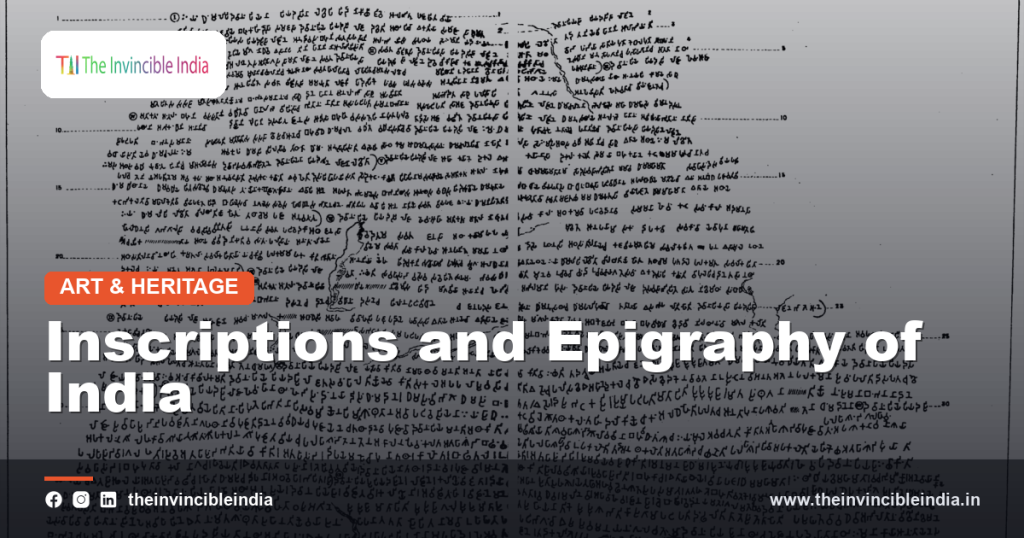
Inscriptions and the study of epigraphy provide some of the most valuable windows into India’s ancient and medieval past, preserving the words of rulers, donors and communities carved or engraved onto durable materials centuries ago. Found on monuments such as those explored in this guide to Indian temple architecture, as well as on pillars, rocks and copper plates, these inscriptions offer direct evidence of language, administration, religion and society across many centuries. Where other records perished, inscriptions carved in stone or engraved on metal have endured. This guide explores the materials, scripts, content and enduring importance of India’s inscriptions and the discipline of epigraphy that studies them.
Quick Facts
| Detail | Information |
|---|---|
| Type | The study of inscriptions carved or engraved on durable materials |
| Materials | Stone, copper plates and other durable surfaces |
| Scripts | Brahmi, Kharosthi and later regional scripts |
| Content | Royal edicts, donations, grants and dedications |
| Importance | A vital source for reconstructing Indian history |
| Custodian | Studied and preserved through Indian epigraphy |
Windows into the Past
Inscriptions and the study of epigraphy provide some of the most valuable windows into India’s ancient and medieval past, preserving the words of rulers, donors and communities carved or engraved onto durable materials centuries ago. Where other historical records may have perished, inscriptions carved in stone or engraved on metal have survived the passage of time, offering direct evidence of language, administration, religion and society. This durability makes inscriptions uniquely valuable historical sources. As windows into the past, preserving direct evidence from centuries ago, India’s inscriptions and the discipline of epigraphy that studies them hold an essential place in understanding the country’s long and rich history.
What Is Epigraphy
Epigraphy is the scholarly study of inscriptions, the texts carved, engraved or otherwise inscribed onto durable materials such as stone, metal or other surfaces, rather than written on perishable materials like paper or palm leaf. Epigraphists examine the script, language, content and context of inscriptions to extract historical, linguistic and cultural information, often piecing together fragmentary or worn evidence with great care. This careful discipline underpins much of what is known about ancient India. This definition of epigraphy as the careful study of durable inscribed texts explains the discipline’s central importance to Indian history, since so much knowledge of the ancient and medieval periods depends on the patient work of epigraphists.
The Earliest Inscriptions
The tradition of inscriptions in India extends back to antiquity, with some of the earliest known inscriptions dating from the ancient period and marking crucial milestones in the historical record. These early inscriptions provide some of the first datable written evidence for the languages, administration and beliefs of their times, offering historians a foothold from which to reconstruct the broader history of the subcontinent. Their discovery and study opened new chapters in Indian historical research. These earliest inscriptions of India, among the first substantial written records to survive from antiquity, laid the foundation for the entire discipline of Indian epigraphy and remain of fundamental importance to historians of the ancient period.
Ashokan Edicts
Among the most celebrated of India’s ancient inscriptions are the edicts associated with the emperor Ashoka, carved on rocks and pillars across a wide area of the subcontinent and conveying messages of moral and administrative guidance. These edicts are of immense historical value, offering insight into the governance, values and reach of an ancient Indian empire through the ruler’s own recorded words. Their wide distribution testifies to the scale of the empire they represent. These Ashokan edicts, among the most significant inscriptions in Indian history, remain a cornerstone of ancient Indian epigraphy and a uniquely direct source of insight into the concerns and administration of an early Indian empire.
Materials: Stone, Copper Plates and More
Indian inscriptions have been recorded on a variety of durable materials, most notably stone and copper, each suited to different purposes and contexts. Stone inscriptions are commonly found on rock faces, pillars, temple walls and monuments, intended for public and lasting display, while copper plates were frequently used to record land grants and donations, often issued as durable legal documents. Other materials were used more occasionally. This variety of materials used for Indian inscriptions, chosen according to purpose and permanence, reflects the practical considerations behind the ancient and medieval practice of recording important texts for the long term.
Scripts of Indian Inscriptions
Indian inscriptions were written in a variety of scripts that evolved over the centuries, including early scripts such as Brahmi and Kharosthi, from which many later Indian scripts descended. The study of these scripts, and how they changed over time and across regions, is a central part of epigraphic scholarship, allowing experts to date inscriptions and trace the development of India’s many writing systems. This evolution of script mirrors the evolution of language and culture. This diversity and evolution of scripts found in Indian inscriptions, providing a record of the development of the subcontinent’s writing systems, is one of the most valuable dimensions of the country’s epigraphic heritage.
Languages of Inscriptions
Alongside their varied scripts, Indian inscriptions were composed in a range of languages, including early forms of Prakrit and Sanskrit as well as numerous regional languages that developed over time. The choice of language in an inscription often reflects the period, region and purpose of the text, and the study of these languages provides valuable evidence for the history of India’s linguistic development. This linguistic variety enriches the value of the inscriptional record. This use of a wide range of languages in Indian inscriptions, evolving over the centuries, offers scholars a rich body of evidence for tracing the linguistic history of the subcontinent alongside its political and religious history.
Royal and Donative Inscriptions
Many Indian inscriptions record the acts of rulers and other patrons, commemorating royal proclamations, achievements, or the granting of land, resources or privileges to religious institutions and individuals. Such royal and donative inscriptions provide valuable evidence of governance, patronage and religious practice, often naming the ruler, the recipient and the terms of the grant with considerable specificity. These records illuminate the workings of ancient and medieval administration. These royal and donative inscriptions, recording the acts and grants of rulers and patrons, form a substantial and historically rich category of India’s epigraphic record, offering direct evidence of governance and patronage across many centuries.
Temple Inscriptions
Temples across India frequently bear inscriptions on their walls, pillars and foundations, recording matters such as donations, construction, endowments and the names of patrons and craftsmen associated with the site. These temple inscriptions are an invaluable source for the history of religious institutions, temple administration and patronage, and they often provide precious evidence connecting a monument to the community that built and supported it. Such inscriptions bring temples to life as historical documents. This wealth of temple inscriptions found across India, recording the history and patronage of religious sites, adds enormously to the value of temples as sources of historical information, extending their significance well beyond their architecture and sculpture alone.
Copper Plate Grants
Copper plate grants form a distinctive and important category of Indian inscriptions, typically recording the donation of land or revenue to individuals or institutions, often issued as formal and lasting legal documents. These grants frequently specify details such as the parties involved, the land or resources granted, and the terms of the grant, providing valuable evidence of administrative and economic history. Their durability has helped preserve many such records to the present. This tradition of copper plate grants, preserving detailed records of land and revenue donations, is one of the most historically informative categories of Indian inscriptions and a vital resource for understanding the administrative and economic history of the subcontinent.
Inscriptions as Historical Sources
Inscriptions serve as an essential historical source for reconstructing India’s past, often providing more reliable and directly dated evidence than later literary or traditional accounts. Historians rely on inscriptions to establish chronologies, verify the existence and reigns of rulers, understand administrative practices, and trace the spread of religions and cultures across the subcontinent. Their contemporaneous nature gives them particular evidentiary value. This role of inscriptions as a primary historical source, offering direct and often precisely dated evidence, underlies much of what is known with confidence about India’s ancient and medieval history, making epigraphy indispensable to the wider discipline of history.
Deciphering and Study of Inscriptions
The study of Indian inscriptions requires specialised skills in deciphering ancient scripts and languages, often demanding careful examination of worn, damaged or fragmentary texts. Epigraphists compare inscriptions, cross-reference known scripts and languages, and apply rigorous scholarly method to establish accurate readings and interpretations, a process that has, over time, unlocked a vast body of historical knowledge. This painstaking work continues to yield new discoveries. This careful process of deciphering and studying inscriptions, requiring great scholarly skill and patience, is the foundation of the entire discipline of epigraphy and has been responsible for many of the most important advances in the understanding of Indian history.
Preservation Challenges
Despite their durability, Indian inscriptions face challenges of preservation, including natural weathering, damage to monuments, and the risk of loss or destruction over time. Efforts to record, photograph, transcribe and protect inscriptions are essential to safeguarding this fragile yet vital historical record for future study, particularly as some inscriptions become increasingly worn or inaccessible. Conservation of the monuments bearing inscriptions is equally important. These preservation challenges facing India’s inscriptions highlight the importance of ongoing conservation and documentation efforts, without which valuable pieces of the historical record risk being lost before they can be fully studied and understood.
Epigraphy in India
The systematic study, recording and preservation of Indian inscriptions has been carried forward over many years by dedicated scholarly and institutional efforts within the country, building a substantial body of documented and studied inscriptions. This institutional work has been essential in cataloguing inscriptions, publishing their texts and translations, and training successive generations of epigraphists to continue the discipline. Such sustained effort has greatly expanded historical knowledge. This sustained institutional effort behind the study of epigraphy in India, cataloguing and preserving the country’s vast inscriptional heritage, has been essential to building the rich body of historical knowledge that scholars and the public rely upon today.
A Legacy of Written Memory
India’s inscriptions together constitute a vast legacy of written memory, preserving the voices, decisions and beliefs of rulers, donors and communities across many centuries and regions. This legacy connects the present to the distant past in a uniquely direct way, offering evidence not filtered through later retelling but recorded at or near the time of the events themselves. Such direct testimony is a rare and precious historical resource. This legacy of written memory preserved in India’s inscriptions, offering direct testimony from across the centuries, stands as one of the most valuable and enduring contributions of the ancient and medieval past to the historical understanding of the present.
Epigraphy Today
Today the study of Indian inscriptions and epigraphy continues as an active field of scholarship, with ongoing efforts to document, decipher and interpret inscriptions found across the country. Advances in technology have aided the recording and analysis of worn or damaged texts, while scholars continue to build on the foundations laid by earlier generations of epigraphists. Public interest in these inscriptions also continues through museums and heritage sites. As windows into the past that continue to inform and enrich historical understanding, India’s inscriptions and the discipline of epigraphy remain an essential and living part of the country’s engagement with its own history.
Sources & Further Reading
- Archaeological Survey of India, on the epigraphy and inscriptions of India (asi.nic.in).
- Ministry of Culture, Government of India, on the historical heritage of India (indiaculture.gov.in).
Frequently Asked Questions
What is epigraphy?
Epigraphy is the scholarly study of inscriptions, texts carved or engraved onto durable materials such as stone or metal. It is essential to reconstructing the history, language and culture of ancient and medieval India.
What materials were used for Indian inscriptions?
Indian inscriptions were most commonly recorded on stone, used for public monuments and temples, and on copper plates, often used for land grants and donations, chosen for their durability and permanence.
Why are the Ashokan edicts important?
The Ashokan edicts are important because they are among the most significant ancient Indian inscriptions, offering direct insight into the governance, values and reach of an early Indian empire through the ruler’s own words.
Why are inscriptions valuable historical sources?
Inscriptions are valuable historical sources because they often provide directly dated, contemporaneous evidence, allowing historians to establish chronologies, verify rulers and reigns, and understand administration and religion more reliably than later accounts.
What challenges affect the preservation of Indian inscriptions?
Indian inscriptions face challenges such as natural weathering, damage to monuments, and the risk of loss over time, making ongoing documentation, photography and conservation essential to preserving this historical record.