


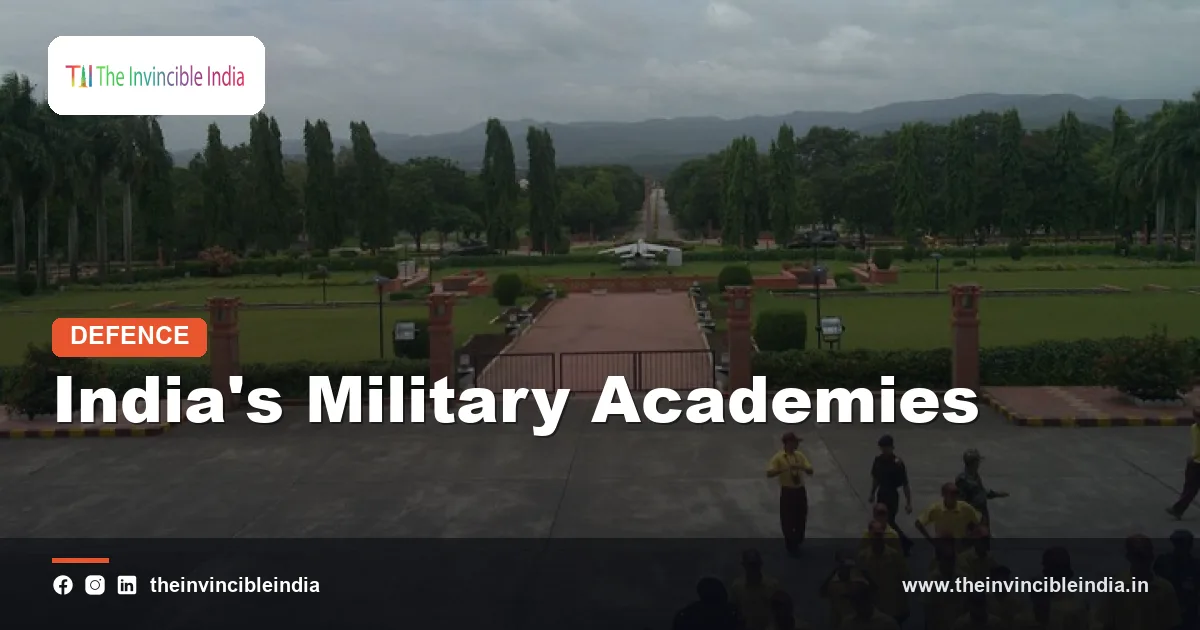
Every soldier, sailor and airman in India’s armed forces is led by an officer who spent months or years being shaped at one of a handful of institutions scattered from the Western Ghats to the foothills of the Himalayas. At the head of this system stands the National Defence Academy at Khadakwasla near Pune, a unique tri-service institution where future Army, Navy and Air Force officers begin their careers together. Around it sit the Indian Military Academy, the Officers Training Academy, the Indian Naval Academy and the Air Force Academy.
This explainer walks through each of these academies, how a young Indian gets into them, what daily life inside looks like, and how recent changes have opened the doors to women. It also covers the feeder schools that quietly supply many of the cadets and the long-discussed idea of a National Defence University.
Quick Facts
| Topic | India’s premier military training academies |
|---|---|
| Tri-service academy | National Defence Academy (NDA), Khadakwasla, Pune, established 1954 |
| Army officer academy | Indian Military Academy (IMA), Dehradun, established 1932 |
| Short service commission | Officers Training Academy (OTA), Chennai (and Gaya) |
| Naval academy | Indian Naval Academy (INA), Ezhimala, Kerala, commissioned 2009 |
| Air Force academy | Air Force Academy (AFA), Dundigal, Hyderabad |
| Entry after Class 12 | UPSC National Defence Academy and Naval Academy exam |
| Entry after graduation | Combined Defence Services (CDS) exam, direct entries and special entries |
| Women in the NDA | Opened to women after the Supreme Court’s 2021 intervention; first cadets joined in 2022 |
Why India Needs a Dedicated Officer Training System
An armed force is only as good as the people who lead it. In the Indian system, commissioned officers command units, plan operations and carry the moral responsibility for the men and women serving under them. That responsibility cannot be learnt on the job alone, so the country invests heavily in academies that blend academics, physical conditioning, military skills and character building.
The architecture of these academies is largely a legacy of the years just before and after Independence. The British Indian Army trained Indian officers at institutions such as the Royal Military Academy at Sandhurst and, from 1932, at the new academy in Dehradun. After 1947, India reorganised the system, and in the 1950s created a joint academy for the three services. That one decision, to let young cadets of all services train side by side, has shaped Indian military culture ever since.
The basic pattern
- Pre-commission training: every officer-to-be spends months to years in a residential academy.
- Service-specific finishing: each service has its own final academy for specialised training.
- Commissioning: the cadet becomes a Lieutenant (or the equivalent rank in the Navy and Air Force) at a passing-out parade.
- Continuous learning: staff colleges, war colleges and technical courses follow throughout a career.
National Defence Academy, Khadakwasla: The Cradle of Leaders
The National Defence Academy, widely known by its acronym NDA, is often described as the world’s first tri-service academy, meaning that cadets of the Army, Navy and Air Force study and train together under one roof. The idea was to ensure that tomorrow’s service chiefs would already know, respect and trust one another long before they reached high command. The institution grew out of a joint services wing that was first set up in Dehradun and then shifted to its permanent home at Khadakwasla, on the shores of a lake near Pune. The academy was formally established in 1954.
Campus and traditions
The sprawling campus, set against the Sahyadri hills, has academic blocks, drill squares, riding and swimming facilities, sailing on the Khadakwasla lake and an extensive obstacle course. Cadets are grouped into squadrons and battalions, and they compete for honours in sports, drill and academics. The academy’s motto, “Seva Paramo Dharma” (service before self), sums up the spirit expected of every cadet.
Notable alumni
The roll of NDA alumni includes several service chiefs and gallantry award winners from every service. Captain Manoj Kumar Pandey, who was awarded the Param Vir Chakra for his courage in the Kargil conflict of 1999, was an NDA graduate. The sense of fellowship among “NDA mates” persists across decades and across services, which is precisely what the founders hoped to achieve.
Life and Training at the NDA
A cadet’s three years at the National Defence Academy are divided into six terms. The first year is a shock for most: wake-up calls before dawn, drill, physical training, and a rigid daily timetable that leaves little spare time. Senior cadets, in turn, hold leadership responsibilities that give them an early taste of command.
Academics and degree
The academic programme is structured so that, by the end of three years, a cadet graduates with a degree. Streams offered include science, computer science and arts or humanities, and naval cadets are also offered a technical stream that leads to an engineering degree. The academic curriculum runs alongside military subjects such as map reading, weapons, tactics and the fundamentals of naval and air force operations.
Physical and character training
- Physical training: running, obstacle courses, gymnastics, boxing and swimming build stamina and confidence.
- Outdoor activities: trekking, camping, sailing, riding and adventure activities teach resilience and teamwork.
- Drill and ceremony: precision drill instils discipline and pride in the uniform.
- Service training: cadets spend time in service-specific classes and exercises, giving each one a flavour of life in their future branch.
After the NDA
After the three years, the cadets disperse. Army cadets go to the Indian Military Academy in Dehradun for a further year of pre-commission training, naval cadets move on to the Indian Naval Academy at Ezhimala, and Air Force cadets proceed to the Air Force Academy at Dundigal for flying and ground training. This is the stage at which the common NDA experience gives way to individual service identity.
Indian Military Academy, Dehradun: Where the Army Commissions Its Officers
The Indian Military Academy (IMA), at Dehradun in Uttarakhand, was established on 1 October 1932, with a first batch of 40 cadets known as the “Pioneers”. Among those early cadets was Sam Manekshaw, who went on to become India’s first Field Marshal, as well as two others who later became chiefs of the armies of Burma and Pakistan. The academy was meant to give India its own pipeline of trained officers rather than depending entirely on overseas institutions.
The Chetwode motto
The IMA’s guiding creed comes from Field Marshal Sir Philip Chetwode, who opened the academy. Cadets know it by heart: “The safety, honour and welfare of your country come first, always and every time. The honour, welfare and comfort of the men you command come next. Your own ease, comfort and safety come last, always and every time.” The words are displayed prominently at Chetwode Hall, the academy’s main building, and they are meant to serve as a moral compass for every officer who passes through its gates. The academy’s own motto is “Valour and Wisdom”.
Gentlemen Cadets
At the IMA, cadets are traditionally called Gentlemen Cadets, or GCs. Training is intense and wide-ranging, covering tactics, weapon handling, leadership, military law, communications, field craft and physical endurance. Candidates enter through several routes: those from the NDA, those selected through the CDS exam, those entering under technical graduate schemes and the Army Cadet College, and others who rise from the ranks.
The Antim Pag and Passing-Out Parades
The most memorable moment in a cadet’s journey is the passing-out parade, when the cadets who began their training as raw recruits become commissioned officers. At the IMA, this ritual reaches its emotional peak with the Antim Pag, which means the “final step”. As the cadets march at the Drill Square, they cross a marked line, and in that single stride they formally become officers of the Indian Army.
What happens at a parade
- Reviewing officer: a senior dignitary, often a service chief, takes the salute.
- Drill and march past: cadets march to the strains of the band, in precise, synchronised formations.
- Awards: the Sword of Honour, along with gold, silver and bronze medals, recognises the most outstanding cadets.
- Pipping ceremony: parents or loved ones attach the newly earned rank insignia to the officer’s shoulders.
- Oath and Antim Pag: the cadets take the oath of allegiance and step across the line into commissioned service.
IMA passing-out parades are held twice a year, around June and December, and are attended by families, veterans and dignitaries. The NDA, the Naval Academy and the Air Force Academy hold similar ceremonies, each with its own distinct rituals, such as the Combined Graduation Parade at the Air Force Academy, in which the President’s commission is formally conferred on officers.
Officers Training Academy, Chennai and Gaya
The Officers Training Academy (OTA) at Chennai trains officers who join the Army under the Short Service Commission, typically for an initial period of ten years that can be extended. The institution traces its origins to the early 1960s, when India expanded its officer corps after the 1962 conflict with China, and it was later renamed the Officers Training Academy. A second OTA has since been set up at Gaya in Bihar.
Women at the OTA
The OTA has a special place in the story of women in the Indian military. Since the early 1990s, women have entered the Army as short service officers, with the Chennai academy taking them through the same demanding pre-commission training that their male counterparts undergo. For decades, their entry was limited to certain branches and to short service, but that picture has been changing over the last few years.
Training and commissioning
The course at the OTA lasts a little under a year and covers military skills, leadership, physical fitness and basic professional subjects. Graduating officers are commissioned as Lieutenants and posted to their units. The OTA also trains officers entering through the CDS, as well as those joining under special schemes such as the Technical Graduate and Non-Technical Graduate courses.
Indian Naval Academy, Ezhimala
The Indian Naval Academy (INA) at Ezhimala, in Kannur district of Kerala, is described as Asia’s largest naval academy. It was commissioned in 2009 and occupies a spectacular site on the Malabar coast, facing the Arabian Sea and backed by the hills. The academy is the common pre-commission training establishment for officers of the Indian Navy, as well as for officers of the Indian Coast Guard and, on occasion, friendly foreign navies.
Who trains here
- NDA graduates who have opted for the Navy.
- Candidates who joined through the 10+2 Cadet Entry Scheme and take an engineering degree.
- Graduates who entered through the CDS and other direct entry schemes.
- Coast Guard officers, who follow a similar pre-commission pattern.
Training at sea
Cadets here learn seamanship, navigation, naval warfare basics and technical subjects, and they spend extended periods on training ships before being commissioned. The academy also emphasises sailing, boat work, swimming and survival at sea, because these skills define a naval officer’s identity.
Air Force Academy, Dundigal
The Air Force Academy (AFA) at Dundigal, near Hyderabad, is the Indian Air Force’s principal training institution for officers. It trains the flying branch, the technical branch and the ground duty branches, all of which are commissioned from the academy. Flying training is demanding: trainee pilots progress from basic aircraft to more advanced types, and only those who meet the required standards are awarded their wings.
Courses and branches
- Flying branch: fighter, transport and helicopter pilots.
- Technical branch: engineers who maintain and support the aircraft and systems.
- Ground duty branch: administration, logistics, accounts, meteorology and education.
The academy is also home to the Combined Graduation Parade, held twice a year, where the President’s commission is conferred on newly graduating officers. As in other academies, the most deserving cadets receive awards for their overall performance, flying skill and academic achievement.
Main Academies at a Glance
| Academy | Location | Service | Established |
|---|---|---|---|
| National Defence Academy (NDA) | Khadakwasla, Pune, Maharashtra | Army, Navy and Air Force (tri-service) | 1954 |
| Indian Military Academy (IMA) | Dehradun, Uttarakhand | Army | 1932 |
| Officers Training Academy (OTA) | Chennai, Tamil Nadu (and Gaya, Bihar) | Army (short service commission) | Early 1960s |
| Indian Naval Academy (INA) | Ezhimala, Kerala | Navy and Coast Guard | 2009 |
| Air Force Academy (AFA) | Dundigal, Hyderabad, Telangana | Air Force | Late 1960s, at Dundigal since the early 1970s |
Entry Routes: How to Become an Officer
There is no single door into the officer corps. Instead, the Union Public Service Commission (UPSC) and the individual services provide multiple routes, depending on a candidate’s age and qualification.
After Class 12: the NDA exam
Young men and, since 2022, young women who have passed or are appearing for Class 12 can sit the UPSC’s National Defence Academy and Naval Academy Examination, held twice a year. Those aiming for the Air Force and Navy need physics and mathematics at the school level, while the Army wing is open to candidates from any stream. The exam consists of written papers in mathematics and general ability, followed by a multi-day Services Selection Board (SSB) interview that tests intelligence, personality, group dynamics and leadership potential. A medical examination follows.
After graduation: the CDS and other entries
Graduates can enter through the Combined Defence Services Examination, also conducted by the UPSC, which leads to the IMA, INA, AFA and OTA. There are also special entry schemes, including the NCC Special Entry for cadets with a “C” certificate, the Technical Graduate courses for engineers, the University Entry Scheme for engineering students, and other short service commission entries. Candidates from the ranks can also be selected for officer training through the Army Cadet College.
| Route | Qualification | Leads to |
|---|---|---|
| NDA exam | Class 12 | NDA, then IMA / INA / AFA |
| CDS exam | Graduation | IMA, INA, AFA or OTA |
| NCC Special Entry | Graduation with NCC “C” certificate | IMA or OTA |
| Technical entries | Engineering degree | IMA, OTA, INA or AFA |
| Army Cadet College | Serving personnel | IMA |
Women and the Academies
The last few years have brought some of the most significant changes in the history of Indian military training. Women officers first entered the Army in the early 1990s, but only on short service commissions, which limited their careers. Landmark Supreme Court judgments in the early 2020s directed that women officers be considered for permanent commission in the Army and Navy, and that they be eligible for command roles on par with their male counterparts.
Opening the NDA
In 2021, following a petition and an order of the Supreme Court, the government agreed to allow women to appear for the NDA exam. The first batch of women cadets joined the academy in 2022. This decision removed a long-standing barrier and means that women can now follow the same path as men from the age of 16 to 17, rather than waiting until after graduation.
Impact on the system
- Women can now join the three services in larger numbers and across more branches.
- Training standards and curricula remain the same, with suitable infrastructure adjustments.
- Women flying officers, naval officers and Army officers are increasingly visible in leadership roles.
Feeder Schools and the National Defence University Idea
Many NDA cadets come from a network of schools that prepare students from an early age. The Rashtriya Indian Military College (RIMC) in Dehradun, founded in 1922 as the Prince of Wales Royal Indian Military College, is the oldest and most prestigious of these. Students join after Class 7 or 8, and the college has produced numerous senior officers.
Sainik Schools and Military Schools
The Sainik School system, launched in 1961 with the first school at Satara in Maharashtra, was conceived to broaden the base from which officers are drawn, making a military career accessible to talented students from across India. Rashtriya Military Schools, descended from the old King George’s Royal Indian Military Schools, perform a similar role. Though only some of their students join the armed forces, these schools have contributed a large number of NDA candidates.
A National Defence University
For years, policymakers have discussed the idea of an Indian National Defence University, a degree-granting institution for advanced military education, research and joint studies across the services. The proposal has been debated in Parliament and defence circles as a means of integrating professional military education, strategy and technology. Whatever its eventual form, the concept highlights a long-standing aim: to make India’s military education more joint, more research-oriented and more closely linked to the wider academic world.
Training Ethos: What Makes an Indian Officer
Across all the academies, the ethos is surprisingly consistent. It rests on four pillars: discipline, leadership, physical fitness and academic learning. A cadet is expected to excel in each, and no single strength can compensate for a lapse in another.
- Discipline: punctuality, obedience to lawful orders and honesty are non-negotiable.
- Leadership: cadets are given graded responsibilities, from leading a small team to commanding a squadron or a battalion of cadets.
- Fitness: a cadet must be able to run, climb, swim and endure hardship.
- Academics: modern warfare demands technology, geography, history, languages and strategy.
- Esprit de corps: the bond among batchmates, often lasting a lifetime, is among the most valued outcomes of academy life.
The most important lesson is perhaps the one in the Chetwode creed: that command is a service to the country and to those one leads, never a privilege to be enjoyed for its own sake.
Conclusion
India’s military academies are more than training grounds; they are institutions that carry a national tradition. From the National Defence Academy at Khadakwasla, where the three services first learn to think as one, to the Antim Pag at the Indian Military Academy, to the sea training at Ezhimala and the flying sorties from Dundigal, these academies have produced generations of officers who have served the country in peace and in war. With women now entering the academies in greater numbers and with new reforms in joint training, the system continues to evolve while holding on to the values that define it.
Frequently Asked Questions
What is the National Defence Academy, and where is it located?
The National Defence Academy (NDA) is the joint services academy of India’s armed forces, located at Khadakwasla near Pune in Maharashtra. It trains cadets of the Army, Navy and Air Force together for three years and awards them a degree before they move on to their respective service academies. The academy was established in 1954.
How can a student join the NDA?
A candidate who has passed or is appearing in Class 12 can apply for the UPSC’s National Defence Academy and Naval Academy Examination, held twice a year. After the written test, shortlisted candidates face a multi-day Services Selection Board interview and a medical examination. Candidates for the Air Force and Navy need physics and mathematics at the school level.
What is the difference between the IMA and the OTA?
The Indian Military Academy at Dehradun trains officers for permanent commission in the Army, including those coming from the NDA and the CDS. The Officers Training Academy at Chennai trains officers who join under the Short Service Commission. Both give a similar pre-commission training, although the entry schemes and the initial terms of service differ.
What is the Antim Pag?
Antim Pag, meaning the “final step”, is the symbolic moment at the passing-out parade of the Indian Military Academy when cadets take the last step of their training and become commissioned officers. It is one of the most emotional traditions of Indian military life, usually witnessed by families, veterans and senior officers.
Can women join the NDA and the other academies?
Yes. After a Supreme Court intervention in 2021, the NDA examination was opened to women, and the first women cadets joined the academy in 2022. Women officers also train at the Officers Training Academy, and judicial rulings in the early 2020s paved the way for permanent commission for women in the Army and Navy.
What are the Rashtriya Indian Military College and Sainik Schools?
The Rashtriya Indian Military College in Dehradun, founded in 1922, and the network of Sainik Schools, launched in 1961, are residential schools that prepare students for a career in the armed forces. Many of their students go on to join the NDA, though admission to the academy is still determined through the UPSC exam and the SSB.
{“@context”:”https://schema.org”,”@graph”:[{“@type”:”FAQPage”,”mainEntity”:[{“@type”:”Question”,”name”:”What is the National Defence Academy, and where is it located?”,”acceptedAnswer”:{“@type”:”Answer”,”text”:”The National Defence Academy (NDA) is the joint services academy of India’s armed forces, located at Khadakwasla near Pune in Maharashtra. It trains cadets of the Army, Navy and Air Force together for three years and awards them a degree before they move on to their respective service academies. The academy was established in 1954.”}},{“@type”:”Question”,”name”:”How can a student join the NDA?”,”acceptedAnswer”:{“@type”:”Answer”,”text”:”A candidate who has passed or is appearing in Class 12 can apply for the UPSC’s National Defence Academy and Naval Academy Examination, held twice a year. After the written test, shortlisted candidates face a multi-day Services Selection Board interview and a medical examination. Candidates for the Air Force and Navy need physics and mathematics at the school level.”}},{“@type”:”Question”,”name”:”What is the difference between the IMA and the OTA?”,”acceptedAnswer”:{“@type”:”Answer”,”text”:”The Indian Military Academy at Dehradun trains officers for permanent commission in the Army, including those coming from the NDA and the CDS. The Officers Training Academy at Chennai trains officers who join under the Short Service Commission. Both give a similar pre-commission training, although the entry schemes and the initial terms of service differ.”}},{“@type”:”Question”,”name”:”What is the Antim Pag?”,”acceptedAnswer”:{“@type”:”Answer”,”text”:”Antim Pag, meaning the “final step”, is the symbolic moment at the passing-out parade of the Indian Military Academy when cadets take the last step of their training and become commissioned officers. It is one of the most emotional traditions of Indian military life, usually witnessed by families, veterans and senior officers.”}},{“@type”:”Question”,”name”:”Can women join the NDA and the other academies?”,”acceptedAnswer”:{“@type”:”Answer”,”text”:”Yes. After a Supreme Court intervention in 2021, the NDA examination was opened to women, and the first women cadets joined the academy in 2022. Women officers also train at the Officers Training Academy, and judicial rulings in the early 2020s paved the way for permanent commission for women in the Army and Navy.”}},{“@type”:”Question”,”name”:”What are the Rashtriya Indian Military College and Sainik Schools?”,”acceptedAnswer”:{“@type”:”Answer”,”text”:”The Rashtriya Indian Military College in Dehradun, founded in 1922, and the network of Sainik Schools, launched in 1961, are residential schools that prepare students for a career in the armed forces. Many of their students go on to join the NDA, though admission to the academy is still determined through the UPSC exam and the SSB.”}}]}]}