


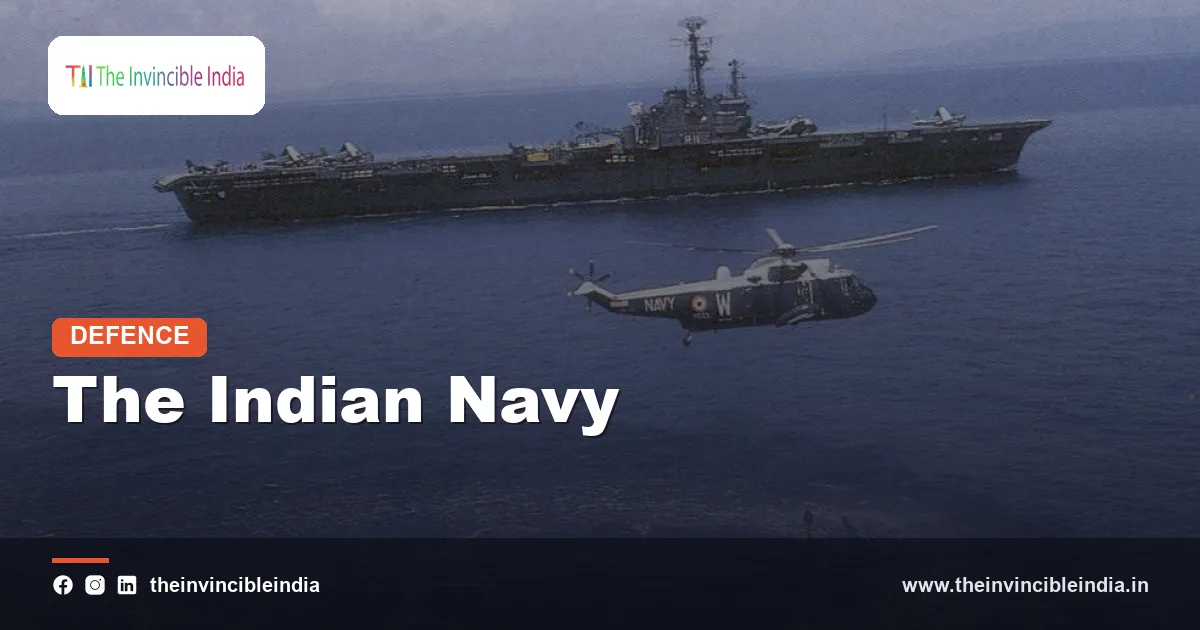
The Indian Navy is the maritime branch of the Indian Armed Forces, responsible for defending the country’s long coastline, its island territories and its vast ocean interests. With a peninsula jutting deep into the Indian Ocean, more than seven thousand kilometres of coast and the Andaman, Nicobar and Lakshadweep islands scattered across the sea, India’s security and prosperity have always been tied to the water. The Navy is the force that guards those sea lanes and projects Indian influence well beyond its shores.
This explainer walks through how the service is organised, where it came from, what it operates and why it matters. It covers the chain of command, the three operational commands, the carriers, destroyers, frigates and submarines, the indigenous shipbuilding drive, and the everyday roles that range from war-fighting to disaster relief. Fleet figures change every year as ships are commissioned and retired, so the article describes them in broad, dated terms rather than exact counts. It was last reviewed on 29 September 2026.
| Quick Fact | Detail |
|---|---|
| Service | Maritime branch of the Indian Armed Forces |
| Supreme Commander | The President of India |
| Professional head | Chief of Naval Staff (CNS), an Admiral |
| Historical roots | Bombay Marine (1612), later the Royal Indian Marine and Royal Indian Navy |
| Present name adopted | 26 January 1950, when the “Royal” prefix was dropped |
| Navy Day | 4 December, commemorating Operation Trident (1971) |
| Operational commands | Western (Mumbai), Eastern (Visakhapatnam), Southern (Kochi) |
| Motto | Sam No Varunah (May the Lord of the Oceans be auspicious unto us) |
| Fleet size | Roughly 150 ships and submarines, plus a naval air arm (approximate; changes yearly) |
What the Indian Navy Is and What It Does
The Indian Navy is one of three uniformed services under the Ministry of Defence, alongside the Indian Army and the Indian Air Force. Constitutionally, the supreme command of all the armed forces rests with the President of India. Day-to-day professional leadership belongs to the Chief of Naval Staff, who is an Admiral and is assisted by a Vice Chief and a group of Principal Staff Officers at Naval Headquarters in New Delhi. Policy and budgets are set by the civilian government through the Ministry of Defence, which keeps the military firmly under democratic control.
Core missions
The Navy’s tasks are commonly grouped into four categories, which the service itself describes as military, diplomatic, constabulary and benign roles.
- Military: deterring and, if needed, defeating threats at sea, protecting offshore assets and supporting operations ashore.
- Diplomatic: port calls, joint exercises and goodwill visits that build partnerships with friendly navies.
- Constabulary: anti-piracy patrols, coastal security, anti-smuggling and maritime law enforcement duties, often alongside the Indian Coast Guard.
- Benign: humanitarian assistance, disaster relief, search and rescue and evacuation of citizens from crisis zones.
Because about 90 per cent of India’s trade by volume travels by sea, and a large share of its crude oil arrives on tankers, keeping the ocean open for commerce is a national economic priority as much as a military one.
Origins and Independence: From the Bombay Marine to the Indian Navy
The story of Indian naval power stretches back much further than the twentieth century. Coastal kingdoms such as the Cholas, whose fleets reached Southeast Asia, and the Maratha Navy under Chhatrapati Shivaji Maharaj and later admirals such as Kanhoji Angre, showed that Indian rulers understood the value of sea power. The modern service, however, traces its institutional line to the British era.
The colonial-era forces
In 1612 a small marine force was set up to protect East India Company trading ships along the western coast, and it evolved into the Bombay Marine. Over the following centuries it was renamed several times. In 1892 it became the Royal Indian Marine, and in 1934 it was reorganised as the Royal Indian Navy, a formally constituted combatant service. During the Second World War the Royal Indian Navy grew rapidly, escorting convoys, clearing mines and taking part in operations in the Indian Ocean and beyond.
- 1612: Beginnings of the Bombay Marine.
- 1892: Renamed the Royal Indian Marine.
- 1934: Reconstituted as the Royal Indian Navy.
- 1947: Fleet divided between India and Pakistan at Partition.
- 1950: Renamed the Indian Navy after India became a republic.
Independence, Republic and the Modern Service
Independence in 1947 brought both opportunity and difficulty. The Royal Indian Navy was divided between India and Pakistan, leaving the Indian side with a modest fleet of sloops, minesweepers and smaller vessels, along with a shortage of trained officers. The senior ranks were still largely held by British officers, and it took years to build an Indian leadership. In 1958 Vice Admiral R. D. Katari became the first Indian Commander-in-Chief of the Navy.
When India became a republic on 26 January 1950, the “Royal” prefix was dropped and the service became simply the Indian Navy. Its ensign, the flag flown at the stern of its ships, was later redesigned, most recently in 2022, to shed the old colonial cross and draw on Indian maritime heritage.
The 1950s and 1960s saw the acquisition of the first light cruiser and, in 1961, the aircraft carrier INS Vikrant, obtained from Britain. That same year the Navy took part in the operation that ended Portuguese rule in Goa. The service slowly moved from dependence on British-built ships towards a mix of Soviet, British and, increasingly, Indian designs.
Navy Day and Operation Trident, 1971
India celebrates Navy Day on 4 December every year. The date commemorates one of the most celebrated actions in the service’s history, Operation Trident, which took place during the 1971 war with Pakistan. On the night of 4 December 1971, a strike group of missile boats supported by escort vessels attacked Karachi harbour, the main base of the Pakistan Navy. The Indian force used Soviet-built Osa-class missile boats armed with Styx anti-ship missiles, a weapon that was then new to the region.
The raid sank or damaged several enemy ships and set fuel installations on fire, giving the Indian Navy the initiative at sea. A follow-up operation, Operation Python, struck again a few days later. Operation Trident is remembered as the first use of anti-ship missiles in this part of the world and a model of surprise, speed and coordination.
Other wartime episodes
- 1971: Alongside the Karachi raids, the Navy imposed a blockade in the Bay of Bengal, which helped isolate East Pakistan. INS Vikrant played a prominent role. The loss of INS Khukri to a submarine attack is also remembered as a sacrifice of that war.
- 1988: Operation Cactus, in which Indian forces helped the Maldivian government resist an attempted coup.
- 1999: Operation Talwar, a naval deployment in the Arabian Sea during the Kargil conflict.
Organisation: The Three Commands
The Indian Navy is organised into three geographic commands, each headed by a Flag Officer Commanding-in-Chief holding the rank of Vice Admiral. Two of them are operational commands that hold the fleets, while the third is responsible for training. Each command has its own dockyard, air stations and support facilities.
| Command | Headquarters | Main role |
|---|---|---|
| Western Naval Command | Mumbai | Operations in the Arabian Sea; home of the Western Fleet |
| Eastern Naval Command | Visakhapatnam | Operations in the Bay of Bengal; home of the Eastern Fleet |
| Southern Naval Command | Kochi | Training command for officers and sailors |
Western and Eastern fleets
The Western Naval Command, based at Mumbai, covers the Arabian Sea and the busy trade routes leading to the Persian Gulf and the Suez Canal. The Eastern Naval Command, based at Visakhapatnam, watches the Bay of Bengal and the approaches to the Malacca Strait. Each hosts a fleet made up of carriers, destroyers, frigates, corvettes and submarines.
Southern Command and the training role
The Southern Naval Command at Kochi has been the Navy’s training command for decades. It runs schools for seamanship, navigation, gunnery, submarine and aviation skills, and many young recruits take their first steps in naval life there. Officer cadets are trained at the Indian Naval Academy in Ezhimala, Kerala, which is a separate institution feeding the wider system.
Besides these three, the Andaman and Nicobar Command at Port Blair, established in 2001, is India’s first joint tri-service command and looks after the strategic island chain near the Malacca Strait.
The Fleet: Carriers, Destroyers and Frigates
The Indian Navy operates a balanced blue-water fleet. The figure of around 150 ships and submarines is often quoted, but the composition shifts as older vessels retire and new ones enter service, so it is best read as an approximate, dated snapshot rather than an exact count.
Aircraft carriers
Carriers are the most visible symbols of naval power. The Navy’s flagship for many years has been INS Vikramaditya, a modified Kiev-class carrier bought from Russia, where she had been the Admiral Gorshkov, and commissioned into Indian service in 2013. She was joined by INS Vikrant, India’s first indigenous aircraft carrier, built at Cochin Shipyard Limited in Kerala and commissioned on 2 September 2022. The new ship took its name from the first Vikrant, the carrier of the 1961 to 1997 period, and has become a leading symbol of self-reliance in defence manufacturing. Carriers give the Navy the ability to project air power over the ocean and secure sea lanes far from India’s coast.
Destroyers, frigates and corvettes
The surface fleet’s backbone is made up of guided-missile destroyers, frigates and corvettes. Well-known classes include:
- Kolkata-class and Visakhapatnam-class destroyers: large, missile-armed ships built in Mumbai to Indian designs.
- Shivalik and Talwar-class frigates: multi-role ships, the former built in India and the latter imported from Russia.
- Kamorta-class corvettes: compact anti-submarine warships built in Kolkata.
- Offshore patrol vessels, fast attack craft and minesweepers: smaller ships for coastal defence and patrolling.
Supporting them are fleet tankers, landing ships, survey vessels and other auxiliaries that keep the force running far from home.
Submarines and the Nuclear Triad
India’s submarine arm is one of its oldest and most important. It began in 1967 with the commissioning of the first Soviet-built submarine, and today includes conventional diesel-electric boats and nuclear-powered boats. Submarines are valued because they are hard to detect and can threaten enemy shipping.
Conventional submarines
The diesel-electric fleet includes older Russian Kilo-class boats and German-designed Shishumar-class boats, alongside the newer Kalvari-class, derived from the French Scorpene design and built at Mazagon Dock in Mumbai under a technology-transfer arrangement. Further additions are planned as part of long-running submarine-building programmes.
INS Arihant and the sea leg of the triad
The most strategically significant boat is INS Arihant, India’s first indigenously built nuclear-powered ballistic missile submarine, which entered service in the middle of the last decade. Carrying nuclear-tipped ballistic missiles, it gave India a secure, survivable sea-based deterrent, completing the “nuclear triad” of land-based missiles, air-delivered weapons and submarine-launched missiles. Follow-on boats have joined or are being built, extending this capability. India’s declared doctrine is one of credible minimum deterrence and no first use, and the submarine leg is central to the second-strike logic of that policy.
Naval Aviation and Special Forces
The Navy has its own air arm, the Naval Air Arm, which flies from carriers, destroyers and shore bases. Its aircraft are as diverse as its ships.
- Carrier-borne fighters: MiG-29K jets operate from the carriers, replacing the old Sea Harriers that were retired earlier.
- Maritime patrol aircraft: long-range aircraft such as the P-8I, along with Dornier and Il-38 types, watch the seas and hunt submarines.
- Helicopters: anti-submarine and utility helicopters, such as the Kamov, Sea King and indigenous Chetak and Dhruv types, fly from ships and shore.
- Unmanned systems: drones for surveillance over the ocean have grown in importance.
The Navy also fields the Marine Commandos, known as MARCOS, an elite special force trained for amphibious, counter-terrorism and special operations. Naval Air Stations and airfields along both coasts and on the islands ensure that the fleet has air cover and surveillance almost everywhere it sails.
Indigenous Shipbuilding and Aatmanirbhar Bharat
One of the most notable trends of the past few decades is the Navy’s push for self-reliance. The first Indian-built warship of a major type, INS Nilgiri, a frigate, was launched in 1972 and inspired a design tradition. Today the Navy has an in-house Directorate of Naval Design that draws up plans for warships, and public and private yards across the country build them.
The yards and the numbers
- Mazagon Dock Shipbuilders (Mumbai): destroyers, frigates and submarines.
- Garden Reach Shipbuilders and Engineers (Kolkata): frigates, corvettes and survey ships.
- Cochin Shipyard (Kochi): the aircraft carrier INS Vikrant and other large vessels.
- Goa Shipyard and private shipyards: patrol vessels and support ships.
Under the “Make in India” and Aatmanirbhar Bharat initiatives, the government has stressed domestic production, and the vast majority of warships and submarines currently on order or under construction are being built in Indian yards. The push also covers sensors, weapons and engines, though some critical components are still imported. The goal is to cut dependence on foreign suppliers, create skilled jobs and strengthen the industrial base.
The Indian Ocean Region, SAGAR and Naval Diplomacy
The Indian Navy sees the Indian Ocean Region as its primary area of interest. It stretches from the Persian Gulf and the Horn of Africa to the Straits of Malacca. In 2015 India articulated the SAGAR vision, short for Security and Growth for All in the Region, which frames the Navy as a responsible, net security provider that works with its neighbours in coastal surveillance, hydrography and capacity building.
Anti-piracy and Gulf of Aden patrols
Since 2008 Indian warships have been deployed in the Gulf of Aden to protect merchant vessels from piracy off Somalia. They escort ships, respond to distress calls and have rescued crews from hijacked vessels. This long-running deployment is a good example of how the Navy contributes to the safety of global shipping.
Exercises and partnerships
Regular exercises build trust and practical skills. The best known is Malabar, which began in the early 1990s as a bilateral drill between India and the United States and has since grown to include other partners such as Japan and Australia. India also conducts exercises with countries such as France, Russia, the United Kingdom and members of ASEAN. The Navy hosts the multinational biennial exercise MILAN and the International Fleet Review, bringing many navies together, and organises the Indian Ocean Naval Symposium, a platform for regional cooperation.
Humanitarian Assistance and Disaster Relief
Alongside its combat role, the Indian Navy is often the first responder when calamity strikes. Ships carry medical teams, helicopters, divers and stores, and can act as floating bases for relief.
- Operation Sea Waves (2004): relief after the Indian Ocean tsunami in India, Sri Lanka, the Maldives and Indonesia.
- Operation Rahat (2015): evacuation of Indian nationals and foreigners from Yemen.
- Operation Samudra Setu (2020): ships brought Indian citizens home from Gulf countries and the region during the pandemic and carried medical oxygen supplies.
- Cyclone and flood relief: rescue and supply missions along the coasts and in neighbouring countries.
The abbreviation HADR, for humanitarian assistance and disaster relief, has become a standard part of naval vocabulary and a way of demonstrating goodwill in the neighbourhood.
Sea Control, Sea Denial and Strategy
Naval strategists describe two complementary ideas. Sea control means being able to use an area of the ocean for your own purposes, such as moving trade or forces, while preventing an adversary from doing the same. Aircraft carriers, destroyers and frigates with air-defence systems are the main instruments. Sea denial means preventing an enemy from using the sea, for instance by threatening his ships with submarines, missile-armed vessels and long-range aircraft. The Indian Navy is designed to do both.
Choke points and island territories
Much of the world’s energy trade passes through a few narrow passages, such as the Strait of Hormuz and the Strait of Malacca, and India’s geography places it near the centre of these routes. The Andaman and Nicobar Islands overlook the approaches to Malacca, while Lakshadweep and the Minicoy region watch the main east-west shipping lanes. Persistent surveillance from ships, aircraft and satellites, combined with information-sharing centres, helps the Navy maintain awareness of what is happening at sea.
Training Ship INS Tarangini and Tri-Service Integration
INS Tarangini is the Navy’s sail training ship, a three-masted barque commissioned in 1997 and used to teach young sailors and officers the traditional skills of seamanship, teamwork and courage. Under sail, trainees learn to read the weather and to live in close quarters, lessons that remain useful even on modern warships. Tarangini has crossed oceans on goodwill voyages and completed a circumnavigation of the globe in 2003 to 2004, a feat that added to its fame.
Working with the Army and Air Force
The Navy also works more closely with the other services than ever before. In December 2019 India created the post of Chief of Defence Staff, who leads the Department of Military Affairs and acts as the principal military adviser to the government. A major goal of this reform is greater jointness across the three services, including integrated theatre commands that would bring land, sea and air assets under a single commander for specific regions. Discussion on these arrangements has continued, but the direction of travel is clear: joint planning, shared logistics and combined training. The Andaman and Nicobar Command already offers a working example of tri-service integration.
Ranks in the Indian Navy
The Navy uses a rank structure that, like its uniforms and traditions, has British roots but is now firmly Indian. Officers, junior commissioned officers and sailors wear distinct insignia, with gold stripes on the sleeve or shoulder for officers.
| Category | Ranks (highest to lowest) |
|---|---|
| Flag officers | Admiral, Vice Admiral, Rear Admiral |
| Senior officers | Commodore, Captain, Commander |
| Junior officers | Lieutenant Commander, Lieutenant, Sub Lieutenant |
| Sailors | Master Chief Petty Officer, Chief Petty Officer, Petty Officer, Leading Seaman, Seaman |
The rank of Admiral is held by the Chief of Naval Staff. Officers usually join through the National Defence Academy, the Indian Naval Academy or the short-service routes, while sailors enter through recruitment schemes and are trained at establishments in Kochi and Chilka in Odisha. The Navy has also opened many roles to women, who now serve in a growing range of branches, including at sea.
Conclusion
From a small company marine force in 1612 to a blue-water navy that operates carriers, nuclear submarines and cutting-edge warships built at home, the Indian Navy has come a long way. It protects trade, deters threats, saves lives during disasters and represents India in the world’s oceans. As the Indian Ocean grows in economic and strategic weight, and as domestic shipyards deliver more of the fleet, the Navy’s role in India’s security and prosperity is set to deepen further.
Frequently Asked Questions
Who is the head of the Indian Navy?
The President of India is the Supreme Commander of all the armed forces, including the Navy. The professional head of the service is the Chief of Naval Staff, an Admiral who works from Naval Headquarters in New Delhi and reports to the government through the Ministry of Defence.
Why is Navy Day celebrated on 4 December?
Navy Day marks Operation Trident, the missile-boat attack on Karachi harbour on the night of 4 December 1971 during the war with Pakistan. The raid is remembered as one of the most successful operations in the service’s history, and the day is observed with ceremonies and displays every year.
What are the three commands of the Indian Navy?
The Western Naval Command is based in Mumbai, the Eastern Naval Command in Visakhapatnam, and the Southern Naval Command in Kochi. The first two are operational commands with their own fleets, while the Southern Naval Command functions as the Navy’s main training command.
What is INS Vikrant and why is it important?
INS Vikrant is India’s first indigenously designed and built aircraft carrier. It was constructed at Cochin Shipyard and commissioned on 2 September 2022. It shows the country’s growing shipbuilding capability and, together with INS Vikramaditya, gives the Navy two carriers.
What is the significance of INS Arihant?
INS Arihant is India’s first indigenously built nuclear-powered ballistic missile submarine. By carrying nuclear-armed missiles under the sea, it gave India a survivable second-strike capability and completed the sea leg of the nuclear triad, alongside land-based missiles and air-delivered weapons.
When did the Royal Indian Navy become the Indian Navy?
The Royal Indian Navy was renamed the Indian Navy on 26 January 1950, the day India became a republic. The word “Royal” was dropped as the country moved away from its colonial-era symbols, though the service’s professional traditions and structure remain rooted in that earlier history.
{“@context”:”https://schema.org”,”@graph”:[{“@type”:”FAQPage”,”mainEntity”:[{“@type”:”Question”,”name”:”Who is the head of the Indian Navy?”,”acceptedAnswer”:{“@type”:”Answer”,”text”:”The President of India is the Supreme Commander of all the armed forces, including the Navy. The professional head of the service is the Chief of Naval Staff, an Admiral who works from Naval Headquarters in New Delhi and reports to the government through the Ministry of Defence.”}},{“@type”:”Question”,”name”:”Why is Navy Day celebrated on 4 December?”,”acceptedAnswer”:{“@type”:”Answer”,”text”:”Navy Day marks Operation Trident, the missile-boat attack on Karachi harbour on the night of 4 December 1971 during the war with Pakistan. The raid is remembered as one of the most successful operations in the service’s history, and the day is observed with ceremonies and displays every year.”}},{“@type”:”Question”,”name”:”What are the three commands of the Indian Navy?”,”acceptedAnswer”:{“@type”:”Answer”,”text”:”The Western Naval Command is based in Mumbai, the Eastern Naval Command in Visakhapatnam, and the Southern Naval Command in Kochi. The first two are operational commands with their own fleets, while the Southern Naval Command functions as the Navy’s main training command.”}},{“@type”:”Question”,”name”:”What is INS Vikrant and why is it important?”,”acceptedAnswer”:{“@type”:”Answer”,”text”:”INS Vikrant is India’s first indigenously designed and built aircraft carrier. It was constructed at Cochin Shipyard and commissioned on 2 September 2022. It shows the country’s growing shipbuilding capability and, together with INS Vikramaditya, gives the Navy two carriers.”}},{“@type”:”Question”,”name”:”What is the significance of INS Arihant?”,”acceptedAnswer”:{“@type”:”Answer”,”text”:”INS Arihant is India’s first indigenously built nuclear-powered ballistic missile submarine. By carrying nuclear-armed missiles under the sea, it gave India a survivable second-strike capability and completed the sea leg of the nuclear triad, alongside land-based missiles and air-delivered weapons.”}},{“@type”:”Question”,”name”:”When did the Royal Indian Navy become the Indian Navy?”,”acceptedAnswer”:{“@type”:”Answer”,”text”:”The Royal Indian Navy was renamed the Indian Navy on 26 January 1950, the day India became a republic. The word “Royal” was dropped as the country moved away from its colonial-era symbols, though the service’s professional traditions and structure remain rooted in that earlier history.”}}]}]}