


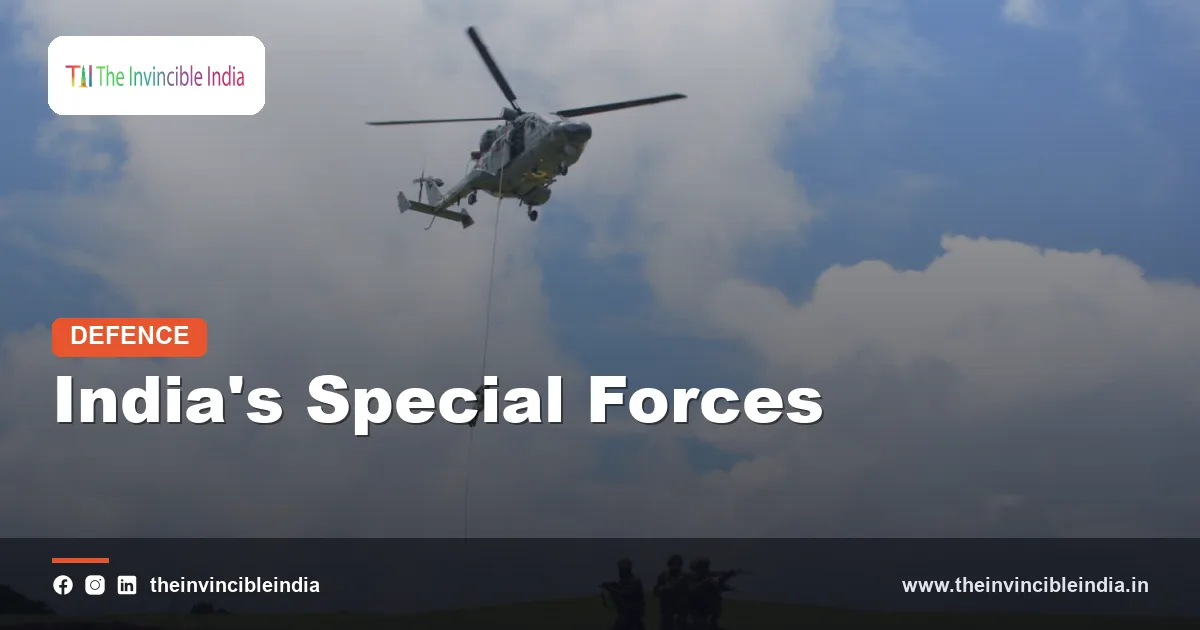
When a hostage crisis erupts, a hijacked ship is boarded at sea or an enemy camp has to be hit quietly across a border, ordinary units are not the ones sent in. That job falls to the Indian special forces: small, intensely trained and carefully selected teams that operate where conventional troops cannot, or should not, go. Their work is usually invisible, and the public typically learns of it only through a brief official statement or a hard-won gallantry award.
India does not have a single “special forces” organisation. Instead, each service has raised its own elite unit, while the Home Ministry and the intelligence establishment maintain others. This explainer walks through the main ones, namely the Army’s Para (SF), the Navy’s MARCOS, the Air Force’s Garud, the National Security Guard and the Special Frontier Force, and explains how they are selected, trained and increasingly brought together under a joint structure.
| Quick Facts | |
|---|---|
| Army unit | Para (SF), the Special Forces battalions of the Parachute Regiment |
| Navy unit | MARCOS (Marine Commandos), raised in 1987 as the Indian Marine Special Force |
| Air Force unit | Garud Commando Force, raised in the early 2000s (formally in 2004) |
| Federal counter-terror force | National Security Guard (NSG), raised in 1984, under the Ministry of Home Affairs |
| Covert force | Special Frontier Force (SFF), raised in 1962, under the Cabinet Secretariat |
| Tri-service body | Armed Forces Special Operations Division (AFSOD), approved in 2019 |
| Landmark operations | Operation Cactus (1988), the 26/11 response (2008), cross-LoC strikes (2016) |
| Strength and equipment | Officially classified; only general descriptions are public |
What Are Special Forces, and How Are They Different?
Special forces are military units selected and trained to carry out missions that are too sensitive, too dangerous or too technically demanding for regular formations. What sets them apart is not just toughness. It is the combination of rigorous selection, long and specialised training, small team sizes, greater autonomy for junior leaders and access to unusual equipment and methods of insertion.
Internationally, special operations are commonly grouped into a few broad categories, and the Indian units fit the same pattern:
- Direct action: short, violent, precisely planned raids against high-value targets such as hideouts, command posts or key installations.
- Special reconnaissance: gathering information deep in hostile or denied territory, often well ahead of the main force.
- Unconventional warfare: working with, or against, irregular forces and insurgent groups.
- Counter-terrorism and hostage rescue: neutralising armed attackers while protecting civilians.
- Combat search and rescue (CSAR): recovering downed aircrew or isolated personnel from hostile ground.
Special forces versus commandos
The terms are often used loosely in India. The Army also has “commando” platoons, called Ghatak platoons, inside ordinary infantry battalions. These are specially trained but belong to a lower tier than the full Special Forces battalions. Likewise, the word “commando” is used for paramilitary and state police units, such as the Greyhounds in Andhra Pradesh. Each has value, but the formations discussed here are the core of the country’s special operations capability.
Para (SF): The Army’s Special Forces
The Army’s special forces are drawn from the Parachute Regiment, which traces its origins to the airborne units raised in the 1940s and became a regiment of the independent Indian Army in 1952. Within the regiment, some battalions are designated Para (Special Forces) and take on the most demanding tasks, while the rest are paratroopers in a more conventional airborne role. The first special forces battalions were developed from commando units that took shape in the mid-1960s, and the number of Para (SF) battalions has grown over the decades.
Insignia and identity
The Parachute Regiment is known for its maroon beret, and the special forces wear it with the Balidan badge. The badge shows a winged dagger, and “Balidan” means sacrifice. A soldier who clears selection earns the right to wear the badge, and it is treated with great respect within the Army. Unlike many military honours, it is earned through a single, brutal test rather than through years of service.
Roles
- Direct action: raids on terrorist camps, insurgent hideouts and other high-value targets.
- Special reconnaissance: deep observation behind the lines, including at high altitude.
- Counter-insurgency: sustained operations in Jammu and Kashmir and the Northeast, often alongside the Rashtriya Rifles and Assam Rifles.
- Hostage rescue and airborne operations: including parachute insertion into hard-to-reach terrain.
Para (SF) units have a long record that stretches from the 1971 war, in which paratroopers were dropped into Bangladesh, to the better-known operations of recent decades, covered in a later section.
MARCOS: The Navy’s Marine Commandos
The Navy’s special force began in 1987 as the Indian Marine Special Force, a small unit tasked with maritime special operations. It was renamed the Marine Commandos, or MARCOS, in 1991. The unit is based in Mumbai and is sometimes nicknamed “Magarmach” (the Hindi word for crocodile) because it is equally at home in water and on land.
What they do
MARCOS are trained for operations that the Navy cannot assign to ordinary sailors. These include boarding and recapturing hijacked ships, counter-terrorism at sea and along the coast, protection of offshore oil and gas installations, amphibious reconnaissance and raids, and underwater demolition. They also work in rivers, lakes and marshy terrain. The unit has operated inland, notably in the Wular Lake area of Jammu and Kashmir, where it has been used against militants in a water-dominated environment.
Anti-piracy and the 26/11 role
MARCOS teams have served on warships deployed against piracy in the Gulf of Aden and the wider Indian Ocean since 2008. During the November 2008 Mumbai attacks, popularly known as 26/11, MARCOS were among the first special units to reach the scene. They were deployed in the early hours at the targeted hotels, and they helped contain the situation and secure parts of the buildings before the National Security Guard arrived in strength and took charge of the main hostage-rescue operations.
Garud: The Air Force’s Commando Force
The Garud Commando Force was set up in the early 2000s, with formal establishment in 2004, after attacks on air bases highlighted a gap in the Air Force’s ability to protect its own installations. Until then, airfield security had depended on general ground defence arrangements. Named after the mythical eagle of Hindu tradition, the unit was designed to give the Air Force its own trained specialists.
Core tasks
- Airfield defence: protecting air bases and vital installations against terrorist or special forces attacks.
- Airfield seizure and control: securing a hostile airstrip so that follow-on forces can land.
- Combat search and rescue: reaching and recovering downed aircrew, often from behind enemy lines.
- Special operations: including special reconnaissance and direct action in support of air campaigns.
- Disaster response: assisting rescue efforts when floods, earthquakes or other calamities strike.
Garud personnel are trained in parachuting and in controlling air strikes from the ground, a particularly useful skill because they can guide aircraft onto targets. The unit was involved in the response to the January 2016 attack on the Pathankot air base, where the Air Force lost one of its Garud commandos while operations against the attackers were carried out together with the Army and the National Security Guard.
National Security Guard: The “Black Cats”
The National Security Guard (NSG) was created in 1984 in the aftermath of the events of that year, and its legal basis comes from the National Security Guard Act, 1986. Its main mission is to deal with terrorist threats and hijack or hostage situations, particularly when state resources are overwhelmed. The force is headquartered near Delhi at Manesar and reports to the Union Ministry of Home Affairs, and it is classed among the Central Armed Police Forces for administrative purposes even though it is trained and employed as a specialist counter-terrorism unit.
Structure and name
Its personnel wear black uniforms and black combat gear, which earned it the popular name “Black Cats”. The NSG has two parts. The Special Action Group (SAG) is drawn mainly from the Army and is the strike element. The Special Rangers Group (SRG) is drawn from the Central Armed Police Forces and state police forces and provides support and security roles. After the 2008 Mumbai attacks, regional hubs were set up in cities such as Mumbai, Chennai, Kolkata and Hyderabad so that the force could reach a crisis faster. The NSG also has bomb disposal, explosive detection and sniper expertise.
Notable operations and VIP security
Operations associated with the force include Operation Black Thunder (1988) at the Golden Temple complex in Amritsar, the 2002 response to the attack at the Akshardham temple in Gandhinagar, and Operation Black Tornado during 26/11. NSG personnel killed in action in Mumbai included Major Sandeep Unnikrishnan and Havaldar Gajender Singh Bisht, both honoured with the Ashoka Chakra. Historically, the NSG also supplied protection teams for a number of high-risk protectees. This is distinct from the Special Protection Group (SPG), which has a separate mandate for the Prime Minister and certain former Prime Ministers and their families.
The Special Frontier Force and the Intelligence Link
The Special Frontier Force (SFF) is India’s most discreet special unit. It was raised in 1962, after the war with China, and was initially intended to operate behind Chinese lines in the event of another conflict. It is administered under the Cabinet Secretariat and has long been associated with the Research and Analysis Wing (R&AW), India’s external intelligence agency, which itself was created in 1968 and reports to the Cabinet Secretariat.
Composition and base
The force was recruited largely from the Tibetan community living in exile in India, and over time Gorkhas and others have also served in it. It is led by an officer on deputation from the Army, and its home is in Chakrata in Uttarakhand. The unit is known unofficially as “Establishment 22”, after the Army officer who first helped raise it, and its battalions have been referred to as the Vikas Regiment.
What is known
Because the SFF is covert, official information is limited. It is widely reported to have taken part in the 1971 operations in the Chittagong Hill Tracts, and later in other high-altitude and counter-terrorism missions. Its members have been trained in parachuting, mountaineering and special operations, and the force has occasionally come into public view, most notably when the death of one of its soldiers during a tense standoff in Ladakh in 2020 was publicly acknowledged. Beyond that, readers should be wary of sensational accounts, as little can be verified.
The wider agency landscape
Special operations rely on intelligence. Besides R&AW, the Intelligence Bureau, the Defence Intelligence Agency (set up in 2002) and technical agencies provide the information that makes precise, small-scale missions possible. Neither these bodies nor the special forces commit their methods to the public record, and officials rarely comment on specifics.
India’s Special Forces at a Glance
The table below summarises the main units, the authority they report to and what they are best known for.
| Force | Parent body | Raised | Primary focus |
|---|---|---|---|
| Para (SF) | Indian Army (Parachute Regiment) | Mid-1960s onwards | Direct action, special reconnaissance, counter-insurgency |
| MARCOS | Indian Navy | 1987 | Maritime special operations, anti-piracy, counter-terror at sea |
| Garud | Indian Air Force | 2004 | Airfield defence, combat search and rescue, special operations |
| NSG | Ministry of Home Affairs | 1984 | Counter-terrorism, hostage rescue, bomb disposal |
| SFF | Cabinet Secretariat | 1962 | Covert operations, mountain and border tasks |
| AFSOD | Integrated Defence Staff (tri-service) | Approved 2019 | Joint planning and command of special operations |
Selection and Training: Earning the Badge
Every special force depends on a demanding selection process, and the Indian ones are no exception. Volunteers must first be serving soldiers, sailors or airmen with good records and sound fitness. They are then put through a probation period lasting several months, designed to push physical endurance and mental resolve to the limit. A large majority do not complete it, and those who drop out simply return to their parent units without stigma.
What probation involves
- Physical endurance: long marches under heavy loads, obstacle courses, swimming and extended periods with little sleep, food or rest.
- Mental strength: decision-making when exhausted, isolation exercises and pressure designed to test whether a candidate can still think clearly.
- Teamwork: small groups must complete tasks together, so selection also reveals who can be trusted in a team of a handful of operators.
Specialist training
After selection come advanced skills. Army personnel train at the Parachute Training School in Agra and at special forces schools in the hills, as well as at mountain and jungle warfare institutions. Typical skill areas include:
- HALO and HAHO parachuting: High Altitude Low Opening jumps get operators down quickly, while High Altitude High Opening jumps let them glide a long distance to a landing zone.
- Combat diving and amphibious operations, especially for MARCOS.
- Demolitions and explosives handling.
- Sniping, close-quarter battle and urban combat.
- Languages, survival, medical skills and communications.
Joint exercises with partner countries are also an important part of keeping skills current and exposing operators to different tactics.
Equipment and Capability in General Terms
Exact inventories and numbers are classified, and responsible reporting avoids guessing at them. In general terms, however, India’s special forces use modern small arms, precision rifles, night vision and thermal imaging devices, secure communications, body armour and specialised breaching tools. Units that operate at sea use inflatable boats, diving gear and underwater delivery equipment, while airborne troops rely on advanced parachute systems that allow precise landings from great heights.
Transport and support
Special operations depend on the platforms that carry and support them. Transport aircraft and helicopters of the Air Force carry the Army and Navy teams into position, and naval ships provide a base for maritime teams. Drones and satellite imagery increasingly support reconnaissance and planning, helping small teams reduce risk before a mission begins.
Why capability is about people
Equipment matters, but special forces doctrine holds that the operator is more important than the weapon. The emphasis is on adaptability, small-unit leadership and the ability to carry out a plan even when conditions change. This is also why numbers remain small. Quality over quantity is the principle that shapes recruitment, training and deployment.
Landmark Operations
A few operations are publicly documented and show how the different forces have been employed. The details of many others remain classified.
| Year | Operation | Forces involved | Summary |
|---|---|---|---|
| 1971 | Bangladesh Liberation War | Parachute Regiment, SFF | Airborne and special tasks supported the advance in East Pakistan. |
| 1988 | Operation Cactus | Parachute Regiment, Air Force, Navy | Rapid intervention in the Maldives at the request of its government. |
| 2008 | 26/11 Mumbai attacks | MARCOS, NSG, Army | Multi-day operation to neutralise attackers and rescue hostages. |
| 2015 | Myanmar cross-border operation | Para (SF) | Action against militant camps after an ambush in Manipur. |
| 2016 | Surgical strikes across the LoC | Para (SF) | Strikes on terrorist launch pads after the Uri attack. |
Operation Cactus, 1988
In November 1988 the government of the Maldives asked India for help after armed mercenaries attempted a coup in Male. Paratroopers were flown by the Indian Air Force across the Indian Ocean, landed at Hulule airport and secured it, then moved to protect the President and restore order. The Navy helped intercept the mercenaries as they fled. The operation was completed within a day or so, and it demonstrated India’s ability to project force quickly at long range.
The 2015 and 2016 cross-border operations
In June 2015, after an ambush in Manipur killed a number of Army personnel, Indian special forces were reported to have struck militant camps across the border in Myanmar. In September 2016, after the attack on the Army base at Uri, the Army announced that special forces had crossed the Line of Control and hit terrorist launch pads, an action described officially as surgical strikes. In both cases the Army confirmed the broad outlines, but the finer details have not been made public.
AFSOD and the Push for Jointness
For many years the three services ran their special forces largely independently, with separate training, doctrine and command arrangements. That sometimes meant duplication, and it made it harder to plan a single operation that needed Army, Navy and Air Force elements at once.
The answer was a joint structure. In 2019 the government approved the Armed Forces Special Operations Division (AFSOD), a tri-service body led by a two-star officer. It draws on the Army’s Para (SF), the Navy’s MARCOS and the Air Force’s Garud, and is meant to plan and conduct special operations jointly, to work with the intelligence agencies and to build common doctrine and training. The reform was part of a wider push to create integrated structures after the appointment of the Chief of Defence Staff, and it sits alongside new agencies for space and cyber defence.
Why it matters
- Single planning: operations requiring multiple services can be designed together from the start.
- Shared training and equipment: fewer gaps and less duplication between the services.
- Faster response: a clearer chain of command during a crisis.
Each force is expected to retain its own identity and parent service, while AFSOD acts as a coordinating command for joint tasks.
Conclusion
The Indian special forces are a mix of Army, Navy, Air Force, federal and covert units, each built for a particular kind of threat. Para (SF) hit targets on land, MARCOS operate in water, Garud protect and support air power, the NSG responds to terrorist emergencies in cities, and the SFF works in the shadows. What they share is a rigorous culture of selection, a tradition of small-team discipline and an expectation that most of their work will never be publicised. With AFSOD now seeking to unify planning and training, India’s special operations community is moving towards closer cooperation. Last reviewed: 1 October 2026.
Frequently Asked Questions
What are the main Indian special forces?
The principal units are the Army’s Para (SF), the Navy’s MARCOS, the Air Force’s Garud Commando Force, the National Security Guard under the Home Ministry and the Special Frontier Force under the Cabinet Secretariat. The Armed Forces Special Operations Division coordinates the three military units for joint operations.
What is the difference between Para (SF) and the NSG?
Para (SF) is part of the Army and is used for military missions such as raids, reconnaissance and counter-insurgency, including across borders. The NSG is a federal counter-terrorism force under the Ministry of Home Affairs and is mainly used for hostage rescue and anti-terror operations within the country.
What does MARCOS stand for and what do they do?
MARCOS stands for Marine Commandos, the special force of the Indian Navy, raised in 1987. They carry out maritime special operations, including counter-terrorism at sea, anti-piracy, boarding operations, amphibious raids and underwater tasks, and they took part in the response to the 26/11 attacks.
Why is the NSG called the “Black Cats”?
The nickname comes from the black uniforms and gear worn by NSG commandos. The force was raised in 1984 and handles counter-terrorism and hostage-rescue tasks, and it played a major role in the 26/11 Mumbai operation.
How hard is it to join the special forces?
Selection is extremely demanding. Volunteers from within the services go through a probation lasting several months that tests physical and mental endurance, and many drop out. Those who succeed then complete specialised training in areas such as parachuting, combat diving, demolitions and close-quarter battle.
What is AFSOD?
The Armed Forces Special Operations Division is a tri-service body approved in 2019 to bring the Army, Navy and Air Force special units together. Its aim is joint planning, common training and better coordination for special operations.
{“@context”:”https://schema.org”,”@graph”:[{“@type”:”FAQPage”,”mainEntity”:[{“@type”:”Question”,”name”:”What are the main Indian special forces?”,”acceptedAnswer”:{“@type”:”Answer”,”text”:”The principal units are the Army’s Para (SF), the Navy’s MARCOS, the Air Force’s Garud Commando Force, the National Security Guard under the Home Ministry and the Special Frontier Force under the Cabinet Secretariat. The Armed Forces Special Operations Division coordinates the three military units for joint operations.”}},{“@type”:”Question”,”name”:”What is the difference between Para (SF) and the NSG?”,”acceptedAnswer”:{“@type”:”Answer”,”text”:”Para (SF) is part of the Army and is used for military missions such as raids, reconnaissance and counter-insurgency, including across borders. The NSG is a federal counter-terrorism force under the Ministry of Home Affairs and is mainly used for hostage rescue and anti-terror operations within the country.”}},{“@type”:”Question”,”name”:”What does MARCOS stand for and what do they do?”,”acceptedAnswer”:{“@type”:”Answer”,”text”:”MARCOS stands for Marine Commandos, the special force of the Indian Navy, raised in 1987. They carry out maritime special operations, including counter-terrorism at sea, anti-piracy, boarding operations, amphibious raids and underwater tasks, and they took part in the response to the 26/11 attacks.”}},{“@type”:”Question”,”name”:”Why is the NSG called the “Black Cats”?”,”acceptedAnswer”:{“@type”:”Answer”,”text”:”The nickname comes from the black uniforms and gear worn by NSG commandos. The force was raised in 1984 and handles counter-terrorism and hostage-rescue tasks, and it played a major role in the 26/11 Mumbai operation.”}},{“@type”:”Question”,”name”:”How hard is it to join the special forces?”,”acceptedAnswer”:{“@type”:”Answer”,”text”:”Selection is extremely demanding. Volunteers from within the services go through a probation lasting several months that tests physical and mental endurance, and many drop out. Those who succeed then complete specialised training in areas such as parachuting, combat diving, demolitions and close-quarter battle.”}},{“@type”:”Question”,”name”:”What is AFSOD?”,”acceptedAnswer”:{“@type”:”Answer”,”text”:”The Armed Forces Special Operations Division is a tri-service body approved in 2019 to bring the Army, Navy and Air Force special units together. Its aim is joint planning, common training and better coordination for special operations.”}}]}]}