


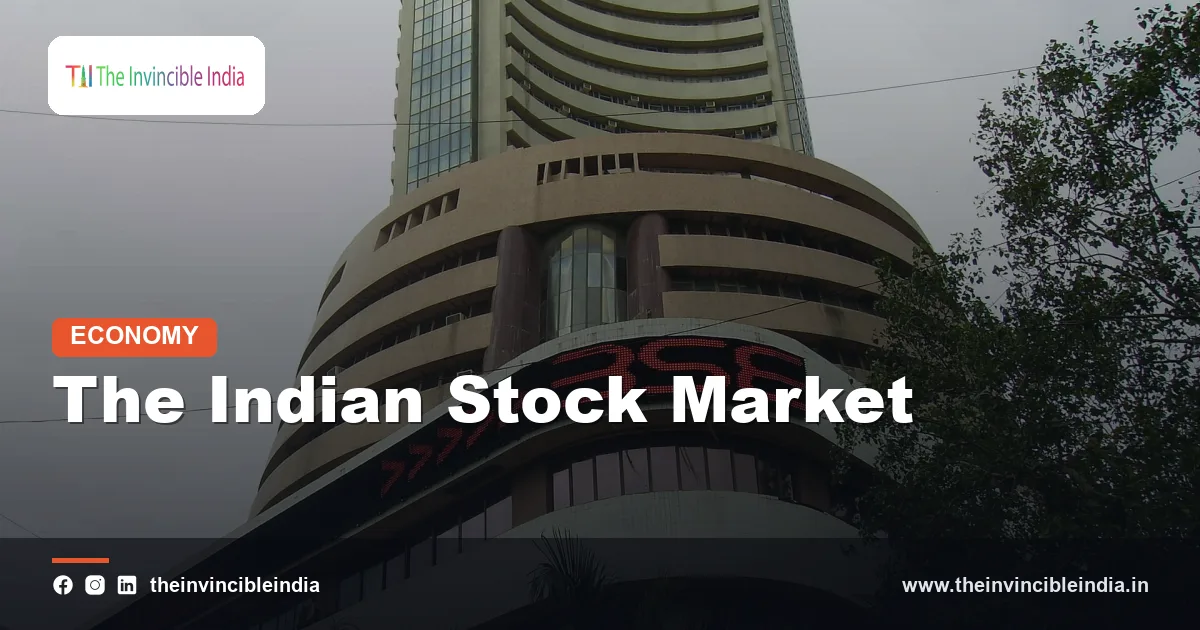
The Indian stock market is the marketplace where shares of publicly listed companies are bought and sold, and where businesses raise money from the public to grow. Every day that it is open, millions of investors, from first-time retail participants to giant mutual funds and overseas institutions, trade claims on the ownership of India’s biggest and smallest listed companies. Behind the flickering screens lies a simple idea: connect those who have savings with those who need capital.
Two exchanges dominate this world, the Bombay Stock Exchange (BSE) and the National Stock Exchange (NSE), and two numbers are quoted in almost every news bulletin, the Sensex and the Nifty. This guide explains what these names mean, how the market is organised and regulated, who takes part in it, how an ordinary person can invest, and what the risks are. 1 October 2026
| Topic | Key Fact |
|---|---|
| Oldest exchange | Bombay Stock Exchange (BSE), established in 1875, Asia’s oldest stock exchange |
| Largest electronic exchange | National Stock Exchange (NSE), established in 1992, with trading starting on its capital market segment in 1994 |
| BSE headquarters | Dalal Street, Mumbai |
| BSE benchmark index | S&P BSE SENSEX, tracking 30 large and well-established companies |
| NSE benchmark index | NIFTY 50, tracking 50 large companies across sectors |
| Market regulator | Securities and Exchange Board of India (SEBI), given statutory powers by the SEBI Act, 1992 |
| Depositories | NSDL (set up 1996) and CDSL (set up 1999) hold shares in electronic form |
| Settlement cycle | T+1, meaning trades are settled one working day after the trade day |
| Trading hours | Normal market session runs from roughly 9:15 am to 3:30 pm IST on weekdays, excluding market holidays |
What Is the Stock Market and Why Does It Exist?
A company that wants to expand, whether by building a factory, developing a new product or entering a new city, needs money. It can borrow from a bank, or it can sell small slices of ownership to the public. Each slice is called a share or a stock. When a company lists its shares on a stock exchange, anyone can buy or sell them through a registered broker, and the price keeps changing with demand and supply.
The stock market therefore serves two kinds of people at once. Companies get long-term capital without having to repay it on a fixed schedule. Investors get a chance to own part of a business, share in its profits and, if they are patient, benefit from its growth. The exchange itself is only the neutral platform: it does not decide prices, it simply matches buyers with sellers under transparent rules.
Shares, stocks and ownership
- A share represents a unit of ownership in a company. A shareholder is a part-owner, not a lender.
- Shareholders may earn returns in two ways: dividends (a share of profits paid out by the company) and capital gains (profit made when the price rises and the share is sold).
- Unlike a bank deposit, share prices can fall as well as rise, so returns are never guaranteed.
A Short History of the Indian Stock Market
The roots of the Indian stock market go back to the nineteenth century. In the 1850s, a handful of brokers began meeting informally under a banyan tree opposite the Town Hall in Bombay to trade shares in banks and cotton-related companies. As their numbers grew, they moved from place to place before settling near what is now Dalal Street. In 1875 they formalised the arrangement as the Native Share and Stock Brokers’ Association, which is the origin of today’s BSE and the reason it is described as Asia’s oldest exchange.
Over the next century, exchanges also came up in Ahmedabad, Calcutta (now Kolkata), Madras (now Chennai) and other cities, which often traded in local stocks. Trading was by open outcry, with brokers shouting bids and offers in a crowded hall, and settlement was slow and paper-based. The system worked, but it was opaque, and investors in smaller towns had limited access.
Milestones that shaped the market
| Year | Milestone |
|---|---|
| 1875 | Bombay’s brokers organise as the Native Share and Stock Brokers’ Association, later the BSE |
| 1956 | Securities Contracts (Regulation) Act passed to regulate stock exchanges |
| 1988 | SEBI set up by the government as an administrative body |
| 1992 | SEBI Act gives the regulator statutory powers; NSE is incorporated |
| 1994 | NSE begins screen-based trading in its capital market segment |
| 1996 | Depositories Act in force; NSDL becomes the first depository |
| 2000 | Index futures introduced, opening the derivatives market |
| 2003 | Rolling settlement on a T+2 basis becomes standard |
| 2022-23 | Phased move to T+1 settlement |
The Two Exchanges: BSE and NSE
The Bombay Stock Exchange (BSE)
The BSE, often simply called Bombay Stock Exchange, is the elder statesman of Indian markets. Founded in 1875, it is based in Mumbai and is closely associated with Dalal Street, the lane in the city’s financial district that has become shorthand for the Indian market itself, much as Wall Street does for the United States. The exchange moved from open outcry to an electronic trading system in the mid-1990s, and it now operates a modern trading platform.
The BSE lists a very large number of companies, more than almost any other exchange in the world by count, ranging from India’s biggest industrial houses to small firms that few investors have heard of. It also runs a platform for small and medium enterprises, which lets young companies raise funds without the heavy listing requirements of the main board. Its flagship index is the SENSEX, which has been India’s best-known market barometer for decades.
The National Stock Exchange (NSE)
The NSE was promoted by leading financial institutions at the instance of the government and was incorporated in 1992. It was designed to bring transparency, national reach and technology to a market that had been fragmented across regional exchanges. The NSE began its wholesale debt market in 1994 and started trading shares on its capital market segment later that same year.
Its great contribution was screen-based electronic trading. Instead of a crowded floor, buyers and sellers anywhere in the country could place orders through computer terminals, and the system matched them automatically on price and time. This made prices more uniform, narrowed the gap between buying and selling rates, and allowed brokers in small towns to trade on equal terms with those in Mumbai. The NSE also pioneered the launch of index futures and options in India and today handles a large share of the country’s equity and derivatives trading volumes. Its benchmark is the NIFTY 50.
BSE vs NSE: How They Compare
Both exchanges are regulated by SEBI and follow similar rules, and the shares of most large companies are listed on both. The differences lie mainly in history, scale of trading and flagship products. The table below summarises the essentials.
| Feature | BSE | NSE |
|---|---|---|
| Established | 1875 | 1992 (trading from 1994) |
| Location | Dalal Street, Mumbai | Mumbai |
| Known for | Being Asia’s oldest exchange; very large number of listed companies | Pioneering screen-based electronic trading and leadership in derivatives |
| Benchmark index | SENSEX (30 companies) | NIFTY 50 (50 companies) |
| Clearing arm | Indian Clearing Corporation | NSE Clearing |
| Typical use | Equity trading, SME platform, listing of a wide range of companies | Equity and derivatives trading, index-linked products |
For an investor, the choice between the two is rarely a major concern. A broker usually routes an order to whichever exchange offers the better price, and the two exchanges keep each other’s prices closely aligned through arbitrage.
Sensex and Nifty: The Market’s Barometers
An index is a basket of selected shares whose combined movement is expressed as a single number. It lets people see at a glance whether the market as a whole is rising or falling, without checking thousands of individual prices. The BSE SENSEX was launched in 1986 and its name is a blend of the words “sensitive” and “index”. It tracks 30 large, financially sound and actively traded companies drawn from major sectors of the economy. The NIFTY 50, launched by the NSE in 1996, follows 50 companies, and its name combines “National” and “fifty”.
How the indices are built
- Free-float market capitalisation: Both indices give each company a weight based on the market value of the shares actually available for public trading, not those held by promoters or the government.
- Base year and base value: Each index is anchored to a starting date and value, so that its later movement shows percentage change over time.
- Periodic review: The constituents are reviewed regularly. Companies that no longer meet size or liquidity criteria are replaced by stronger candidates.
- Sector balance: Banking, information technology, energy, consumer goods, automobiles and other sectors are represented so that the index reflects the wider economy.
Because the biggest and most liquid companies are included, the indices are often treated as a barometer of investor sentiment and, loosely, of economic confidence. However, they are not the economy itself. A booming index can coexist with weak conditions in sectors that are not well represented, and index levels are better judged over years than over days. Besides the headline indices, there are many broader and sectoral ones, such as indices for mid-cap and small-cap stocks, banks and information technology.
Primary and Secondary Markets, Bulls, Bears and Market Capitalisation
The stock market has two connected parts, and a handful of basic terms explain most financial news.
The primary market
In the primary market, a company issues new securities and receives money directly from investors. The best-known route is the Initial Public Offering (IPO), when a private company offers its shares to the public for the first time. It files a detailed offer document with SEBI, discloses its finances, risks and plans, and invites bids within a fixed window. Retail investors can apply through their bank accounts, and the money stays blocked until shares are allotted. A company that is already listed can also raise capital through a follow-on public offer or a rights issue offered to existing shareholders.
The secondary market
The secondary market is where existing shares change hands between investors, and it is what most people mean by “the stock market”. When you buy a share of a listed company through your broker, the company does not receive your money; it goes to the investor who sold the share. The secondary market matters to companies all the same, because the ability to sell easily is exactly what makes investors willing to buy in the primary market. A liquid secondary market is the foundation of a healthy primary market.
Bulls, bears, market capitalisation and dividends
- Bull market: A prolonged period of rising prices and general optimism. The image is of a bull thrusting its horns upward.
- Bear market: A prolonged period of falling prices and pessimism. The image is of a bear swiping its paws downward. Markets typically move in cycles between the two.
- Market capitalisation: The total market value of a company’s shares, calculated by multiplying the share price by the number of shares in issue.
- Dividend: A portion of profit distributed to shareholders. Many mature companies pay regular dividends, while fast-growing firms often retain profits to reinvest.
Large-cap, mid-cap and small-cap
Companies are grouped by market capitalisation. In India, the Association of Mutual Funds in India (AMFI), working under SEBI’s framework, classifies roughly the first 100 companies by market value as large-cap, the next 150 as mid-cap, and the rest as small-cap. Large-caps tend to be established and relatively stable. Mid-caps offer a balance of growth and risk, while small-caps can grow quickly but are generally more volatile and harder to trade. This classification is reviewed periodically, so a company can move from one category to another over time.
The Ecosystem: SEBI, Depositories, Brokers and Clearing Corporations
A trade on a screen is the visible tip of a large system, and every layer exists to protect investors and make sure the trade actually completes.
SEBI, the regulator
The Securities and Exchange Board of India, set up in 1988 and made a statutory body by the SEBI Act of 1992, is the market’s watchdog. It frames rules for exchanges, brokers, mutual funds and listed companies, registers market intermediaries, demands disclosures from issuers, and investigates and penalises fraud such as insider trading and price manipulation. Its mandate has three strands: protecting investors, developing the market and regulating it.
Depositories and dematerialisation
In the past, shares were held as paper certificates that could be lost, forged or delayed in transfer. The Depositories Act of 1996 paved the way for dematerialisation, the conversion of paper shares into electronic entries. The two depositories, the National Securities Depository Limited (NSDL) and the Central Depository Services Limited (CDSL), hold investors’ securities in electronic form, much as a bank holds money. Today almost all trading in listed shares is in demat form.
Brokers, Demat and trading accounts
Investors cannot trade directly on an exchange. They place orders through a registered stockbroker, using a trading account to buy and sell and a Demat account, opened with a depository participant, to hold the shares. A linked bank account handles the money.
Clearing corporations and T+1 settlement
Once a trade is matched, a clearing corporation steps in as the guarantor, becoming the counterparty to both buyer and seller so that neither has to worry about the other defaulting. The NSE has its own clearing arm, and the BSE is served by the Indian Clearing Corporation. Settlement, the actual transfer of money and shares, has become steadily faster. India moved from long weekly cycles to rolling settlement, then to T+2, and in 2022-23 introduced T+1 settlement in phases, so that funds and shares reach the right accounts one working day after the trade.
Who Takes Part: Retail, Institutional and Foreign Investors
The market is a meeting ground for very different kinds of participants, and their behaviour often explains why prices move.
- Retail investors: Individuals investing their own savings, either directly in shares or through mutual funds. Their numbers have grown considerably over the past decade as digital onboarding, mobile apps and small SIPs made investing easier.
- Domestic institutional investors (DIIs): Large Indian institutions such as mutual funds, insurance companies, banks and pension funds. They pool money from millions of households and invest it professionally, and they provide an important cushion when foreign money moves out.
- Foreign portfolio investors (FPIs): Overseas funds and institutions that invest in Indian securities without taking control of companies. Their inflows and outflows are closely watched because they can move prices sharply in the short run and reflect global views on emerging markets.
- Promoters and others: The founders and controlling shareholders of a company, along with market makers and proprietary traders, who also shape trading volumes.
The balance between these groups has shifted over time. Domestic participation, in particular, has deepened, which has made the Indian market less dependent on foreign flows than it once was.
How to Invest in the Indian Stock Market
Investing does not require large sums or specialist knowledge, but it does require a few practical steps and a long-term mindset.
Step 1: Complete KYC and open accounts
Investors must complete the Know Your Customer (KYC) process with proof of identity, address and a PAN card. They then open a trading account and a Demat account with a SEBI-registered broker and link a bank account. Much of this can now be done online.
Step 2: Choose a route
- Direct equity: Buying shares of individual companies. This offers control but demands research and carries concentrated risk.
- Mutual funds: A fund manager pools money from many investors and spreads it across many securities, giving diversification and professional management.
- SIPs (Systematic Investment Plans): A method of investing a fixed amount in a mutual fund at regular intervals, such as monthly. It builds discipline and averages out the purchase cost over market ups and downs.
- Index funds and ETFs: Funds that simply replicate an index such as the Nifty 50 or the Sensex. They have low costs and aim to match the market’s return rather than beat it.
Step 3: Stay informed and patient
Understand why you are investing, diversify across companies and sectors, and match your investments to your goals and time horizon. Equity investment is generally considered more suitable for long-term goals, because short-term price swings are normal.
Role of the Stock Market in the Economy
The stock market is more than a place for speculation; it performs several functions that matter to the whole economy.
- Capital formation: It channels household savings into productive investment. A company that raises funds through an IPO can build plants, hire people and develop technology, which in turn creates jobs and output.
- Wealth creation: Over long periods, equity ownership has allowed households to share in the growth of Indian business, broadening financial participation beyond bank deposits, gold and property.
- Price discovery: Thousands of buyers and sellers continuously assess a company’s prospects, so the market price summarises collective expectations about its future earnings.
- Liquidity: Investors can convert holdings into cash quickly, which makes long-term investment less risky.
- Corporate discipline: Listed companies must publish financial results and follow governance norms, which improves transparency and accountability.
- Disinvestment and funding: The government can sell part of its stake in public sector companies through the market, and stock listings also help new-age start-ups find investors and exit routes.
Derivatives: Futures and Options in Brief
Besides ordinary shares, the exchanges offer derivatives, contracts whose value depends on an underlying asset such as a share or an index. India introduced index futures in 2000, followed by index options and options and futures on individual stocks in 2001.
- Futures: An agreement to buy or sell an asset at a fixed price on a set future date. Both sides are obliged to complete the deal.
- Options: A contract that gives the buyer the right, but not the obligation, to buy (a call) or sell (a put) at a fixed price on or before a given date. The seller of the option carries the obligation.
Derivatives were designed to help investors and companies hedge, or reduce, their exposure to price swings. They are also used for speculation. Because they involve leverage, losses can be larger than the initial amount invested, and regulators have repeatedly warned that derivatives trading is risky, especially for those who do not fully understand it.
Risks, Scams and the Case for Regulation
Markets reward risk-taking, but they have also seen abuse. The most famous episode in Indian market history is the securities scam of 1992, linked to the broker Harshad Mehta. Funds meant for the banking system were diverted through irregular transactions, and the money was used to push up share prices to unsustainable levels. When the facts emerged in 1992, the market crashed and millions of investors suffered losses. A later episode in 2001, associated with the broker Ketan Parekh, again exposed weaknesses in oversight and in the way trading was settled.
Reforms that followed
- SEBI was given statutory powers in 1992, with authority to inspect, investigate and penalise.
- Screen-based trading at the NSE and later the BSE replaced opaque floor dealings.
- Dematerialisation removed the risks of paper certificates.
- Rolling settlement replaced long settlement cycles that allowed speculative carry-forward trading.
- Clearing corporations and risk-management systems, including circuit breakers that pause trading during extreme moves, were strengthened.
Risks every investor should know
- Market risk: Prices can fall because of economic, political or global events.
- Company risk: A business can underperform or fail.
- Liquidity risk: Some shares are hard to sell quickly at a fair price.
- Fraud and misinformation: Beware of unregistered advisers, tips on social media and promises of guaranteed or unusually high returns.
SEBI runs investor awareness programmes and provides grievance redressal channels, but the first line of defence is an informed investor. Always deal with SEBI-registered intermediaries and read offer documents before investing.
Conclusion
The Indian stock market has grown from brokers trading under a tree in the nineteenth century to a fully electronic, regulated system that touches households across the country. The BSE gives it history, the NSE gave it technology, the Sensex and Nifty give it a daily pulse, and SEBI, the depositories and the clearing corporations give it safety. For a citizen, understanding how this machinery works is the first step toward using it wisely: invest regularly, diversify, think long-term and never put in money that you cannot afford to see fluctuate.
Frequently Asked Questions
What is the difference between the Sensex and the Nifty?
The Sensex is the benchmark index of the Bombay Stock Exchange and tracks 30 large companies. The Nifty 50 is the benchmark index of the National Stock Exchange and tracks 50 large companies. Both are weighted by free-float market capitalisation and usually move in the same direction, though not by identical amounts.
Which is older, the BSE or the NSE?
The BSE is much older. It was established in 1875 and is Asia’s oldest stock exchange. The NSE was incorporated in 1992 and began trading its capital market segment in 1994, introducing fully electronic screen-based trading.
What is a Demat account and why do I need one?
A Demat account holds your shares and other securities in electronic form, just as a bank account holds money. You need it, together with a trading account, to buy and sell listed shares. Demat accounts are maintained through depository participants linked to NSDL or CDSL.
What does T+1 settlement mean?
T+1 means a trade is settled one working day after the trading day (T). On settlement, the buyer receives the shares and the seller receives the money. India moved to this faster cycle in phases during 2022 and 2023 from the earlier T+2 cycle.
Who regulates the Indian stock market?
The Securities and Exchange Board of India (SEBI) regulates the market. It was set up in 1988 and given statutory powers by the SEBI Act of 1992. It supervises exchanges, brokers, mutual funds and listed companies, and works to protect investors from fraud and unfair practices.
Is it safe for a beginner to invest in the stock market?
Share prices can rise and fall, so there is always risk, but beginners can reduce it by investing through SEBI-registered intermediaries, diversifying, and starting with options such as SIPs in mutual funds or index funds. Investing for the long term and only with money you do not need soon helps manage short-term volatility. This article is general information and not personal financial advice.
{“@context”:”https://schema.org”,”@graph”:[{“@type”:”FAQPage”,”mainEntity”:[{“@type”:”Question”,”name”:”What is the difference between the Sensex and the Nifty?”,”acceptedAnswer”:{“@type”:”Answer”,”text”:”The Sensex is the benchmark index of the Bombay Stock Exchange and tracks 30 large companies. The Nifty 50 is the benchmark index of the National Stock Exchange and tracks 50 large companies. Both are weighted by free-float market capitalisation and usually move in the same direction, though not by identical amounts.”}},{“@type”:”Question”,”name”:”Which is older, the BSE or the NSE?”,”acceptedAnswer”:{“@type”:”Answer”,”text”:”The BSE is much older. It was established in 1875 and is Asia’s oldest stock exchange. The NSE was incorporated in 1992 and began trading its capital market segment in 1994, introducing fully electronic screen-based trading.”}},{“@type”:”Question”,”name”:”What is a Demat account and why do I need one?”,”acceptedAnswer”:{“@type”:”Answer”,”text”:”A Demat account holds your shares and other securities in electronic form, just as a bank account holds money. You need it, together with a trading account, to buy and sell listed shares. Demat accounts are maintained through depository participants linked to NSDL or CDSL.”}},{“@type”:”Question”,”name”:”What does T+1 settlement mean?”,”acceptedAnswer”:{“@type”:”Answer”,”text”:”T+1 means a trade is settled one working day after the trading day (T). On settlement, the buyer receives the shares and the seller receives the money. India moved to this faster cycle in phases during 2022 and 2023 from the earlier T+2 cycle.”}},{“@type”:”Question”,”name”:”Who regulates the Indian stock market?”,”acceptedAnswer”:{“@type”:”Answer”,”text”:”The Securities and Exchange Board of India (SEBI) regulates the market. It was set up in 1988 and given statutory powers by the SEBI Act of 1992. It supervises exchanges, brokers, mutual funds and listed companies, and works to protect investors from fraud and unfair practices.”}},{“@type”:”Question”,”name”:”Is it safe for a beginner to invest in the stock market?”,”acceptedAnswer”:{“@type”:”Answer”,”text”:”Share prices can rise and fall, so there is always risk, but beginners can reduce it by investing through SEBI-registered intermediaries, diversifying, and starting with options such as SIPs in mutual funds or index funds. Investing for the long term and only with money you do not need soon helps manage short-term volatility. This article is general information and not personal financial advice.”}}]}]}