


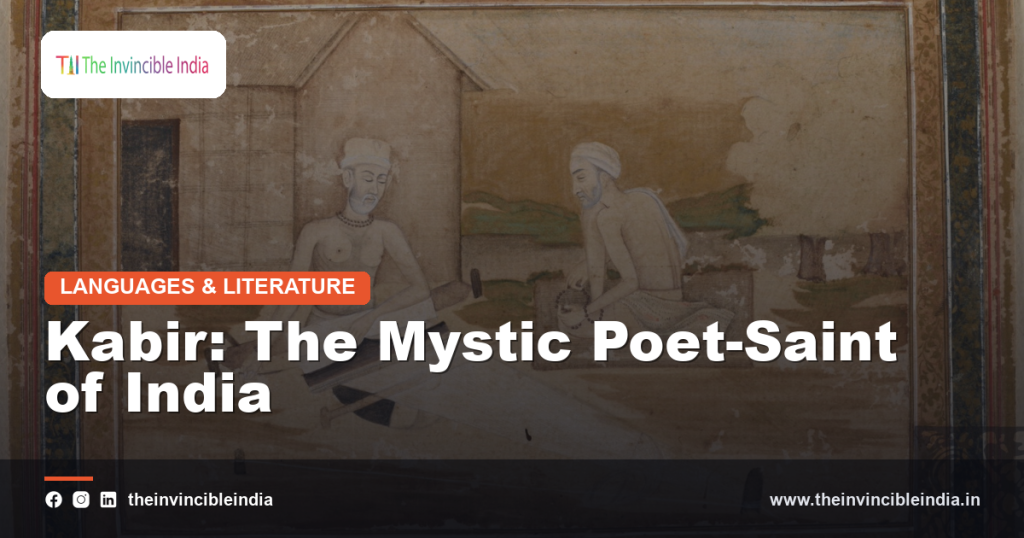
Kabir is one of the greatest and most beloved of India’s mystic poet-saints, a towering figure of the Bhakti tradition whose pithy, powerful couplets have been cherished across the centuries. A weaver by trade and a mystic by calling, Kabir sang of a formless, universal divine beyond all names and forms, and he boldly challenged the hypocrisy, ritualism and social divisions of the religion of his day, in both its Hindu and Muslim forms. His verses, blunt, witty, profound and full of homely imagery, spoke directly to the hearts of ordinary people and continue to do so today. Revered across religious boundaries, Kabir remains a beloved voice of truth and devotion. This guide explores his life, his poetry, his message and his enduring influence.
Quick Facts
| Detail | Information |
|---|---|
| Type | Mystic poet-saint of the Bhakti tradition |
| Trade | A weaver by profession |
| Region | Associated above all with Varanasi |
| Style | Pithy couplets (dohas) in the language of the people |
| Message | A formless divine; a critique of ritual and division |
| Legacy | Revered across religious boundaries; verses in the Sikh scripture |
A Beloved Poet-Saint
Kabir is among the most beloved and influential of all India’s poet-saints, a figure revered across religious and social boundaries for the power and truth of his words. His couplets, brief and pointed, are known and quoted throughout India, cherished for their wisdom, their boldness and their spiritual depth, and he is honoured as both a great mystic and a great poet. Kabir spoke of the deepest spiritual truths in the plainest language, cutting through hypocrisy and pretension to reach the heart of religion, the love and realisation of the divine. As a voice of truth, devotion and fearless independence, Kabir holds a unique and cherished place in the spiritual and literary heritage of India.
The Weaver of Varanasi
Kabir is traditionally associated with the holy city of Varanasi and is remembered as a weaver, a man of humble trade who worked with his hands even as he sang of the divine. This humble background is central to his identity and his appeal, for he was not a learned pundit or priest but an ordinary working man who spoke from lived experience and common wisdom. His trade as a weaver even entered his poetry as imagery for spiritual truths. That so profound a mystic and so great a poet came from such humble circumstances is part of the power of his example, embodying the Bhakti teaching that the divine is open to all, regardless of birth or station.
A Life of Legend
As with many of the saint-poets, much of what is told of Kabir’s life belongs to legend rather than documented history, and his life has been embroidered with many stories by the traditions that revere him. Tales are told of his birth, his spiritual search, his teacher, his encounters with the learned and the powerful, and his death, many of them carrying spiritual meaning. What shines through all these stories is the picture of a fearless, independent mystic who spoke the truth without regard for authority or convention. Though the historical details are uncertain, the figure of Kabir that emerges from legend and, above all, from his own words, is vivid, powerful and deeply human.
The Couplets of Kabir
Kabir is most famous for his couplets, the brief two-line verses known as dohas in which he distilled profound spiritual truths into a few pointed, memorable words. These couplets, composed in the language of the common people, are masterpieces of compression, packing deep wisdom, sharp criticism or spiritual insight into a form easily remembered and repeated. Their directness, their vivid homely imagery and their wit made them immensely popular, and countless people who could not read learned and treasured them by heart. The couplets of Kabir are among the most quoted and beloved verses in all of Indian literature, and they are the perfect vehicle for his blunt, profound and unforgettable message.
The Formless Divine
At the heart of Kabir’s message is devotion to a formless, universal divine, beyond all names, forms and images, a God who cannot be confined to any temple, mosque or idol but who dwells within the heart and pervades all things. Kabir belonged to the nirguna stream of bhakti, teaching love and realisation of this attributeless divine, and he insisted that the same one God underlay the different names and forms worshipped by different religions. This vision of a single, formless divine, accessible within and beyond all outward religion, is central to Kabir’s teaching and gives his message its universal, boundary-crossing power, uniting rather than dividing seekers of the truth.
Beyond Hindu and Muslim
One of the most striking features of Kabir is that he stood beyond the division of Hindu and Muslim, drawing on and criticising both traditions and pointing to a truth beyond them. He rejected the exclusive claims and the outward forms of both religions, insisting that the one divine was the same for all and that true religion lay not in labels and rituals but in the love and realisation of God within. This transcendence of religious boundaries made Kabir a figure revered by Hindus and Muslims alike, and it gives his message a profound relevance in a world divided by religion. His vision of a truth beyond sectarian division is one of his greatest and most enduring teachings.
A Critic of Hypocrisy
Kabir was a fearless critic of religious hypocrisy, empty ritual and pretension, and much of his poetry pours scorn on those who mistake outward observance for true religion. With sharp wit and blunt honesty, he mocked the pride of the learned, the empty rituals of priests, the show of piety without inner devotion, and the folly of seeking God in mere ceremony and pilgrimage while ignoring the divine within. His criticism spared neither Hindu nor Muslim orthodoxy. This fearless exposure of hypocrisy, delivered with humour and force, is one of the most memorable features of Kabir’s poetry, and it reflects his insistence that true religion is a matter of the heart, not of outward form.
Against Social Division
In keeping with the spirit of the Bhakti movement, Kabir challenged the social divisions and hierarchies of his day, above all the barriers of caste. He taught that all people were equal before the divine, that birth conferred no spiritual superiority, and that the love of God was open to everyone regardless of their station. Himself of humble background, he rejected the pride of the high-born and the exclusion of the low, insisting on the essential equality of all human beings. This bold challenge to social division, rooted in his vision of a single divine present in all, is one of the most important and enduring aspects of Kabir’s message, and it continues to inspire movements for equality and dignity.
The Power of Plain Speech
One of the sources of Kabir’s enduring power is his use of plain, direct, vigorous speech, the language of ordinary life rather than of scholarship. He drew his imagery from everyday things, from weaving and the household, from the market and the field, making profound truths vivid and homely, and he spoke bluntly, without flattery or evasion. This plain speech gave his poetry a directness and force that reached straight to the heart, and it made his message accessible to all. The power of Kabir’s plain, earthy, fearless speech, carrying the deepest wisdom in the simplest words, is one of the great secrets of his appeal and one of his distinctive gifts as a poet.
Kabir and the Guru
A recurring and important theme in Kabir’s poetry is the supreme importance of the true guru, the spiritual teacher who leads the seeker to the divine. For Kabir, the guru is beyond price, the one who opens the eyes of the soul, dispels ignorance and reveals the truth within, and he sings again and again of the guru’s grace and greatness. This emphasis reflects the deep spiritual tradition to which Kabir belonged, in which the guidance of a realised teacher is held essential to spiritual awakening. The exaltation of the true guru is one of the recurring and cherished themes of Kabir’s verse, expressing his understanding of the path to realisation of the divine.
Revered Across Religions
Because he transcended religious boundaries and spoke a universal message, Kabir is revered across the religious traditions of India, honoured by Hindus, Muslims and Sikhs alike. His verses were included in the sacred scripture of the Sikhs, a mark of the high esteem in which he is held, and a religious community, the Kabir Panth, grew up around his teachings. His universal message of a single formless divine, beyond sectarian division, has made him a shared treasure of many traditions rather than the property of any one. This reverence across religious boundaries is a striking testament to the universal appeal of Kabir and to the boundary-crossing power of his vision.
Verses in the Sikh Scripture
A signal honour reflecting Kabir’s stature is the inclusion of his verses in the Guru Granth Sahib, the holy scripture of the Sikhs, alongside the words of the Sikh Gurus and other saints. This inclusion, in one of the great scriptures of the world, testifies to the high regard in which Kabir was held and to the resonance of his message of devotion to the one formless divine with the teachings of Sikhism. Through the Sikh scripture, Kabir’s verses are sung and revered in Sikh worship to this day. This honour underlines Kabir’s place as a saint revered far beyond any single tradition and the enduring, cross-religious power of his poetry.
The Kabir Panth
Such was the devotion Kabir inspired that a religious community, known as the Kabir Panth, or the path of Kabir, grew up around his teachings and continues to this day. The followers of this path revere Kabir as their spiritual master and guide, preserve and sing his verses, and seek to live by his teachings of devotion to the formless divine, truth, equality and the rejection of hypocrisy and division. The existence of this living community, devoted to Kabir and his message across the centuries, testifies to the enduring power of his teaching and personality. Through the Kabir Panth and beyond it, the spirit and words of Kabir remain a living force in Indian religious life.
Kabir Today
Today Kabir remains one of the most beloved and widely quoted of all India’s poet-saints, his couplets known and cherished across the country and his message as relevant as ever. His verses are sung by devotees, quoted in everyday speech, studied as literature and drawn upon by all who seek a religion of the heart beyond division and hypocrisy. In an age still troubled by religious division and social inequality, his vision of a single divine, his rejection of hypocrisy and his insistence on human equality speak with undiminished power. Fearless, profound and universal, Kabir endures as one of the great voices of truth and devotion in the spiritual heritage of India and the world.
Sources & Further Reading
- Ministry of Culture, Government of India, on the saint-poets and the Bhakti movement (indiaculture.gov.in).
- Sahitya Akademi, national academy of letters, on Kabir and Bhakti poetry (sahitya-akademi.gov.in).
Frequently Asked Questions
Who was Kabir?
Kabir was one of the greatest mystic poet-saints of India, a towering figure of the Bhakti tradition. A weaver by trade, he sang of a formless, universal divine and boldly challenged religious hypocrisy and social division, and is revered across religious boundaries.
What are Kabir's dohas?
Kabir’s dohas are the brief two-line couplets for which he is most famous, in which he distilled profound spiritual truths, sharp criticism or insight into a few pointed, memorable words in the language of the common people, and which are among the most quoted verses in Indian literature.
What was Kabir's message?
Kabir taught devotion to a single, formless, universal divine beyond all names and forms, present within the heart and the same for all religions. He rejected empty ritual and hypocrisy, challenged the barriers of caste, and insisted on the equality of all people before the divine.
Why is Kabir revered across religions?
Kabir transcended the division of Hindu and Muslim, teaching that the one divine was the same for all and that true religion lay in the heart, not in outward forms. This universal message made him revered by Hindus, Muslims and Sikhs alike, and his verses were included in the Sikh scripture.
Are Kabir's verses in the Guru Granth Sahib?
Yes. Verses of Kabir were included in the Guru Granth Sahib, the holy scripture of the Sikhs, alongside the words of the Sikh Gurus and other saints, reflecting the high esteem in which he is held and the resonance of his message.