


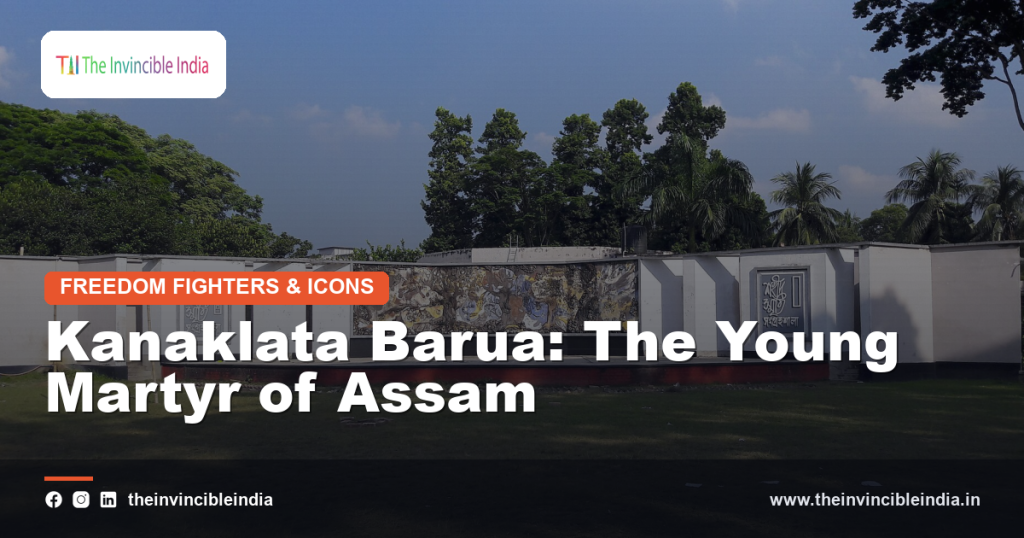
Kanaklata Barua is remembered as one of the youngest martyrs of India’s freedom struggle, a teenage participant in the Quit India Movement whose courage in a small Assamese town became a symbol of the movement’s reach into every corner of the country. Growing up amid hardship in rural Assam, she joined the wave of youthful nationalist activity that swept the region in 1942, becoming part of a local group of volunteers determined to assert India’s claim to self-rule. Her death, while attempting to hoist the national flag in the face of colonial police, transformed her into an enduring figure of remembrance in Assam and across the nation, much like Matangini Hazra in Bengal. This guide traces her short life and lasting legacy.
Quick Facts
| Detail | Information |
|---|---|
| Known as | Young martyr of Assam, Quit India Movement |
| Born | 1924, in Gohpur, Assam |
| Associated with | Local volunteer group formed during Quit India Movement |
| Known for | Attempting to hoist the national flag at Gohpur police station |
| Age at martyrdom | In her teenage years |
| Died | 1942, shot by colonial police |
The Young Martyr of Assam
Kanaklata Barua occupies a special place in the history of Assam’s freedom struggle as one of its youngest and most widely remembered martyrs. Her story, brief as it was, captures the extraordinary breadth of participation in the Quit India Movement of 1942, a moment when Indians of every age and background responded to the call for immediate self-rule. Unlike many other figures associated with the freedom struggle, Kanaklata did not come from a background of privilege or organised political training, yet she displayed a resolve that matched that of far more experienced activists. As the young martyr of Assam, her example continues to represent the movement’s deep roots among ordinary people.
Early Life and Family Background
Kanaklata Barua was born in 1924 in Gohpur, a small town in the Assam region, into a family of modest means. Her childhood was marked by considerable hardship, including the loss of close family members at a young age, circumstances that required her to take on responsibilities beyond her years within her household. Despite these difficulties, she grew up within a community that was becoming increasingly drawn into the currents of the nationalist movement spreading across Assam. This early life of hardship and responsibility helped shape a young woman of unusual determination and resilience, qualities that would define her brief but significant contribution to the freedom struggle.
Childhood Hardships and Upbringing
Growing up amid personal loss and limited means, Kanaklata Barua faced circumstances common to many families in rural Assam during the colonial period, where economic hardship was compounded by the broader injustices of foreign rule. She is remembered by those who knew her as a young woman of quiet strength, someone who bore difficulty without complaint and who found in the nationalist movement a cause larger than her own circumstances. This upbringing, though difficult, appears to have contributed to the steady resolve she would later display in her involvement with the Quit India Movement. Her childhood hardships form an important part of understanding the courage she later showed.
The Quit India Movement Reaches Assam
The Quit India Movement launched in 1942 called for an immediate end to British rule and drew participation from Indians across the country, including remote and rural areas such as Gohpur in Assam. The movement’s call resonated strongly with young people, who organised local demonstrations, processions and acts of civil resistance in support of the demand for self-rule. In Assam, as elsewhere, this period saw an unusual mobilisation of ordinary townspeople and villagers, many of whom had not previously been directly involved in organised political activity. The arrival of this movement in Gohpur set the stage for Kanaklata’s own involvement in the events that followed.
Joining the Nationalist Cause
Inspired by the call of the Quit India Movement, Kanaklata Barua joined the local nationalist activity taking shape in and around Gohpur, aligning herself with volunteers determined to demonstrate their support for immediate independence. Her decision to participate reflected a conviction shared widely among young people of the period, that even modest, local acts of defiance contributed meaningfully to the wider national struggle. She became associated with a group of young volunteers organising to assert the town’s support for the movement through direct, visible action. This step marked the beginning of the final and most consequential chapter of her short life.
The Mrityu Bahini Volunteers
Kanaklata Barua became part of a local group of young volunteers known as the Mrityu Bahini, formed to carry out acts of civil resistance in support of the Quit India Movement, including the symbolic hoisting of the national flag at government buildings. Membership in such a group required a willingness to accept considerable personal risk, given the certainty of a forceful response from colonial authorities. The formation of the Mrityu Bahini in a small Assamese town illustrates how deeply the spirit of the Quit India Movement had penetrated even areas some distance from major urban centres of political activity. This group’s determination set the stage for the events that followed.
Determination to Hoist the National Flag
Central to the plan of Kanaklata Barua and her fellow volunteers was the determination to hoist the national flag at the local police station in Gohpur, an act intended as a direct and visible assertion of India’s claim to self-governance. The choice of a police station as the site for this act carried particular symbolic weight, representing an attempt to plant the flag of a free India at the very seat of colonial authority in the town. This act of flag hoisting, though brief in duration, was conceived as a powerful statement of defiance and hope. Her role in this determined effort placed her at the centre of the unfolding events.
The March to the Police Station
On the day of the planned action, Kanaklata Barua joined a procession of volunteers marching toward the police station at Gohpur, carrying the national flag as a central symbol of their demand for freedom. The march proceeded with a sense of collective purpose, even as those involved were aware of the likelihood of a forceful response from the colonial administration. Kanaklata is remembered for her prominent and determined role at the front of this procession, embodying the resolve of the group as a whole. This march toward the police station represents the final and most decisive act of her brief life.
Confrontation with Colonial Police
As the procession approached the police station, colonial police attempted to halt the marchers and prevent the hoisting of the flag, leading to a tense and ultimately violent confrontation. Kanaklata Barua continued forward with the flag despite the danger, reflecting the depth of her commitment to the act she and her comrades had set out to accomplish. The confrontation that followed was brief but consequential, ending in the use of force by the colonial police against the unarmed volunteers. This moment of confrontation marks the tragic climax of the events at Gohpur.
Martyrdom at Gohpur
Kanaklata Barua was shot and killed by colonial police in 1942 while attempting to hoist the national flag at the Gohpur police station, becoming, in her teenage years, one of the youngest martyrs of the entire freedom struggle. Her death, occurring in the course of a peaceful act of symbolic defiance, shocked the local community and drew wide attention to the events unfolding in Assam during the Quit India Movement. The circumstances of her martyrdom, a young volunteer struck down while carrying the flag of a free India, gave her story an immediate and lasting emotional resonance. This act of martyrdom remains the defining moment of her life.
Immediate Impact on the Local Movement
News of Kanaklata Barua’s death spread quickly through Gohpur and the surrounding region, intensifying local participation in the Quit India Movement rather than discouraging it. Her sacrifice is widely credited with strengthening the resolve of fellow volunteers and residents, who saw in her death a powerful reminder of the stakes involved in the struggle for self-rule. The events at Gohpur became a rallying point for further nationalist activity in the area during the remainder of the movement. This immediate impact on the local movement demonstrates how deeply her sacrifice was felt within her own community.
Posthumous Recognition as Birbala
In the years following her death, Kanaklata Barua came to be affectionately remembered in Assam under the honorific title of Birbala, meaning a brave girl or heroine, a recognition of the courage she displayed in her final act. This posthumous title reflects the deep and lasting regard in which she is held within Assamese public memory, distinct from more formal historical recognition. The use of such an affectionate, honorific title illustrates how communities often preserve the memory of local heroes through popular tradition alongside official commemoration. This recognition as Birbala remains an important part of how her story continues to be told.
A Symbol of Youthful Courage
Kanaklata Barua’s story has come to symbolise the youthful courage that characterised much of the participation in the Quit India Movement, a moment when the freedom struggle drew in ordinary people, including teenagers, from every corner of the country. Her willingness to place herself at the front of the procession despite the evident danger reflects a depth of conviction remarkable in someone so young. This symbolism of youthful courage has made her story a frequently cited example in accounts of the Quit India Movement’s reach beyond the major cities and established leadership. Her example continues to resonate with young people learning of the freedom struggle today.
Place Among Women Freedom Fighters
Alongside other notable women of the freedom struggle, Kanaklata Barua holds a distinct place as one of the youngest to give her life for the national cause, her story often mentioned in the same context as other women martyrs who came forward during the Quit India Movement. Her participation illustrates that the movement’s call for immediate action resonated across generations and drew in young women from even the most modest and rural backgrounds. This place among women freedom fighters situates her story within a wider pattern of female courage and sacrifice during this decisive phase of the struggle. Her memory continues to be honoured alongside these fellow women martyrs.
Memorials and Commemoration
In Gohpur and across Assam, Kanaklata Barua is remembered through memorials, statues and annual commemorative programmes that honour her courage and her sacrifice during the Quit India Movement. Educational institutions and public spaces in the region bear her name in tribute, ensuring that her story remains part of local historical memory. State-level commemorations in Assam continue to mark the anniversary of the events at Gohpur, drawing attention to her role in the wider freedom struggle. These memorials and commemorations reflect the enduring and heartfelt place Kanaklata Barua occupies in Assamese public memory.
Kanaklata Barua Today
Today Kanaklata Barua is remembered as one of the youngest and most poignant martyrs of India’s freedom struggle, her story recounted in schools and public commemorations across Assam as an example of courage undiminished by youth or humble circumstance. She is remembered particularly for the determination she displayed while carrying the national flag toward the police station at Gohpur, an act that cost her life but secured her a lasting place in national memory. Her example continues to be cited as evidence of how deeply the call for independence resonated among ordinary people. As a symbol of youthful sacrifice, Kanaklata Barua endures in the nation’s memory as a true martyr of India’s freedom.
Sources & Further Reading
- Ministry of Culture, Government of India, on the Quit India Movement and regional freedom struggles (indiaculture.gov.in).
- National Archives of India, records relating to the freedom struggle (nationalarchives.gov.in).
Frequently Asked Questions
Who was Kanaklata Barua?
Kanaklata Barua was a teenage participant in the Quit India Movement from Gohpur, Assam, who was shot by colonial police in 1942 while attempting to hoist the national flag at the local police station.
What was the Mrityu Bahini?
The Mrityu Bahini was a local group of young volunteers in Assam formed to carry out acts of civil resistance during the Quit India Movement, including the attempted flag hoisting in which Kanaklata Barua took part.
Why is Kanaklata Barua called Birbala?
Following her death, Kanaklata Barua came to be affectionately known in Assam as Birbala, meaning a brave girl, in recognition of the courage she showed in her final act.
How did Kanaklata Barua die?
She was shot by colonial police in 1942 while marching with fellow volunteers to hoist the national flag at the Gohpur police station during the Quit India Movement.
How is Kanaklata Barua remembered today?
She is remembered through memorials, statues and annual commemorations across Assam, and through institutions named in her honour that preserve the memory of her youthful courage and sacrifice.