


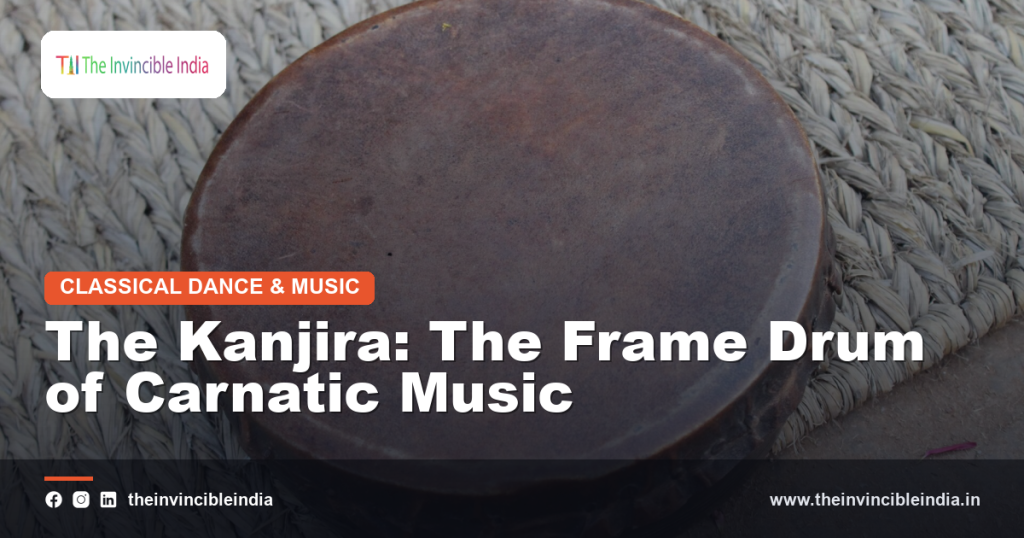
The kanjira is a small, single-headed frame drum of South India, held in one hand and struck with the fingers and palm of the other to produce a crisp, rippling percussive voice within Carnatic music. Though modest in size, it has long served as an important secondary percussion instrument, traditionally taking its place beside the mridangam in concert ensembles to add rhythmic texture and brightness. Over the twentieth century, dedicated performers expanded its technical vocabulary considerably, transforming an instrument once confined to a supporting role into one capable of extended solo passages within a Carnatic concert. Its light frame, sensitive skin head and small metal jingle give it a tonal range that belies its simple construction. This guide explores its origins, construction, technique and place in South Indian classical music.
Quick Facts
| Detail | Information |
|---|---|
| Type | Frame drum (membranophone) |
| Origin | Tamil Nadu, South India |
| Body | Circular wooden frame, traditionally jackfruit wood |
| Head | Single stretched skin, traditionally lizard skin |
| Jingle | A single pair of small metal discs set into the frame |
| Role | Secondary percussion (upa-pakkavadyam) in Carnatic concerts |
What Is the Kanjira
The kanjira is a small circular frame drum belonging to the family of hand-held percussion instruments found across South India, distinguished by its single drumhead and its compact, lightweight build. Held upright in one hand, it is struck along the edge and centre of its head with the fingers, thumb and heel of the other hand, producing a range of crisp, resonant and muted tones depending on where and how it is struck. Its small size belies a surprisingly wide expressive range, and in skilled hands it can shift quickly between soft, textured patterns and sharp, cutting accents. This versatility has made it one of the most recognisable supporting percussion voices within Carnatic classical music.
Origins in South Indian Percussion
The kanjira belongs to a broad and ancient family of frame drums found in many forms across South Asia, though its specific development into the instrument known today took place within the South Indian, and particularly Tamil, musical tradition. For much of its early history it was associated with folk and devotional performance rather than the formal classical concert stage, valued for its portability and its ability to provide lively rhythmic support to singers and street performers. Its gradual movement into Carnatic concert settings reflects a broader pattern in Indian music, in which instruments rooted in popular practice are refined and absorbed into classical performance over time.
Construction and Materials
A kanjira is built from a single circular wooden frame, traditionally turned from jackfruit wood prized for its light weight and stable resonance, over which a drumhead is stretched and secured. Historically the head was made from monitor lizard skin, valued for its thinness and sensitivity, though conservation concerns have led most modern instruments to use synthetic membranes that aim to reproduce a similar tonal quality. A narrow slot cut into the frame holds a small set of metal discs that jingle sympathetically as the drum is played, adding a shimmering texture to its percussive sound and distinguishing it from plain, jingle-free frame drums found elsewhere.
The Frame and Skin
The wooden frame of the kanjira is shallow and carefully shaped so that it remains light enough to hold and manipulate for extended periods without fatigue, an important consideration given the physical demands of continuous accompaniment. The head is stretched tightly across one face of the frame and fixed permanently, unlike some drums whose tension can be adjusted mechanically, which means the instrument’s basic pitch is set largely at the time of construction and head preparation. Skilled players compensate for this fixed tuning through pressure and technique, using the flexibility of the skin itself to introduce subtle variations in pitch during performance.
The Jingle and Its Sound
Set into a narrow cut along the kanjira’s frame is a small pair of metal discs, loosely fitted so that they rattle and shimmer whenever the drum is struck or shaken. This jingle adds a layer of bright, metallic colour to the instrument’s percussive voice, distinguishing its sound from unadorned frame drums and giving skilled players an additional expressive resource, since varying the intensity of strikes changes how prominently the jingle sounds against the drumhead’s tone. Balancing the crisp attack of the skin with the shimmer of the jingle is part of the subtlety involved in developing a mature, musical kanjira technique.
Tuning and Moisture Sensitivity
Because its head is fixed permanently to the frame, the kanjira cannot be tuned in the same mechanical way as drums with adjustable lacing or straps, making it unusually sensitive to humidity and temperature, both of which affect the tension and tone of the skin. Players traditionally moisten the head lightly during a performance to soften and darken its tone when it becomes too dry and bright, a practical adjustment that must be judged carefully by ear. This sensitivity to environmental conditions is a defining practical challenge of the instrument, and experienced players develop an intuitive feel for managing it through the course of a concert.
Playing Technique
Kanjira technique centres on the fingers, thumb and heel of the striking hand, which together produce a wide vocabulary of distinct sounds by varying where on the head they land and how much force is applied. Strikes near the rim tend to produce sharper, higher sounds, while strikes closer to the centre yield a deeper, more muted tone, and rapid combinations of these strokes allow players to build intricate rhythmic patterns. Because the drum has only one head, all of this tonal variety must be achieved through subtlety of touch alone, requiring considerable precision and control developed over years of dedicated practice.
The Role of the Supporting Hand
While one hand strikes the head, the other holds the frame and plays an active supporting role, applying varying pressure against the underside of the skin to bend and shift its pitch during performance. This pressure technique allows the kanjira to approximate short melodic inflections despite being fundamentally a percussion instrument, adding an expressive dimension not immediately obvious from its simple construction. Coordinating this pressure with the striking hand’s rhythmic patterns is a defining skill of advanced kanjira playing, distinguishing accomplished performers from those who have mastered only the instrument’s basic strokes.
Kanjira as Upa-Pakkavadyam
Within the structure of a Carnatic concert, the kanjira traditionally occupies the role of upa-pakkavadyam, or secondary percussion accompaniment, supporting the primary rhythmic instrument rather than leading the ensemble. In this capacity it adds rhythmic density and colour beneath the main percussion line, filling out the ensemble’s texture and responding to the soloist’s phrases with complementary patterns. This supporting role, while less prominent than that of the lead percussionist, requires equally close listening and rhythmic discipline, since the kanjira player must integrate seamlessly with the rest of the ensemble rather than perform independently of it.
Kanjira and the Mridangam
The kanjira most commonly appears alongside the mridangam, the principal double-headed drum of Carnatic music, forming a percussion partnership in which the two instruments interact closely throughout a concert. The mridangam typically carries the main rhythmic structure, while the kanjira weaves lighter, more textured patterns around it, occasionally echoing or answering phrases in a form of rhythmic dialogue. This pairing has become a standard feature of Carnatic concert practice, and the interplay between the two drums is often one of the most engaging elements for audiences during a performance’s rhythmic passages.
Rhythmic Vocabulary and Solkattu
Like other Carnatic percussion instruments, the kanjira’s technique is taught and organised through solkattu, a system of spoken rhythmic syllables that name and structure each stroke and pattern before it is translated to the drum. Students recite these syllables aloud, internalising complex rhythmic sequences through voice before applying them physically, a method that allows intricate compositions to be memorised, taught and performed with precision. This shared vocabulary links kanjira practice closely to the broader tradition of Carnatic rhythm, ensuring that its patterns remain compatible with those played on the mridangam and other percussion instruments within an ensemble.
Kanjira Solo Performance
Beyond its accompanying role, the kanjira has developed a tradition of solo performance, most often heard during the tani avartanam, the dedicated percussion interlude near the close of a Carnatic concert in which accompanying instruments take turns presenting extended rhythmic passages. In this setting the kanjira player demonstrates the instrument’s full range of tone and technique, engaging in rhythmic dialogue with the mridangam and any other percussion present. This solo tradition, expanded considerably over the twentieth century, has elevated the kanjira’s status considerably, showing audiences the instrument’s capacity for genuine rhythmic virtuosity rather than mere accompaniment.
Modern Concert Evolution
Over recent generations, dedicated performers have significantly expanded the kanjira’s technical vocabulary, introducing new stroke combinations and refining the instrument’s role within the tani avartanam to give it a more prominent and independent voice than it traditionally held. This evolution has been supported by a growing body of teaching material and structured training, helping standardise advanced technique for new generations of students. As a result the kanjira, once viewed mainly as a supporting instrument, is now regularly featured and appreciated in its own right within contemporary Carnatic concert programmes.
Synthetic Heads and Conservation
Traditional kanjira heads were made from monitor lizard skin, chosen for its thinness and responsiveness, but growing awareness of wildlife conservation has led most contemporary makers and players to adopt synthetic membrane materials designed to reproduce a comparable tone. This shift reflects a broader movement within Indian instrument-making toward materials that do not depend on the use of protected or endangered species, while still aiming to preserve the sonic qualities valued by performers. Many musicians report that well-made synthetic heads now serve as effective substitutes, allowing the instrument’s tradition to continue without relying on materials of conservation concern.
Learning the Kanjira
Training in the kanjira typically follows the guru-shishya method common to Carnatic music, with students learning rhythmic syllables and stroke technique directly from an experienced teacher over an extended period of study. Early lessons focus on basic strokes and simple rhythmic cycles, gradually progressing toward the more advanced combinations and pressure techniques required for both accompaniment and solo performance. Because of the instrument’s sensitivity to touch and environmental conditions, much of a student’s development involves developing a refined physical and auditory sensitivity that can only be cultivated through sustained, attentive practice under careful guidance.
The Kanjira Today
Today the kanjira holds a firmly established place in Carnatic music, valued both as an essential secondary percussion instrument and, increasingly, as a solo voice in its own right within concert programmes. Its light, portable build and expressive range continue to attract dedicated students, while established performers carry forward and extend the technical innovations of recent generations. As Carnatic music continues to be performed and taught both in India and among audiences abroad, the kanjira’s distinctive shimmering, rhythmic voice remains a familiar and valued part of the tradition’s living percussion ensemble.
Sources & Further Reading
- Sangeet Natak Akademi, national academy for music, dance and drama (sangeetnatak.gov.in).
- Ministry of Culture, Government of India (indiaculture.gov.in).
Frequently Asked Questions
What is a kanjira?
The kanjira is a small, single-headed frame drum from South India, held in one hand and struck with the fingers of the other. It is widely used as a secondary percussion instrument in Carnatic classical music.
What is the kanjira traditionally made from?
A kanjira’s frame is traditionally turned from jackfruit wood, with a head that was historically made from monitor lizard skin. Conservation concerns have led most modern instruments to use synthetic membranes instead.
How is the kanjira played?
The kanjira is held in one hand while the fingers, thumb and heel of the other hand strike its head at different points to produce a range of tones, aided by a small metal jingle set into the frame.
What role does the kanjira play in a Carnatic concert?
The kanjira traditionally serves as upa-pakkavadyam, or secondary percussion, supporting the mridangam. It also frequently performs solo passages during the tani avartanam, the percussion interlude of a concert.
Why do kanjira players sometimes moisten the drumhead?
Because the kanjira’s head is fixed and cannot be mechanically tuned, players moisten it during a performance to soften its tone when dryness or heat makes it sound too bright or brittle.