


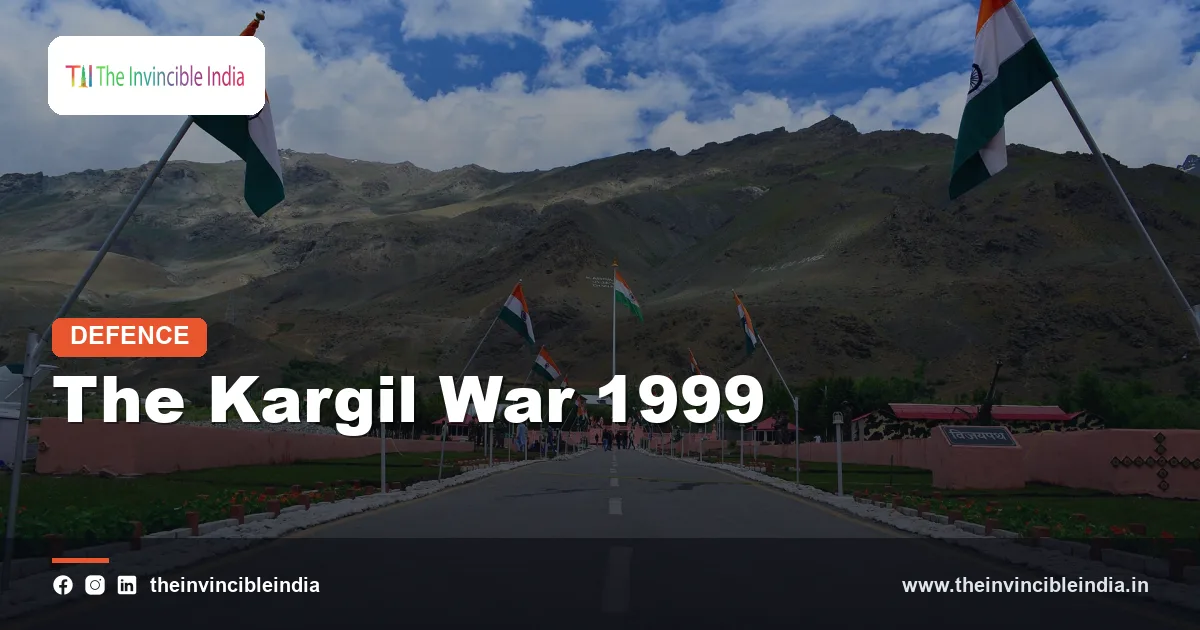
The Kargil War was a limited but intense conflict fought between India and Pakistan from May to July 1999 in the Kargil district of Ladakh, then part of the state of Jammu and Kashmir. Also called the Kargil conflict, it was fought on some of the highest and coldest battlefields anywhere in the world, on ridges and peaks that rise well above 16,000 feet. It began when Pakistani soldiers and militants quietly occupied heights on the Indian side of the Line of Control (LoC), and it ended when India recaptured those positions and Pakistan withdrew.
For India, the war is remembered as a story of extraordinary courage, patience under diplomatic pressure and a hard lesson in intelligence and preparedness. Every year, 26 July is observed as Kargil Vijay Diwas to honour the soldiers who fought and fell. This guide explains the background, the course of the fighting, the major battles, the acts of gallantry and the reforms that followed.
Quick Facts
| Aspect | Details |
|---|---|
| Conflict | Kargil War (Kargil conflict), India versus Pakistan |
| Duration | Early May to late July 1999 (roughly three months) |
| Location | Kargil district, Ladakh, then in Jammu and Kashmir; sectors such as Mushkoh, Dras, Kaksar and Batalik |
| Trigger | Covert occupation of vacated Indian winter posts overlooking National Highway 1A (Srinagar-Leh) |
| Indian military operations | Operation Vijay (Army) and Operation Safed Sagar (Indian Air Force) |
| Altitude of fighting | Roughly 16,000 to 18,000 feet and above |
| Outcome | India recaptured the occupied heights; Pakistan withdrew across the LoC |
| Indian fatalities | Over 500 soldiers (approximate; officially in the vicinity of 520-530) |
| Commemoration | Kargil Vijay Diwas, observed every year on 26 July |
Background: The Line of Control and the Road to 1999
To understand the Kargil War, one must begin with the LoC. India and Pakistan fought over Jammu and Kashmir in 1947-48, and a ceasefire line was drawn under United Nations supervision. After the 1971 war, the two countries signed the Simla Agreement in July 1972. Under it, the ceasefire line in Jammu and Kashmir was redefined as the Line of Control, and both sides agreed to resolve differences through bilateral talks and to respect the LoC without seeking to change it by force.
A decade of tension
The years that followed saw periodic tension, notably the dispute over the Siachen Glacier from the mid-1980s and a long insurgency in the Kashmir Valley from 1989 onwards. In May 1998, both countries conducted nuclear tests, which raised the stakes of any future confrontation. Many observers wondered whether nuclear weapons would deter conventional war or embolden limited adventures below the nuclear threshold.
The Lahore Declaration
In February 1999, Prime Minister Atal Bihari Vajpayee travelled to Lahore by bus on the newly launched Delhi-Lahore bus service. He and Pakistan’s Prime Minister Nawaz Sharif signed the Lahore Declaration on 21 February 1999, pledging to pursue peace, avoid nuclear escalation and settle disputes bilaterally. The optimism of Lahore made the discovery of intrusions only weeks later all the more jarring, and it is why many in India described the Kargil episode as a breach of trust.
Why Kargil Mattered: Geography and the Winter Posts
Kargil lies in the Himalayan cold desert region of Ladakh. Its terrain is a chain of barren, snow-covered ridges cut by deep valleys, with few trees and thin air. The town of Kargil sits along National Highway 1A, the road that links Srinagar with Leh through the Zoji La pass and the town of Dras. This highway is the main lifeline supplying Ladakh, including the army formations deployed there and the civilians who live in the region.
Vacated winter posts
Winters in the region are brutal, with heavy snowfall and temperatures that can fall far below freezing. By an informal understanding that had been followed in earlier years, troops of both armies often withdrew from some of the highest, most inaccessible posts during the coldest months and reoccupied them once the snow melted. This meant that in this sector the LoC was not continuously held at every point, and gaps existed between posts.
Why the ridges were dangerous
Whoever holds the heights above a road can watch and fire on traffic below. Positions on the ridges above the Srinagar-Leh highway therefore offered a strategic advantage: they could disrupt supplies, threaten to isolate Ladakh and, in principle, alter the military balance in the region. This was the central worry once the intrusions were discovered.
How the Kargil Conflict Began
In the winter of 1998-99, Pakistani forces moved across the LoC into vacant Indian positions and occupied features on the high ridges. The intruders included soldiers as well as militants, and they brought weapons, supplies and fortifications to hold their positions. They dug in on the crests and built sangars, small stone-and-rock defensive shelters, from which they had a commanding view of the valley below.
Discovery in May 1999
The intrusions came to light in early May 1999, when local shepherds and Indian patrols reported suspicious activity in the Batalik area. Army patrols sent to check were fired upon, and some patrol members were captured and killed, an event that hardened opinion in India. As reports arrived from Mushkoh, Dras, Kaksar and elsewhere, it became clear that the occupation was not a single incursion but a wide, well-planned one across many ridgelines.
Competing narratives
At first, Pakistan described the intruders as independent Kashmiri fighters. India maintained from the beginning that regular Pakistani troops, including units of the Northern Light Infantry, were involved, and later accounts and admissions within Pakistan pointed the same way. The question of who authorised the plan and how far the political leadership knew about it remained a matter of public debate in Pakistan for years afterwards.
Operation Vijay and Operation Safed Sagar
India’s response was launched under the name Operation Vijay, the Army’s campaign to evict the intruders and restore the LoC. Thousands of troops, together with artillery and additional formations, were moved into the Kargil-Dras area, and a long, difficult campaign began to recapture each occupied feature one by one. The numbers involved are usually described as very large by the standards of a limited conflict, though exact figures vary between sources.
The air component
The Indian Air Force joined the campaign through Operation Safed Sagar, which began in late May 1999. Fighter aircraft such as the MiG-21, MiG-27, MiG-29 and Mirage 2000, along with helicopters, supported ground troops. Operating at such altitudes was demanding, since thin air reduces engine performance and payload, and narrow valleys leave little room to manoeuvre. The Mirage 2000, using precision-guided munitions, was notably used against fortified positions and supply areas in the later phase.
Losses and courage in the air
The IAF lost aircraft during the operation, and a young pilot, Flight Lieutenant K. Nachiketa, was captured after ejecting and was returned to India in early June. The Indian Navy also moved ships in the Arabian Sea as a precaution and a signal of readiness, an effort commonly referred to as Operation Talwar.
Fighting at the Roof of the World
The Kargil War is often studied as a case of high-altitude warfare. Soldiers fought at heights of roughly 16,000 to 18,000 feet, where oxygen is thin, the cold is severe and the terrain is largely bare rock and loose scree. Advancing uphill towards an enemy who is dug in above, with clear lines of sight, is one of the hardest tasks in warfare.
Challenges faced by the troops
- Thin air: reduced oxygen slowed movement, sapped stamina and made simple tasks exhausting.
- Exposure to fire: approaches were narrow and open, so attackers were visible to defenders on the crests.
- Cold and weather: freezing nights, wind and sudden weather changes added the risk of frostbite and altitude sickness.
- Logistics: ammunition, food and equipment had to be carried up steep slopes, often by hand and at night.
- Casualty evacuation: bringing wounded soldiers down was slow and dangerous.
Artillery as the decisive tool
Because direct assaults uphill were so costly, artillery played a major role. Field guns, including the Bofors howitzer, were used in direct-fire and other roles to bombard enemy sangars and cut off their supplies, so that infantry could then climb at night or in the pre-dawn hours and close in with small-arms fire, grenades and hand-to-hand combat.
Key Battles and Sectors
The fighting spread across several sectors, each with its own peaks and its own dramas. The table below summarises some of the best-known engagements. Dates and details are simplified, and readers seeking precise military records should consult official histories.
| Feature / Sector | Area | Why it mattered |
|---|---|---|
| Tololing | Dras sector | Dominated the highway near Dras; its capture in mid-June 1999 was among the first major successes and lifted morale |
| Tiger Hill | Dras sector | A high, prominent peak overlooking the highway; recaptured in early July 1999 after a difficult night climb |
| Point 4875 (later called Batra Top) | Mushkoh / Dras sector | A key feature whose capture in early July 1999 was tied to acts of great gallantry; named after Captain Vikram Batra |
| Point 5140 | Dras sector | Captured in June 1999 by 13 JAK Rifles; associated with the phrase “Yeh Dil Maange More” |
| Batalik | Batalik sector | Where intrusions were first reported; fighting here cleared ridges overlooking the Indus valley approaches |
| Mushkoh Valley | Mushkoh sector | Contained several fortified positions that were dislodged in the closing stages |
Tololing and Tiger Hill
Tololing, overlooking Dras, was one of the first significant features recaptured, following days of heavy fighting in June. Tiger Hill, one of the most recognisable peaks of the war, was retaken in July after infantry units climbed steep faces under fire, supported by artillery. Both victories opened the way for further advances along the ridgelines.
Point 4875 and the Batra Top
Point 4875 in the Mushkoh-Dras area was a long, tough objective in early July. After the war, the feature was named Batra Top in honour of Captain Vikram Batra, who led the assault and was killed in action during the fighting.
Restraint at the LoC and the Diplomatic Front
One of the defining features of India’s strategy was its decision not to cross the LoC, even though crossing would have offered tactical advantages by cutting enemy supply lines. Indian leadership held that the conflict should remain limited, both to avoid wider escalation between two nuclear-armed neighbours and to preserve the moral high ground.
Winning international opinion
This restraint helped India win considerable diplomatic support. Major powers and international groupings urged Pakistan to withdraw its forces to its side of the LoC and respect the sanctity of the line. A meeting between Nawaz Sharif and the United States President Bill Clinton in Washington on 4 July 1999 led to a commitment to withdraw, and pressure on Islamabad mounted during the following weeks.
Managing information at home
The Kargil War was also among the first Indian conflicts widely followed on television, with reporters bringing images from the front to households across the country. This raised public engagement, with donations, letters and tributes flowing to soldiers and families, and it set a precedent for how modern wars are covered.
Gallantry: The Param Vir Chakra Awardees
The Param Vir Chakra (PVC) is India’s highest military gallantry award. Four soldiers received it for actions in the Kargil War, and their stories are still taught to new recruits and schoolchildren.
- Captain Vikram Batra (13 JAK Rifles): Led assaults on Point 5140 and Point 4875. After capturing Point 5140 he radioed the now-famous line “Yeh Dil Maange More”. He was killed in July 1999 while leading an attack on Point 4875 and was awarded the PVC posthumously.
- Rifleman Sanjay Kumar (13 JAK Rifles): Volunteered to lead an assault on a feature in the Mushkoh area and, though wounded, continued to fight and helped clear the position. He survived and received the PVC.
- Grenadier Yogendra Singh Yadav (18 Grenadiers): Took part in the attack on Tiger Hill, continued fighting despite multiple wounds, and became one of the youngest recipients of the award. He survived.
- Lieutenant Manoj Kumar Pandey (1/11 Gorkha Rifles): Led his platoon in the Khalubar area of the Batalik sector, pressed on despite being wounded and was killed in action in early July 1999. He was awarded the PVC posthumously.
Many other soldiers received the Maha Vir Chakra, Vir Chakra and other honours. Their stories reflect the wider truth of Kargil: that battles at this altitude were won by small units and individuals acting with extraordinary determination.
Outcome and Kargil Vijay Diwas
By the third week of July 1999, Indian forces had recaptured the great majority of the occupied positions, and Pakistan’s forces withdrew or were pushed back across the LoC. India announced that the operation to clear the intruders was complete, and 26 July came to be marked as Kargil Vijay Diwas, the day of victory in Kargil.
A timeline at a glance
- 21 February 1999: Lahore Declaration signed by the two Prime Ministers.
- Early May 1999: Intrusions detected in the Kargil sector, beginning with the Batalik area.
- Late May 1999: Operation Vijay is in full swing; the Air Force begins Operation Safed Sagar.
- June 1999: Major recaptures such as Tololing and Point 5140 in the Dras sector.
- 4 July 1999: Tiger Hill is recaptured; the Clinton-Sharif meeting takes place in Washington.
- Early to mid July 1999: Point 4875 and other Mushkoh and Batalik heights are taken.
- 26 July 1999: India declares the operation successful; now observed as Kargil Vijay Diwas.
Remembrance at Dras
Each year, ceremonies are held at the Kargil War Memorial near Dras, where the names of fallen soldiers are inscribed, and in many cities across India. The memorial stands in the shadow of the Tololing and Tiger Hill ridges, close to where the fighting took place.
The Human Cost
The war took a heavy toll. India lost over 500 soldiers, a figure usually given as approximate and in the vicinity of 520 to 530 in official accounts, and well over a thousand were wounded. Casualty figures on the Pakistani side remain uncertain and are given differently in different sources, so they are best treated with caution.
Behind each number were families who lost a son, husband or father. Many of the fallen were young officers and soldiers in their twenties. Their sacrifice led to schemes of support for the families of martyrs, memorials in home towns, and the naming of roads, schools and institutions in their memory.
Aftermath: The Kargil Review Committee and Reforms
Soon after the war, the Government of India set up the Kargil Review Committee under the strategic affairs analyst K. Subrahmanyam to examine how the intrusions went undetected and to recommend improvements. Its report was submitted in early 2000 and tabled in Parliament, and a Group of Ministers then studied its recommendations across intelligence, border management, defence procurement and higher defence organisation.
Major changes that followed
- Intelligence: Better coordination among agencies, a new Defence Intelligence Agency and a stronger technical intelligence apparatus, including the National Technical Research Organisation.
- Surveillance: More investment in surveillance equipment, unmanned aerial vehicles and border monitoring in high-altitude areas.
- Higher defence management: A long-running debate on integration of the armed forces led to the creation of the post of Chief of Defence Staff (CDS) in December 2019, along with the Department of Military Affairs.
- Preparedness: Improved equipment for high-altitude troops, including clothing, weapons and mountain warfare training.
The war also changed thinking about limited conflict under a nuclear shadow, showing that a conventional war could still be fought and contained without crossing into nuclear escalation.
Conclusion
The Kargil War was short compared with other conflicts, but its impact was lasting. It tested the courage of Indian soldiers, the patience of Indian diplomacy and the resilience of a nation that followed the war closely. It also exposed gaps in intelligence and surveillance, which triggered long-overdue reforms. Kargil Vijay Diwas each 26 July is a reminder of both the price and the pride of that summer of 1999.
Frequently Asked Questions
When was the Kargil War fought and where?
The Kargil War was fought between India and Pakistan from May to July 1999 in the Kargil district of Ladakh, then part of Jammu and Kashmir. The fighting took place on high ridges and peaks overlooking National Highway 1A, in sectors such as Dras, Mushkoh, Kaksar and Batalik.
What was Operation Vijay?
Operation Vijay was the name of the Indian Army’s operation to evict the intruders from the Kargil heights and restore the Line of Control. The Indian Air Force supported it with its own campaign, Operation Safed Sagar.
Why did India not cross the Line of Control?
India chose to keep the war limited and not cross the LoC, mainly to avoid escalation between two nuclear-armed neighbours and to maintain international goodwill. This restraint helped India gain diplomatic support from many countries while it recaptured the occupied heights on its own side.
Who were the Param Vir Chakra winners of the Kargil War?
Four soldiers received the Param Vir Chakra for the Kargil War: Captain Vikram Batra, Rifleman Sanjay Kumar, Grenadier Yogendra Singh Yadav and Lieutenant Manoj Kumar Pandey. Batra and Pandey received the award posthumously, while Sanjay Kumar and Yogendra Singh Yadav survived.
Why is Kargil Vijay Diwas celebrated on 26 July?
By late July 1999, India had recaptured the occupied heights and declared the operation successful, and 26 July has since been observed as Kargil Vijay Diwas. It is a day to honour the soldiers who fought and those who gave their lives, with ceremonies at the Kargil War Memorial in Dras and elsewhere.
What changed in India after the Kargil War?
The Kargil Review Committee examined the intelligence and surveillance failures and made recommendations that led to reforms in intelligence coordination, border management and defence organisation. Over time, this thinking contributed to steps such as the creation of the Chief of Defence Staff in 2019.
{“@context”:”https://schema.org”,”@graph”:[{“@type”:”FAQPage”,”mainEntity”:[{“@type”:”Question”,”name”:”When was the Kargil War fought and where?”,”acceptedAnswer”:{“@type”:”Answer”,”text”:”The Kargil War was fought between India and Pakistan from May to July 1999 in the Kargil district of Ladakh, then part of Jammu and Kashmir. The fighting took place on high ridges and peaks overlooking National Highway 1A, in sectors such as Dras, Mushkoh, Kaksar and Batalik.”}},{“@type”:”Question”,”name”:”What was Operation Vijay?”,”acceptedAnswer”:{“@type”:”Answer”,”text”:”Operation Vijay was the name of the Indian Army’s operation to evict the intruders from the Kargil heights and restore the Line of Control. The Indian Air Force supported it with its own campaign, Operation Safed Sagar.”}},{“@type”:”Question”,”name”:”Why did India not cross the Line of Control?”,”acceptedAnswer”:{“@type”:”Answer”,”text”:”India chose to keep the war limited and not cross the LoC, mainly to avoid escalation between two nuclear-armed neighbours and to maintain international goodwill. This restraint helped India gain diplomatic support from many countries while it recaptured the occupied heights on its own side.”}},{“@type”:”Question”,”name”:”Who were the Param Vir Chakra winners of the Kargil War?”,”acceptedAnswer”:{“@type”:”Answer”,”text”:”Four soldiers received the Param Vir Chakra for the Kargil War: Captain Vikram Batra, Rifleman Sanjay Kumar, Grenadier Yogendra Singh Yadav and Lieutenant Manoj Kumar Pandey. Batra and Pandey received the award posthumously, while Sanjay Kumar and Yogendra Singh Yadav survived.”}},{“@type”:”Question”,”name”:”Why is Kargil Vijay Diwas celebrated on 26 July?”,”acceptedAnswer”:{“@type”:”Answer”,”text”:”By late July 1999, India had recaptured the occupied heights and declared the operation successful, and 26 July has since been observed as Kargil Vijay Diwas. It is a day to honour the soldiers who fought and those who gave their lives, with ceremonies at the Kargil War Memorial in Dras and elsewhere.”}},{“@type”:”Question”,”name”:”What changed in India after the Kargil War?”,”acceptedAnswer”:{“@type”:”Answer”,”text”:”The Kargil Review Committee examined the intelligence and surveillance failures and made recommendations that led to reforms in intelligence coordination, border management and defence organisation. Over time, this thinking contributed to steps such as the creation of the Chief of Defence Staff in 2019.”}}]}]}