


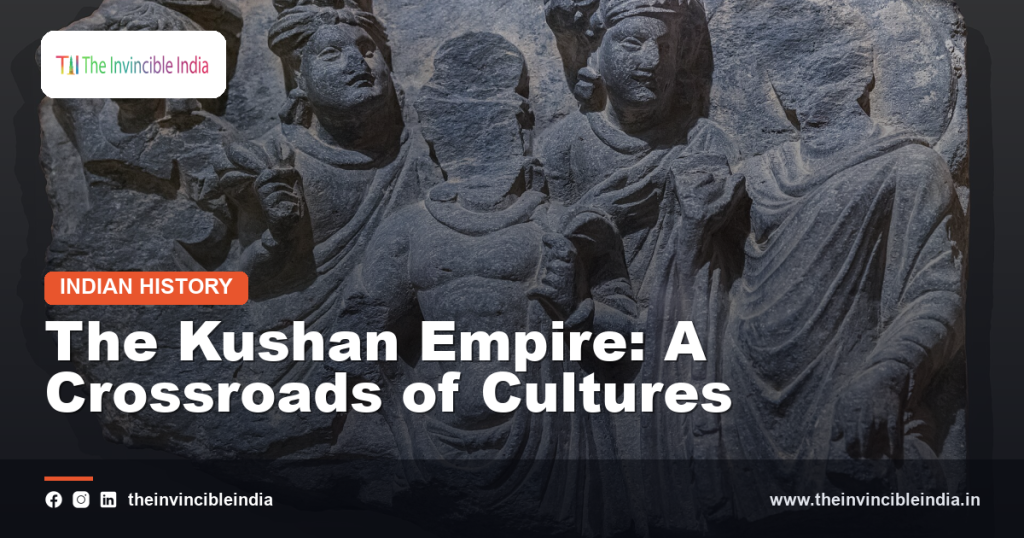
The Kushan Empire was one of the great ancient powers of Asia, a far-flung realm that linked the Indian subcontinent with Central Asia and the wider world along the routes of the Silk Road. Rising from origins in Central Asia, the Kushans built an empire that stretched across a vast territory, and under their most celebrated ruler, Kanishka, the empire became a great patron of Buddhism and a crossroads where the artistic traditions of India, Central Asia, Persia and the Greek world met and blended into new and beautiful forms, most famously in the Gandhara school of art. This guide explores the Kushan Empire, its rise, its great ruler, and its enduring legacy, an ancient chapter that unfolded across the same subcontinent shaped in earlier centuries by the Indus Valley Civilisation.
Quick Facts
| Detail | Information |
|---|---|
| Origin | Central Asia |
| Territory | Central Asia and northern India |
| Famous ruler | Kanishka |
| Known for | Patronage of Buddhism and Gandhara art |
| Trade | A key power along the Silk Road |
| Legacy | A meeting point of great civilisations |
A Crossroads of Cultures
The Kushan Empire was one of the great ancient powers of Asia, a far-flung realm whose territory stretched across Central Asia and into the northern part of the Indian subcontinent. Rising to prominence in the early centuries of the common era, the empire became a remarkable meeting point of different civilisations, where the cultures, religions and artistic traditions of India, Central Asia, Persia and the Greek world came together and influenced one another in lasting ways. This role as a crossroads defines the empire. This role of the Kushan Empire as a great crossroads of cultures, where the traditions of India, Central Asia and the wider ancient world met and blended, defines its significance, and it secures the empire a distinctive place in the history of ancient Asia.
Origins in Central Asia
The origins of the Kushan Empire lie among nomadic and semi-nomadic peoples of Central Asia, who migrated over time and eventually established settled rule over territories that included parts of the region and, later, northern India. Emerging from these Central Asian origins, the Kushans gradually built a powerful and organised state, drawing on both their own traditions and those of the settled populations they came to govern. These origins shaped the empire’s character. These Central Asian origins of the Kushan people, who migrated and eventually established settled and organised rule over a wide territory, shaped the character of the empire from the very beginning, giving it the distinctive blend of cultures for which it became renowned.
The Rise of the Kushan Empire
Over time, the Kushan rulers expanded their authority from their Central Asian base into the regions of Bactria and Gandhara and eventually into the northern plains of India, building one of the largest and most far-reaching empires of the ancient world. This expansion brought together diverse peoples, languages and traditions under a single rule, and it established the Kushans as a major power controlling important trade routes between East and West. This expansion is central to the empire’s rise. This expansion of Kushan authority from Central Asia into Gandhara and northern India, building one of the great far-reaching empires of antiquity, is central to the story of the dynasty’s rise, and it laid the foundation for the empire’s later fame as a meeting point of cultures.
A Vast and Far-Flung Realm
At the height of its power, the Kushan Empire commanded a vast and far-flung territory stretching from parts of Central Asia through Afghanistan and into the northern regions of the Indian subcontinent. This extensive realm brought together many different peoples, languages and cultural traditions under Kushan rule, and the empire’s control of this wide territory placed it in a uniquely advantageous position along the major trade and cultural routes connecting East and West. This vast extent is a mark of the empire’s power. This vast and far-flung extent of the Kushan Empire, stretching across Central Asia and into northern India, is a mark of its power, and the empire’s control of this wide territory secured its place as one of the great powers of the ancient world.
The Great Kanishka
The most celebrated ruler of the Kushan Empire was Kanishka, a powerful king whose reign is remembered as a high point of the empire’s strength, culture and religious patronage. Under his rule, the empire expanded and prospered, and Kanishka became renowned above all for his devoted and generous patronage of Buddhism, which flourished and spread widely during his reign, earning him a lasting reputation as one of the great patrons of the faith in ancient history. This reign is a celebrated peak of the empire. This reign of Kanishka, remembered as a celebrated peak of Kushan power and as a time of devoted patronage of Buddhism, is central to the fame of the empire, and Kanishka himself is remembered among the most important patrons in the history of Buddhism.
Patronage of Buddhism
The Kushan Empire, and especially the reign of Kanishka, is remembered for extensive and generous patronage of Buddhism, which flourished across the empire’s territories during this period. Kanishka and other Kushan rulers supported the building of monasteries and stupas, the copying and preservation of sacred texts, and the gathering of Buddhist scholars and monks, contributing greatly to the strength and spread of the faith during this important era. This patronage of Buddhism is a defining feature. This extensive patronage of Buddhism by the Kushan Empire, especially under Kanishka, through the support of monasteries, texts and scholars, is a defining feature of the dynasty’s legacy, and it played an important role in the wider history of the Buddhist faith.
The Spread of Buddhism along the Silk Road
Under Kushan rule, Buddhism spread widely beyond India along the trade routes of the Silk Road, carried by monks, traders and pilgrims who travelled across the empire’s vast territories. The Kushan control of key routes linking India, Central Asia and China provided a vital channel through which Buddhist teachings, texts and art travelled eastward, contributing significantly to the establishment of Buddhism in Central Asia and, eventually, in China and beyond. This spread of Buddhism is a major historical development. This spread of Buddhism along the Silk Road during the era of Kushan rule, carried by monks and travellers across the empire’s vast territories, is a major historical development, and it stands among the most significant religious and cultural achievements associated with the Kushan Empire.
The Gandhara School of Art
The Kushan Empire is celebrated for fostering the Gandhara school of art, a remarkable and distinctive artistic tradition that blended Indian subject matter with styles and techniques drawn from the Greek and Roman artistic traditions of the wider ancient world. This fusion produced sculptures, particularly images of the Buddha, that combined Indian religious content with a naturalistic, classical style of representation, creating some of the most influential and widely admired religious art of the ancient world. This school of art is a celebrated legacy. This Gandhara school of art fostered under Kushan patronage, blending Indian religious subjects with classical artistic styles, is a celebrated legacy of the empire, and its influence can be traced in Buddhist art across large parts of Asia in the centuries that followed.
The Mathura School of Art
Alongside the Gandhara tradition, another important school of art flourished in the city of Mathura during the era of Kushan rule, developing its own distinctive style rooted more directly in earlier Indian artistic traditions. Mathura became an important centre for the production of sculpture, including images of the Buddha and other religious figures, characterised by its own particular style and sensibility, and the two schools together represent the rich artistic diversity fostered under Kushan patronage. This Mathura school adds to the empire’s artistic richness. This Mathura school of art that flourished alongside the Gandhara tradition under Kushan rule adds to the artistic richness of the empire, and together the two schools represent one of the great flowerings of religious art in ancient Indian history.
Coinage and Its Testimony
The Kushan Empire is notable for its extensive and varied coinage, which provides historians with valuable evidence about the rulers, religions and cultural influences present within the empire. Kushan coins, issued in gold and copper, depicted rulers alongside a striking variety of deities drawn from different religious traditions, including Indian, Iranian and Greek gods, offering a vivid testimony to the empire’s role as a meeting point of diverse cultures and beliefs. This coinage is an important historical source. This extensive and varied coinage of the Kushan Empire, depicting a striking range of deities from different traditions, is an important historical source for understanding the empire, and it vividly illustrates the diverse cultural and religious character of Kushan rule.
Masters of the Silk Road Trade
The Kushan Empire occupied a strategically vital position along the trade routes of the Silk Road, controlling territory through which goods, ideas and people passed between the civilisations of East and West. This position allowed the Kushans to benefit greatly from long-distance trade, connecting India with Central Asia, China and, indirectly, with the Roman world, and the wealth generated by this trade contributed significantly to the prosperity and cultural flowering of the empire. This role in trade is central to the empire’s importance. This strategic role of the Kushan Empire in controlling and benefiting from Silk Road trade between East and West is central to its historical importance, and it explains much of the wealth and cultural richness for which the empire became renowned.
A Meeting of Civilisations
The Kushan Empire is remembered as a remarkable meeting point of civilisations, where the traditions of India, Central Asia, Persia and the Greek world came into close and lasting contact. This meeting of civilisations, fostered by the empire’s vast extent and its control of important trade routes, produced a rich and distinctive culture that drew upon multiple traditions, visible especially in the empire’s art, coinage and religious life. This meeting of civilisations is the empire’s defining character. This remarkable meeting of civilisations fostered by the Kushan Empire, bringing together the traditions of India, Central Asia, Persia and the Greek world, is the defining character of the dynasty, and it secures the empire’s lasting reputation as a bridge between the great cultures of the ancient world.
Religion and Syncretism
The Kushan Empire is notable for the religious diversity and syncretism that characterised its territories, where Buddhism flourished alongside other faiths and traditions drawn from the many cultures under Kushan rule. Rulers and subjects alike honoured deities from Indian, Iranian, Greek and other traditions, often side by side, reflecting a spirit of religious openness that was well suited to an empire spanning such a wide and culturally diverse territory. This religious diversity enriches the empire’s story. This religious diversity and syncretism that characterised the Kushan Empire, in which multiple faiths and traditions coexisted across its territories, enriches the story of the dynasty, and it reflects the broader character of the empire as a meeting point of cultures and beliefs.
Cities and Urban Life
Under Kushan rule, cities across the empire’s territories flourished as centres of trade, religion, art and administration, reflecting the prosperity brought by the empire’s control of important trade routes. Urban centres in Gandhara, Bactria and northern India grew in size and importance during this period, supporting a rich urban culture of markets, monasteries, workshops and public buildings that reflected the wealth and cosmopolitan character of the empire. This urban flourishing is a feature of Kushan rule. This flourishing of cities and urban life across the Kushan Empire’s territories, supported by trade and reflecting the empire’s cosmopolitan character, is a notable feature of Kushan rule, and it underlines the prosperity and cultural richness that the empire achieved during its height.
The Decline of the Kushans
Over time, the Kushan Empire gradually declined, weakened by a combination of internal pressures and the rise of rival powers on its frontiers, until its once-extensive territories fragmented into smaller successor states. This decline unfolded over a considerable period, and though the unified empire eventually passed from the historical stage, various successor states and cultural influences descended from the Kushan era persisted in parts of its former territory for some time thereafter. This decline marks the end of the unified empire. This gradual decline of the Kushan Empire, weakened by internal pressures and rival powers until its territories fragmented, marks the end of the unified empire, though the cultural and artistic legacy of the Kushan era endured well beyond the fall of the state itself.
The Legacy of the Kushan Empire
The Kushan Empire left an enduring legacy as one of the great meeting points of ancient civilisation, remembered above all for its patronage of Buddhism, its role in spreading the faith along the Silk Road, and its magnificent Gandhara art. The empire’s contribution to the spread of Buddhism across Asia, its fostering of a distinctive and influential artistic tradition, and its role as a bridge between East and West all endure as significant achievements, securing the Kushans a lasting place in the history of the ancient world. This legacy continues to be studied and admired. As a great ancient empire that linked India, Central Asia and the wider world along the Silk Road, and that fostered the flowering of Buddhism and Gandhara art, the Kushan Empire endures as one of the most fascinating and significant chapters in the history of ancient Asia.
Sources & Further Reading
- National Museum, New Delhi, on Gandhara and Kushan-era art (nationalmuseumindia.gov.in).
- Archaeological Survey of India (asi.nic.in).
Frequently Asked Questions
What was the Kushan Empire?
The Kushan Empire was a great ancient power that arose from origins in Central Asia and came to rule a vast territory stretching across Central Asia and into northern India. It became renowned as a meeting point of cultures along the Silk Road.
Who was Kanishka?
Kanishka was the most celebrated ruler of the Kushan Empire, remembered for presiding over the empire at the height of its power and for his devoted and generous patronage of Buddhism, which flourished widely during his reign.
What is Gandhara art?
Gandhara art is a distinctive artistic tradition that flourished under Kushan patronage, blending Indian religious subjects, especially images of the Buddha, with styles and techniques drawn from Greek and Roman artistic traditions.
How did the Kushan Empire contribute to the spread of Buddhism?
The Kushan Empire, especially under Kanishka, supported the building of monasteries and stupas and the preservation of sacred texts, and its control of Silk Road trade routes helped carry Buddhism from India into Central Asia and beyond.
Why is the Kushan Empire important in history?
The Kushan Empire is important as a great crossroads of civilisations that linked India, Central Asia and the wider ancient world, fostering the spread of Buddhism and producing the influential Gandhara school of art.