


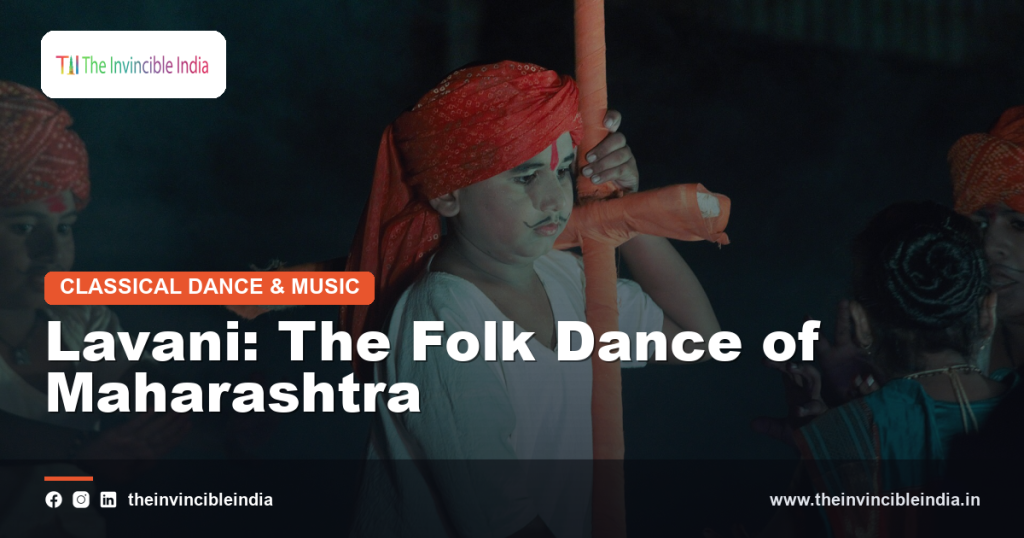
Lavani is the exuberant folk dance and song tradition of Maharashtra, distinct from the codified classical dance forms of India yet every bit as demanding in its rhythm, poetry and stagecraft. Born in the villages and fairs of the Deccan plateau, it combines swift footwork, expressive glance and gesture, and the propulsive beat of the dholki drum with verse composed in vivid, often playful Marathi. Traditionally carried by travelling tamasha troupes, Lavani has moved from rural courtyards to the modern stage and screen while keeping its earthy vitality intact. This guide traces its origins, its two broad streams, its music and costume, and its place in Maharashtrian culture today.
Quick Facts
| Detail | Information |
|---|---|
| Type | Folk dance and song tradition |
| Origin | Maharashtra, western India |
| Core drum | Dholki, a double-headed hand drum |
| Costume | Nau-vari (nine-yard) sari |
| Two streams | Nirguni (devotional) and Shringarik (romantic) |
| Traditional setting | Tamasha folk theatre |
Origins in Rural Maharashtra
Lavani grew out of the everyday cultural life of rural Maharashtra, where song and dance accompanied village fairs, harvest celebrations and travelling entertainments long before it became a recognised performing art. It emerged in an agrarian society where itinerant performers moved from village to village, offering an evening of music, wit and spectacle to communities with few other sources of organised entertainment. Over generations this loose tradition of sung verse and rhythmic movement acquired its own conventions of metre, melody and gesture, distinguishing it from other regional folk forms. The dance retained a close bond with the land and its seasons, and that rustic, communal origin remains audible in its rhythms and visible in its unpretentious, direct style of performance today.
The Meaning of the Word
The name Lavani is generally traced to the Marathi word lavanya, meaning beauty or grace, a fitting root for a tradition built around graceful movement and alluring expression. Some scholars also connect it to a family of poetic metres used in Marathi verse, since Lavani songs are composed in a distinctive rhymed and rhythmic form suited to being sung and danced simultaneously. Whichever derivation is favoured, the name points to the twin heart of the art: physical beauty of movement and verbal beauty of composition. This dual sense of the word helps explain why Lavani has always been valued as much for its sung poetry as for its dance, with the two elements inseparable in performance.
Lavani and the Tamasha Tradition
Lavani developed as the centrepiece of tamasha, the popular folk theatre of Maharashtra that blends song, dance, comic interludes and narrative episodes into a single evening of entertainment. Travelling tamasha troupes, often built around extended families of performers, carried the tradition from village to village, staging performances in open-air settings for rural audiences. Within a tamasha programme, the Lavani sequences provided the emotional and rhythmic high points, drawing the audience in with their infectious beat and playful verse. This close bond between Lavani and tamasha shaped the dance’s theatrical, audience-facing character, and even as Lavani has since been performed independently on the concert stage, its roots in this lively folk theatre remain central to its identity.
Nirguni and Shringarik Lavani
Lavani is generally understood as flowing along two broad streams. Nirguni Lavani is devotional and philosophical in character, often sung by men, dwelling on themes of spirituality, morality and the formless divine in a manner closer to reflective folk hymn than dance spectacle. Shringarik Lavani, by contrast, is romantic and sensuous, performed chiefly by women dancers, and explores themes of love, longing, coquetry and playful banter between lovers. It is this second stream that is most widely associated with Lavani in popular imagination, thanks to its vivid costume, spirited footwork and expressive performance style. Together the two streams show the range of the tradition, from contemplative song to exuberant dance-drama.
The Dholki and Its Driving Rhythm
At the rhythmic centre of Lavani sits the dholki, a double-headed hand drum whose sharp, propulsive beat drives both the singing and the dancer’s footwork. The dholki player sits close to the performer, matching and accentuating each turn, stamp and gesture, so that drummer and dancer appear to converse through rhythm. Alongside the dholki, instruments such as the harmonium provide melodic support, the tuntune adds a droning undertone, and small cymbals called manjira mark the beat. This tight, percussion-led ensemble gives Lavani its unmistakable energy, and the interplay between drum and dance is often the most electrifying element of a live performance, building excitement as the tempo quickens toward a climax.
Costume and Adornment
The visual identity of Lavani owes much to its costume, above all the nau-vari or nine-yard sari, draped in a distinctive Maharashtrian style that allows freedom of movement for vigorous footwork and turns. The sari is typically vividly coloured and paired with a fitted blouse, heavy traditional jewellery at the neck, ears and wrists, and a large nose ring or bindi that frames the face for close, expressive audience engagement. Ghungroo bells worn at the ankles sound with every step, adding a further rhythmic layer to the performance. This ensemble is chosen not merely for ornament but for practicality and expression alike, letting the dancer’s movements read clearly even from a distance.
Movement, Footwork and Expression
Lavani technique combines swift, percussive footwork with fluid movements of the waist, hips and shoulders, all coordinated tightly with the beat of the dholki. The dancer often performs rapid spins and sudden stops, using the swirl of the sari for dramatic effect, while facial expression and darting glances carry the flirtatious or narrative content of the song. Unlike the restrained abstraction of some classical forms, Lavani favours a direct, engaging style that plays openly to the audience, inviting an immediate emotional response. This blend of technical control and theatrical immediacy demands considerable stamina and confidence, and a skilled performer can hold a crowd’s attention through sheer energy and presence alone.
Poetic Form and Lyrics
Lavani songs are composed in Marathi verse with a strong sense of rhyme, metre and rhythmic phrasing designed to be sung and danced to at once. The lyrics often employ vivid imagery, clever wordplay and double meanings, allowing performers to convey wit, longing or gentle mockery within a compact, memorable form. This poetic craftsmanship elevates Lavani beyond simple entertainment, giving it a literary dimension appreciated by connoisseurs of Marathi language and verse. The best-loved Lavani compositions have endured for generations, passed down and reinterpreted by successive performers, and their popularity attests to the enduring appeal of well-turned folk poetry set to an irresistible beat.
The Shahir Poet-Composers
The verses performed in Lavani were traditionally composed by shahirs, poet-composers of Maharashtra who worked within an oral tradition of balladry and folk song. Shahirs were skilled wordsmiths who could craft verse on social, romantic, devotional or topical themes, often composing and performing on the spot in response to an audience or an occasion. Beyond Lavani, shahirs are also associated with the powada, a related genre of heroic ballad celebrating valour and historical events. Their contribution gave Lavani its literary backbone, and the figure of the shahir remains an important symbol of Maharashtra’s folk literary heritage, representing the close partnership between poet and performer that sustains the tradition.
Themes of Love, Longing and Wit
The subject matter of Lavani, particularly in its Shringarik form, centres on romantic love in its many moods: the joy of union, the ache of separation, playful teasing between lovers, and gentle social commentary delivered with a wink. Songs frequently take the form of a dialogue or address, allowing the performer to embody a range of emotional states within a single piece, from coy hesitation to bold declaration. This emotional directness, paired with clever verbal wit, gives Lavani its lively, engaging character and distinguishes it from the more formal expressive vocabulary of classical dance. The universality of these themes has helped the tradition remain relatable to audiences across generations.
Historical Patronage
Lavani is understood to have flourished with particular vigour under courtly patronage in the eighteenth and nineteenth centuries, when rulers and nobility in the Maharashtra region supported performers and encouraged the composition of new verse. This patronage helped refine the art, encouraging skilled shahirs and dancers to develop and showcase their craft before discerning audiences. Beyond the court, the tradition continued to thrive at the grassroots level, sustained by rural fairs, festivals and the touring tamasha troupes that carried it to ordinary villagers. This dual life, moving between courtly appreciation and popular festivity, gave Lavani a resilience that has allowed it to survive and adapt across changing social and political circumstances.
Women Performers and Their Legacy
Women performers have long been central to Lavani, particularly in its Shringarik form, where hereditary communities of dancers developed and refined the art across generations. These performers combined considerable skill in music, dance and improvised repartee with the demanding physical discipline of the dance itself, often training from a young age within family traditions. Their contribution has not always been matched by social recognition, and performers historically faced complex and sometimes difficult social attitudes toward their profession. In recent decades growing appreciation of Lavani as a serious performing art has brought greater respect to these artists, whose skill and endurance sustained the tradition through periods when it received little formal acknowledgement.
Lavani on the Marathi Stage and Screen
Lavani’s vivid energy has long made it a favourite subject and set piece in Marathi theatre and cinema, where dramatized tamasha scenes and standalone Lavani sequences have introduced the form to wide audiences beyond its rural origins. Popular Marathi films built entire narratives around tamasha troupes and their Lavani performers, cementing certain songs and dance sequences in the public imagination. Stage adaptations have similarly reframed traditional Lavani for urban theatre audiences, presenting it with production values quite different from its village setting while retaining its core music and choreography. This crossover into mainstream entertainment has been instrumental in keeping Lavani visible and relevant to modern audiences across Maharashtra.
Social Perception and Changing Attitudes
For much of its history, Lavani occupied an ambivalent position in Maharashtrian society, admired for its artistry and entertainment value yet often looked down upon because of its association with a marginalised performing community and its frank romantic content. This tension shaped how the art was discussed and supported, even as it remained hugely popular with audiences. Over recent decades, growing scholarly interest, institutional recognition and the efforts of dedicated performers and cultural advocates have worked to reposition Lavani as a legitimate and valuable folk art deserving preservation and respect. This shift in perception has opened new opportunities for practitioners and has encouraged a more serious critical and academic engagement with the tradition.
Learning and Preserving Lavani
Formal institutions and cultural academies in Maharashtra now offer structured training in Lavani, extending its transmission beyond the hereditary performing families that once carried it exclusively. Workshops, cultural festivals and government-supported programmes have helped document the repertoire, record veteran performers, and introduce new generations of students, including those from outside traditional performing communities, to its music and choreography. Such efforts aim to safeguard the distinctive dholki rhythms, poetic verse and dance vocabulary of Lavani even as social and economic conditions for traditional touring troupes change. This combination of institutional support and continued grassroots practice gives the tradition a broader and more secure foundation for the future.
Lavani Today
Today Lavani is celebrated as one of Maharashtra’s defining folk arts, performed at cultural festivals, on television, in films and on concert stages both within India and among the Maharashtrian diaspora abroad. While traditional tamasha troupes continue to tour, Lavani has also been embraced by trained dancers and cultural institutions who present it as a serious performing art in its own right. Its driving rhythms, witty verse and striking visual style continue to attract new audiences and performers, ensuring that a tradition once confined to village fairs now stands proudly among India’s recognised folk treasures. Lavani’s ongoing popularity reflects the enduring appeal of a dance rooted in genuine community celebration.
Sources & Further Reading
- Sangeet Natak Akademi, national academy for music, dance and drama, on the folk performing traditions of India (sangeetnatak.gov.in).
- Ministry of Culture, Government of India, on the folk arts of Maharashtra (indiaculture.gov.in).
Frequently Asked Questions
What is Lavani?
Lavani is a folk dance and song tradition from Maharashtra, known for its driving dholki rhythm, expressive footwork and witty Marathi verse. It developed as the centrepiece of the tamasha folk theatre and remains one of the state’s most recognisable performing arts.
What is the difference between Nirguni and Shringarik Lavani?
Nirguni Lavani is devotional and philosophical, often sung by men on spiritual themes, while Shringarik Lavani is romantic and sensuous, performed chiefly by women and centred on love, longing and playful banter. Shringarik Lavani is the form most widely associated with the dance today.
What instruments accompany Lavani?
Lavani is driven chiefly by the dholki, a double-headed hand drum, supported by the harmonium for melody, the tuntune for drone and small cymbals called manjira for additional rhythm, all closely coordinated with the dancer’s footwork.
How is Lavani connected to tamasha?
Lavani traditionally forms the musical and dance centrepiece of tamasha, the popular folk theatre of Maharashtra performed by travelling troupes. Tamasha combines song, dance and comic or narrative episodes, with Lavani sequences providing its most energetic highlights.
Is Lavani still performed today?
Yes, Lavani remains actively performed in Maharashtra, on stage, screen and at cultural festivals, and it is now taught in dedicated academies. It has moved from its rural, itinerant origins to become a respected and widely celebrated folk art.