


Rising from a spur of rock above the old town of Leh, the royal palace of Ladakh is a landmark visible from almost every part of the valley. Its massive walls, tapering profile, and rows of wooden balconies give it a commanding presence against the high desert mountains, and its design shows the strong influence of Tibetan building traditions. Constructed in the seventeenth century by the ruling Namgyal dynasty, Leh Palace once housed the royal family and served as the centre of a kingdom that controlled important trans-Himalayan trade routes. It belongs to the great family of monuments described in the guide to royal palaces of India, and offers a distinctive Himalayan variation on the theme.
Quick Facts
| Detail | Information |
|---|---|
| Location | Leh, Ladakh |
| Type | Royal palace |
| Period | Seventeenth century |
| Builder | King Sengge Namgyal |
| Style | Tibetan-influenced Ladakhi architecture |
| Materials | Stone, mud brick, and timber |
An Introduction to Leh Palace
Leh Palace occupies a rocky ridge overlooking the town of Leh, the historic capital of the kingdom of Ladakh. Its high, sloping walls and stacked storeys make it one of the most recognizable buildings in the Indian Himalaya. Conceived as both a residence and a statement of royal authority, the palace was placed so that it could be seen from far along the valley, reminding visitors and subjects alike of the power of the ruling house. The structure is built of local materials, and its earthy tones blend into the surrounding landscape while still standing out sharply against the sky. Today, although the royal family no longer lives there, the palace remains a central symbol of the region and one of its most cherished historical monuments, drawing visitors from across the world.
Ladakh and Its Strategic Setting
Ladakh lies between the Karakoram and Himalayan ranges, a high-altitude cold desert crossed by ancient routes connecting India, Tibet, and Central Asia. Leh developed as a key trading centre on these routes, where caravans carrying textiles, salt, wool, and other goods paused on long journeys. Control of the trade brought wealth and influence to the rulers of the region and shaped the growth of the town. The palace was built at the heart of this landscape, overlooking the bazaar and the approaches to the valley. Its position on high ground offered defensive advantages as well as visibility. Understanding the geography of Ladakh is therefore essential to understanding the palace, which grew from the needs of a mountain kingdom that connected several great cultural worlds through commerce and shared religious traditions.
The Namgyal Dynasty and the Founding of the Palace
The palace is associated with the Namgyal dynasty, which ruled Ladakh for several centuries and reached a high point of power in the seventeenth century. King Sengge Namgyal is traditionally credited with building the palace, and his reign is remembered as a period of expansion, cultural patronage, and the construction of important monasteries and temples. The palace was intended to express the ambitions of a confident royal house, with a scale and design worthy of a kingdom of growing prestige. Its construction demonstrated the ability of the state to organize labour and materials on a large scale in a difficult mountain environment. The founding of Leh Palace thus marks a moment of royal self-assertion, and the building remains the most visible legacy of the Namgyal rulers who shaped the history of Ladakh.
Tibetan Influence on the Design
The architecture of Leh Palace reflects the close cultural ties between Ladakh and Tibet. Many features, including the inward-sloping walls, the flat roofs, the projecting wooden balconies, and the rows of small windows, are typical of Tibetan building. The palace is often compared with the Potala Palace in Lhasa, and the resemblance points to a shared architectural vocabulary developed in high Himalayan regions. Yet Leh Palace is also distinctly Ladakhi, adapted to local materials, climate, and craft traditions. The influence of Tibetan Buddhism on the visual language of the building is visible in the ornament and in the placement of prayer spaces. This layering of borrowed and local elements makes the palace a fine example of how Himalayan cultures exchanged ideas while retaining regional identity.
Building Materials and Construction Techniques
Leh Palace was constructed from the resources available in the region, principally stone, sun-dried mud brick, and timber. Thick walls of stone and packed earth provide insulation against extreme cold and give the structure great stability. Wooden beams support floors and roofs, and carved timber is used for balconies, window frames, and doorways. Timber was precious in a treeless landscape, so its use was a mark of status as well as necessity. The sloping profile of the walls, narrower at the top than at the base, strengthens the structure and shrugs off wind and weather. These techniques reflect centuries of accumulated knowledge about building in harsh conditions, and they help explain how the palace has endured for hundreds of years despite the demands of altitude, temperature swings, and seismic activity.
The Nine-Storey Structure
The palace is commonly described as having nine storeys, an impressive height for a traditional building in the Himalaya. The lower levels were used for storage and stables, while the upper floors housed the royal family and their attendants, an arrangement typical of Tibetan-style buildings. The vertical layering reinforced a social hierarchy, with the ruler occupying the highest and most protected rooms. Narrow stairways and small connecting chambers link the levels, and roof terraces provide sweeping outlooks over the valley. The height of the structure gave the palace a dominant place in the skyline of Leh and contributed to its defensive character. Even in its present condition, with many rooms empty, the sequence of levels conveys the complexity of life in the royal household and the careful organization of space within a large residence.
Life Inside the Royal Household
In its heyday, Leh Palace was the centre of a lively royal household. The king and queen resided in the upper rooms, while servants, officials, and guards occupied other levels. Kitchens, storerooms, and stables supported the daily needs of the household, and audience chambers were used for receiving visitors and conducting the business of the kingdom. Festivals and ceremonies brought the wider community into contact with the court, and the palace served as a stage for these public occasions. The rhythm of life was shaped by the long winters, when the household relied on stored supplies and the insulating strength of its thick walls. Reconstructing this daily world helps visitors see the palace not merely as an empty shell but as a living home that once held generations of the ruling family.
The Palace and Ladakhi Buddhism
Buddhism is deeply woven into the culture of Ladakh, and the palace reflects this relationship. Within its walls lies a small temple and shrine rooms that once served the spiritual needs of the royal family, and the nearby hilltop of Namgyal Tsemo holds a monastery associated with the dynasty. The Namgyal kings supported monasteries, and royal patronage of religion was a fundamental part of their legitimacy. Prayer flags flutter from the roofs and surrounding heights, a common sight in the region. The integration of sacred and political life is typical of Himalayan Buddhist kingdoms, where rulers were expected to protect the faith and encourage its institutions. The palace therefore stands as a monument of both worldly power and religious devotion, embodying the close partnership of throne and monastery in Ladakhi history.
Murals, Thangkas, and Interior Art
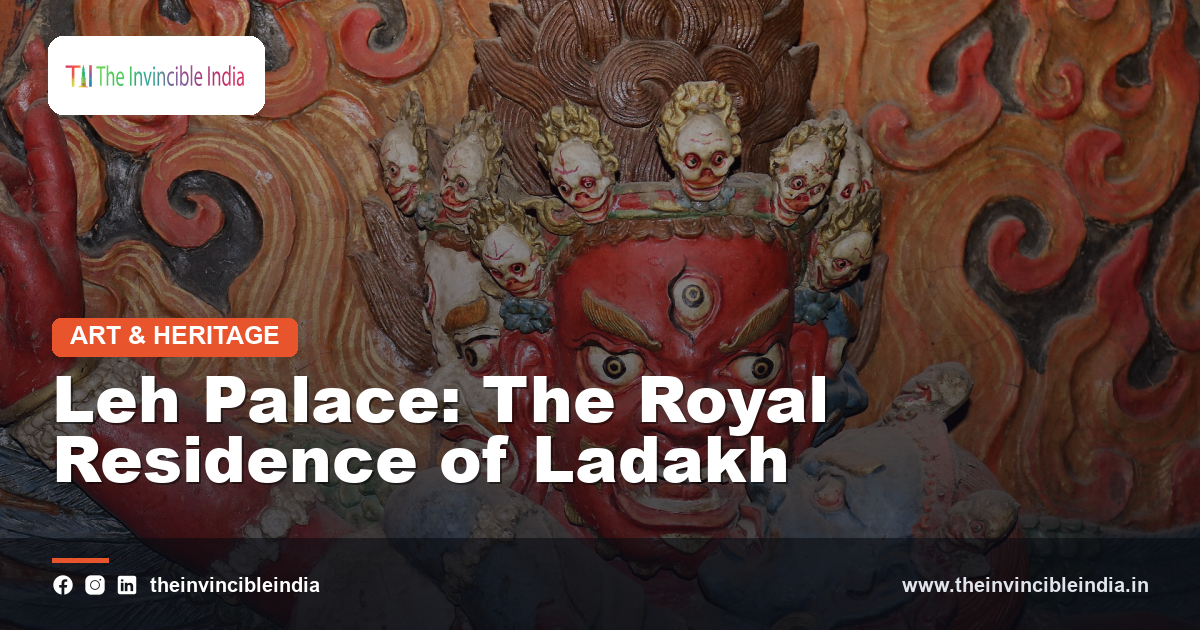
The interior of Leh Palace preserves traces of traditional Ladakhi and Tibetan Buddhist art, including wall paintings and sacred images. Thangkas, the painted or embroidered scrolls that depict deities, teachers, and cosmological diagrams, are among the treasures associated with the palace and its neighbouring monasteries. Mural paintings employ a vivid palette of mineral pigments, and their fine lines and symbolic details reflect a devotional artistic tradition. Wooden ceilings and beams are sometimes painted or carved with decorative patterns. Although time and neglect have caused fading and damage in places, conservation has recovered many elements of this artistic heritage. Together they show that the palace was not only an administrative and residential centre but also a repository of religious and artistic culture, connecting the daily life of the court to the wider traditions of Himalayan Buddhism and its visual expression.
Decline, Abandonment, and the Move to Stok
The fortunes of the palace changed in the nineteenth century when Ladakh came under the control of the Dogra rulers of Jammu and Kashmir. The Namgyal royal family was displaced from Leh Palace and moved to a residence at Stok, across the Indus valley, where their descendants continued to live. With the departure of the court, the great palace fell gradually into disuse and disrepair. Roofs sagged, walls cracked, and rooms emptied, leaving a partly ruined shell above the town. This period of decline, however, did not erase the palace’s symbolic importance. It remained a powerful reminder of the former kingdom, and later efforts at restoration recognized its significance as a heritage site. The story of abandonment adds a sober chapter to the palace’s history, one that underlines the fragility of historic monuments.
Restoration and Conservation Efforts
In recent decades the palace has been the focus of conservation work aimed at stabilizing its walls, restoring roofs, and preserving surviving interiors. The Archaeological Survey of India has taken responsibility for the monument, working with specialists in traditional building techniques. Conservation in a high-altitude environment is demanding, since freezing and thawing, strong sunlight, and dry air all take a toll on earthen materials. Repairs must use compatible traditional materials so that the structure continues to breathe and behave as it was designed to. Restoration has opened parts of the building to visitors and allowed a museum-like presentation of its history. This careful work has given the palace a new lease of life, and it demonstrates how respect for local materials and methods can be combined with modern conservation principles to safeguard a fragile masterpiece.
Leh Palace Among the Palaces of India
India possesses a great variety of royal palaces, from the sandstone courts of Rajasthan to the domed halls of the Deccan and the timber residences of the hills. Leh Palace differs from most of them in its Himalayan character and its Tibetan-derived design. While Rajput palaces celebrate ornament and courtyards, and many Mughal-influenced buildings favour symmetry and gardens, the Ladakhi palace emphasizes strength, height, and adaptation to a severe climate. Yet like the great forts of India, it combines residential and defensive functions on a prominent site. Placed within the wider study of palaces, Leh stands as evidence that the Indian architectural heritage extends far beyond the plains, and that the mountain regions produced monuments of equal ambition and distinction.
The View from the Roof
One of the great pleasures of visiting Leh Palace is the view from its upper levels. From the rooftop terraces, the whole of the Leh valley opens out, with the town spread beneath and the Indus valley beyond. The dry, sculpted mountains rise on every side, and on clear days the snow-covered peaks of the Stok Kangri range glow in the distance. The vantage point explains why the site was chosen for the palace, since it commands the approaches to the town and offers unobstructed observation. The clean, thin air of the high altitude gives the scene a remarkable clarity. Standing on the roof, visitors sense the relationship between the palace, the town, and the wider landscape, and they understand how deeply the architecture was shaped by its dramatic and demanding setting.
Visiting Leh Palace and Nearby Sites
A visit to Leh Palace is usually combined with time in the old town, whose narrow lanes and traditional houses lie directly below. The climb to the palace is steep, and because Leh sits at high altitude, visitors are advised to acclimatize before exploring and to move slowly. Warm clothing, sun protection, and water are essential, even in summer. Nearby, the Namgyal Tsemo monastery and the hilltop fort provide further views and insights into the history of the kingdom. Respectful behaviour is expected in the religious spaces, where visitors should follow local customs and avoid disturbing devotees. With a thoughtful approach, a visit to the palace becomes more than sightseeing, offering a deeper appreciation of Ladakh’s history, its adaptation to a challenging environment, and the enduring traditions of its people.
Leh Palace Today
Today Leh Palace stands as one of the defining monuments of Ladakh, both a protected heritage site and a powerful emblem of regional identity. Its restored rooms and terraces welcome visitors who come to learn about the Namgyal dynasty, Ladakhi Buddhism, and the traditional architecture of the Himalaya. The palace continues to inspire artists, photographers, and scholars, and it plays an important role in the cultural life and tourism of the region. Ongoing conservation aims to keep the walls strong and the interiors safe for the future. In its sturdy silhouette and its long association with the kings of Ladakh, the palace preserves the memory of a mountain kingdom whose culture linked India, Tibet, and Central Asia, and it remains a proud symbol of the enduring heritage of the Himalayan north.
Sources & Further Reading
- Archaeological Survey of India (asi.nic.in).
- Ministry of Culture, Government of India (indiaculture.gov.in).
Frequently Asked Questions
Where is Leh Palace located?
Leh Palace is located in Leh, the principal town of Ladakh, standing on a rocky ridge above the old town. Its elevated position makes it visible from much of the surrounding valley.
Who built Leh Palace?
Leh Palace is traditionally attributed to King Sengge Namgyal of the Namgyal dynasty, in the seventeenth century. It was built as a royal residence and a symbol of the kingdom’s authority.
Why does Leh Palace resemble the Potala Palace?
Both buildings belong to the Himalayan tradition of Tibetan-influenced architecture, with sloping walls, flat roofs, and rows of small windows. Leh Palace is much smaller, but the shared design vocabulary reflects the cultural ties between Ladakh and Tibet.
Why did the royal family leave Leh Palace?
After Ladakh came under the control of the Dogra rulers in the nineteenth century, the Namgyal royal family moved to a residence at Stok. The palace gradually fell into disuse and later became the subject of restoration.
Who looks after Leh Palace today?
The Archaeological Survey of India is responsible for the conservation of the palace. Restoration work uses traditional materials and methods suited to the high-altitude environment.