


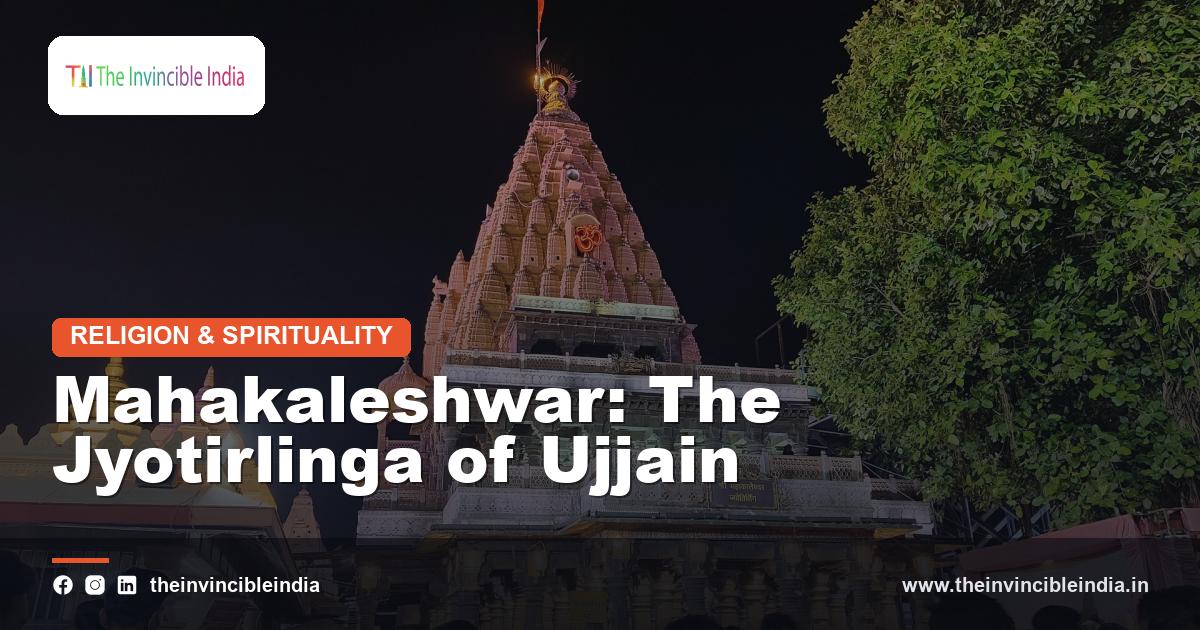
On the banks of the Shipra river in the ancient city of Ujjain in Madhya Pradesh stands Mahakaleshwar, among the most venerated shrines dedicated to Shiva. Honored as one of the twelve Jyotirlingas, the temple is associated with Shiva in his aspect as Mahakala, the lord of time, and it draws devotees throughout the year from every part of the country. Its lingam is traditionally described as swayambhu, or self-manifested, and it is unusual among the twelve for facing south. The temple’s rituals, especially the early morning Bhasma Aarti, are widely known. To understand where this shrine fits within the larger sacred circuit, readers may consult the overview of the twelve Jyotirlingas. This guide explores its setting, history, worship, and enduring importance.
Quick Facts
| Detail | Information |
|---|---|
| Deity | Shiva as Mahakaleshwar |
| Location | Ujjain, Madhya Pradesh |
| Sacred River | Shipra |
| Category | One of the twelve Jyotirlingas |
| Distinctive Feature | South-facing lingam |
| Famous Ritual | Bhasma Aarti |
Ujjain: An Ancient Sacred City
Ujjain is among the oldest continuously inhabited cities of India and has long been counted among the seven sacred cities known as the Saptapuri, places believed to grant liberation to those who visit with devotion. Set on the Shipra river in the Malwa region, it has served through the ages as a centre of learning, trade, astronomy, and worship. Ancient literature refers to the city under names such as Avantika and Ujjayini, reflecting its long prominence in the subcontinent’s cultural memory. The city is also linked in tradition with the legends of King Vikramaditya and with classical Sanskrit poetry. Against this backdrop of scholarship and faith, the Mahakaleshwar temple stands as the spiritual heart of Ujjain. The city and the shrine are so closely joined in the popular imagination that to speak of one is almost always to evoke the other and its long heritage.
Shiva as Mahakala, Lord of Time
The name Mahakaleshwar combines maha, meaning great, kala, meaning time or death, and ishwar, meaning lord, and it presents Shiva as the master of time itself. In this aspect the deity is understood to stand beyond the cycle of birth, change, and dissolution that governs all living beings, and to be the refuge of those who seek freedom from fear of mortality. Devotees approach Mahakala not only with petitions for protection but also with contemplation of impermanence and of the deeper reality that underlies it. This theological idea gives the shrine a distinctive character among the many temples dedicated to Shiva. Rather than emphasizing only gentleness or grace, the worship of Mahakala confronts the reality of time directly and finds comfort in surrender to the one who transcends it. That meaning shapes the atmosphere and the rituals of the temple to this day.
The Jyotirlinga Tradition
The Jyotirlingas are twelve shrines across India regarded as especially sacred manifestations of Shiva, each understood as a luminous column, or jyoti, of divine presence. Their locations span the country, from the Himalayas to the southern coast and from the western sea to the eastern plains, and pilgrims often aspire to visit all twelve over a lifetime. Mahakaleshwar is counted among them and holds a special place because of its association with the ancient city of Ujjain and its unusual features of worship. Traditional lists of the Jyotirlingas name the same twelve sites, and hymns of praise recite them together as a single sacred circuit. Visiting Mahakaleshwar therefore places a pilgrim within a network of devotion that links many regions of India, uniting them through a shared reverence for Shiva. The temple’s status as a Jyotirlinga underscores its importance far beyond the boundaries of its own state.
The Swayambhu and South-Facing Lingam
The lingam at Mahakaleshwar is traditionally regarded as swayambhu, meaning that it manifested by itself rather than being installed by human hands, and this belief lends the shrine a particular sanctity. It is also known as Dakshinamukhi, or south-facing, a rare orientation among Shiva temples, since south is traditionally associated with Yama, the lord of death. This orientation is often linked in devotional thought with the protective power of Mahakala over the fear of death, and it has inspired a well-known tradition of special veneration of the south-facing form. Many Tantric texts and teachers have spoken with special respect of the south-facing lingam. The sanctum where it resides is a place of deep quiet and concentrated devotion, where worshippers offer water, flowers, and prayers. In this way both the self-manifested nature and the southward direction of the lingam give Mahakaleshwar its unique identity among the twelve Jyotirlingas.
History, Destruction, and Restoration
Mahakaleshwar has been mentioned in Indian literature for many centuries, and classical Sanskrit poets described the shrine and its rituals in their verses. Like many ancient temples of northern India, it passed through periods of damage and neglect over the long course of history, followed by phases of rebuilding and renewal supported by rulers and devotees. In later centuries the temple was rebuilt and its present structure developed with patronage from regional rulers, including the Maratha dynasties who were prominent in the Malwa region. Because specific details of each phase are debated by historians, it is best to speak of the temple’s story in general terms as one of resilience and continuity. The essential fact is that worship at the site has persisted across many changes of fortune. This continuity, sustained by the devotion of countless generations, is one of the strongest testimonies to the shrine’s enduring importance in the religious life of the region.
Mahakaleshwar in Classical Literature
The shrine appears in classical Sanskrit writing, most famously in the poetry of Kalidasa, whose celebrated lyric Meghaduta describes a cloud messenger traveling over northern India and passing through Ujjain. The poem is often cited in discussions of the city because it evokes the temple’s evening worship and the beauty of the surrounding land. The Puranas also refer to Mahakala and Ujjain, weaving the site into the wider mythology of Shiva. These literary references, though they cannot be used to date the temple precisely, show that Mahakaleshwar has been a recognized and admired place of worship for a very long time. They also illustrate how sacred geography and literature reinforced one another, since poets carried the fame of the shrine to audiences who might never visit it. Through these texts, Mahakaleshwar became part of the shared cultural inheritance of the whole subcontinent as well as of its immediate region.
Legends and Devotional Narratives
Devotional tradition preserves several stories about the origin of the shrine, and pilgrims often hear them recounted by priests and guides. One widely told narrative describes how Shiva appeared as Mahakala to protect the devotees of Ujjain from danger, and how the lingam remained there as a lasting sign of his presence at the request of the faithful. Other versions differ in their details, and they are best appreciated as expressions of faith and communal memory rather than as documented history. What the stories share is a consistent message that the deity dwells at Ujjain in a protective and compassionate form, responding to the sincerity of his worshippers. Such narratives are an important part of how sacred places are understood and passed down, and they form a layer of meaning that visitors carry away with them. In this way legend and worship work together to keep the meaning of the temple alive in the minds of pilgrims.
Temple Architecture and Layout
The Mahakaleshwar temple is built in a style associated with the traditions of central India, and its structure features a tall shikhara, or spire, rising above the main sanctum. The complex is arranged on several levels, with the principal lingam in the lower sanctum and other shrines located above and around it. A distinctive feature of the layout is that the shrine of Omkareshwar is situated on an upper level of the same complex, while the shrine of Nagachandreshwar, located higher still, is traditionally opened for worship only on one day of the year, at the festival of Nag Panchami. Around the sanctum are halls, courtyards, and subsidiary shrines, along with a sacred pond in the temple’s vicinity. The overall design serves both the rituals of worship and the movement of large crowds of pilgrims. Its combination of vertical spires and layered shrines makes Mahakaleshwar architecturally and ritually distinctive among Shiva temples.
Daily Worship and Rituals
Worship at Mahakaleshwar follows a daily cycle of rituals conducted by the temple priests, beginning before dawn and continuing through the day and evening. Devotees offer water, milk, flowers, and sacred leaves to the lingam, and the abhishek, or ritual bathing of the deity, is among the most common forms of worship. Hymns and mantras dedicated to Shiva are recited, most often the Rudra hymns and the mantra associated with the protective power of Mahakala. Aarti ceremonies with lamps, bells, and chanting mark important moments of the day and create an atmosphere of collective devotion. The order of rituals is set by long-established temple custom, and it is maintained by families of priests who have served the shrine over many generations. Through this steady rhythm of daily worship, the temple offers pilgrims a continuous experience of prayer that links their individual visit to the living tradition of the shrine.
The Bhasma Aarti
The best-known ritual at Mahakaleshwar is the Bhasma Aarti, an early morning ceremony in which the lingam is worshipped with sacred ash, or bhasma. Ash holds deep significance in Shaiva tradition as a symbol of impermanence and of the transformation that follows the end of worldly attachments, and its use in the ritual is consistent with the character of Shiva as Mahakala. The ceremony takes place well before sunrise and is attended by devotees who often register in advance because of the great demand to witness it. Participants are expected to observe the dress and conduct prescribed by the temple, and the details of the ritual are governed by the priests. The ceremony is a solemn one, marked by chanting, drums, and lamps in the dim light of early morning. Its distinctive combination of austerity and devotion has made the Bhasma Aarti one of the most recognized forms of worship in the entire Jyotirlinga tradition.
Mahashivratri and Major Festivals
Mahashivratri, the great night of Shiva, is the most important festival at Mahakaleshwar and is celebrated with special worship, extended hours, and large gatherings of devotees. Pilgrims often keep a vigil through the night, offering prayers and reciting hymns in honor of Shiva. The month of Shravan, sacred to Shiva, brings a steady flow of worshippers, and processions connected with the deity are a notable feature of that period. Ujjain also hosts the Simhastha Kumbh Mela, a great religious gathering held at intervals on the banks of the Shipra, which draws ascetics and pilgrims from across India in very large numbers. During such occasions the city and the temple become the focus of a wide devotional celebration. The festivals reinforce the bond between the temple and the community, and they give each year’s cycle of worship a sense of occasion and shared purpose that carries through generations.
The Shipra River and Sacred Bathing
The Shipra river flows beside Ujjain and is regarded as a sacred stream, with its ghats serving as places of bathing, prayer, and ritual observance. Pilgrims commonly bathe in its waters before visiting the temple, following the widespread Indian custom of purification before worship. The river is associated with several rites, including offerings to ancestors, and the ghats fill with devotees during festivals and holy days. During the Simhastha Kumbh Mela, bathing in the Shipra takes on special significance, and the riverbanks become a vast encampment of pilgrims and ascetics. The relationship between the temple and the river illustrates a recurring pattern in Indian sacred geography, in which shrines are placed beside flowing water so that purification and worship form a single movement. By connecting the temple to the Shipra, tradition places Mahakaleshwar within a landscape where earth, water, and devotion join in a unified sacred setting.
Ujjain and the Measure of Time
The idea of Mahakala as the lord of time finds an interesting parallel in Ujjain’s long association with astronomy and the reckoning of time. In ancient Indian astronomical tradition, the city was regarded as an important reference point for calculation, and scholars of the subject worked and taught there over many centuries. The site is also home to an observatory built in a later period to continue this tradition of celestial observation. The connection between the temple of the lord of time and the city’s scientific heritage has often been noted by writers, who see in it a harmony between devotion and inquiry. While the details of the ancient calculations belong to specialist study, the general point is clear: Ujjain has long been a place where the measurement of time and the worship of its divine master were closely linked. This union of science and spirituality remains one of the city’s most distinctive cultural themes.
Connections to Other Sacred Places
Mahakaleshwar is part of a wider network of sacred sites in Madhya Pradesh and the surrounding region. Not far from Ujjain lies Omkareshwar, another of the twelve Jyotirlingas, and pilgrims frequently combine visits to the two shrines. Ujjain itself contains many other temples, including those dedicated to the goddess and to Hanuman, and the city is a stop on longer pilgrim routes. For an account of how devotees travel between sacred centres, see the overview of pilgrimage in India. The broader tradition of Shiva worship in temples is also described in the guide to Hindu temples and worship. These connections show that a visit to Mahakaleshwar is rarely an isolated event; it is usually one stage in a longer devotional journey that draws together numerous shrines and the communities that sustain them.
Visiting Mahakaleshwar: Etiquette and Practicalities
Visitors to Mahakaleshwar are expected to observe the customs of a working place of worship. Modest dress, removal of footwear, and quiet, respectful behavior are standard, and some rituals have specific dress requirements set by the temple management. Because the shrine draws large crowds, particularly on festival days and Mondays, which are traditionally sacred to Shiva, pilgrims often plan their visit with attention to timing and queues. Facilities are managed by temple authorities, and arrangements for entry, offerings, and special ceremonies change from time to time, so it is wise to check current guidance before traveling. Photography and the carrying of certain items may be restricted inside the sanctum. Approaching the temple with patience and reverence makes for a more meaningful experience, and it shows respect for the many devotees for whom the visit is a cherished act of faith rather than a tourist stop.
Mahakaleshwar Today
Today Mahakaleshwar remains one of the most visited and cherished Shiva shrines in India, drawing pilgrims from every region and many walks of life. Facilities and surroundings around the temple have been developed in recent years to help manage the large number of visitors, while the core of worship continues according to long-established custom. The Bhasma Aarti, the celebration of Mahashivratri, and the great gatherings of the Simhastha Kumbh Mela keep the temple at the centre of Ujjain’s religious life. For many devotees the shrine represents a source of courage in the face of uncertainty, since it presents Shiva as the master of time and the protector of those who trust in him. Its continued vitality shows how an ancient sacred place can serve each new generation, offering a fixed point of faith amid change and a link to a tradition stretching far into the past.
Sources & Further Reading
- Ministry of Culture, Government of India (indiaculture.gov.in).
- Madhya Pradesh Tourism (mptourism.com).
Frequently Asked Questions
Where is Mahakaleshwar temple located?
Mahakaleshwar temple stands in the city of Ujjain in Madhya Pradesh, on the banks of the Shipra river. It is one of the twelve Jyotirlingas dedicated to Shiva.
Why is the Mahakaleshwar lingam special?
The lingam is traditionally regarded as swayambhu, or self-manifested, and it faces south, which is unusual among Shiva temples. Devotional tradition connects this orientation with the protective power of Shiva as the lord of time.
What is the Bhasma Aarti?
The Bhasma Aarti is an early morning ritual in which the lingam is worshipped with sacred ash. Ash symbolizes impermanence in Shaiva tradition, and the ceremony is one of the best-known observances at the temple.
When is the busiest time to visit Mahakaleshwar?
The temple is especially crowded during Mahashivratri, the month of Shravan, and on Mondays, which are sacred to Shiva. The Simhastha Kumbh Mela, held at intervals in Ujjain, also brings very large numbers of pilgrims.
What is the meaning of the name Mahakaleshwar?
The name combines words meaning great, time, and lord, and it presents Shiva as the lord of time. It expresses the idea that the deity transcends birth, change, and death.