


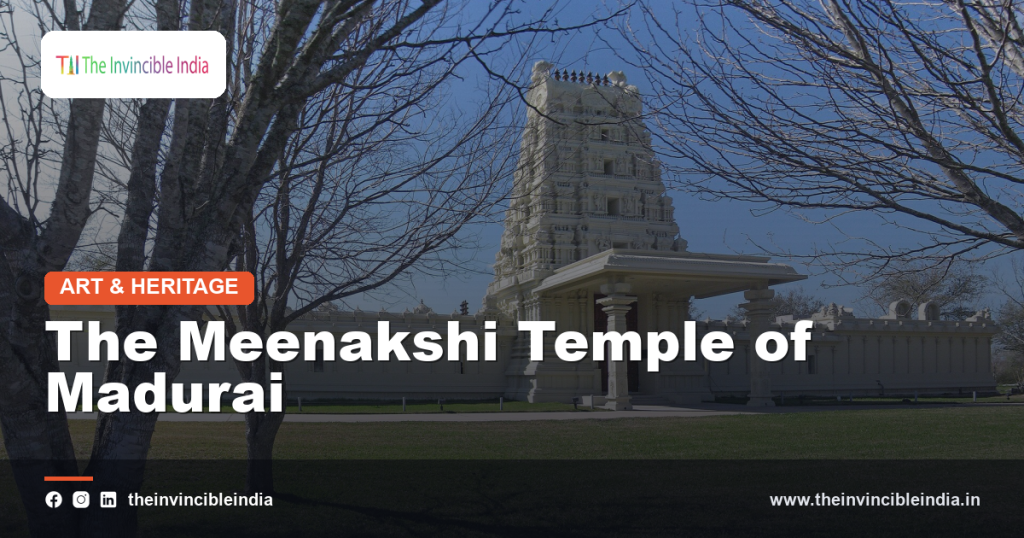
The Meenakshi Temple in Madurai stands among the most striking expressions of South Indian temple architecture, its soaring gopurams visible for miles across the Tamil Nadu plains. Dedicated to the goddess Meenakshi and her consort Sundareswarar, the temple complex has functioned for centuries as both a place of worship and the organizing center of the city that grew around it. Its scale, sculptural richness, and continuous ritual life place it alongside other great Dravidian temple traditions that shaped religious and urban life across the southern peninsula. The temple remains a living institution, drawing pilgrims and visitors who come to witness its towers, corridors, and daily rites.
Quick Facts
| Detail | Information |
|---|---|
| Location | Madurai, Tamil Nadu |
| Deities | Meenakshi and Sundareswarar |
| Architectural style | Dravidian |
| Notable feature | Multiple painted gopuram towers |
| Religious tradition | Hindu (Shaiva and Shakta) |
| Status | Active place of worship |
A Landmark of Madurai
The Meenakshi Temple occupies the heart of Madurai, one of the oldest continuously inhabited cities in southern India. The temple complex is not a peripheral monument but the literal and symbolic center around which the old city was laid out, with streets radiating outward in concentric squares. This arrangement reflects a broader tradition in which temple towns were planned as sacred geographies, with the shrine functioning as the axis of civic and religious life.
Visitors approaching Madurai from any direction can see the temple’s gopurams rising above the surrounding rooftops, a visual anchor that has defined the city’s skyline for generations. The temple’s continued centrality, both physically and culturally, underscores how deeply embedded it remains in the daily rhythms of the city that grew up around it.
Meenakshi and Sundareswarar
The temple is dedicated jointly to the goddess Meenakshi, a form of Parvati, and to Sundareswarar, a form of Shiva. This dual dedication is notable because the goddess is traditionally regarded as the presiding deity of the temple, with her own shrine and rituals holding particular prominence. The pairing reflects a devotional tradition in which the divine feminine is honored as a sovereign figure in her own right rather than solely as a consort.
Their mythological union is commemorated annually through temple festivals that reenact the celestial marriage, drawing large numbers of devotees. The narrative of their courtship and wedding is woven into the temple’s ritual calendar, its sculptural programs, and the popular memory of the city, reinforcing the temple’s identity as a site of sacred marriage and divine partnership.
Origins and Early History
The site’s association with sacred worship in Madurai is understood to reach back many centuries, with the city itself long recognized as a center of Tamil learning and religious life. The temple’s early history is intertwined with the Pandya dynasty, which ruled the region and is generally credited with helping establish and patronize the shrine in its formative period.
Over the centuries, the temple was expanded, renovated, and enriched by successive rulers, reflecting the shifting political fortunes of the region. Its layered history, in which each era added structures, endowments, or artistic embellishments, is characteristic of major South Indian temples, which grew organically over long spans of time rather than being built in a single campaign.
The Nayaka Period Transformation
Much of the temple’s present form is associated with the Nayaka rulers of Madurai, who governed the region in the medieval and early modern periods and are remembered as prolific patrons of temple building. Under their patronage, the complex was substantially enlarged, with new halls, corridors, and towers added to the existing sacred core.
This period is often regarded as a high point of Dravidian temple art in the region, marked by ambitious architectural projects and elaborate sculptural programs. The Nayaka contributions gave the temple much of the grandeur and scale for which it is known today, transforming an already significant shrine into one of the most extensive temple complexes in South India.
The Gopurams
The temple’s most recognizable feature is its set of towering gateway structures known as gopurams, several of which rise well above the surrounding walls and are visible from a considerable distance. Each gopuram is a stepped, pyramidal tower covered from base to summit with sculpted figures depicting deities, mythological scenes, and celestial beings, all rendered in the vivid polychrome typical of South Indian temple art.
These towers serve as monumental gateways marking the successive enclosures of the temple, guiding pilgrims inward toward the sanctified core. Their scale and ornamentation reflect both devotional intent and civic pride, as gopuram construction was often sponsored by rulers or wealthy patrons seeking religious merit and public recognition.
Dravidian Architectural Character
The Meenakshi Temple exemplifies the mature Dravidian architectural idiom, characterized by rectangular walled enclosures, pyramidal gopurams, and richly pillared mandapas arranged around a central sanctum. Unlike the curvilinear shikharas of North Indian temple traditions, Dravidian temples favor a tiered, stepped profile crowned by a distinctive barrel-vaulted or domed finial over the sanctum itself.
The complex’s plan, with its concentric rectangular enclosures and multiple gateway towers, reflects the classic South Indian temple-town model in which sacred space expands outward in layers of increasing accessibility. This architectural vocabulary, refined over centuries by Tamil dynasties, reached one of its most elaborate expressions in the Meenakshi Temple’s sprawling ground plan.
The Thousand Pillar Hall
Among the temple’s most celebrated interior spaces is its great pillared hall, popularly known as the Thousand Pillar Hall, where rows of intricately carved stone columns create a forest-like expanse of sculpted stone. Each pillar is carved with figures of deities, mythical creatures, or decorative motifs, making the hall itself a continuous gallery of sculptural art.
Such pillared halls served practical as well as devotional purposes, providing shaded gathering space for pilgrims, ceremonies, and processions during festivals. The hall’s scale and the density of its carving illustrate the ambition of South Indian temple builders, who treated interior columned spaces as opportunities for extensive artistic expression rather than purely structural necessity.
The Golden Lotus Tank
Within the temple precincts lies a stepped tank traditionally known as the Golden Lotus Tank, a sacred water body used for ritual bathing and purification. Temple tanks of this kind are a standard feature of South Indian shrine complexes, providing both a functional water source and a symbolically significant space associated with purity and renewal.
The tank is bordered by pillared corridors from which devotees can view the surrounding gopurams reflected in the water, creating one of the temple’s most photographed vistas. Such tanks also historically served as gathering points during festivals and as venues for specific rites tied to the temple’s ritual calendar.
Sculptural Traditions
The temple’s sculptural program is vast, encompassing thousands of carved figures across its gopurams, pillars, and shrine walls. These sculptures depict deities, celestial attendants, mythological narratives, and decorative floral and geometric motifs, executed in a style consistent with the broader tradition of Indian sculpture found across South Indian temples.
The craftsmanship reflects generations of skilled artisans working within established iconographic conventions while also introducing regional stylistic flourishes. This sustained investment in sculptural decoration underscores the temple’s role not only as a religious institution but as a major patron and repository of the visual arts across the centuries of its construction and renovation.
Rituals and Daily Worship
The Meenakshi Temple maintains an active daily ritual schedule, with multiple ceremonies conducted for both principal deities from early morning through late evening. These rites include ceremonial waking of the deities, offerings of food and flowers, and processions within the temple precincts, following practices rooted in Agamic temple worship traditions.
The temple employs a hereditary priesthood responsible for maintaining these rituals according to established protocols passed down through generations. This continuity of ritual practice, sustained over centuries, is part of what distinguishes major living temples like this one from monuments preserved primarily as historical sites, since worship here remains an unbroken, everyday reality.
The Meenakshi Tirukalyanam Festival
Among the temple’s major annual observances is the festival commemorating the celestial marriage of Meenakshi and Sundareswarar, an event that draws large crowds of devotees from across the region. The festival involves elaborate processions, ceremonial reenactments, and days of festivities that transform the temple and surrounding streets into a hub of collective celebration.
Such marriage festivals are significant in South Indian temple culture, framing the divine union as a communal event in which the wider populace participates symbolically. The scale of the celebration reflects the temple’s importance not just as a place of individual devotion but as a focal point for shared cultural and religious identity in Madurai.
Madurai as a Temple City
Madurai’s identity has long been shaped by its association with the Meenakshi Temple, with the city’s historic layout, markets, and streets organized in relation to the shrine. This model, in which urban space develops concentrically around a temple, is a distinctive feature of several historic South Indian cities and reflects the temple’s role as both a religious and civic anchor.
The presence of the temple has also sustained a long tradition of related crafts, commerce, and hospitality catering to pilgrims, reinforcing the shrine’s role as an economic as well as spiritual center. This interdependence between temple and city has persisted for generations, giving Madurai its enduring character as a temple town.
Conservation and Restoration
As a structure that has evolved over many centuries, the Meenakshi Temple requires ongoing maintenance to preserve its stone carvings, painted surfaces, and towering gopurams against weathering and the effects of time. Periodic renovation of the gopurams, including repainting of their sculptural figures, is a recognized part of the temple’s traditional upkeep, often carried out in accordance with established religious and artistic conventions.
Such restoration work balances the need for structural preservation with respect for the temple’s living ritual functions, since work must generally be carried out without disrupting ongoing worship. This continuous cycle of maintenance reflects a broader pattern seen at many active Indian temples, where conservation is folded into the rhythm of religious life rather than treated as a separate museological exercise.
The Temple in Tamil Cultural Memory
The Meenakshi Temple occupies a prominent place in Tamil literary and devotional traditions, having inspired hymns, poetry, and popular narratives that celebrate the goddess and her city. References to the temple and its legends appear across various strands of Tamil religious literature, reflecting its long-standing significance beyond the boundaries of ritual practice alone.
This cultural resonance has helped sustain the temple’s prominence across generations, ensuring that its stories and imagery remain familiar well beyond Madurai itself. The temple thus functions as a shared cultural reference point, linking devotional practice with a broader Tamil literary and artistic heritage.
Visiting the Temple Today
Today the Meenakshi Temple remains one of the most visited religious sites in South India, attracting both pilgrims engaged in worship and travelers drawn by its architectural and artistic significance. Visitors typically move through its outer corridors, pillared halls, and courtyards, taking in the scale of the gopurams and the intricacy of the carved pillars along the way.
The temple’s continued popularity reflects its dual identity as both a functioning place of worship and a landmark of architectural heritage. This combination of active religious life and historical significance is part of what makes the temple a compelling destination for anyone interested in South Indian culture and its enduring institutions.
Meenakshi Temple Today
The Meenakshi Temple continues to serve as one of the most important living monuments of Dravidian temple architecture, its gopurams and pillared halls sustaining an unbroken tradition of worship that stretches back many centuries. Its role as the spiritual and civic heart of Madurai remains as central today as it has been throughout the city’s long history.
As both a site of devotion and a masterwork of South Indian art, the temple continues to draw scholars, artists, and pilgrims alike. Its endurance, through changing dynasties and centuries of renovation, testifies to the deep and lasting significance of the Meenakshi Temple within India’s cultural and religious landscape.
Sources & Further Reading
- Ministry of Culture, Government of India (indiaculture.gov.in).
- Archaeological Survey of India (asi.nic.in).
Frequently Asked Questions
Where is the Meenakshi Temple located?
The Meenakshi Temple is located in the city of Madurai in the southern Indian state of Tamil Nadu.
Who are the presiding deities of the temple?
The temple is dedicated to the goddess Meenakshi, a form of Parvati, and her consort Sundareswarar, a form of Shiva.
What architectural style does the temple represent?
The temple is a major example of Dravidian temple architecture, characterized by tiered gopuram towers and extensive pillared halls.
What is the Thousand Pillar Hall?
It is a large pillared hall within the temple complex known for its rows of intricately carved stone columns depicting deities and mythical figures.
Is the Meenakshi Temple still an active place of worship?
Yes, the temple maintains a daily schedule of rituals and remains an active center of Hindu worship and festival life.