


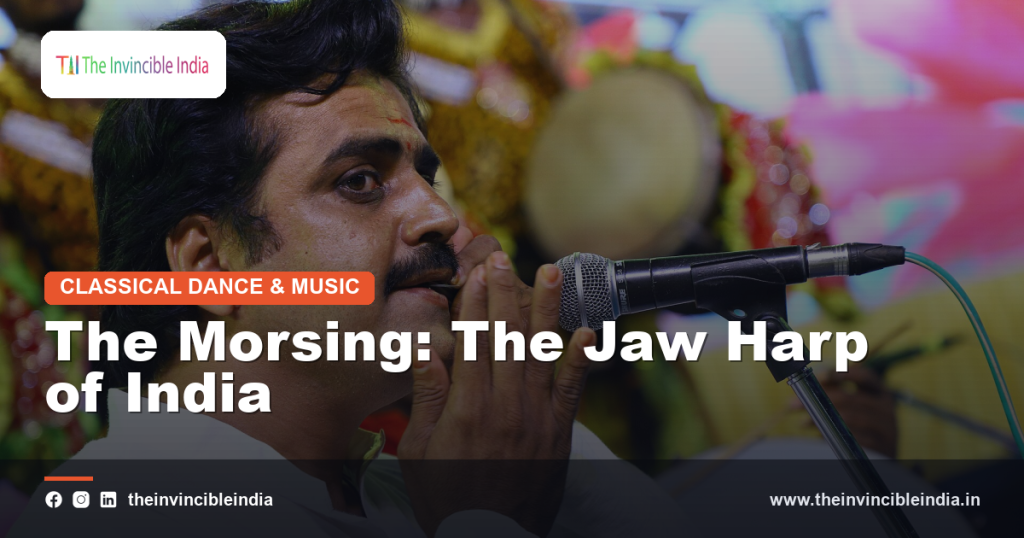
Tucked into the percussion section of a South Indian concert, a small horseshoe-shaped metal instrument produces a twanging, buzzing counterpoint to the mridangam’s resonant strokes: the morsing. Held gently between the performer’s teeth and struck with a finger, it is a variety of jaw harp adapted specifically for the rhythmic vocabulary of Carnatic music. Though modest in size and often overlooked beside more prominent instruments, the morsing plays a distinct role in the layered percussion textures that support Carnatic music performances, particularly during extended rhythmic improvisations. Its unusual playing method, using the mouth cavity as a resonating chamber, sets it apart from almost every other instrument in the classical ensemble.
Quick Facts
| Detail | Information |
|---|---|
| Instrument Type | Idiophone / jaw harp |
| Also Known As | Morsing, Morchang (regional spelling) |
| Primary Tradition | Carnatic classical music |
| Common Regions | Tamil Nadu, Karnataka, Andhra Pradesh, Kerala |
| Main Material | Forged metal (iron alloy) |
| Typical Role | Rhythmic percussion accompaniment |
Origins and Etymology
The morsing is South India’s regional form of the jaw harp, a family of small metal or bamboo instruments found in various forms across many world cultures, each adapted to local musical needs. Its name is generally understood to derive from Kannada and related Dravidian language roots referring to a mouth-played instrument, reflecting its distinctive method of sound production.
Historical references to morsing-like instruments appear in the broader context of South Indian percussion traditions, where small handheld idiophones have long supplemented larger drums in ensemble performance. Over time, the morsing became particularly associated with Carnatic classical music, developing a specialised role that distinguishes it from jaw harps used elsewhere purely for solo or folk entertainment.
Construction and Materials
A morsing is fashioned from a single piece of metal, typically iron or a similar alloy, bent into a horseshoe or ring shape with a thin, flexible metal tongue mounted at its centre. This tongue, sometimes called the reed, is the part set into vibration during play, while the metal frame provides structural support and a fixed point the player holds against the teeth.
Skilled instrument makers carefully shape and temper the metal tongue so that it vibrates freely without touching the frame, since even slight contact can dull or distort the sound produced. Because tone quality depends heavily on precise metalwork, morsing making has traditionally been the domain of specialised craftsmen who fine-tune each instrument by ear.
Anatomy of the Morsing
Understanding the morsing’s construction helps explain how such a small instrument can produce a surprisingly rich and penetrating sound. The frame, or body, forms a stable ring that the player presses lightly against the front teeth, positioning the metal tongue just inside the mouth cavity. The tongue itself extends from one end of the frame, bent slightly so that a flick of the player’s finger sets it oscillating rapidly.
The player’s mouth serves as a variable resonating chamber, and by changing its shape, the tongue position, the cheeks, the throat, the performer can alter the pitch and timbre produced without touching the metal itself, requiring fine control over both finger technique and subtle mouth adjustments.
Playing Technique
Playing the morsing demands a coordinated combination of finger dexterity and precise control of the mouth cavity, making it a deceptively difficult instrument to master despite its small size. The performer holds the frame steady against the front teeth with one hand while using a finger of the other hand to pluck or flick the protruding metal tongue in rhythm.
Because the morsing is typically played alongside the mridangam and other percussion instruments in Carnatic ensembles, timing and rhythmic precision are essential, with the player following complex talas, or rhythmic cycles, in close coordination with fellow percussionists over years of dedicated practice.
Sound Production and Tonal Range
The morsing’s sound is often described as a buzzing, twanging pulse layered beneath the more resonant tones of larger percussion instruments, contributing texture and rhythmic emphasis rather than melody. Because the pitch is shaped primarily by the player’s mouth cavity rather than by the metal tongue’s fixed length, the morsing can produce a range of tonal colours within a fairly narrow overall pitch range.
Skilled players use rapid finger technique to produce intricate rhythmic patterns, sometimes mimicking or complementing phrases played on the mridangam, creating an interlocking rhythmic dialogue that has earned the morsing a respected place in Carnatic percussion.
Role in Carnatic Music Ensembles
Within a typical Carnatic music concert, the morsing usually appears as a supporting percussion instrument alongside the mridangam, adding rhythmic texture rather than serving as the primary timekeeper. Its role is generally to complement and enrich the rhythmic patterns established by the mridangam player, filling out the percussion texture with its distinctive buzzing accents.
Morsing artists must possess a thorough understanding of Carnatic rhythmic theory, including the tala system, in order to contribute meaningfully rather than simply doubling the mridangam’s patterns, a skill that shapes the instrument’s musical vocabulary within the wider ensemble context.
The Morsing and the Mridangam
The relationship between the morsing and the mridangam is central to understanding the instrument’s place in Carnatic music, since the two are almost always heard together in ensemble percussion passages. The mridangam, a double-headed barrel drum, provides the primary rhythmic foundation and a wide tonal range, while the morsing adds a lighter, buzzing texture that threads through and around the drum’s patterns.
During the percussion showcase known as the thani avartanam, the morsing player often engages in intricate call-and-response exchanges with the mridangam, demonstrating both individual skill and ensemble coordination built on shared rhythmic theory.
Regional Presence in South India
The morsing is most closely associated with the states of Tamil Nadu, Karnataka, Andhra Pradesh, and Kerala, the broader region in which Carnatic classical music has developed and flourished over centuries. Within this region, morsing artists typically train and perform within established Carnatic music circles, often studying under senior practitioners.
Certain towns and cities within South India have historically served as centres for instrument making and performance training, sustaining a continuous tradition of skilled craftsmen and musicians who exchange knowledge and refine practice across generations of performers.
Training and Apprenticeship
Becoming a proficient morsing artist typically involves years of structured training, often beginning in childhood under the guidance of an experienced teacher within the Carnatic music tradition. Students learn not only finger technique and breath control but also the extensive theoretical foundation of Carnatic rhythm, including the tala system.
Much of this training follows the guru-shishya, or teacher-student, model common across Indian classical arts, in which the student observes, imitates, and gradually internalises the teacher’s approach, with public performance reserved for those who reach a demonstrable level of competence.
Notable Contexts of Performance
The morsing typically appears in formal Carnatic music concerts, where it accompanies vocal or instrumental performances alongside the mridangam and other percussion instruments. It is also a regular feature of dedicated percussion ensembles and thematic concerts that showcase South Indian rhythmic traditions specifically.
Cultural festivals celebrating Carnatic music frequently include morsing performances, and educational institutions dedicated to Carnatic music incorporate morsing instruction within their broader percussion curricula, ensuring new generations are introduced to the instrument alongside more prominent ones.
The Morsing in Percussion Ensembles
The thani avartanam, a dedicated percussion interlude within a Carnatic concert, offers the clearest showcase of the morsing’s individual capabilities within an ensemble context. During this segment, the main melodic performer steps back, allowing the percussionists to engage in an extended rhythmic exploration and dialogue.
Each percussionist takes turns presenting rhythmic patterns, which are then echoed, varied, or answered by the others, and the morsing’s contribution often includes rapid, intricate patterns that combine creative rhythmic invention with exact structural discipline.
Craftsmanship and Materials Sourcing
Making a high-quality morsing requires considerable metalworking skill, since the instrument’s tone depends almost entirely on the precise shaping and tempering of its vibrating metal tongue. Craftsmen typically select specific metal alloys known to produce a clear, resonant sound when struck, then carefully forge and file the tongue to the correct thickness and curvature.
Even small variations in the tongue’s dimensions can significantly affect pitch, volume, and tonal quality, meaning experienced makers rely heavily on accumulated craft knowledge concentrated among craftsmen based in South India, where sustained demand from musicians has supported this tradition.
Variations of the Jaw Harp Across Cultures
The morsing belongs to a much larger global family of jaw harps, instruments found in numerous cultures across Asia, Europe, and beyond, each developed independently or through cultural exchange to serve local musical purposes. The basic acoustic principle, a vibrating tongue set into motion and resonated within the mouth, remains broadly consistent across these instruments.
The morsing’s specific adaptation for structured accompaniment within Carnatic classical rhythmic theory sets it apart from jaw harp traditions used primarily for solo or informal folk music elsewhere, situating it within a widespread and ancient family of mouth-resonated instruments.
The Morsing in Folk and Devotional Settings
While most closely associated today with formal Carnatic classical concerts, the morsing and related jaw harp instruments have historically also appeared in folk and devotional musical contexts across South India. In these informal settings, the instrument may accompany simpler devotional singing or community gatherings.
Some contemporary morsing artists trace an interest in the instrument back to encountering it first in informal or family settings before pursuing formal classical training, a continuity that has likely helped sustain interest in the instrument across generations of listeners and performers alike.
Preservation and Contemporary Interest
As a specialised accompanying instrument within a broader classical tradition, the morsing has generally been sustained through the continued vitality of Carnatic music itself rather than through separate, dedicated preservation campaigns. Music schools and academies across South India continue to train new generations of percussionists, including morsing specialists.
Occasional dedicated percussion concerts and festivals have helped raise the instrument’s public profile beyond its usual supporting role, while documentation of Carnatic percussion practice has contributed to preserving detailed knowledge of morsing technique for future learners.
Morsing in Modern and Fusion Music
In recent decades, some musicians have brought the morsing beyond its traditional Carnatic concert setting, incorporating its distinctive buzzing sound into fusion projects that combine Indian classical percussion with other musical styles. These collaborations often pair the morsing with instruments from jazz or world music traditions.
Such fusion performances have introduced the morsing to international audiences who might never otherwise encounter South Indian classical percussion, broadening appreciation for the instrument without displacing its central, well-established place within classical performance practice.
Morsing Today
Today, the morsing continues to hold a respected, if specialised, position within Carnatic classical music, valued by knowledgeable audiences for the rhythmic texture and technical virtuosity it contributes to percussion ensembles. Formal training programs across South India continue to produce skilled morsing artists.
Occasional appearances in fusion and international collaborations have modestly broadened the morsing’s audience beyond dedicated Carnatic concertgoers, and as long as concerts continue to feature layered percussion accompaniment, the morsing seems assured of remaining an active part of that living musical ecosystem.
Sources & Further Reading
- Sangeet Natak Akademi (sangeetnatak.gov.in).
- Ministry of Culture, Government of India (indiaculture.gov.in).
Frequently Asked Questions
What is a morsing?
The morsing is a small metal jaw harp used as a percussion accompaniment instrument in South Indian Carnatic classical music, played by plucking a vibrating metal tongue while using the mouth as a resonating chamber.
How is the morsing played?
The player holds the instrument’s metal frame against the front teeth and plucks the protruding tongue with a finger, shaping the resulting buzzing tone by adjusting the mouth cavity and breath.
What role does the morsing play in Carnatic music?
It typically accompanies the mridangam and other percussion instruments, adding rhythmic texture and taking part in extended rhythmic exchanges during the thani avartanam percussion showcase.
What is the morsing made of?
It is forged from a single piece of metal, usually an iron alloy, bent into a frame with a thin, flexible tongue at its centre that vibrates when plucked.
Is the morsing unique to India?
The morsing is India’s, and specifically South India’s, regional form of the jaw harp, a family of similar mouth-resonated instruments found in various forms across many cultures worldwide.