


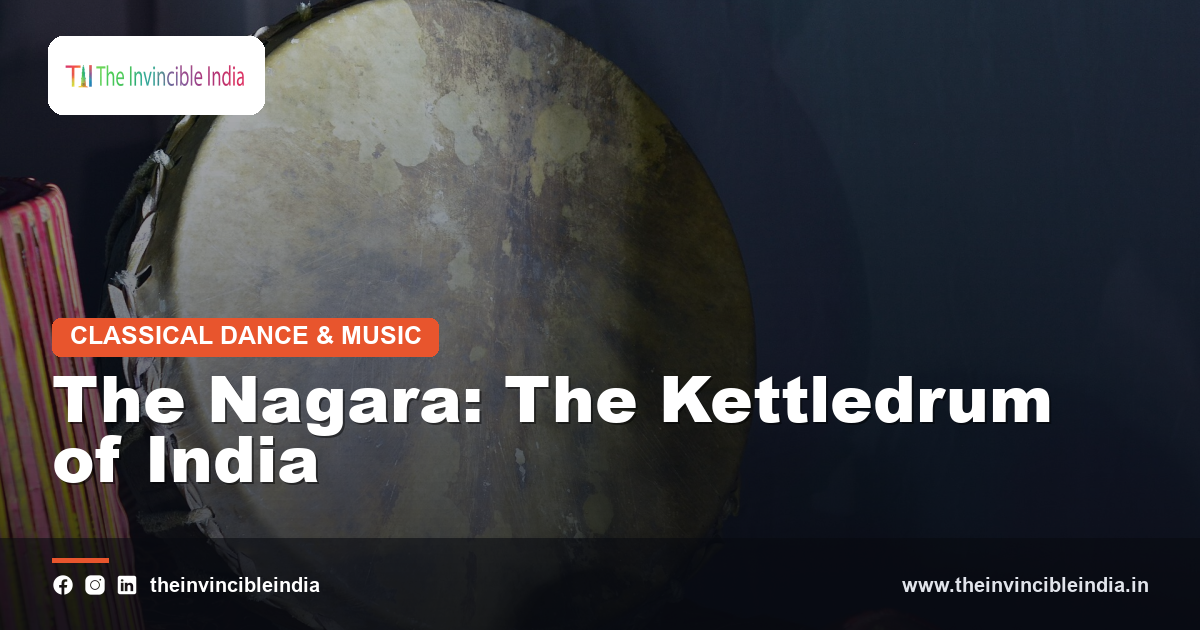
The nagara is one of the most recognisable percussion instruments of the subcontinent, a bowl-shaped kettledrum whose deep, resonant voice has announced kings, accompanied priests and driven village celebrations for centuries. Played with a pair of sticks and often sounded in pairs of contrasting pitch, it belongs to a wide family of drums that travelled across Asia and settled into Indian life with remarkable ease. Today it appears in temple courtyards, wedding processions, folk performances and ceremonial ensembles, standing alongside instruments such as the dhol as a pillar of the country’s living percussion heritage. This guide explains what the nagara is, how it is built and played, and why it still matters.
Quick Facts
| Detail | Information |
|---|---|
| Instrument type | Membranophone (kettledrum) |
| Shape | Bowl-shaped body, skin head |
| Playing method | Two sticks, usually a pair of drums |
| Common settings | Temples, courts, festivals, processions |
| Related names | Naqqara, nagada, nagarkhana |
| Typical partners | Shehnai, horns, other drums |
What the Nagara Is
The nagara is a kettledrum, an instrument built around a rounded, bowl-shaped shell over which a skin is stretched and secured. It is struck with sticks rather than the hands, and it produces a strong, penetrating tone that carries over long distances. In Indian usage the name covers a family of related drums that vary in size, shape and region, from small hand-carried pairs to enormous drums that once required their own carriers or animals. Despite this variety, the essential character remains the same: a resonant, rhythmic voice meant to be heard in open spaces. The nagara therefore sits between the ceremonial and the musical, serving both as a signal and as an accompaniment. Understanding it begins with this dual identity, since the drum has always been as much about announcement and atmosphere as about melody or rhythm in the narrow sense.
Origins and Spread of the Kettledrum
Kettledrums of this type are generally understood to have travelled across West and Central Asia and the Middle East before taking root in the Indian subcontinent. The Persian and Arabic forms of the name, closely related to nagara, reflect this wide shared heritage. In India the drum met existing traditions of temple and martial percussion and was gradually absorbed into local practice. Over time it acquired regional names and styles while keeping a recognisable identity. This pattern of arrival and adaptation is typical of Indian musical history, in which instruments from outside blended with indigenous traditions to create something distinctly local. The nagara is a good example of that process, showing how a shared Asian drum became thoroughly Indian in its use, repertoire and symbolism, and how the subcontinent has long been a meeting place of musical ideas.
Construction and Materials
A nagara is built from a deep bowl-shaped shell, traditionally made of clay or metal, though wooden and later composite shells also exist. Over the open mouth of the shell a skin, commonly from a domestic animal, is stretched and fastened with leather thongs or cords around the rim. The tension of this lacing determines pitch, and makers adjust it with care so that the drum sounds clearly and holds its tone. Clay shells give a warm, earthy voice, while metal shells tend toward a brighter, louder sound. The craft of making a nagara draws on skills passed down through families of artisans, who judge skin thickness, shell shape and tension by experience and ear. The result is an instrument that is simple in principle yet sensitive in practice, rewarding the maker’s patience with a tone that fits its purpose.
The Paired Drums and Their Pitch
The nagara is very often played as a pair, with one drum pitched higher and the other lower. The smaller drum usually gives a sharper, more cutting note, while the larger drum supplies a deeper, rounder sound. Together they create a rhythmic dialogue in which the player alternates and combines strokes to build patterns. This pairing is central to the character of the instrument, because it allows a single performer to produce a layered texture without any additional accompaniment. In some traditions the pair is mounted on a stand or tied to the player’s body, while in others it is carried on an animal or set on the ground. Whatever the arrangement, the contrast between high and low drums gives the nagara its distinctive, driving quality and explains why it works so effectively in processions and open-air gatherings.
Playing Technique with Sticks
Unlike many Indian drums that are played with the fingers and palms, the nagara is traditionally struck with two sticks. The sticks may be straight or slightly curved, and their shape and weight influence the tone and the speed of play. A skilled player controls the point of contact on the skin, the force of the stroke and the rebound, producing everything from soft rolling passages to thunderous accented beats. Rolls and quick alternating strokes are especially characteristic, giving the music a rhythmic excitement that suits ceremonial and festive moments. Technique is learned through imitation, and apprentices often begin by memorising spoken rhythmic syllables before applying them to the drum. This oral method keeps the repertoire alive and ensures that patterns survive from one generation of players to the next within families and communities.
Sound, Tone and Rhythmic Character
The voice of the nagara is bold and carrying, designed to be heard across courtyards, fairgrounds and streets. Its tone is deep and resonant, with a sharp attack from the stick and a lingering ring that blends with surrounding instruments. The rhythmic character varies by region and occasion, but common features include steady pulses, strong accents and energetic rolls that build tension and release. Because the drum has a limited range of pitch compared with melodic instruments, its power lies in rhythm and dynamics rather than in tune. Players shape phrases by varying volume and density, creating a sense of arrival, celebration or solemnity as the moment requires. This focus on rhythm and presence explains why the nagara has been trusted for centuries to set the mood of public events and sacred rituals alike.
The Nagara in Royal and Court Ceremony
In the courts and forts of the subcontinent, large kettledrums were traditionally associated with authority and ceremony. They announced the arrival of rulers, marked the hours of the day and signalled important moments in court life. The place where such drums were kept and sounded was often a dedicated gateway chamber, sometimes called a nagarkhana, from which music greeted visitors and processions. Ensembles of drums and wind instruments performed here at fixed times, turning the daily rhythm of the palace into a kind of public music. Many historic fortresses and palaces still preserve such drum houses, which stand as reminders of how sound once carried political meaning. The nagara thus held a place of honour in royal culture, representing both pageantry and the orderly passage of time within the court.
Naubat and Ceremonial Ensembles
The nagara frequently forms the rhythmic foundation of a ceremonial ensemble often known as the naubat, in which drums combine with wind instruments to create a grand, public sound. In this setting, the kettledrums provide steady, powerful pulses while the shehnai or other horns carry melodic lines above them. Such ensembles traditionally played at gateways, shrines and palaces, and the practice survives in several temple and shrine traditions today. The combination of piercing winds and booming drums creates a sound that feels celebratory and sacred at once, suited to openings, festivals and the welcome of honoured guests. Within this ensemble the nagara acts as the heartbeat, keeping time and giving structure. Its role shows how Indian ceremonial music often depends on the partnership of rhythm and melody rather than on any single instrument.
Temple and Devotional Use
In many temples and shrines, the nagara forms part of daily and festival worship, sounded to mark rituals, invite attention and create an atmosphere of reverence. The drum may be played at specific hours, during processions of deities or at moments of special prayer, its steady rhythm signalling that a sacred event is under way. Its resonant tone is understood by worshippers as both a call and an offering, filling the temple precinct with sound. In devotional gatherings it can also accompany singing, providing a pulse that supports communal participation. This religious role has helped preserve the instrument in places where other uses have faded, ensuring that younger players continue to learn the traditional patterns. The temple nagara demonstrates how music and ritual are intertwined in Indian spiritual life, with sound serving as an essential part of worship.
Folk Traditions and Village Celebrations
Beyond palaces and temples, the nagara thrives in folk music, where it accompanies dance, song and community festivals. In many regions the drum drives lively group performances, its strong beat inviting dancers to move together and giving the music its infectious energy. It is common at weddings, harvest celebrations and religious fairs, often joined by other percussion and wind instruments. Different communities have developed their own rhythms, playing styles and local names, creating a rich variety within a shared instrument family. These folk traditions are usually learned informally, with children absorbing patterns by listening and joining in. The nagara’s adaptability to both sacred and secular settings is a large part of its survival, and its presence in folk dance traditions shows how closely rhythm and movement are linked.
Regional Variations Across India
The nagara appears under many names and forms across India, shaped by local materials, musical tastes and ceremonial customs. Some regions favour large, deep drums that anchor temple and shrine ensembles, while others prefer smaller, lighter pairs suited to processions and dance. Names such as nagada, nagarra and similar variants reflect differences in language and habit, but they point to the same fundamental kettledrum. The shell material, the style of lacing, the type of sticks and the repertoire of rhythms all change from place to place. This diversity illustrates the way Indian music grows from regional soil, with each community adapting a common instrument to its own needs. Studying these variations helps listeners appreciate that the nagara is not a single fixed object but a living family of drums with many local voices.
The Nagara Among Other Indian Drums
Indian percussion is remarkably diverse, and the nagara occupies a particular place within it. Hand-played drums such as the tabla and the dholak emphasise intricate finger work and subtle tonal colour, while barrel drums like the pakhawaj and the mridangam serve classical traditions with complex rhythmic structures. The nagara, by contrast, is a stick-played kettledrum valued for power and presence rather than delicacy. Its strengths lie in outdoor volume, ceremonial weight and driving rhythm. Each type of drum answers a different musical and social need, and together they form a rich percussive vocabulary. Seen in this wider context, the nagara is a distinctive voice that complements, rather than competes with, the other instruments of Indian music.
Learning and Transmitting the Tradition
Like most Indian percussion, nagara playing is passed on through oral and practical teaching, with students learning from experienced players within families, temple communities and local ensembles. Rhythmic patterns are often memorised as spoken syllables before being played, a method that trains both memory and precision. Apprentices begin with basic strokes and steady time, then gradually master rolls, accents and the longer cycles used in ceremonial music. Much of the learning takes place during real performances, where beginners observe, join in and gain confidence in public settings. This apprenticeship model ensures that style, repertoire and etiquette are preserved together. It also means that the tradition depends on the willingness of communities to keep teaching, which is why cultural institutions and festivals that support hereditary musicians play an important role in sustaining the instrument’s future.
Symbolism and Cultural Meaning
Beyond its musical function, the nagara carries a rich layer of symbolic meaning. Its sound has long been associated with authority, celebration and the opening of significant events, whether royal, religious or communal. In ritual contexts the drum is understood to call attention, mark transitions and make a space ready for what follows. Its deep voice can suggest solemnity, while quick rolls convey joy and excitement, allowing one instrument to express a range of moods. In many communities, the drum itself is treated with respect, kept in honoured places and played according to custom. This symbolism reflects a broader Indian understanding of sound as meaningful and powerful, capable of shaping a gathering’s atmosphere. The nagara therefore stands for more than rhythm; it represents a shared language of ceremony that communities have valued for generations.
Challenges and Preservation
As with many traditional instruments, the nagara faces challenges from changing lifestyles, declining court and temple patronage and the spread of electronic sound. Skilled makers and hereditary players are fewer in some regions, and younger generations may have limited opportunities to learn. At the same time, there is growing recognition of the value of traditional ceremonial music, and festivals, cultural institutions and community groups work to document and promote it. Maintaining workshops that craft drums, supporting performers and recording regional repertoires are all part of a wider effort to keep the tradition alive. The nagara’s continued presence at temples, weddings and cultural events suggests that demand for its distinctive sound has not disappeared. With sustained attention, the drum can remain a vital part of India’s musical life rather than a relic of the past.
The Nagara Today
Today the nagara continues to be heard in temple courtyards, folk festivals, wedding processions and cultural performances across India. It also finds a place in modern stage shows and fusion projects, where its powerful voice adds depth and rhythmic drive to new musical settings. For listeners, it offers a direct connection to centuries of ceremonial and community life, expressed through one of the simplest and most compelling forms of music: a drum struck with sticks. Its story shows how an instrument from a wider Asian family became deeply rooted in Indian tradition, serving kings, worshippers and villagers alike. Exploring the nagara alongside the broader world of Indian classical and traditional performance reveals how rhythm underpins every art form. The kettledrum remains a lasting symbol of celebration and heritage.
Sources & Further Reading
- Ministry of Culture, Government of India (indiaculture.gov.in).
- Sangeet Natak Akademi (sangeetnatak.gov.in).
Frequently Asked Questions
What is a nagara drum?
The nagara is a bowl-shaped kettledrum with a stretched skin head, played with two sticks. It is used in temples, ceremonies, processions and folk music across India, often as a pair of drums with different pitches.
How is the nagara played?
It is traditionally struck with a pair of sticks rather than the hands. Players use alternating strokes, accents and rolls to build rhythmic patterns, usually learned orally through spoken syllables.
What is the difference between the nagara and the dhol?
The nagara is a kettledrum with a bowl-shaped shell played with sticks, while the dhol is a barrel-shaped drum usually struck with a stick and the hand. Both are used in festive and ceremonial music, but their shape, tone and playing style differ.
Where is the nagara used in India?
It is found in temple rituals, royal and ceremonial ensembles, wedding processions and many regional folk traditions. Names and forms vary from place to place, but its role as a powerful rhythmic voice is widely shared.
What is a naubat ensemble?
A naubat is a ceremonial ensemble in which kettledrums such as the nagara combine with wind instruments like the shehnai. Traditionally performed at gateways, shrines and palaces, it creates a grand, public sound for celebrations and welcomes.